
Zoe is an executive at Dell Computer Company who is in charge of designing the next
version of laptop computers. She will consider such features as screen size, weight,
processor speed, and CD and DVD drives. Given the fact that it is costly to include
more features in new products, why might Zoe be interested in data on how much
consumers paid for a range of laptops with different attributes?
A) in order to estimate willingness to pay for each feature.
B) in order to set an optimal price for the laptops.
C) in order to determine the best features to include.
D) in order to estimate willingness to trade off one feature for another.
E) all of the above
Suppose a labor market has perfectly inelastic supply that is composed of union and
non-union workers, and there is wage discrimination in the union and nonunion sectors.
If the union shifts its policy from maximizing total economic rents to maximizing total
wages earned by members, what happens to the equilibrium employment level and
wage for non-union workers?
A) Both increase.
B) Employment increases and wage declines.
C) Wage increases and employment declines.
D) Both decline.

Plastic and steel are substitutes in the production of body panels for certain
automobiles. If the price of plastic increases, with other things remaining the same, we
would expect:
A) the price of steel to fall.
B) the demand curve for steel to shift to the right.
C) the demand curve for plastic to shift to the left.
D) nothing to happen to steel because it is only a substitute for plastic.
E) the demand curve for steel to shift to the left.
If there are open first-class seats available on a particular flight, some airlines allow
customers with coach (discount) tickets to upgrade to first-class tickets during the
electronic check-in process. Suppose the regular price of a first-class ticket is $800, the
total price of the upgrade ticket (original price plus the upgrade) is $400, the marginal
cost of serving both types of customers (full-fare and upgrade first-class flyers) is $100,
and the airline maximizes profits. Which of the following statements is true?
A) MR for the full-fare customers must be higher than the MR from upgrade customers.
B) MR for the full-fare customers may be higher or lower than the MR from upgrades.
C) MR = MC for the full-fare customers, but the airline is willing to collect any positive
amount from the upgrade customers.
D) MR must be the same for both full-fare and upgrade customers.
Harding Enterprises has developed a new product called the Gillooly Shillelagh. The
market demand for this product is given as follows:
Q = 240 – 4P
a. At what price is the price elasticity of demand equal to zero?
b. At what price is demand infinitely elastic?
c. At what price is the price elasticity of demand equal to one?
d. If the shillelagh is priced at $40, what is the point price elasticity of demand?

Excess capacity in monopolistically competitive industries results because in
equilibrium
A) each firm’s output level is too great to minimize average cost.
B) each firm’s output level is too small to minimize average cost.
C) firms make positive economic profit.
D) price equals marginal cost.
The Corporate Average Fuel Economy (CAFE) standards are designed to improve the
average fuel economy of cars and light trucks sold in the U.S. The economic analysis
used to develop the CAFE standards was:
A) macroeconomic.
B) positive.
C) normative.
D) none of the above
The price of good A goes up. As a result the demand for good B shifts to the left. From
this we can infer that:
A) good A is a normal good.
B) good B is an inferior good.
C) goods A and B are substitutes.
D) goods A and B are complements.
E) none of the above
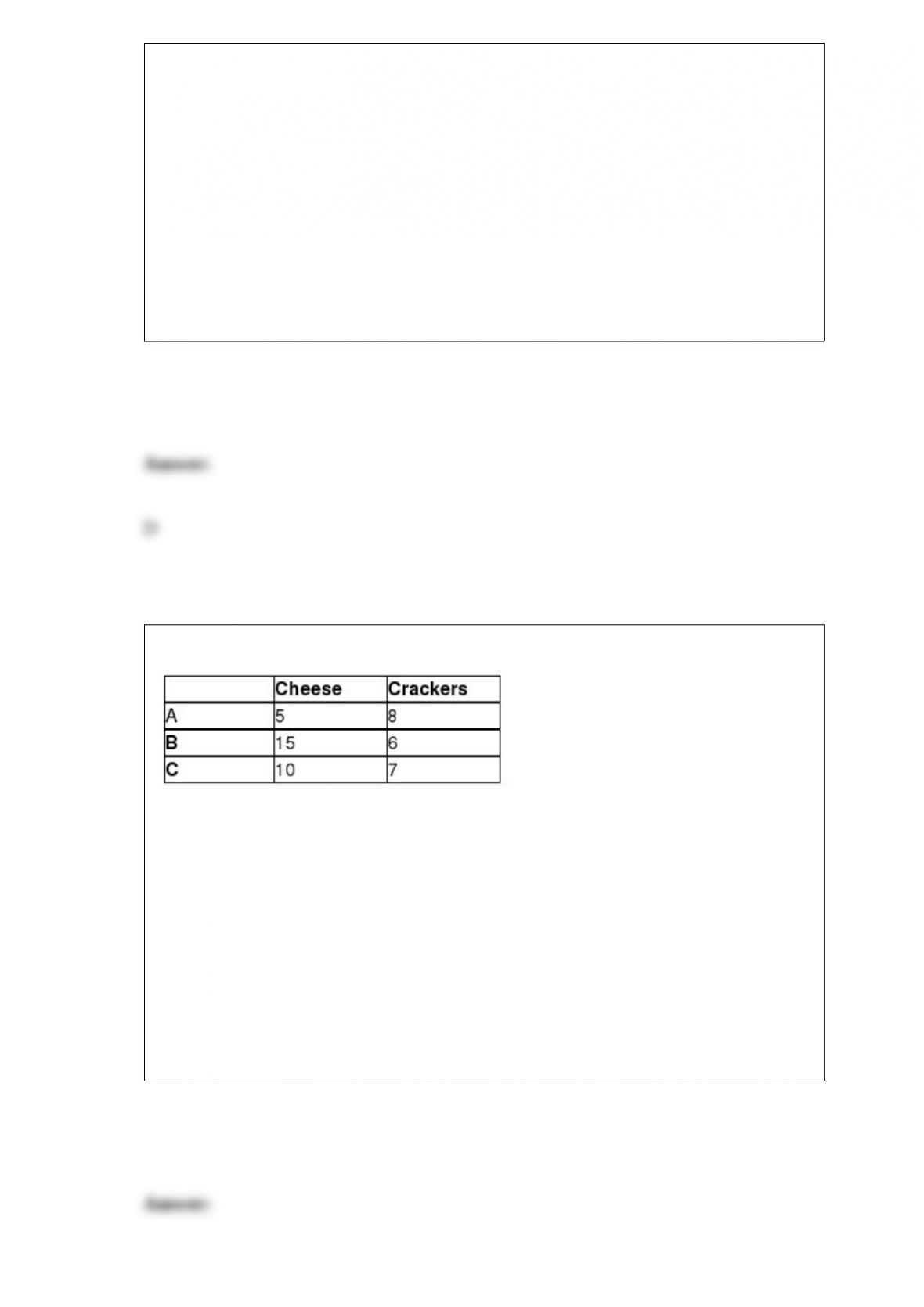
Consider the following three market baskets:
If baskets A and B are on the same indifference curve and if indifference curves exhibit
diminishing MRS:
A) C is preferred to both A and B.
B) A and B are both preferred to C.
C) C is on the same indifference curve as A and B.
D) There is not enough information to determine preferences for C relative to the other
goods.
If a competitive firm has a U-shaped marginal cost curve then
A) the profit maximizing output will always generate positive economic profit.
B) the profit maximizing output will always generate positive producer surplus.
C) the profit maximizing output is found where MC = MR and MC is decreasing.
D) the profit maximizing output is found where MC = MR and MC is constant.
E) the profit maximizing output is found where MC = MR and MC is increasing.
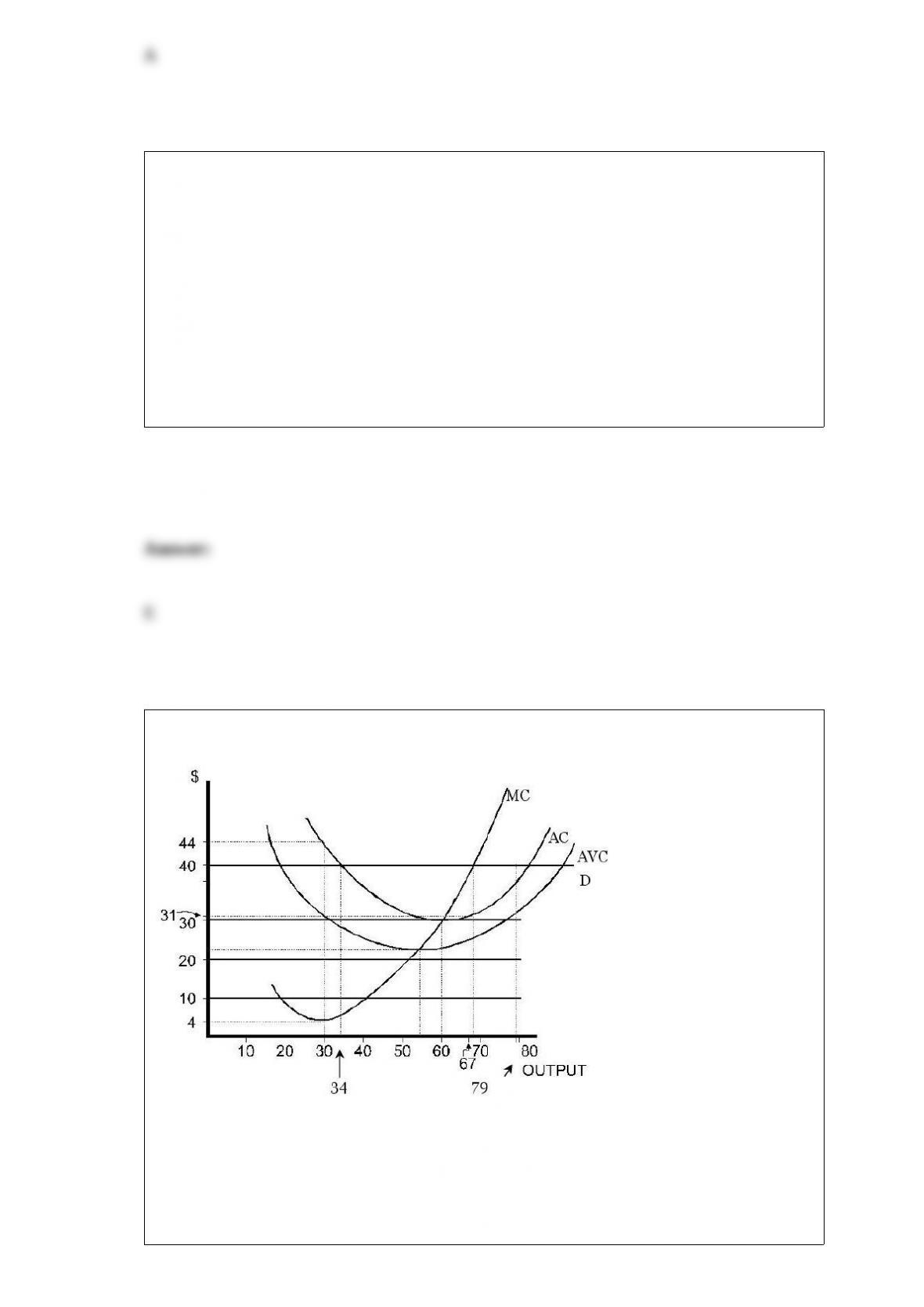
Consider the following diagram where a perfectly competitive firm faces a price of $40.
The profit-maximizing output is
A) 30.
B) 54.

C) 60.
D) 67.
E) 79.
If the initial distribution of labor and capital is Pareto optimal, which of the following
statements is TRUE?
A) It is possible to reallocate labor and capital across industries so as to increase the
production of one good without decreasing the production of another good.
B) It is possible to reallocate labor and capital across industries so as to increase the
production of one good, but only by reducing the production of another good.
C) It is possible to reallocate labor and capital across industries so as to increase the
production of every good.
D) none of the above
Scenario 13.4
Consider the following game:

In the game in Scenario 13.4, the equilibrium outcome:
A) is for both NRG and Vita to sponsor the marathon.
B) is for both NRG and Vita to sponsor the TV show.
C) is for NRG to sponsor the marathon and Vita to sponsor the TV show.
D) is for NRG to sponsor the TV show and Vita to sponsor the marathon.
E) does not exist in pure strategies.
Producer surplus in a perfectly competitive industry is
A) the difference between profit at the profit-maximizing output and profit at the
profit-minimizing output.
B) the difference between revenue and total cost.
C) the difference between revenue and variable cost.
D) the difference between revenue and fixed cost.
E) the same thing as revenue.

Two soft-drink firms, Fizzle & Sizzle, operate on a river. Fizzle is farther upstream, and
gets cleaner water, so its cost of purifying water for use in the soft drinks is lower than
Sizzle’s by $500,000 yearly.
, Fizzle and Sizzle
A) would be perfectly competitive if their purification costs were equal; otherwise, not.
B) would be perfectly competitive if it costs Fizzle $500,000 yearly to keep that land.
C) may or may not be perfect competitors, but their position on the river has nothing to
do with it.
D) cannot be perfect competitors because they are not identical firms.
After the September 11, 2001 attacks on the World Trade Center, the supply of
downtown office space in Manhattan was dramatically reduced. Forecasters predicted
that the equilibrium price would rise, but in fact the price fell. What are some factors
that could explain the fall in the equilibrium price, which the forecasters failed to take
into account?
A) Demand for office space fell due to quality-of-life concerns.
B) The economic slowdown caused demand for office space to fall.
C) both A and B
D) none of the above

Which of the following factors influence the appropriate value for the social rate of
discount used in NPV analysis of stock externalities?
A) Expected rate of economic growth
B) Extent of social risk aversion
C) The society’s rate of time preference
D) all of the above
The market structure in which there is interdependence among firms is
A) monopolistic competition.
B) oligopoly.
C) perfect competition.
D) monopoly.
When the demand curve is downward sloping, marginal revenue is
A) equal to price.

B) equal to average revenue.
C) less than price.
D) more than price.
Suppose that the marginal cost of an additional ton of steel produced by a Japanese firm
is the same whether the steel is set aside for domestic use or exported abroad. If the
price elasticity of demand for steel is greater abroad than it is in Japan, which of the
following will be correct?
A) The Japanese firm will sell more steel abroad than they will sell in Japan.
B) The Japanese firm will sell more steel in Japan than they will sell abroad.
C) The Japanese firm will sell steel at a lower price abroad than they will charge
domestic users.
D) The Japanese firm will sell steel at a higher price abroad than they will charge
domestic users.
E) Insufficient information exists to determine whether the price or quantity will be
higher or lower abroad.
Is there a first-mover advantage in the Bertrand duopoly model with homogenous
products?

A) Yes, first-movers always hold the advantage over other firms.
B) Yes, first-movers may have an advantage, but it depends on the model assumptions.
C) No, first-movers cannot choose a profit maximizing quantity because the
second-mover can always produce a bit less and earn higher profits.
D) No, the second-mover would be able to set a slightly lower price and capture the full
market share.
Use the following two statements to answer this question:
I. The marginal product of labor is the slope of the line from the origin to the total
product curve at that level of labor usage.
II The average product of labor is the slope of the line that is tangent to the total product
curve at that level of labor usage.
A) Both I and II are true.
B) I is true, and II is false.
C) I is false, and II is true.
D) Both I and II are false.

Figure 14.4
Given the information in Figure 14.4, the monopsony wage rate is:
A) W1.
B) W2.
C) W3.
D) W4.
E) none of the above
Use the following statements to answer this question:
I. Even though people need water to survive, the price of water is less than the price of
diamonds because water is in greater supply than diamonds.
II. Suppose that the demand for corn is highly price inelastic. If every corn farmer’s
harvesting technologies become more efficient, the total revenue received by all corn
farmers would fall.
A) I and II are true.

B) I is true, and II is false.
C) II is true, and I is false.
D) I and II are false.
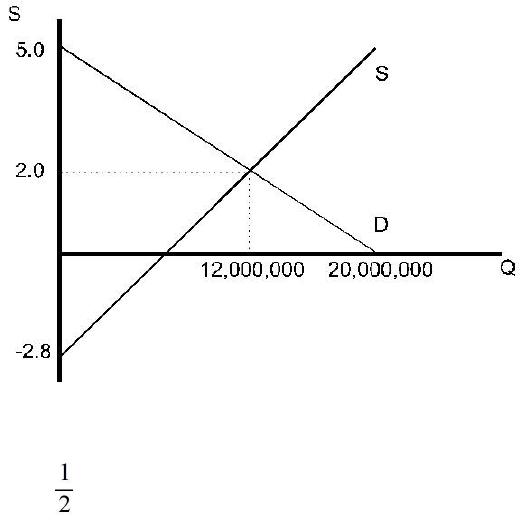
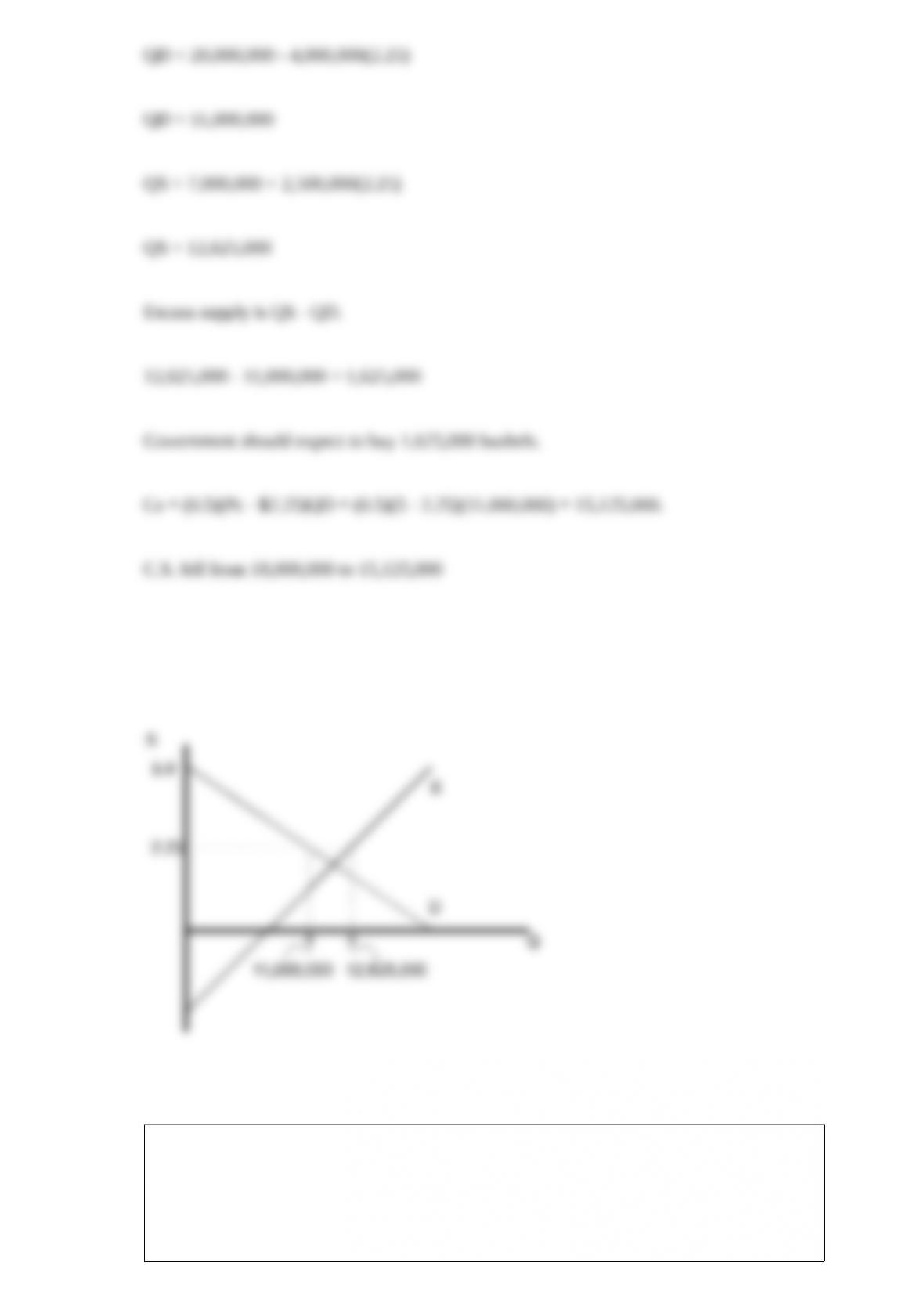
The wheat market is perfectly competitive, and the market supply and demand curves
are given by the following equations:
QD = 20,000,000 – 4,000,000P
QS = 7,000,000 + 2,500,000P,
where QD and QS are quantity demanded and quantity supplied measured in bushels,
and P = price per bushel.
a. Determine consumer surplus at the equilibrium price and quantity.
b. Assume that the government has imposed a price floor at $2.25 per bushel and agrees
to buy any resulting excess supply. How many bushels of wheat will the government be
forced to buy? Determine consumer surplus with the price floor.
A price floor policy establishes a minimum price for a market, and the policy is said to
be binding if the market equilibrium price is less than the floor price. What impact does
a binding price floor have on the market outcome?
A) Excess supply

B) Excess demand
C) Shortage
D) No impact, and the market price and quantity equal their equilibrium values
Although digital storage costs have declined sharply in the past few years, many
universities and companies still have limited storage space for email messages and
impose a fixed limit on the amount of file storage space per user. May we view this as a
common property resource problem, and do the fixed limits resolve the problem?
A) Yes, the storage space used by one person is not available to another person, and the
storage limit is a type of quota that allocates the property rights to the storage space.
B) Yes, the storage space used by one person is not available to another person, and the
storage limit represents a form of single-person ownership that resolves the common
property resource problem.
C) No, one person’s use of the storage space does not have an impact on other people,
so this is not a common property resource problem.
D) This is an example of a common property resource problem, but the fixed limits on
storage space do not resolve the problem.
The trade-offs facing workers include all of the following EXCEPT:

A) decision to work or remain outside the workforce.
B) decision to work or seek additional education.
C) decision to work for a large corporation or a small firm.
D) decision to allocate their time between work and leisure.
E) All of the above are trade-offs facing workers.
Used cars sell for much less than new cars because
A) of imperfect competition in the automobile industry.
B) buyers know much more about the quality of used cars than sellers do.
C) sellers know much more about the quality of used cars than buyers do.
D) physical depreciation of used cars is very high.
E) of licensing arrangements by the government.
Scenario 13.1:
You are negotiating with your florist over the price of flowers for your wedding. You
value the floral arrangements at $500. The florist’s cost for the arrangement is $200.

You finally settled on a price of $250.
Refer to Scenario 13.1. If your negotiated price had been $350 instead of $250, the sum
of consumer surplus and producer surplus would be:
A) less than what would have accrued at the $250 price.
B) the same as what would have accrued at the $250 price.
C) more than what would have accrued at the $250 price.
D) None of the above is necessarily correct.
We observe that both the price of and quantity sold of golf balls are rising over time.
This is due to:
A) continual improvements in the technology used to produce golf balls.
B) increases in the price of golf clubs over time.
C) decreases in membership fees for country clubs with golf facilities.
D) more stringent professional requirements on the quality of golf balls requiring
producers to use more expensive raw materials.
Which of the following product pairs would NOT be good candidates for price
discrimination through tying?

A) Razors and razor blades
B) Ink-jet printers and ink cartridges
C) Pencils and paper
D) Cellular telephones and cell phone service
Suppose the federal government allows labor unions to act as the sole seller in labor
markets, but the government collects an annual $10,000,000 “administrative fee” from
each union in this situation. Assuming this fee is not so large that it forces the unions to
disband, what is the impact of this fee on the equilibrium wage and employment level
in the monopolized labor market?
A) Wages and employment decline.
B) Wages increase and employment declines.
C) Employment increases and wages decline.
D) No change in wages or employment levels.
The principal-agent problem of ownership vs. control of the corporation arises when
owners and managers
A) are the same people.

B) pursue objectives that differ from those their customers wish them to pursue.
C) pursue objectives that differ from those their workers wish them to pursue.
D) pursue objectives that differ from those the government wishes them to pursue.
E) pursue different objectives.
Access to the movie “Casablanca,” showing in a half-empty theater, is
A) a public good because individuals watch movies together.
B) a public good only if the theater is run by the government.
C) not a public good because it is a rival good.
D) not a public good because it is an exclusive good.
E) not a public good because it is both a rival good and an exclusive good.
The market structure of home video gaming systems is best characterized by
monopolistic competition. Quasar Entertainment is one of the producers in this market.
The inverse demand for Quasar systems is:
P = 500 – 9.75Qd
The resulting marginal revenue curve is

MR(Qd) = 500 – 19.5Qd.
Quasar’s cost function is:
C(Q) = 0.25Q2 + 6,250 ⇒MC(Q) = 0.5Q.
Determine Quasar’s profit maximizing level of output and the price charged to
customers. Is this a long-run equilibrium?
Suppose that the short-run world demand and supply elasticities for crude oil are -0.076
and 0.088, respectively. The current price per barrel is $30 and the short-run
equilibrium quantity is 23.84 billion barrels per year. Derive the linear demand and
supply equations.
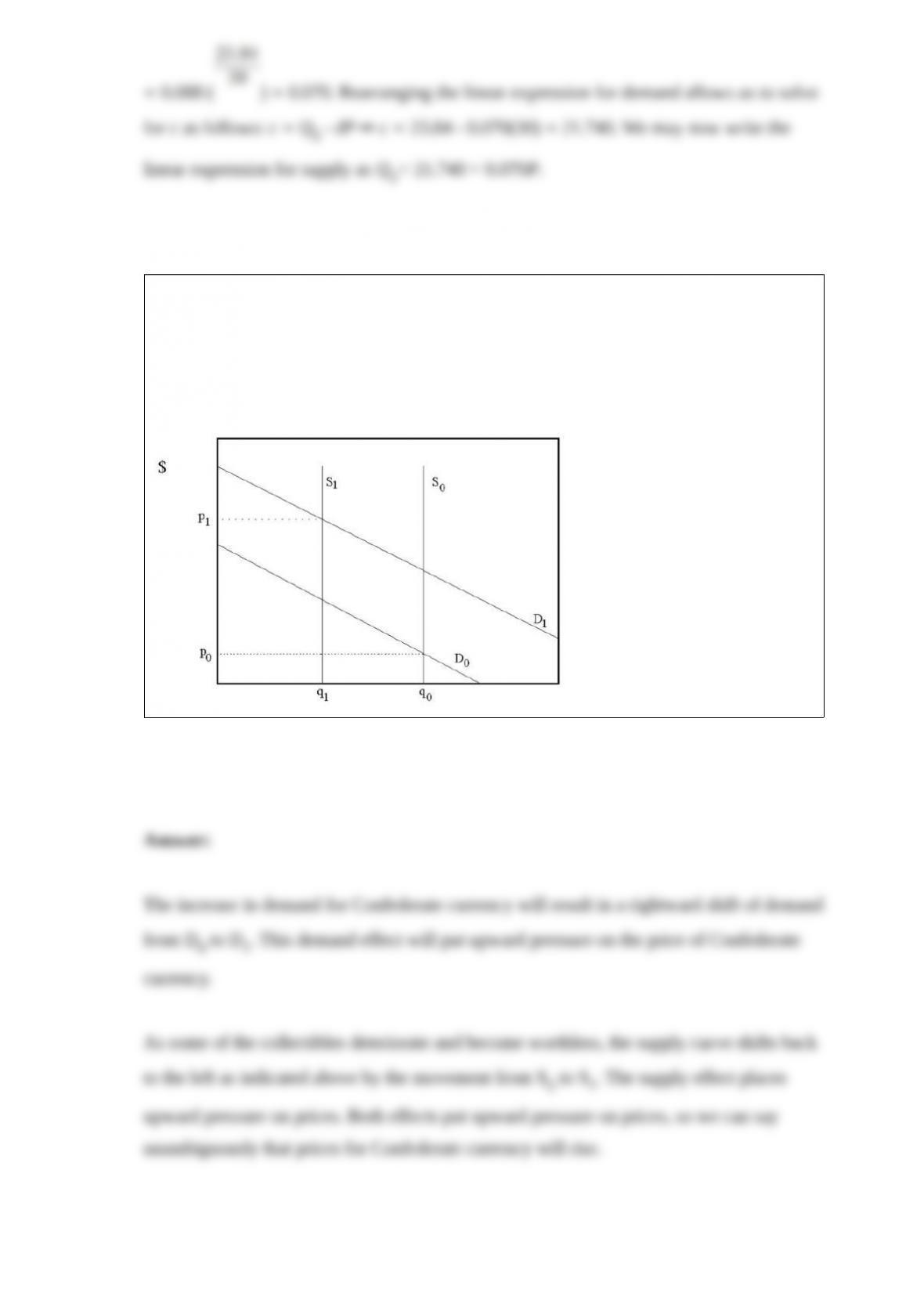
The currency used by the Confederate States of America during its brief existence from
1861 to 1865 has become a collector’s item today. The Confederate Currency supply is
perfectly inelastic. As the demand for the collectible increases and some of the old
currency is destroyed or no longer of value as a collectible, what happens to the market
price?
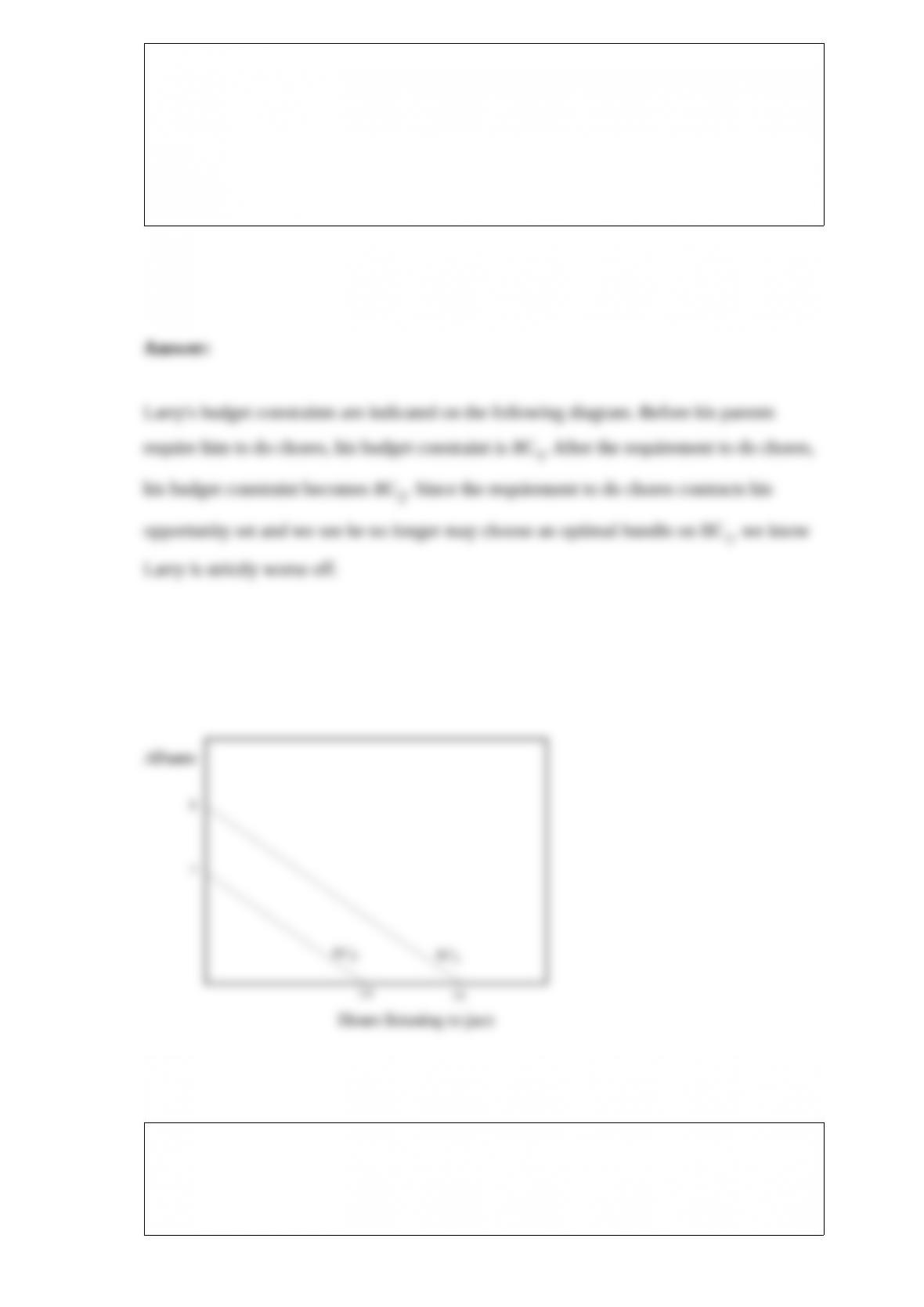
Larry lives with his parents and enjoys listening to jazz. Because of his living
arrangements, his only expense is on jazz music. To earn money to buy new albums,
Larry must work. Larry has 16 hours per day he could spend listening to jazz or
working. Each hour he works he earns $6. Each album costs him $12. Diagram Larry’s
budget constraint for new jazz albums and time spent listening to jazz. If Larry’s parents
require him to spend two hours per day doing chores around the house, what happens to
his budget constraint? Does the requirement to do chores make Larry worse off?
You have won a contest and are allowed to choose between two prizes. One prize is
$200 today and another $200 one year from now. The other prize is $100 today and an
additional $325 one year from now. At what interest rate (if any) would you be
indifferent between the two prizes?

Sandra lives in the Pacific Northwest and enjoys walking to and from work during
sunny days. Her utility is sharply diminished if she must walk while it is raining.
Sandra’s utility function is
U = 1,000 I1 + 250I2 + 1I3 where I2 = 1 if she walks and there is no rain and I1 = 0
otherwise, I2 = 1 if she drives to work and I2 = 0 otherwise, and I3 = 1 if she walks and
it rains and I3 = 0 otherwise. Sandra believes that the probability of rain today is 3/10.
Given her beliefs, what is her expected utility from walking to work? What is her
expected utility from driving to work according to her beliefs? If Sandra maximizes her
expected utility according to her beliefs, will she drive or walk to work? Sandra missed
the weather report this morning that stated the true probability of rain today is 4/5.
Given the weather report is accurate, what is Sandra’s true expected utility from
walking and driving to work? How much could Sandra increase her expected utility if
she read and believed the weather report?
The city of Econoville currently charges a fee of $0.50 to residents for each 50 gallon
can of trash the city garbage service collects from their residence. A 50 gallon can of
recyclable trash costs a resident $3.50 to be collected. The marginal social cost of
garbage disposed is: MSCd (gd) = 12.50 where gd is a 50 gallon drum of garbage
disposed. The marginal social cost of garbage recycled is: MSCr (gr) = 2.50gr. The
marginal benefit function of garbage removed from residences is: MB(gd, gr) = 800 –
2(gd+ gr). Given the payment plan for garbage disposal, what level of garbage are the
city residents disposing each year? How much will each resident recycle with this
payment plan? Is this level of disposal and recycling efficient? Why or why not? What
is the optimal level of garbage disposed and garbage recycled in Econoville? How can
Econoville encourage residents to dispose and recycle the optimal amounts of garbage?

Internet service in the local market is supplied by Laura’s Internet Service. Laura has
two types of consumers. The first type of customers is local businesses, and the
elasticity of business demand at current prices and quantity is -1.25. The second type is
residential customers, and the elasticity of residential demand at current prices and
quantity is -4. Laura is charging business users $50 per unit of service while she charges
residential customers $17.50 per unit. Can we determine if Laura is maximizing profits?
Suppose the marginal rate of substitution is constant at 6 for all possible consumption
bundles. Next suppose that the price of good 1 decreases, and the ratio P1/P2 is greater
than 6. Show that the income and substitution effects from this price change are both
zero.
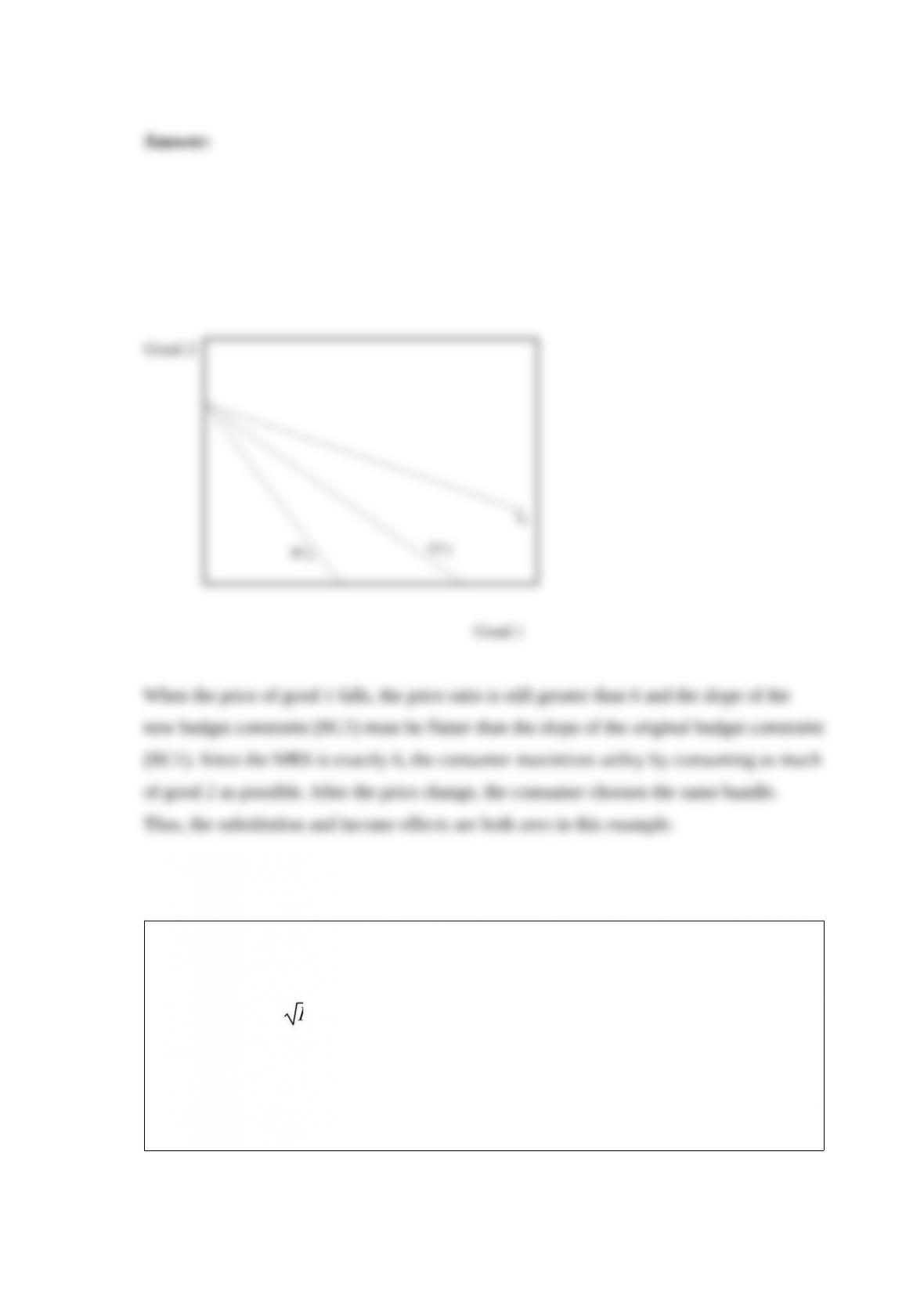
Describe Larry, Judy and Carol’s risk preferences. Their utility as a function of income
is given as follows
Larry: UL(I) = 10 .
Judy: UJ (I) = 3I2.
Carol: UC (I) = 20I.
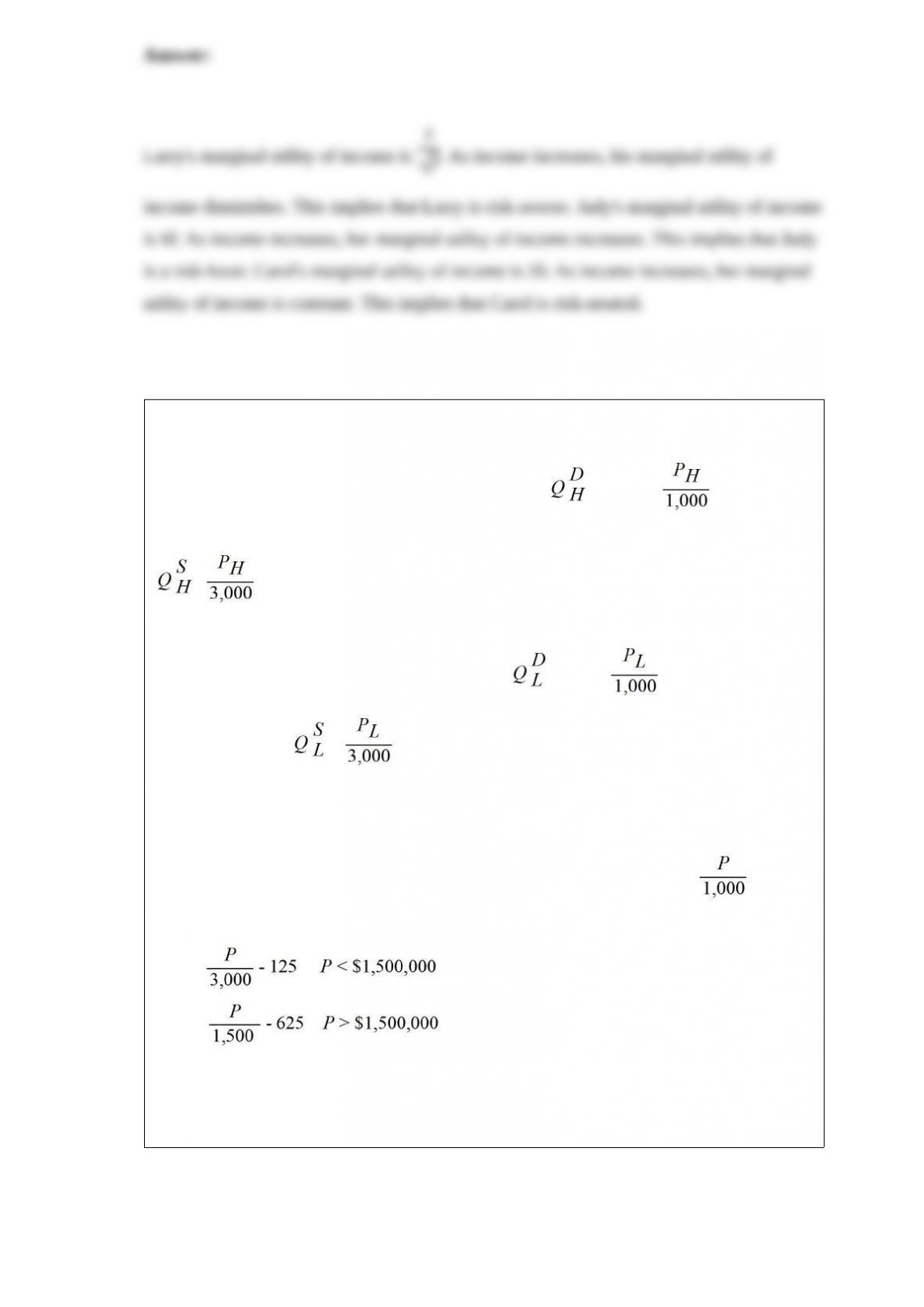
The professional baseball league on planet Economus allows team owners to draft
players for life. Once a player is acquired in the draft, team owners may trade players to
other teams. The demand for high quality players is: = 2,000 – . The supply
of high quality players is:
= – 500. What is the lowest price necessary to induce an owner to trade a
high quality player. Determine the equilibrium price and quantity of high quality
players. The demand for low quality players is: = 400 – . The supply of low
quality players is: = – 125.
Determine the equilibrium price and quantity of low skill players. Now, suppose that
only the team that has the rights to the player knows the quality of the player. This
implies the new demand for players of uncertain quality is: QD = 1,200 – . The
supply of players becomes:
QS = {
Derive the equilibrium price and quantity for players of uncertain ability. Do you
believe any high quality players are being traded at this new market price?
Glen’s friend Andre is a big strong guy. Andre will not allow anyone to harm Glen. Glen
enjoys teasing people. In fact, Glen’s marginal benefit of teasing people is given by:
MB(Q) = 75 – 10Q. Generally, people do not enjoy Glen teasing them. Thus, they
retaliate to Glen’s teasing. Without Andre around to protect Glen from the retaliation,
Glen’s marginal cost of teasing people is
MC(Q) = 20Q due to the retaliation. However, with Andre around, Glen perceives his
marginal costs of teasing to always be zero as no one will retaliate with Andre around.
This is because Andre will step in to protect Glen from retaliation. Without Andre
around, what is Glen’s choice for teasing? How much does Glen increase teasing when
Andre’s around? Is Glen’s behavior characteristic of a moral hazard or adverse
selection?
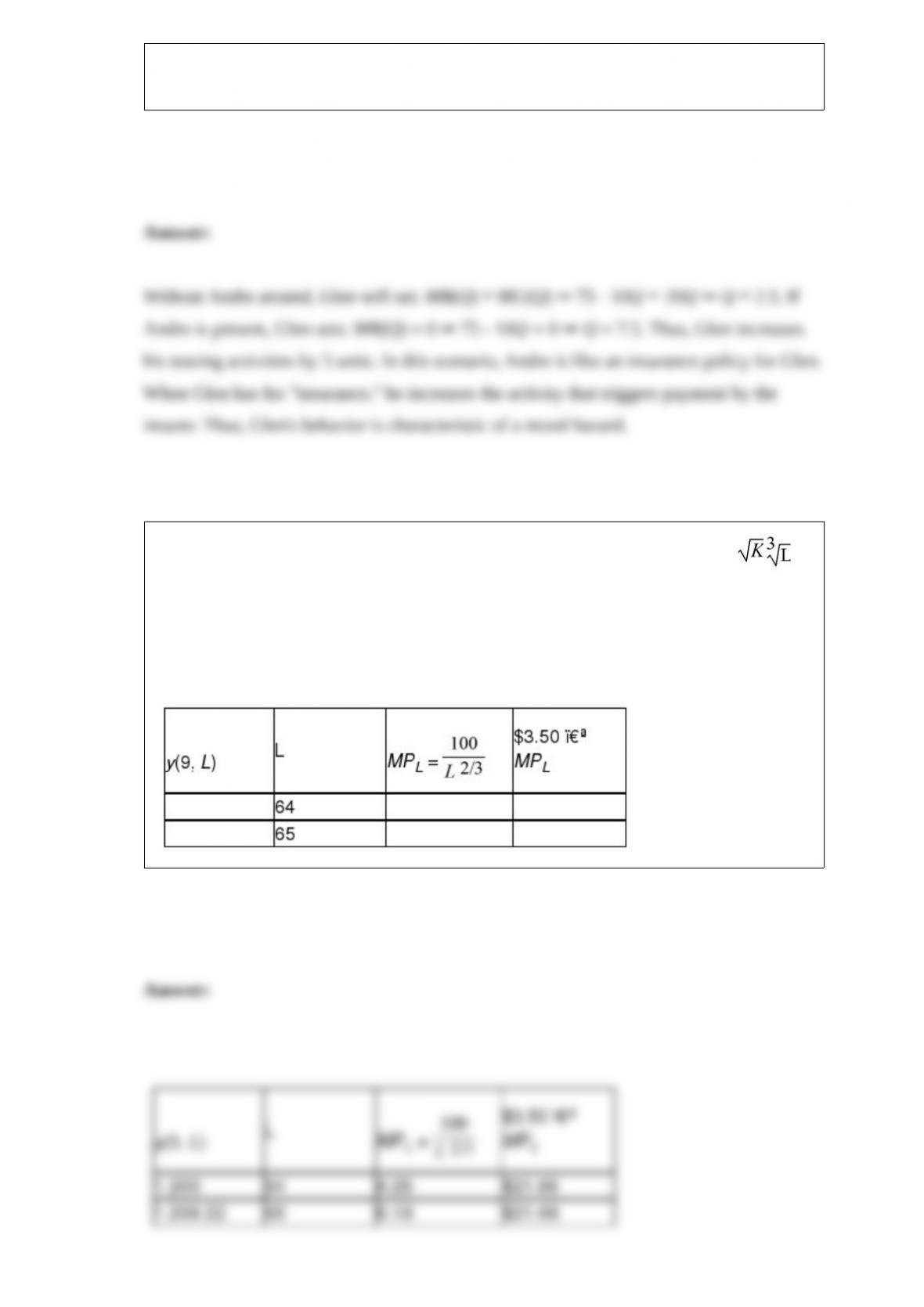
Sarah’s Pretzel Plant produces pretzels according to the function y(K, L) = 100 .
K is the number of ovens, and L is the number of labor hours Sarah uses to produce her
pretzels. At the moment, Sarah uses 9 ovens. Also, she plans to hire 64 labor hours.
Sarah can sell each unit of pretzels produced for $3.50. Fill in the table below. If Sarah
increased her use of labor hours to 65, would the value of the marginal product of labor
exceed the wage rate of $8.50?

The demand curve for the daily edition of the Lubbock Avalanche Journal is D = 85,000
– 30,000P. The current price of the newspaper is $0.50. Derive the Consumer Surplus
for the newspaper.
Laura’s Internet Services firm can design computer systems according to the function
y(K, L) = , where K is the amount of gigabyte storage she has available and L is
the amount of labor hours she employs. Currently, Laura has 125 gigabytes of storage.
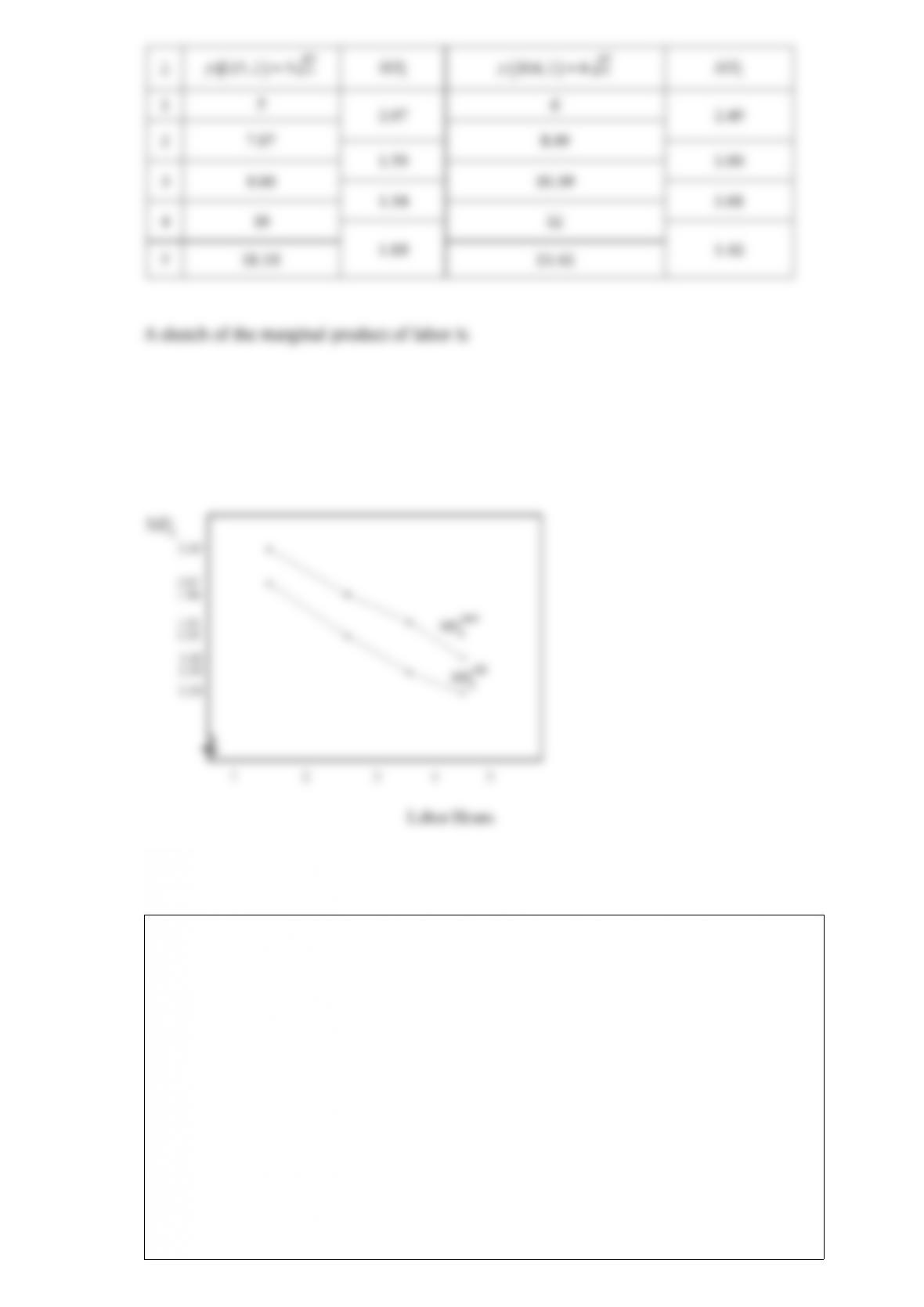
Sketch the change in the marginal product of labor curve for Laura’s firm for values of
L= 1, 2, 3, 4, and 5, if she increases her gigabyte storage capacity to 216.
Match the following descriptions of preferences to the indifference curve diagrams that
follow.
________ Ann does not care whether she has more diet soft drinks or fewer
diet soft drinks.
________ Peter is very picky about his buttered popcorn. He tops every quart
of popped corn with exactly one quarter cup of melted butter.
________ Amy likes M&M’s, plain and peanut. For Amy, the marginal rate of
substitution between plain and peanut M&M’s does not vary with the
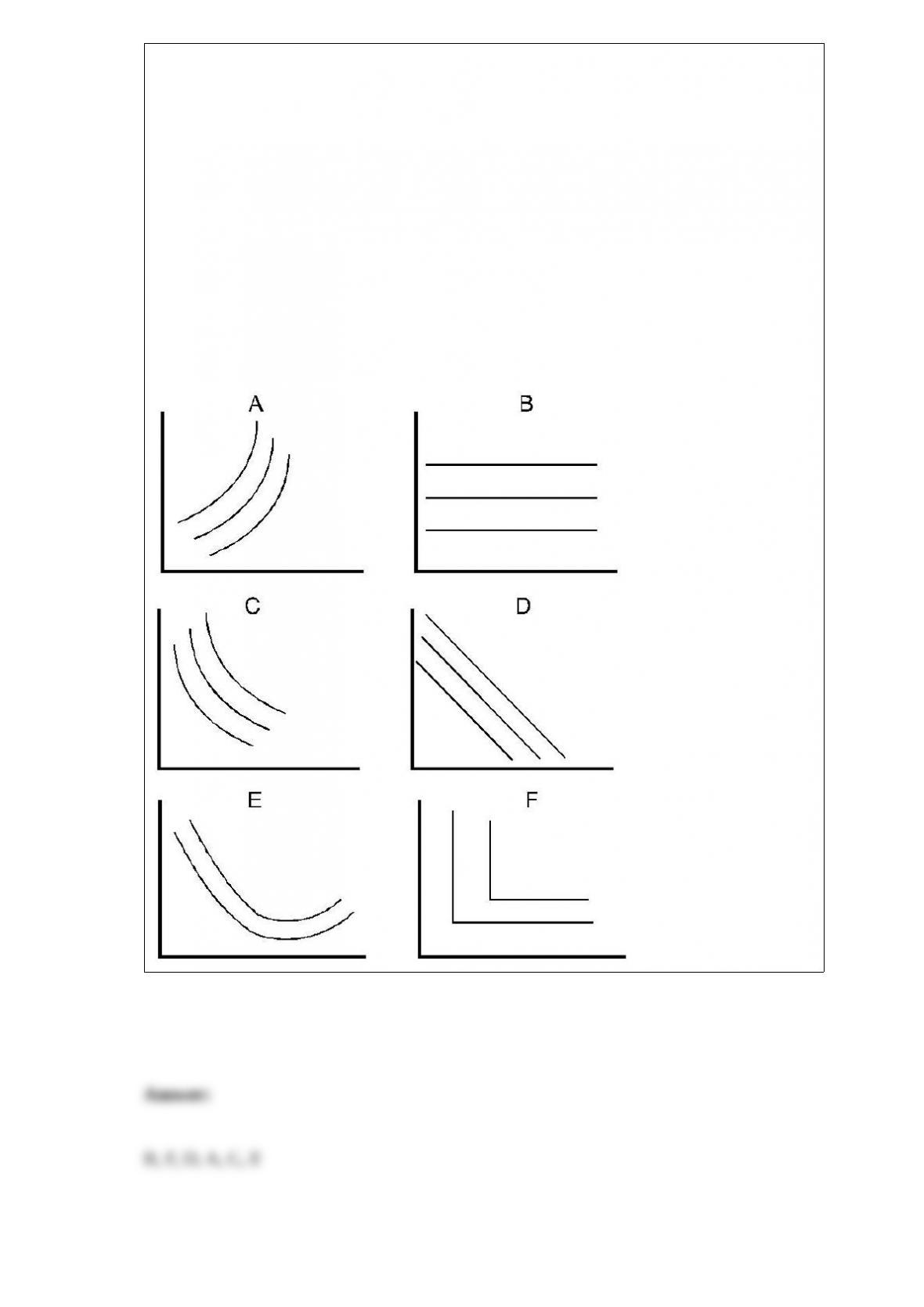
quantities of plain and peanut M&M’s she consumes.
________ George dislikes broccoli and would be willing to pay something to not
have to eat it.
________ Natalya likes rap and rock music. Natalya’s preferences exhibit a
diminishing marginal rate of substitution between the two types of music.
________ Matthew knows his limit. He likes beer up to a point, but if he drinks
too much he gets sick.