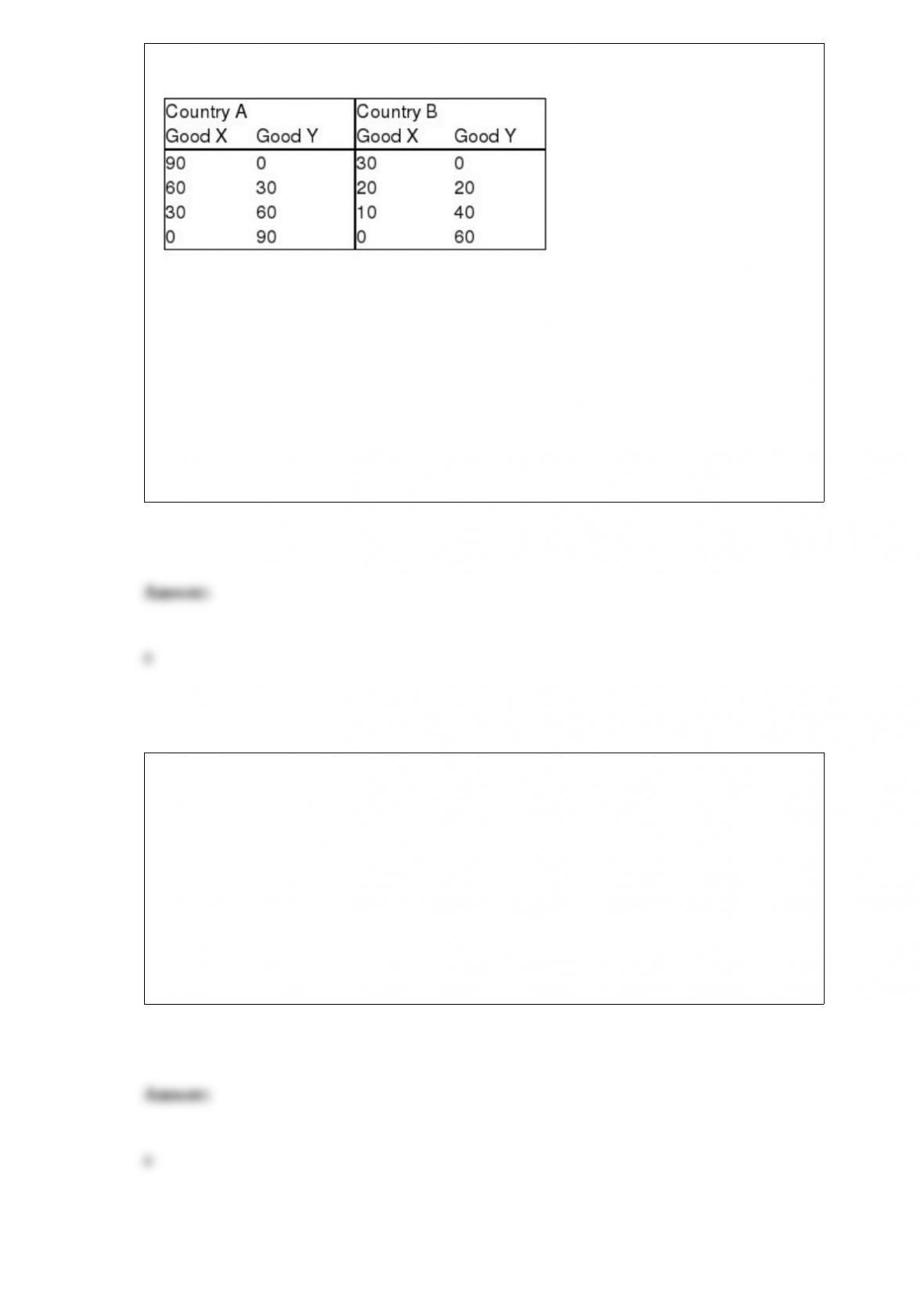
Exhibit 34-1
The opportunity cost of one unit of Y in country A is
a. 1 unit of X.
b. 0.75 units of X.
c. 2 units of X.
d. 10 units of X.
Which of the following statements is false?
a. People who live in cities with good weather receive that benefit for free.
b. People who own property in cities with good weather receive higher rents, ceteris
paribus.
c. Housing prices are higher in cities with better weather, ceteris paribus.
d. The demand for housing is higher in cities with good weather, ceteris paribus.
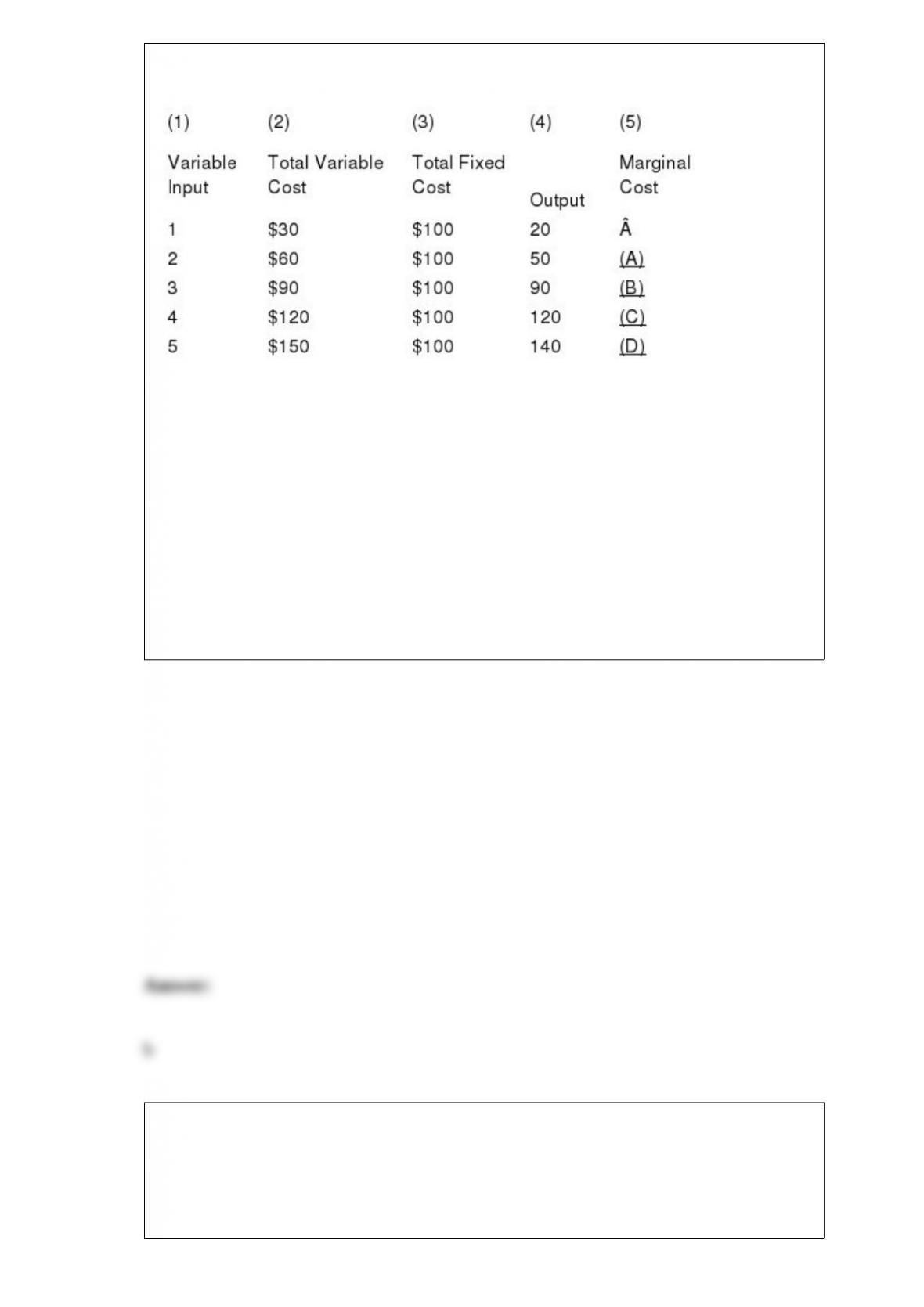
Exhibit 22-2
What is the average total cost of producing 120 units of output?
a. $0.67
b. $1.83
c. $1.07
d. $12.50
e. There is not enough information provided to answer the question.
A decreasing-cost industry has a long-run supply curve that is upward sloping.
a. True
b. False

When P = $5, the quantity demanded of a good is 30 units, and the quantity supplied of
the good is 50 units.For every $1 decrease in the price of this good, quantity demanded
rises by 5 units and quantity supplied falls by 5 units.The equilibrium price of this good
is ___________and the equilibrium quantity of this good is _________ units.
a. $3; 40
b. $4; 35
c. $2; 45
d. $2; 35
e. $3; 35
There is a flexible exchange rate system and only two countries in the world, the United
States and Mexico. An increase in income growth in Mexico relative to income growth
in the United States will cause the
a. dollar to appreciate.
b. peso to depreciate.
c. dollar to depreciate.
d. a and b
e. There is not enough information to answer the question.
All other things being equal, the __________ the percentage of one’s budget spent on a
good, the __________ the price elasticity of demand.

a. greater; higher
b. smaller; lower
c. greater; lower
d. smaller; higher
e. a and b
Public choice economists often explain low voter turnouts in terms of
a. dissatisfaction of many voters with the limited choice of candidates.
b. lack of civic responsibility of the electorate.
c. net costs of voting that many voters perceive.
d. rational ignorance of many voters of the actual date of the elections.
Which of the following statements is false?
a. For a monopolist, the law of diminishing marginal returns does not hold.
b. A monopoly firm will earn profit if it produces the quantity of output at which MR =
MC, and charges a price that is above its average total cost.
c. The monopolist firm searches for the highest per-unit price it can charge for the
quantity of output it produces.
d. The highest per-unit price a monopoly firm can charge is determined by the height of
its demand curve.
Which of the following is an example of a monopolistic competitor?
a. General Motors
b. a wheat farmer in Iowa
c. a long-distance telephone company
d. a family-owned Italian restaurant
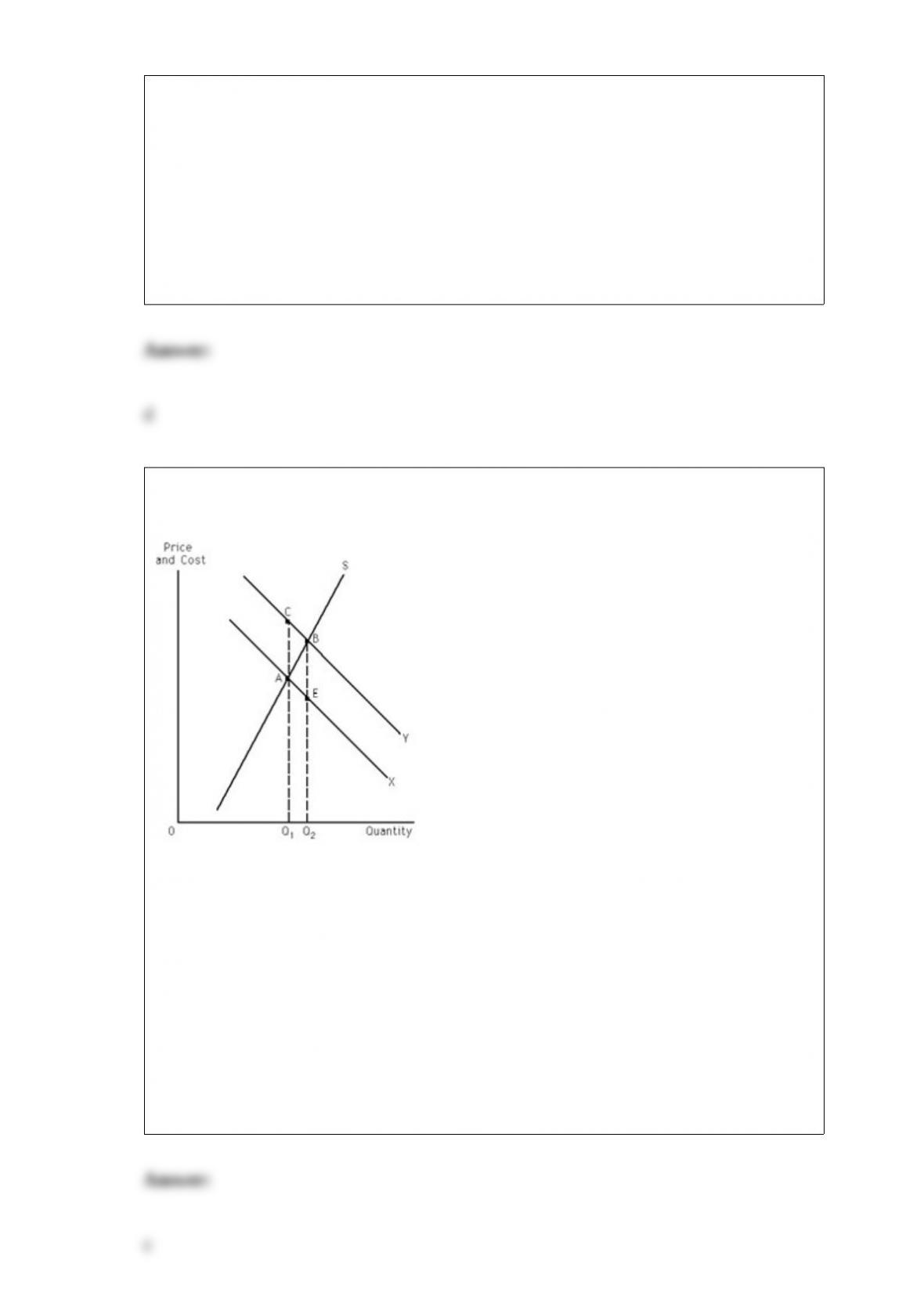
Exhibit 31-2
If the exhibit represents a positive externality situation, the social benefit of expanding
output from Q1 to Q2 is the area of
a. Q1ABQ2.
b. Q1AEQ2.
c. Q1CBQ2.
d. ABE.

No matter what the price of a given item of food, a person will eat the same amount of
that food. This situation is __________ with the concept of __________.
a. consistent; consumer equilibrium
b. not consistent; consumer equilibrium
c. consistent; maximizing total utility
d. consistent; consumers’ surplus
e. none of the above
If the demand for health care is elastic and health care co-payments are lowered, the
percentage change in the quantity demanded of health care will be _______________
than the percentage decrease in co-payments, and the total dollar amount spent on
health care will ___________.
a. greater; rise
b. less; rise
c. greater; fall
d. less; fall
A firm knows that it can borrow funds at 7 percent to invest in capital. Whether or not it
borrows the funds depends upon the
a. amount of people’s saving.
b. rate of time preference of consumers.
c. return on capital relative to the price of credit.
d. difference between its interest payments and the interest rate.
e. none of the above
In a perfectly competitive market, the market demand curve is perfectly elastic.
a. True
b. False
Here are three things you could do if you do not attend your economics class: watch
television with some friends (you value this at $25), read a good novel (you value this
at $13), or go in to work (you could earn $20 during the economics class). The
opportunity cost of going to your economics class is
a. $20, because this is the only alternative of the three where you actually receive a
monetary payment.
b. $13, because this is the lowest valued alternative forfeited.
c. $25, because this is the highest valued alternative forfeited.
d. $58, because this is the total dollar sum of the alternatives forfeited.