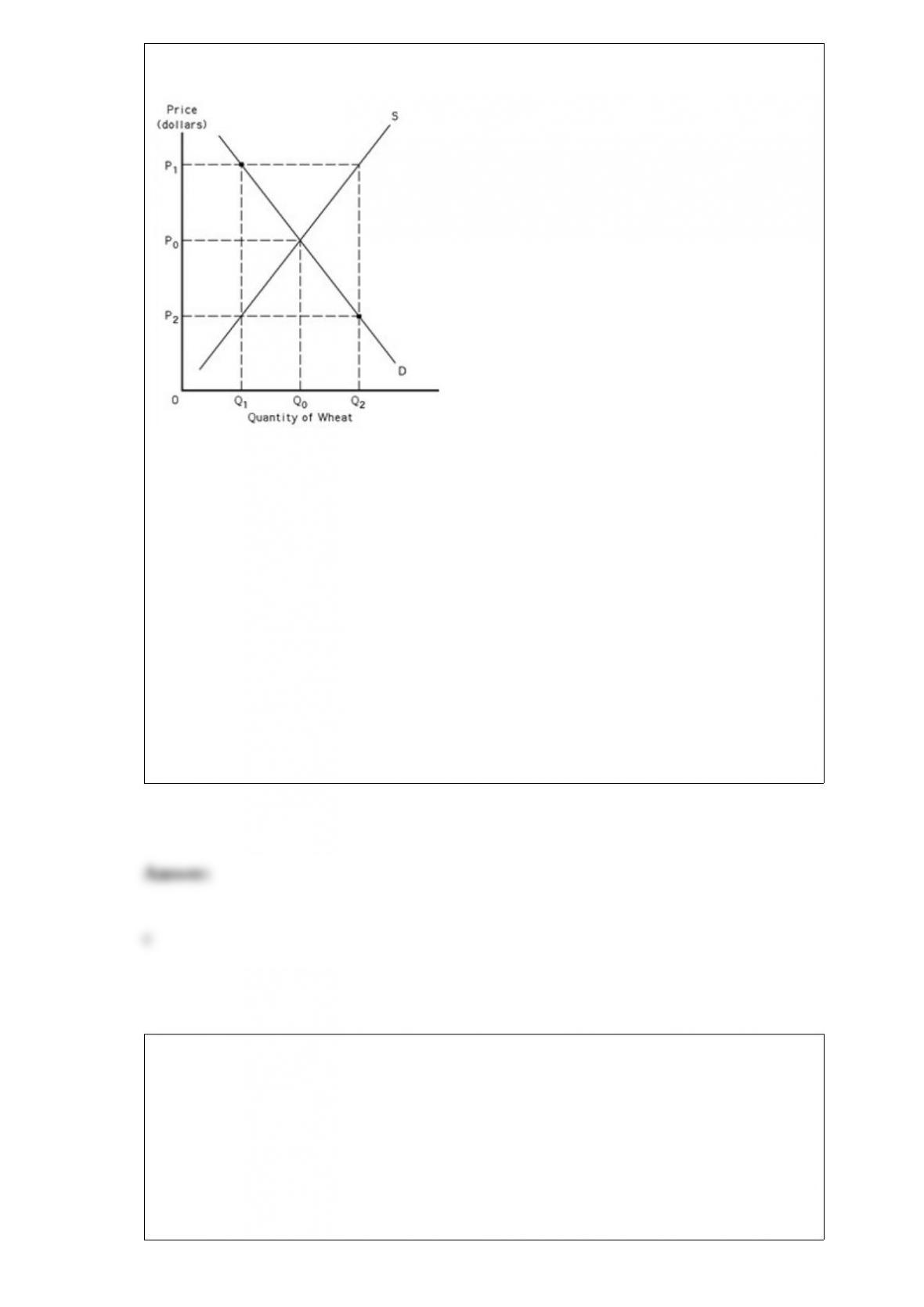
Exhibit 39-2
If P1 is a price support, the quantity of wheat purchased by the market would be equal
to
a. Q2.
b. Q0.
c. Q1.
d. Q2 – Q1.
e. Q1 – Q0.
A person buys a bond with a face value of $10,000 for $9,325. Each year until the
maturity date the bond buyer receives a coupon payment of $650 from the issuer of the
bond. The coupon rate on the bond is
a. 9.11 percent.
b. 6.5 percent.
c. 7.0 percent.
d. 6.75 percent.
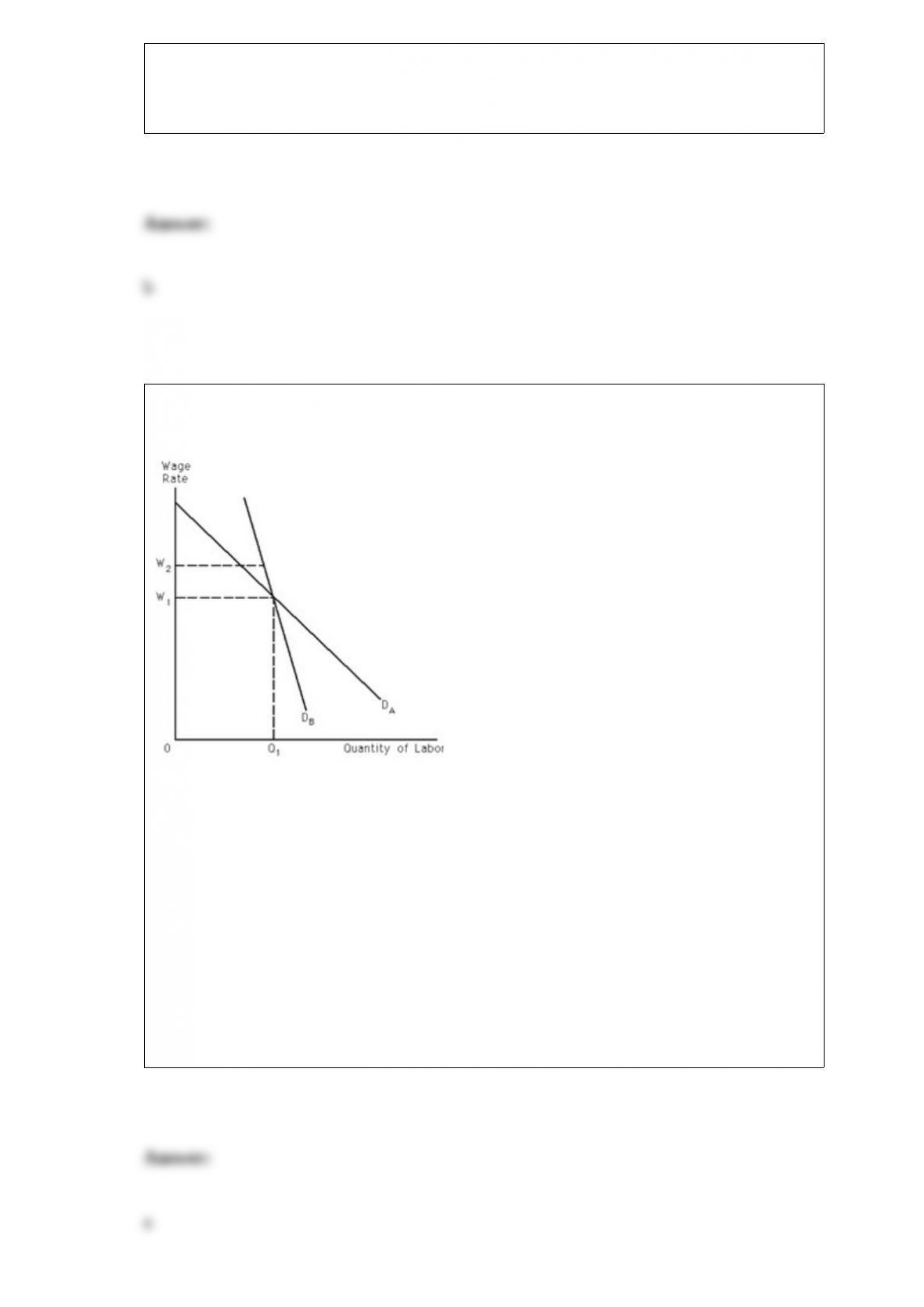
Exhibit 28-9
Let DA and DB represent demand for labor curves facing unions A and B, respectively.
As a result of their efforts, both unions succeed in increasing the wage rate from W1 to
W2. In terms of the wage-employment trade-off, the wage increase
a. had a larger impact on employment for union A than for union B.
b. had a larger impact on employment for union B than for union A.
c. had the same impact on employment in both unions.
d. cannot be determined without further information.

Many years ago someone developed an item that was simply a small rock inside a box
with holes. The person earned large profits from selling “pet rocks.” Which of the
following theories on the source of profits best describes the reason behind this
success?
a. Uncertainty is a source of profits.
b. Profit is the reward for alertness to arbitrage opportunities.
c. Profit is the return to the entrepreneur as innovator.
d. There’s a sucker born every minute.
e. Sometimes all that it takes is to be in the right place at the right time.
A negative externality exists and government wants to impose a per-unit tax in order to
bring about the socially optimal output. To accomplish its objective, government must
set the tax equal to marginal
a. private cost.
b. social benefit.
c. external cost.
d. social cost.
e. private benefit.

When a good is perfectly inelastic in demand, or perfectly elastic in supply, the buyers
will pay the full tax that is placed on the sellers.
a. True
b. False
Successful collective bargaining (on the part of a labor union) will
a. increase the demand for labor.
b. decrease the demand for labor.
c. change the marginal physical product of labor.
d. a and c
e. none of the above
Exhibit 24-8

A profit-maximizing single-price monopolist will set the price at
a. $90 per unit.
b. $82 per unit.
c. $65 per unit.
d. $75 per unit.
e. There is not enough information provided to answer this question.
The effect of a tariff is
a. an increase in consumers’ surplus.
b. a decrease in producers’ surplus.
c. an increase in tariff revenues for government.
d. b and c
e. all of the above

The advantage of the Herfindahl index over the four- and eight-firm concentration
ratios is that it provides information
a. on the degree to which foreign firms impact domestic competition.
b. about the dispersion of firm size in an industry.
c. on the degree to which marginal revenue is greater than marginal cost (for a firm).
d. b and c
e. none of the above
To an economist, an increase in demand means the same thing as an increase in quantity
demanded.
a. True
b. False
Roundabout methods of production are said to be productive. What does this mean?
a. Goods are best produced by many people working together-as in a circle.

b. If you go round and round thinking about something, you will usually come up with
the right way to do it-so you minimize on mistakes.
c. If you take the most direct route to producing a good, you will save time, and time is
something that producers want to save since “time is money.”
d. If you take time out to produce a capital good, with that capital good you can produce
more than you could produce without it.
Which of the following statements is false?
a. If the income elasticity of demand for a good is less than 1, the demand for the good
is income inelastic.
b. If the income elasticity of demand for a good is greater than 1, the demand for the
good is income elastic.
c. If the income elasticity of demand for a good is equal to 1, the demand for the good is
income unit elastic.
d. If the income elasticity of demand for a good is less than zero, the good is a normal
good.
e. A good can be both a normal good and income inelastic.
Simple majority rule can generate inefficient outcomes because
a. it does not register the intensity of voters’ preferences.
b. it cannot adjust for special interest lobbying efforts.

c. it does not adjust for the costs of rational ignorance.
d. people are often misinformed on what it is they are voting on.
e. none of the above
Marginal productivity theory states that
a. firms in price searcher product markets pay factors their marginal factor cost.
b. firms in perfect factor markets pay factors their equilibrium wages.
c. firms that are more productive, earn higher profits.
d. firms in perfect product and factor markets pay factors their marginal revenue
products.
e. none of the above
If we assume that the income elasticity of demand for food has been around 0.2 and that
agricultural producers have become increasingly more productive, we can conclude that
a. prices of food have increased.
b. supply increases have been less than demand decreases.
c. as consumers’ real incomes have been increasing over the years, they have been
spending absolutely less on food.

d. prices of food have been stable.
e. none of the above
For a single-price monopoly, marginal revenue is
a. equal to price for the first unit of output.
b. less than price for all units of output after the first unit.
c. greater than price.
d. horizontal.
e. a and b
In contrast to a tariff, a quota does not
a. reduce consumers’ surplus.
b. increase producers’ surplus.
c. generate revenues for government.
d. raise price.
e. c and d

According to public choice theorists, people behave differently in the market sector
than in the public sector because
a. the more people there are in the market sector the less influence they are able to
exert, whereas the more people there are in the public sector the more influence they are
able to exert.
b. the fewer people there are in the market sector the less influence they are able to
exert, whereas the fewer people there are in the public sector the more influence they
are able to exert.
c. self-interest is the motivating force in the market sector, whereas altruism is the
motivating force in the public sector.
d. altruism is the motivating force in the market sector, whereas self-interest is the
motivating force in the public sector.
e. institutional arrangements are different in the two sectors.
The perfectly competitive firm’s short-run supply curve is that portion of its MC curve
that lies above its AFC curve.
a. True
b. False