
The Office of Management and Budget serves as the central bank of the United States.
A) True
B) False
If the Federal Reserve wanted to increase the money supply, it could _____ the required
reserve ratio, _____, and _____ bonds on the open market.
A) decrease; increase the federal funds rate; sell
B) decrease; decrease the discount rate; buy
C) increase; increase the personal tax rate; sell
D) decrease; increase the personal tax rate; buy
The topics studied in macroeconomics include:
A) the price of a motorcycle.
B) the wages of engineers.
C) the average price level in the economy.
D) how much ice cream consumers buy.
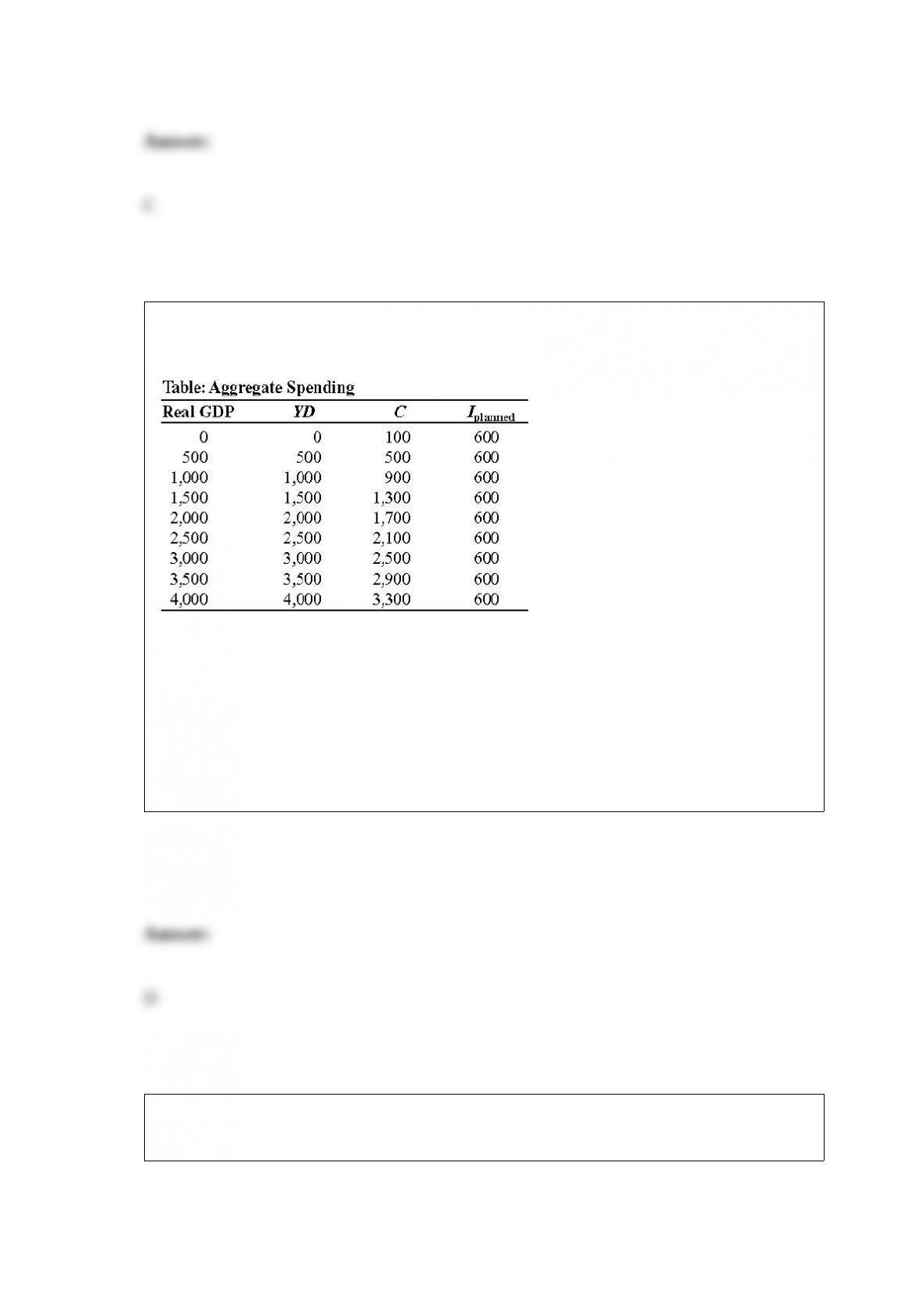
Look at the table Aggregate Spending. Suppose the economy has no government
spending and no foreign trade. With no taxes or transfers, real GDP equals disposable
income (YD). If real GDP is $2,500, what is the level of unplanned inventory
investment?
A) $200
B) $0
C) $2,700
D) “$200
Figure: The Business Cycle
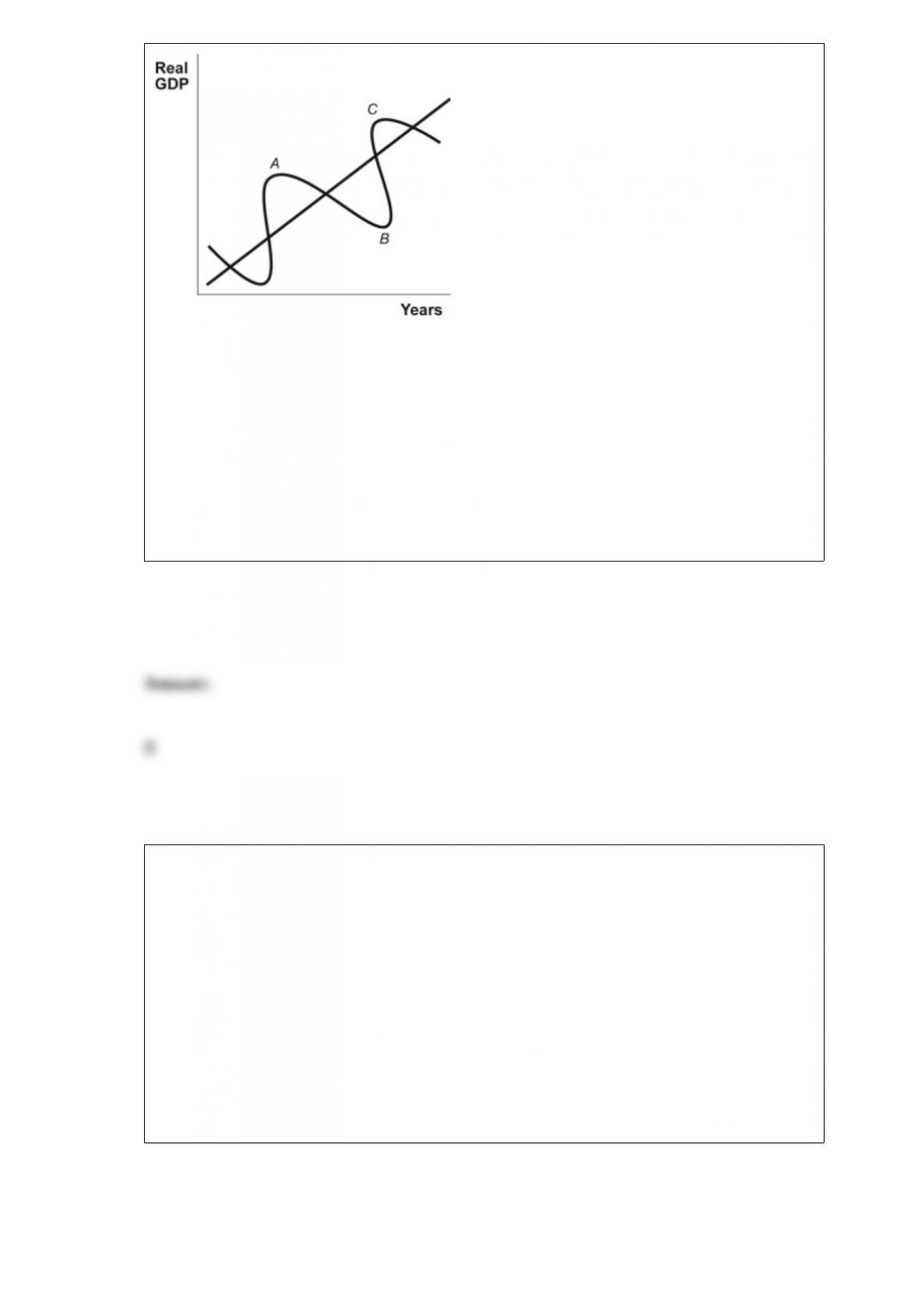
Look at the figure The Business Cycle. Point B on this graph shows a(n):
A) peak.
B) trough.
C) expansion.
D) recession.
The cyclically balanced budget is important because it:
A) is an estimate of the amount of expansionary fiscal policy necessary to close an
inflationary gap.
B) is an estimate of the amount of contractionary fiscal policy necessary to close a
recessionary gap.
C) indicates the amount of tax revenue that will be available for implicit liabilities.
D) helps to determine whether the government’s taxing and spending policies are
sustainable in the long run.

Alison has a linear production possibility frontier in bracelets and necklaces. In one
hour, she can produce 5 bracelets or 10 necklaces. What is the opportunity cost to make
1 necklace?
A) 5 bracelets
B) 10 necklaces
C) 0.5 bracelet
D) 2 necklaces
Two primary goals for macroeconomists are price stability and:
A) no unemployment.
B) no frictional unemployment.
C) low unemployment.
D) no structural unemployment.

The expansion and collapse of the housing market in Ft. Myers between 2003 and 2010
is primarily an example of how:
A) too much government regulation is harmful to the economy.
B) changes in investment spending can affect consumer spending and the entire
economy.
C) immigration affects local economies.
D) high tax rates can decrease economic activity in an area.
According to the aggregate demand curve, when the aggregate price level _____, the
quantity of aggregate output _____.
A) rises; supplied falls
B) falls; demanded falls
C) rises; demanded falls
D) rises; demanded does not change
The United States must give up the production of 500 bicycles to produce 20 additional
tractors. The opportunity cost of producing 5 tractors is _____ bicycles.
A) 5
B) 20
C) 100
D) 125

Holding everything else constant, the multiplier effect for taxes is _____ that for
changes in autonomous aggregate spending.
A) the same as
B) less than
C) bigger than
D) not relevant to
If the economy grew at 3% this year and average prices increased _____, people would
be better off this year than last year.
A) 3%
B) faster than 3%
C) less than 3%
D) faster than 10%

An argument in favor of Britain’s adopting the euro was that using the same currency as
many other European countries would make monetary policy more effective.
A) True
B) False
If an economy has just had a serious recession but real GDP is expanding once again,
we can expect the unemployment rate to:
A) fall immediately.
B) rise immediately.
C) rise if people who were previously discouraged enter the work force but do not find
jobs right away.
D) fall if people who were previously discouraged enter the work force but do not find
jobs right away.
Everyone benefits from street lighting, yet the marginal benefit to any one individual
usually falls short of the marginal cost. This is an example of:

A) individual actions whose side effects are not properly taken into account by the
market.
B) one party preventing mutually beneficial trades in an attempt to capture a greater
share of resources for itself.
C) the unsuitability of some goods for efficient management by markets.
D) regulating self-interest.
Scenario: Holding Cash
Suppose that the public holds 50% of the money supply in currency and the reserve
requirement is 20%. Banks hold no excess reserves. A customer deposits $6,000 in her
checkable deposit.
Look at the scenario Holding Cash. As a result of the deposit, required reserves will
increase by:
A) $0.
B) $1,200.
C) $3,000.
D) $6,000.

When an economy moves from autarky to free international trade, for industries in the
export sector, consumer surplus _____, producer surplus _____, and the economy as a
whole _____.
A) rises; rises; gains
B) rises; falls; gains
C) falls; rises; gains
D) falls; rises; loses
Which of the following BEST explains why the Fed flirted with monetarism but then
gave up?
A) The natural rate hypothesis failed to predict a worsening of the trade-off between
inflation and unemployment.
B) A sharp rise in inflation during the 1970s broke the perceived trade-off between
inflation and unemployment and discredited traditional Keynesianism.
C) Inflation started dropping off sharply in the 1980s, and this helped bolster the view
that targeting the money supply no longer made sense.
D) It finally became evident that there was no longer a trade-off between inflation and
unemployment.
The construction of new housing is considered part of:
A) investment spending.
B) consumption.
C) government purchases of goods and services.
D) private saving.
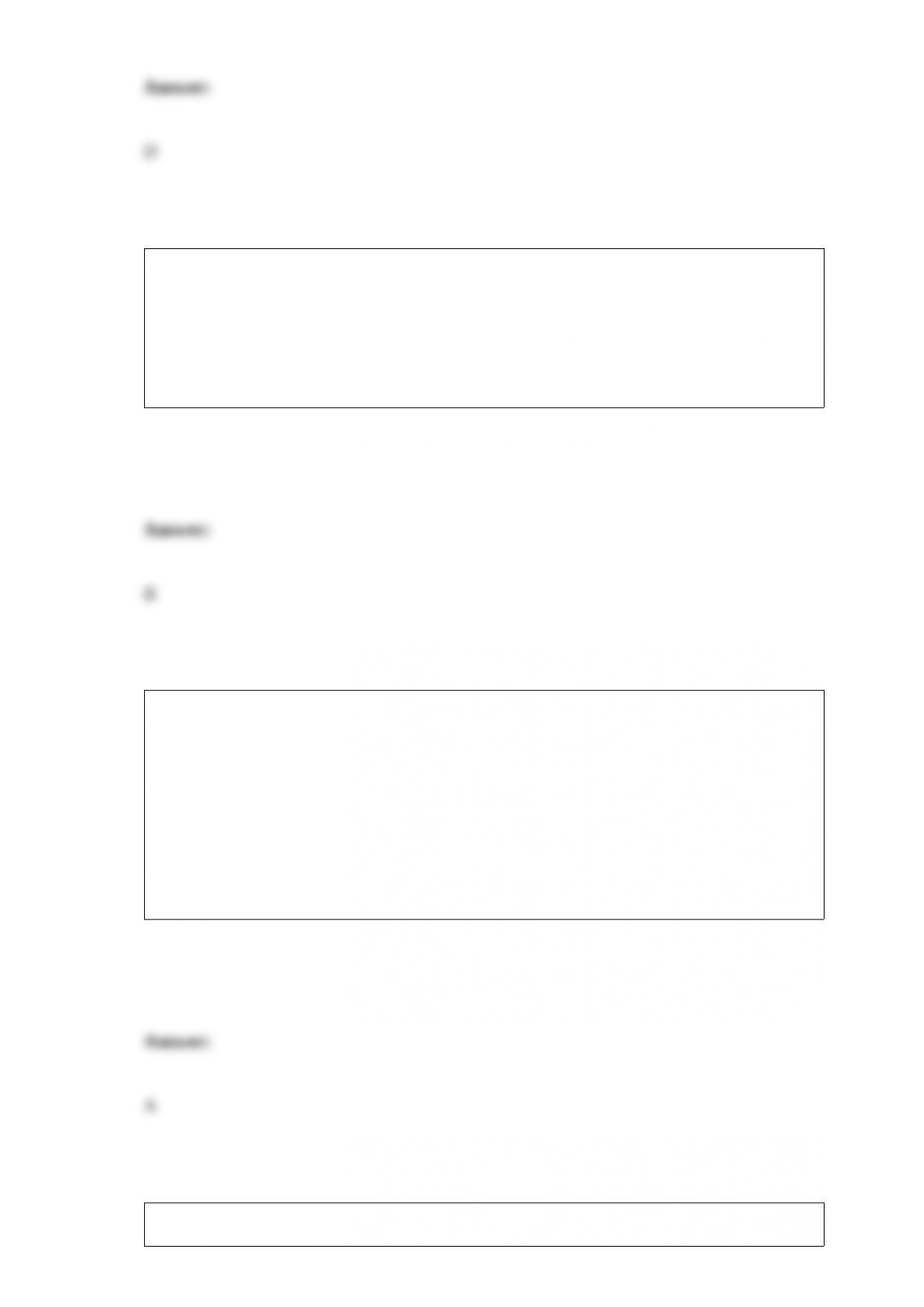
Figure: Loanable Funds Market
Look at the figure Loanable Funds Market. The equilibrium interest rate and total
quantity of lending are:
A) 8% and $2 trillion.
B) 2% and $5 trillion.
C) 10% and $1 trillion.
D) 6% and $3 trillion.
Classical macroeconomists believed that monetary policy should be used to fight
recessions.
A) True
B) False
In 2010, the median U.S. household income was approximately:
A) $50,000.
B) $8,000.
C) $16,000.
D) $25,000.
Scenario: Aggregate Consumption Equation
Suppose that the aggregate consumption function is given by the equation C= 200 +
0.8YD, where Crepresents consumption and YDrepresents disposable income.
Look at the scenario Aggregate Consumption Equation. If disposable income increases
from $500 to $800, aggregate consumption will increase by:
A) $0.
B) $200.
C) $240.
D) $440.
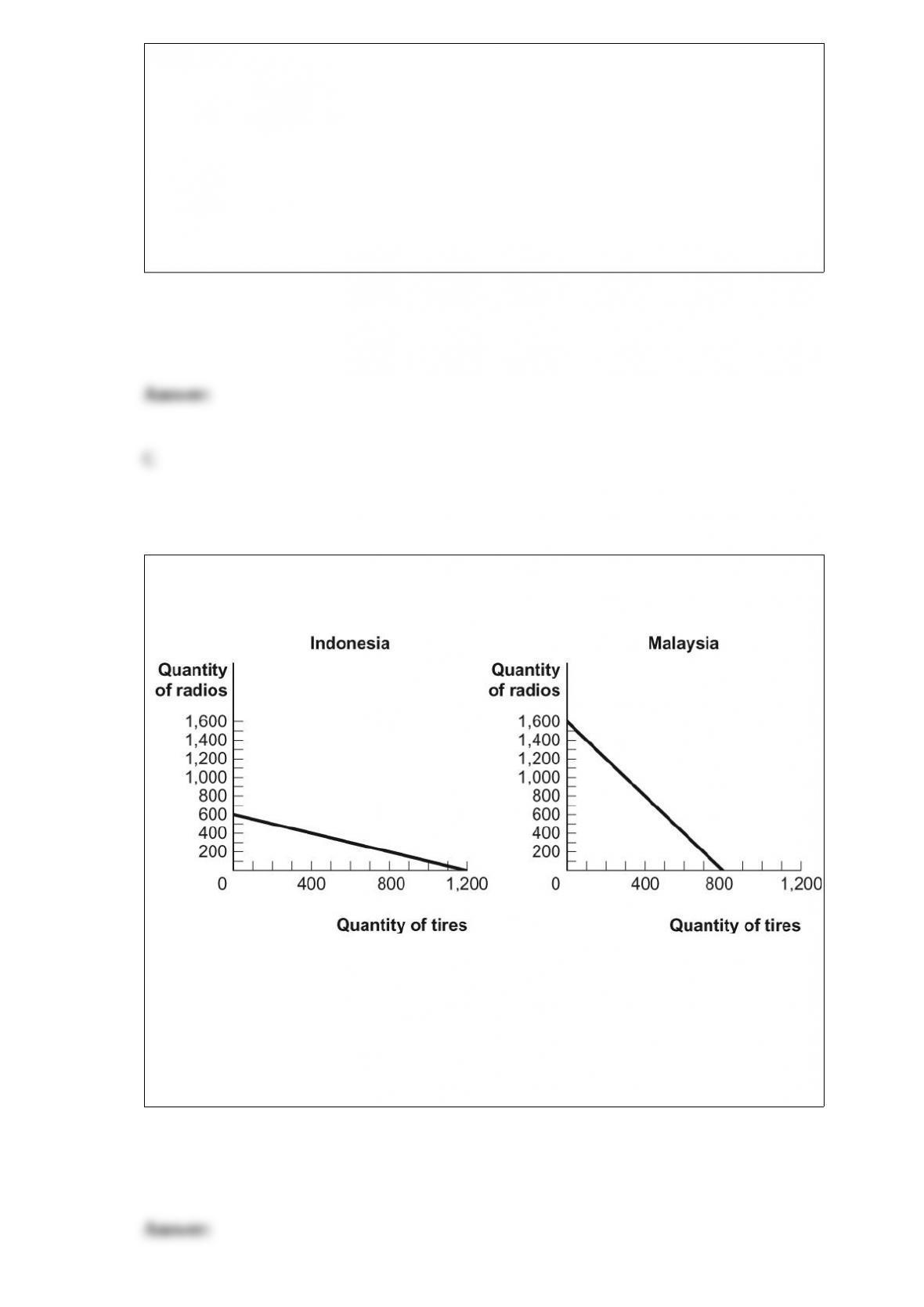
Figure: The Production Possibilities for Two Countries
Look at the figure The Production Possibilities for Two Countries. If Malaysia
specializes completely in the production of the good of its comparative advantage, it
will produce:
A) 800 radios.
B) 1,600 radios.
C) 800 tires.
D) 1,200 tires.
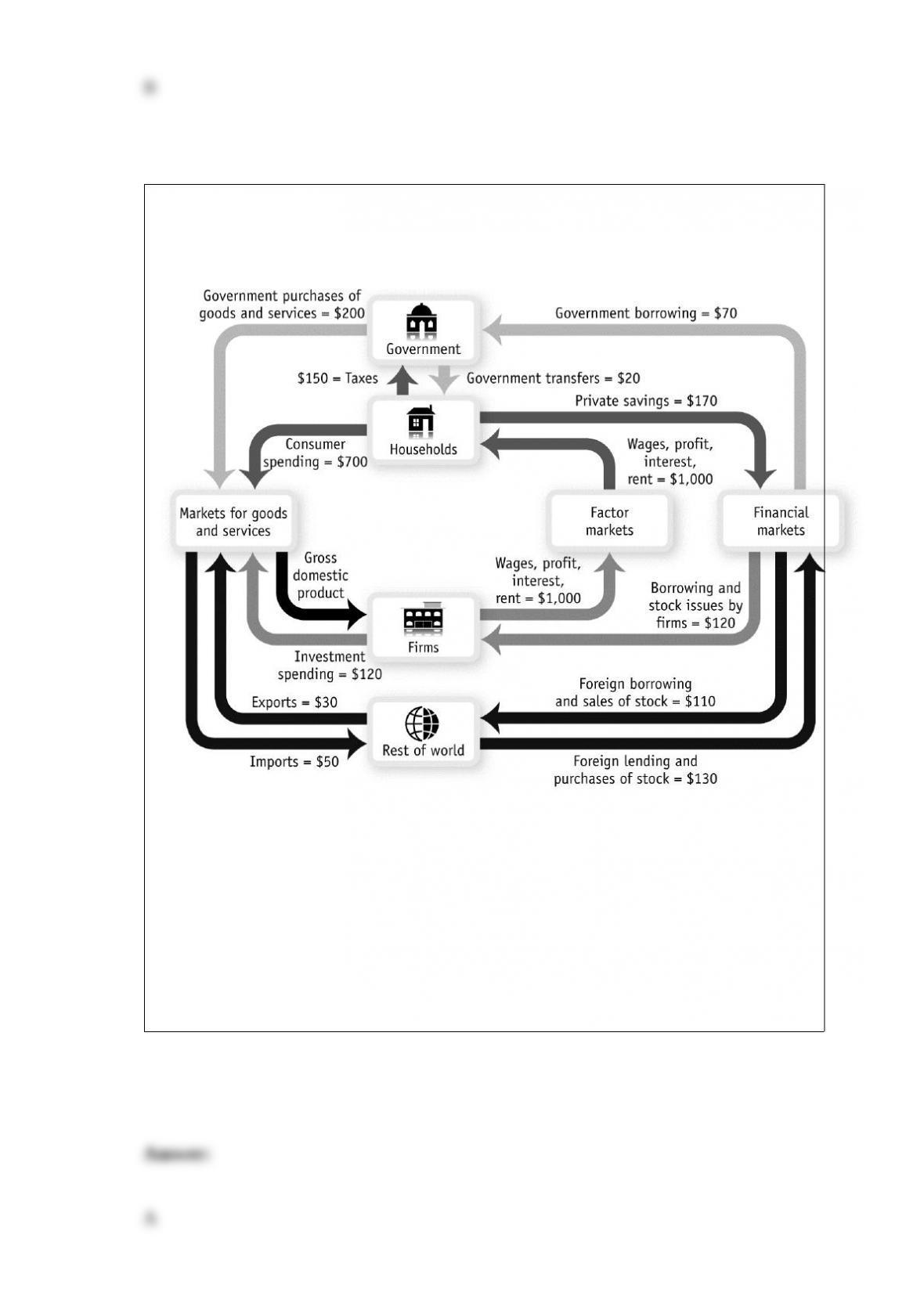
Figure: Expanded Circular-Flow Model
Look at the figure Expanded Circular-Flow Model. What is the value of net exports?
A) “$20
B) $20
C) $50
D) $130

The Fisher effect states that:
A) the nominal rate of interest is unaffected by the change in expected inflation.
B) the nominal rate of interest is unaffected by the change in unexpected inflation.
C) the expected real rate of interest is unaffected by the change in expected inflation.
D) the expected real rate of interest increases by one percentage point for each
percentage change in expected inflation.
A revaluation can help reduce:
I. shortages of domestic currency.
II. surpluses of domestic currency.
A) I only
B) II only
C) I and II
D) neither I nor II

Economists believe that resources should be used as efficiently as possible to:
A) achieve society’s goals.
B) eliminate scarcity.
C) reduce inequity.
D) maximize profits.
Some argue that budget deficits will lead to reduced private spending because:
A) the government will purchase so many goods and services that it will lead to a
shortage of consumer goods and services.
B) budget deficits will reduce interest rates on savings and decrease consumers’ wealth.
C) consumers, anticipating higher taxes, will reduce consumption to save money to pay
the future taxes.
D) the government will have to increase transfer payments to finance the deficit.
As the average age of the labor force increased from the end of the 1970s to the end of
the 1990s, the natural rate of unemployment:
A) increased.
B) decreased.
C) was unaffected.
D) was unpredictable.
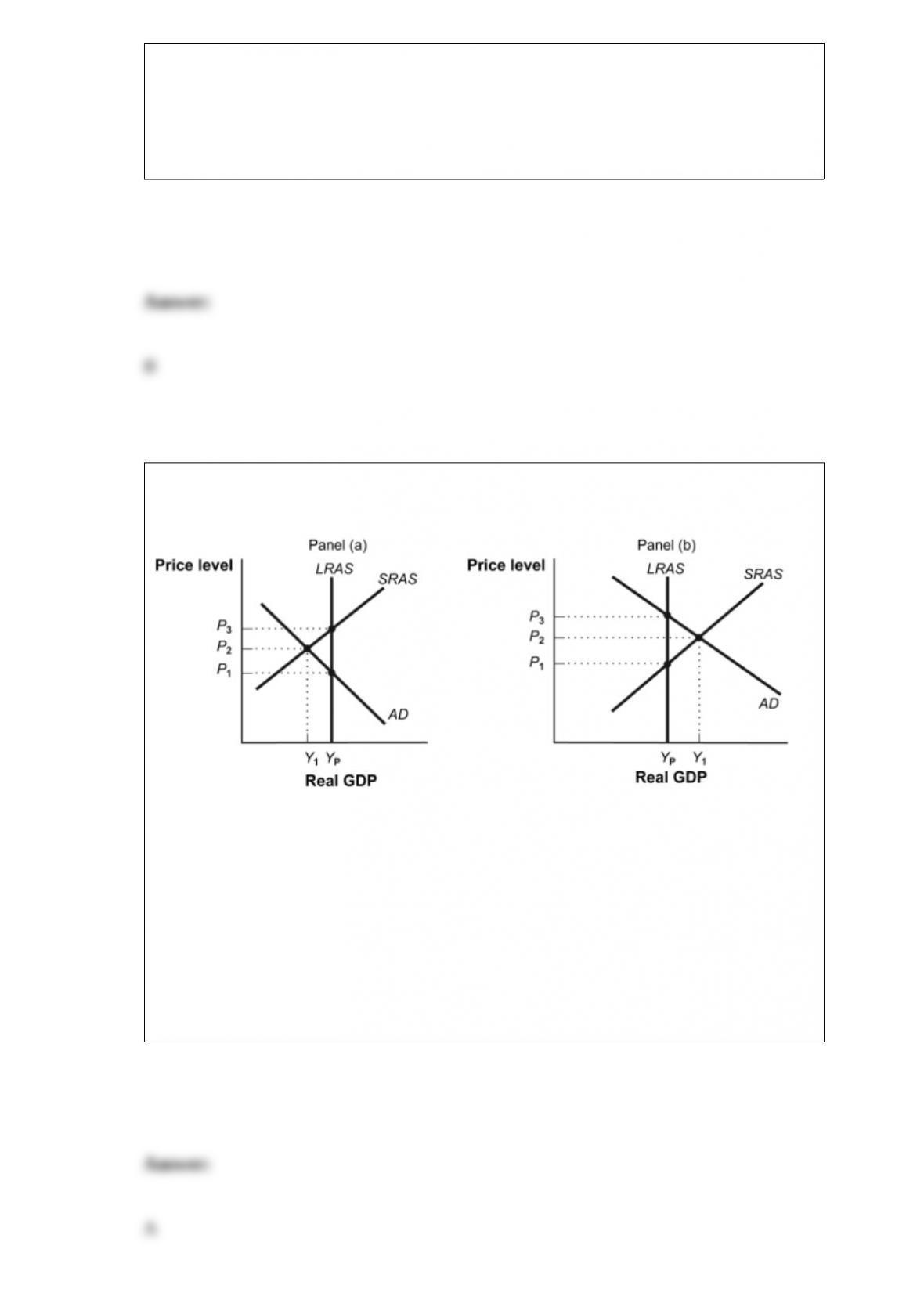
Figure: Inflationary and Recessionary Gaps
Look at the figure Inflationary and Recessionary Gaps. Yp in panel (b):
A) is potential output.
B) indicates a decrease in aggregate demand.
C) indicates a recessionary gap.
D) is associated with considerable unemployment.
Consider each of these forms of investment. Identify whether it is constitutes
investment spending, an investment in physical assets, or a financial investment.
a. You purchase a 1965 Ford Mustang.
b. You buy 50 shares of stock in the Ford Motor Company.
c. Ford Motor Company builds a new plant in Tennessee.
The most important determinant of consumer spending is:
A) the government budget deficit or surplus.
B) the price of gasoline.
C) the trade deficit.
D) disposable income.

Expansionary fiscal policy includes:
A) increasing taxes.
B) increasing the money supply.
C) decreasing government expenditures.
D) increasing government expenditures.