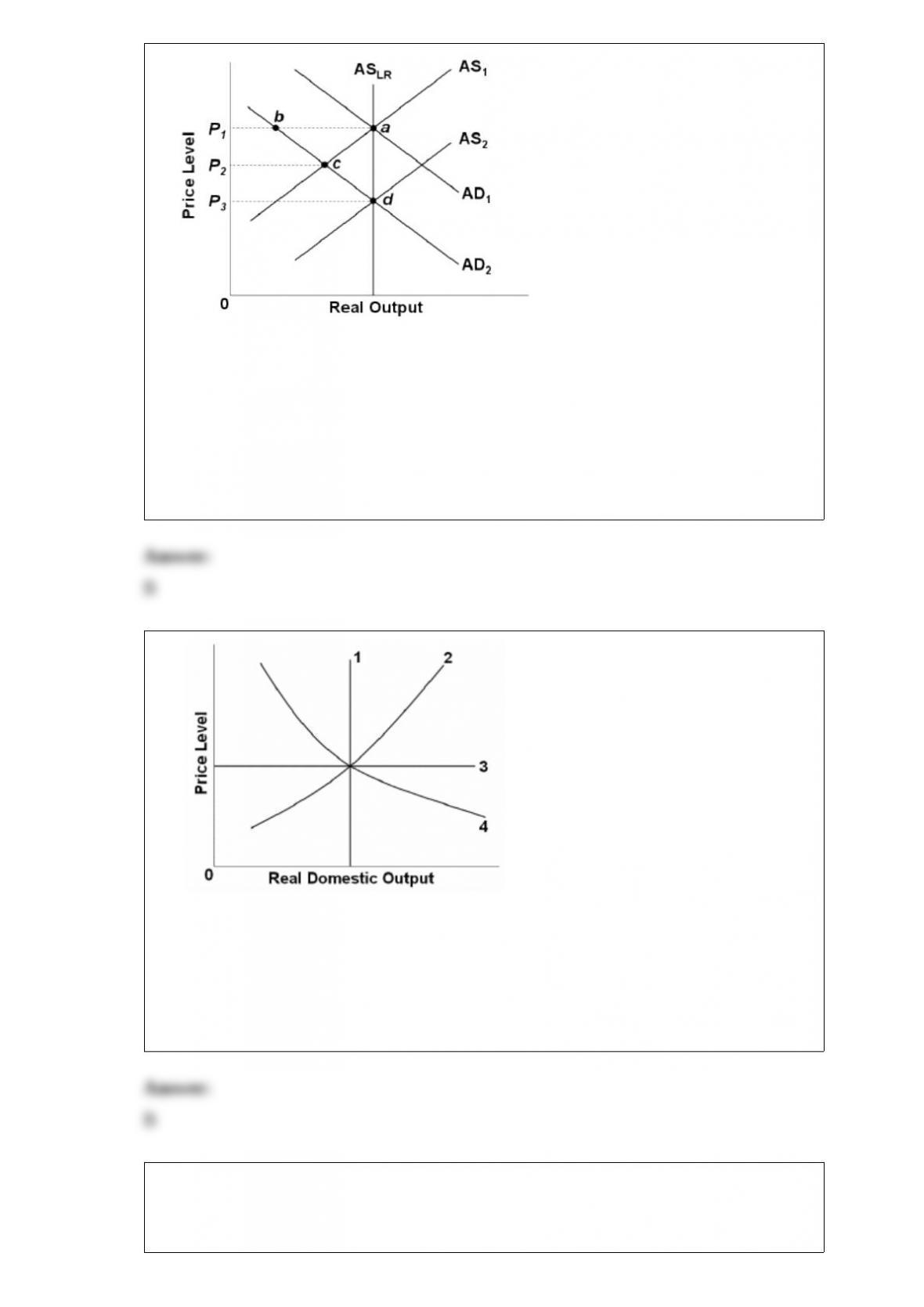
1)
Refer to the above diagram and assume the economy initially is in equilibrium at point
a. Suppose the aggregate demand declines from AD1 to AD2 and the economy moves
from a to c. In the mainstream view, the resulting decline in the price level need not
shift the short-run aggregate supply curve from AS1 to AS2 because:
A.supply creates its own demand.
B.nominal wages are (at least for a time) inflexible downward.
C.firms misperceive the price-level decline as being permanent.
D.deflation reduces the purchasing power of the dollar.
2)
In the above diagram, the economy’s relevant aggregate demand and long-run aggregate
supply curves, respectively, are lines:
A.4 and 2.
B.4 and 1.
C.2 and 4.
D.2 and 3.
3) in a recent policy change, debeers has decided to:
a.sell off its entire inventory of diamonds.
b.abandon its policy of profit maximization.

c.purchase the entire output of other mines and withhold diamonds from the market to
bolster diamond prices.
d.abandon its 66-year policy of trying to monopolize the sale of rough-cut diamonds.
4) Discretionary fiscal policy will stabilize the economy most when:
A.deficits are incurred during recessions and surpluses during inflations.
B.the budget is balanced each year.
C.deficits are incurred during inflations and surpluses during recessions.
D.budget surpluses are continuously incurred.
5) which of the following statements is most accurate about modern economic growth?
a.economic historians mark modern economic growth as beginning around a.d. 1500.
b.modern economic growth is characterized by sustained and ongoing increases in
living standards.
c.modern economic growth has virtually eliminated business cycle fluctuations.
d.modern economic growth has been distributed more or less equally across nations.
6) in performing its stabilization function it may be appropriate for government to:
a.increase both government spending and taxes when the economy is experiencing
rapid inflation.
b.reduce government spending and increase taxes when the economy experiences
substantial unemployment.
c.increase government spending and reduce taxes when the economy experiences rapid
inflation.
d.increase government spending and reduce taxes when the economy experiences
substantial unemployment.
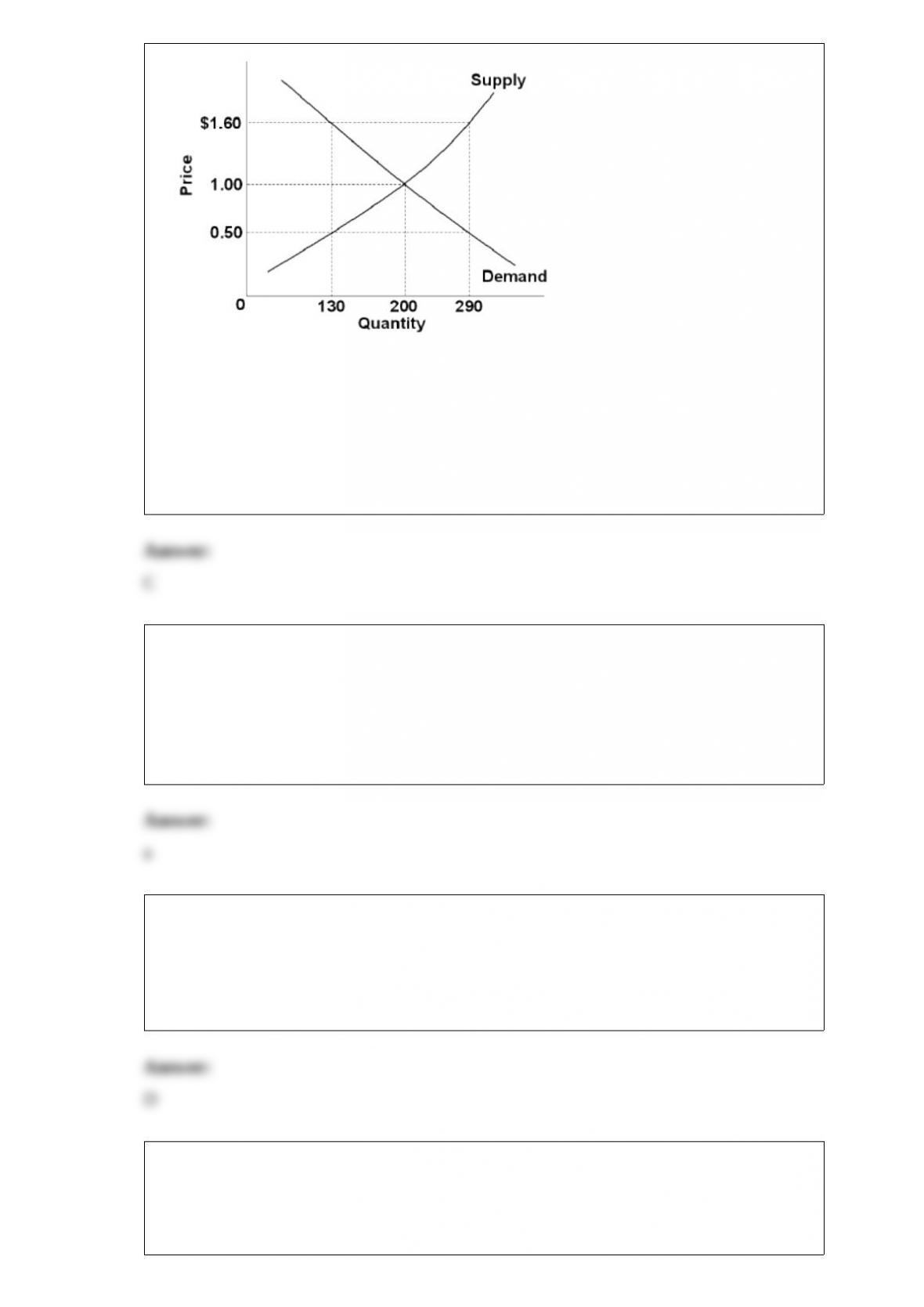
7)
Refer to the above diagram showing the domestic demand and supply curves for a
specific standardized product in a particular nation. If the world price for this product is
$1.60, this nation will experience a domestic:
A.shortage of 160 units, which it will meet with 160 units of imports.
B.shortage of 160 units, which will increase the domestic price to $1.60.
C.surplus of 160 units, which it will export.
D.surplus of 160 units, which will reduce the world price to $1.00.
8) when externalities cause substantial positive benefits for third parties, a competitive
market:
a.underallocates resources to the production of the good.
b.overallocates resources to the production of the good.
c.is allocatively efficient.
d.compensates people for the value of the benefits that these third parties receive.
9) The insider-outsider theory implies that:
A.wages are flexible both upward and downward.
B.unemployment quickly reduces market wages.
C.agents pursue their own agendas, sometimes at the expense of principals.
D.wages may be inflexible downward.
10) the industries or sectors of the economy in which business cycle fluctuations tend to
affect output the most are:
a.military goods and capital goods.
b.services and nondurable consumer goods.
c.clothing and education.
d.capital goods and durable consumer goods.
11) if the number of worker-hours in an economy is 100 and its labor productivity is $5
of output per worker-hour, the economy’s real gdp:
a.is $20.
b.is $500.
c.is $5000.
d.cannot be calculated.
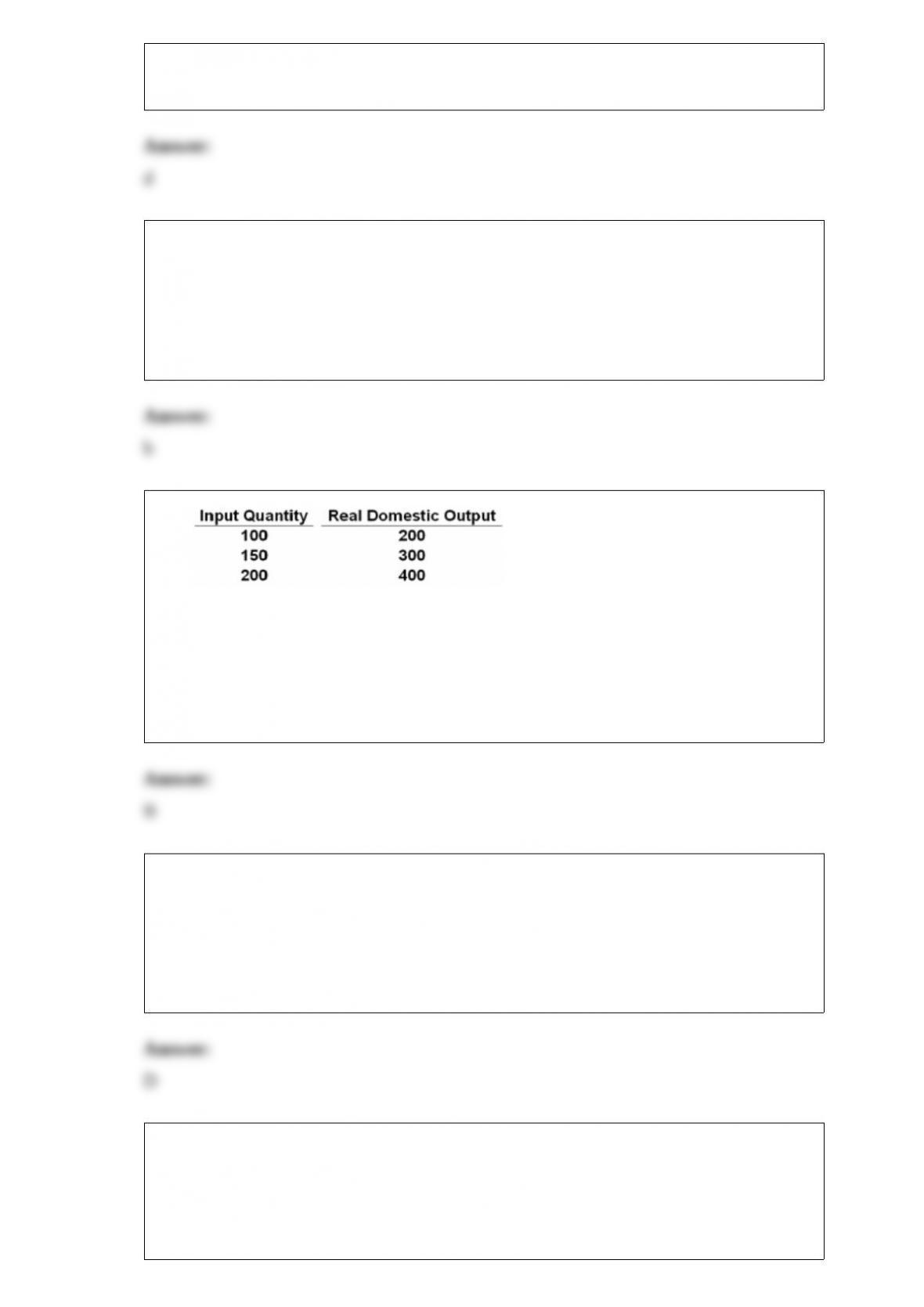
12)
Suppose that the price of each input increased from $5 to $8. The per-unit cost of
production in the above economy would:
A.rise by $1.50 and the aggregate supply curve would shift to the right.
B.rise by 60 percent and the aggregate supply curve would shift to the left.
C.rise by 60 percent and the aggregate demand curve would shift to the left.
D.fall by $1.50 and the aggregate demand curve would shift to the right.
13) Critics of the regulation of natural monopolies contend that:
A.regulation increases the incentive of firms to lower costs.
B.regulated firms may use creative accounting to reduce costs, prices, and profits.
C.when rates of return are based on the value of real capital, an uneconomic
substitution of labor for capital may occur.
D.the industry may “capture” or control the regulatory commission.
14) The cost of not being able to extract and sell a non-renewable resource in the future
(because it is being extracted in the present) is known by natural resource economists as
the:
A.extraction cost.
B.future cost.
C.conservation cost.
D.user cost.
15) Other things equal, if a change in the tastes of American consumers causes them to
purchase more foreign goods at each level of U.S. GDP, then:
A.unemployment will decrease domestically.
B.U.S. GDP will fall.
C.inflation will occur domestically.
D.U.S. real GDP will rise.
16) To say that “the U.S. public debt is also a public credit” is to say that:
A.only interest payments on the public debt are an economic burden.
B.official figures understate the size of the public debt.
C.the bulk of the public debt is owned by U.S. citizens and institutions.
D.the public debt is equal to the land and buildings assets owned by the Federal
government.
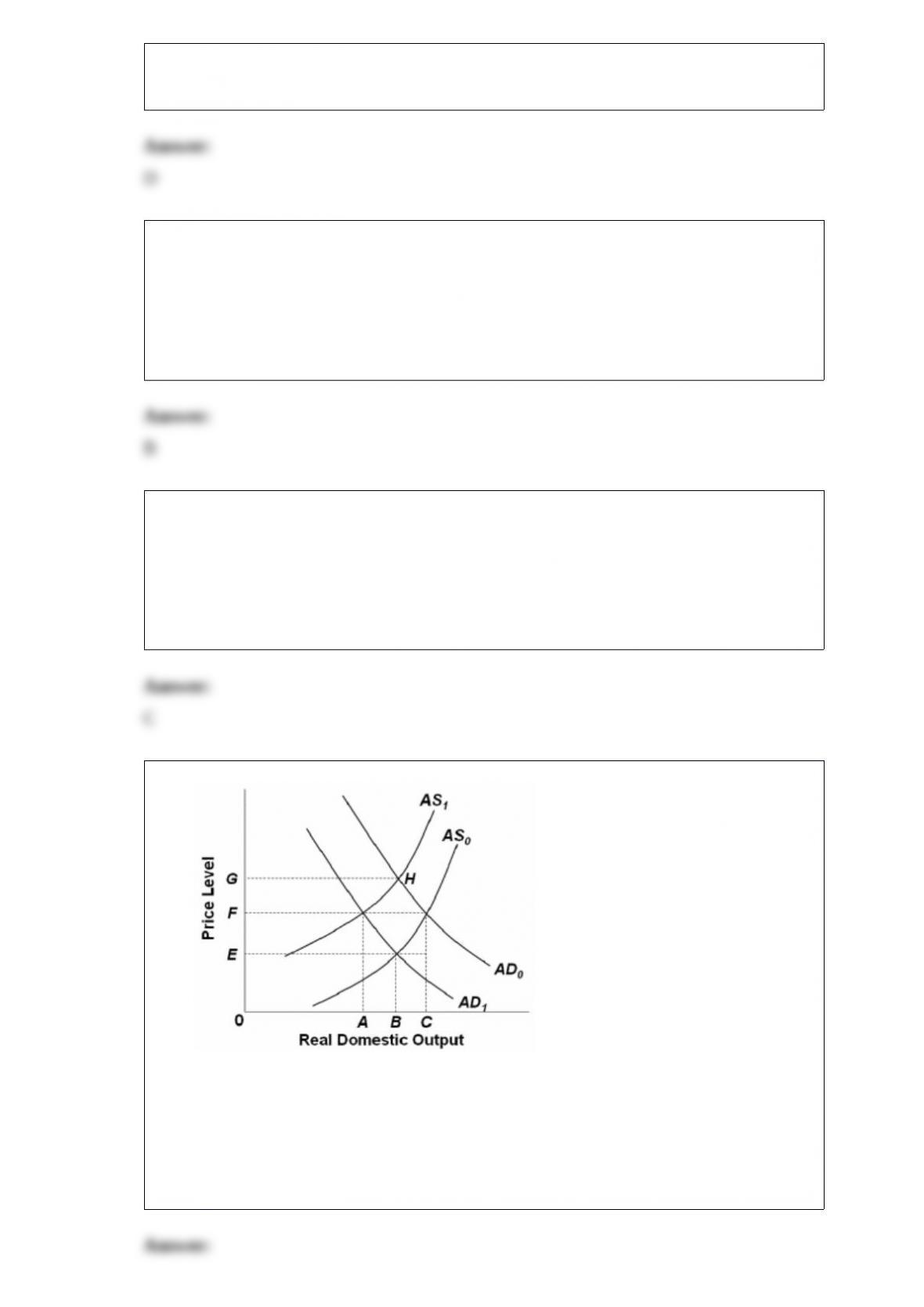
17)
Refer to the above diagram. A shift of the aggregate demand curve from AD1 to AD0
might be caused by a(n):
A.decrease in aggregate supply.
B.decrease in the amount of output supplied.
C.increase in investment spending.
D.decrease in net export spending.

18) competition means that:
a.sellers can manipulate market price by causing product scarcities.
b.there are independently-acting buyers and sellers in each market.
c.a product can be purchased at a number of different prices.
d.there is more than one seller in a market.
19) An adverse aggregate supply shock:
A.automatically shifts the aggregate demand curve rightward.
B.causes the Phillips Curve to shift leftward and downward.
C.can be caused by a boost in the rate of growth of productivity.
D.can cause stagflation.