
If the required reserve ratio is 0.25 and the First National Bank holds $10 million in
demand deposits and $2.5 million in reserves, how much more money is the bank
capable of creating?
a. $0
b. $0.625 million
c. $1.875 million
d. $2.5 million
e. $10 million
The consumption function
a. illustrates the relationship between real disposable income and real consumption
spending
b. illustrates the relationship between the price level and real consumption spending
c. is the relationship between productivity and real consumption spending
d. shows how real consumption increases when real disposable income decreases
e. illustrates the relationship between real consumption spending and employment
Suppose the quantity of bonds demanded exceeds the quantity supplied at a given
interest rate. What will happen to restore equilibrium?
a. Bond prices will increase and the interest rate will rise.
b. Bond prices will decrease and the interest rate will fall.
c. Bond prices will increase and the interest rate will fall.
d. Bond prices will decrease and the interest rate will rise.
e. Bond prices will increase and the interest rate will stay the same, as bond prices are
independent of the interest rate.

The hard-landing scenario begins with
a. a US recession.
b. a decline in foreign demand for US assets.
c. an increase in foreign demand for dollars.
d. an increase in foreign demand for assets.
e. a US expansion.
The expenditure multiplier acts on changes in investment spending, government
purchases, net exports, and autonomous consumption.
Refer to Figure 14-1. If the economy is currently at point X, a decrease in the interest
rate will
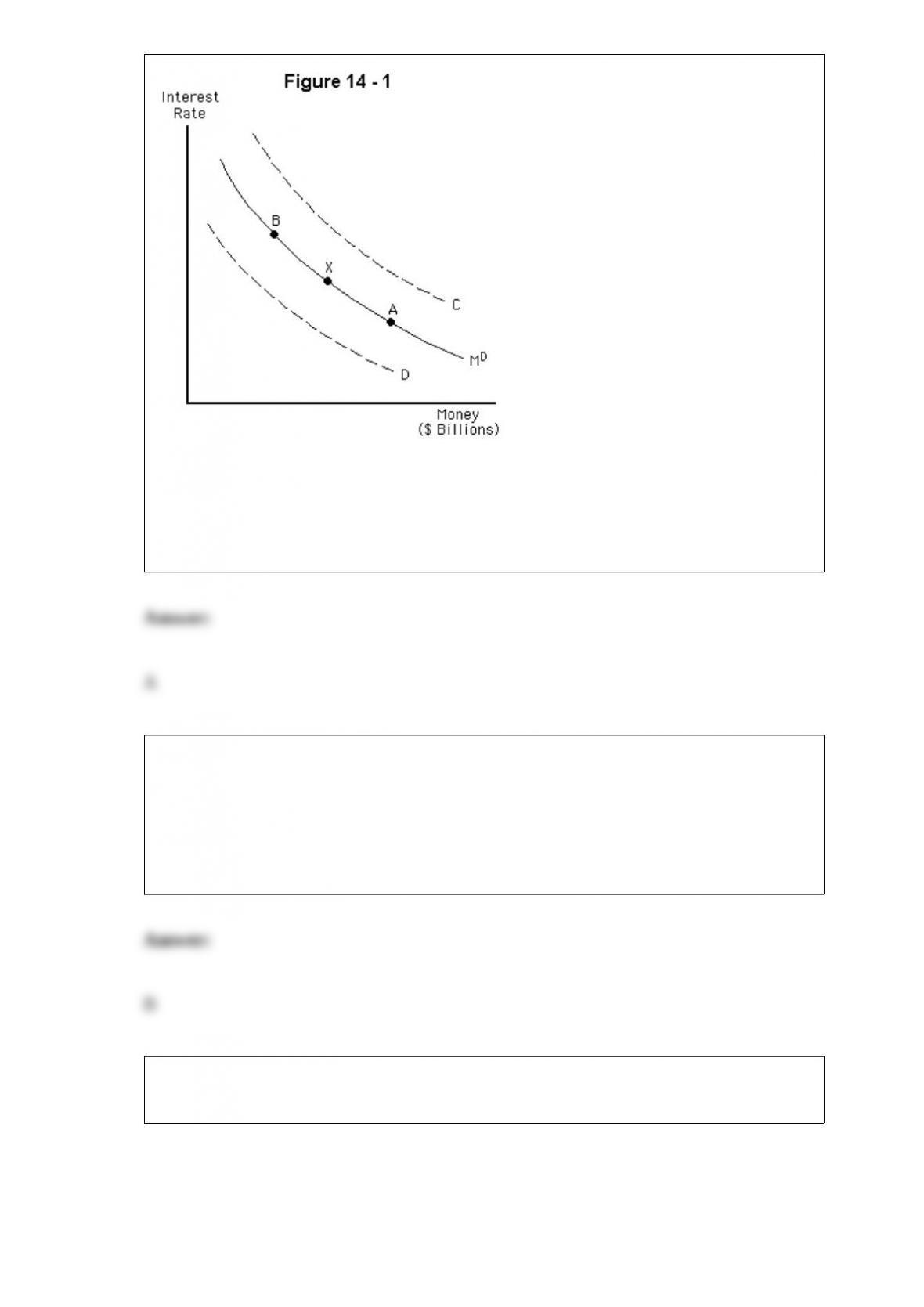
a. increase the quantity of money demanded (moving the economy toward point A)
b. decrease the quantity of money demanded (moving the economy toward point B)
c. increase money demand (shifting the curve toward curve C)
d. decrease money demand (shifting the curve toward curve D)
e. leave the economy at point X
Which of the following is not a function of the Federal Reserve System?
a. Setting the required reserve ratio
b. Establishing the prime lending rate
c. Clearing checks
d. Regulating banking activity
e. Controlling the money supply.
Refer to Figure 14-1. If the economy is currently at point X, an increase in the interest
rate will
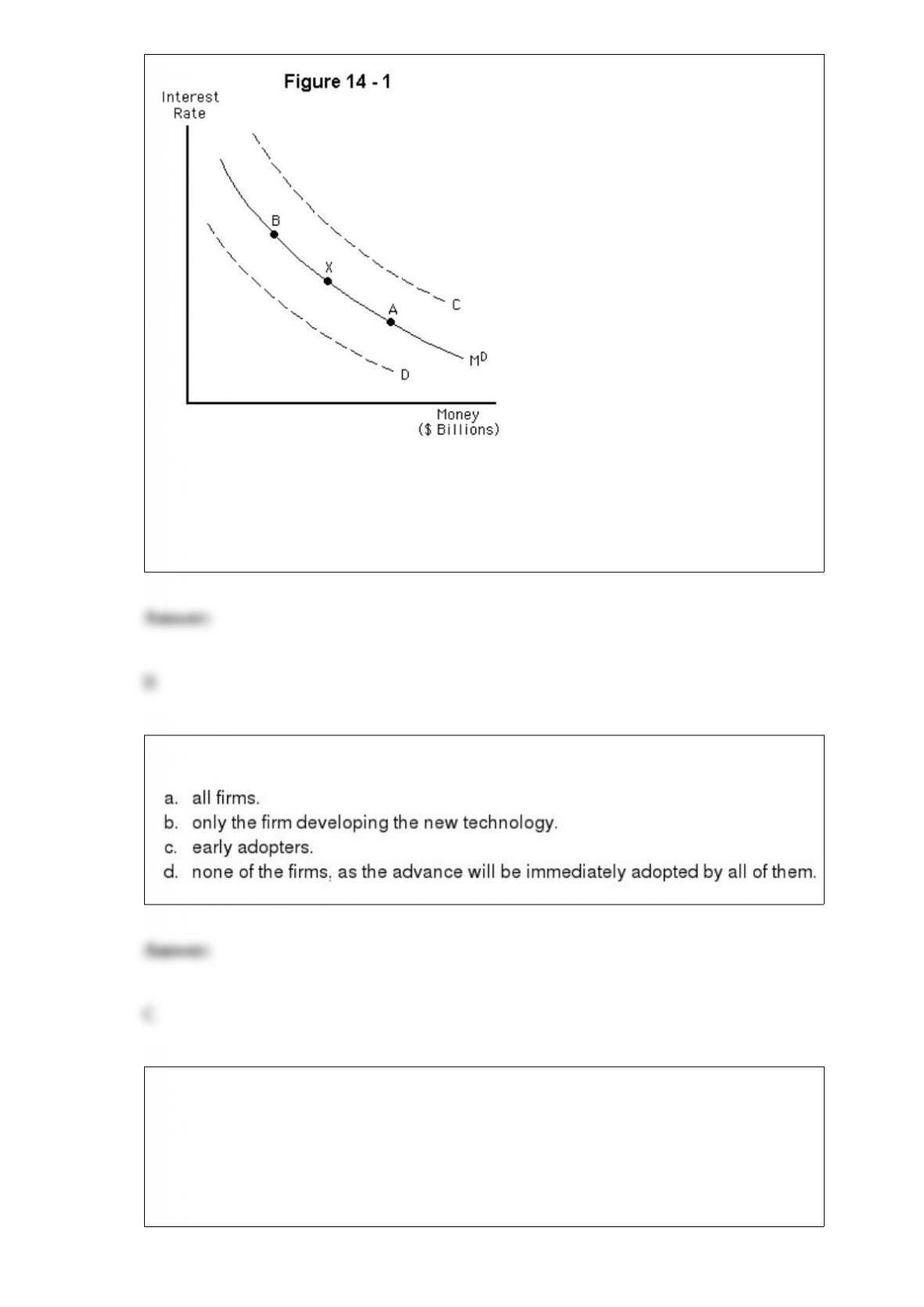
a. increase the quantity of money demanded (moving the economy toward point A)
b. decrease the quantity of money demanded (moving the economy toward point B)
c. increase money demand (shifting the curve toward curve C)
d. decrease money demand (shifting the curve toward curve D)
e. leave the economy at point X
In perfect competition, technological advances will allow economic profits for
International trade
a. reduces world output of goods and services
b. lowers economic efficiency
c. allows countries to specialize in producing particular products
d. creates opportunity cost differentials in production
e. shifts each economy’s production possibilities frontier inward

Investment, as defined for calculating GDP, consists of only two components: business
spending on plant and equipment and unsold inventories.
If there is a sudden increase in government spending, which of the following should the
Fed do if it wants to keep output unchanged?
a. Do nothing, since the self-correcting mechanism will adjust the economy
b. Sell bonds in the open market
c. Wait, since output usually does not change when government spending increases
d. Decrease the required reserve ratio
e. Buy bonds in the open market
If the interest rate is above its equilibrium value, the price of
a. bonds will fall
b. real estate will rise
c. bonds will rise
d. stocks will fall because of fluctuations in the bond market
e. money will rise
The Fed does not try to reduce frictional unemployment because it
a. is easier to eliminate with fiscal policy
b. is not a serious social problem
c. has microeconomic solutions
d. signals a strong economy
e. rarely exceeds a 1 percent rate
In the 1970s and 1980s policies that required retirement of people over age 65 were
repealed. Which variable would this directly affect?
a. The employment-population ratio
b. Productivity
c. Average hours
d. Population
e. Technology
In the factor payments approach to GDP, owners of capital receive
a. wages
b. salaries
c. rent
d. interest
e. profit
If demand is price inelastic,

If prices (as measured by the CPI) fell by one-half and nominal wages fell by one-third,
what would happen to real wages?
a. They would fall by one-third
b. They would remain unchanged
c. They would decrease
d. They would increase
e. They would fall by one-half