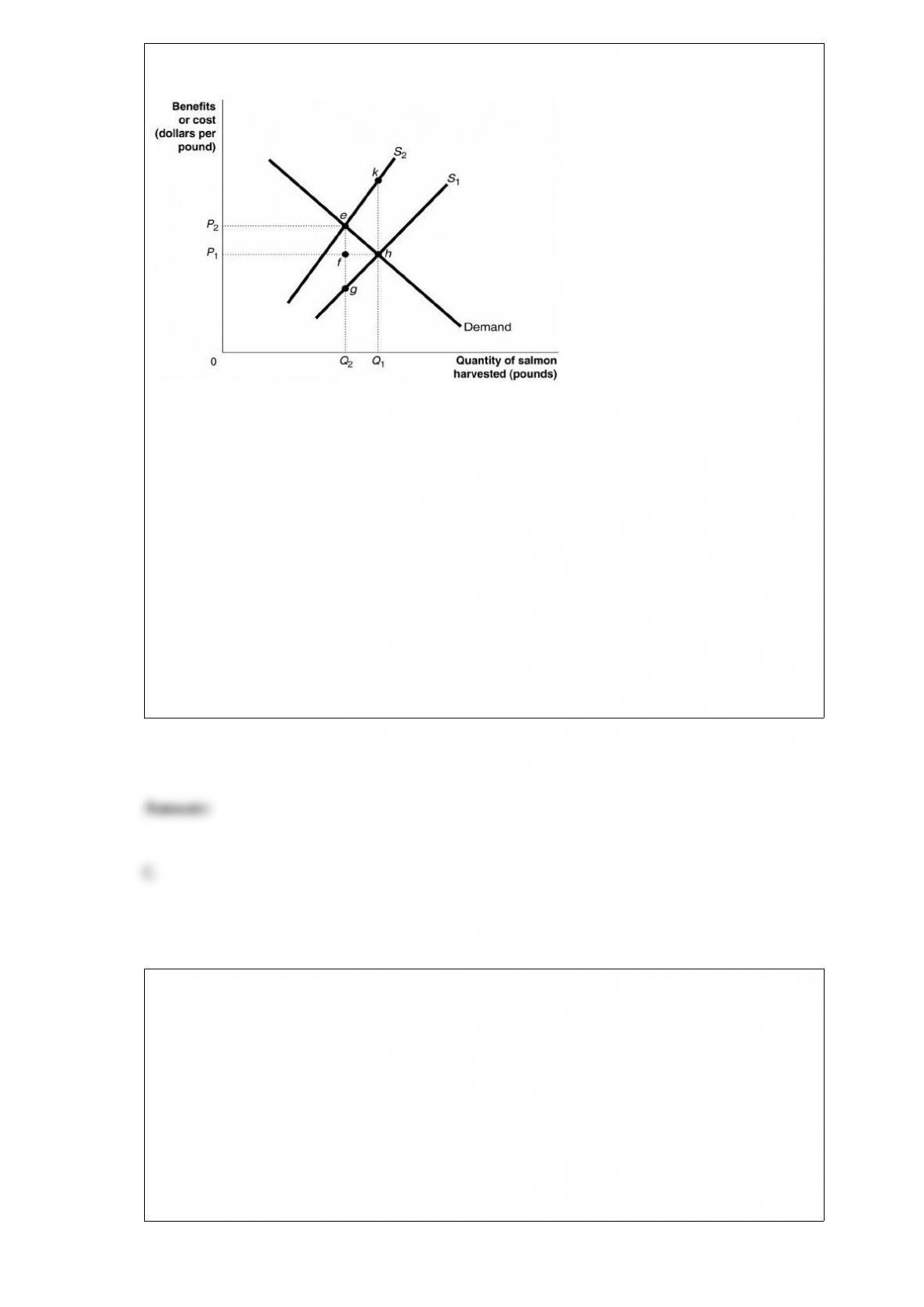
Figure 5-15
Figure 5-15 shows the market for
Atlantic salmon, a common resource. The current market equilibrium output of Q1 is
not the economically efficient output. The economically efficient output is Q2.
The current market equilibrium output is partly the result of overfishing. In that case,
what does S1 represent?
A) the private marginal benefit of harvesting salmon
B) the social marginal benefit of harvesting salmon
C) the private marginal cost of harvesting salmon
D) the social marginal cost of harvesting salmon
The health care system in ________ is referred to as socialized medicine, under which
the government owns most of the hospitals and employs most of the doctors.
A) Canada
B) Japan
C) the United Kingdom
D) the United States
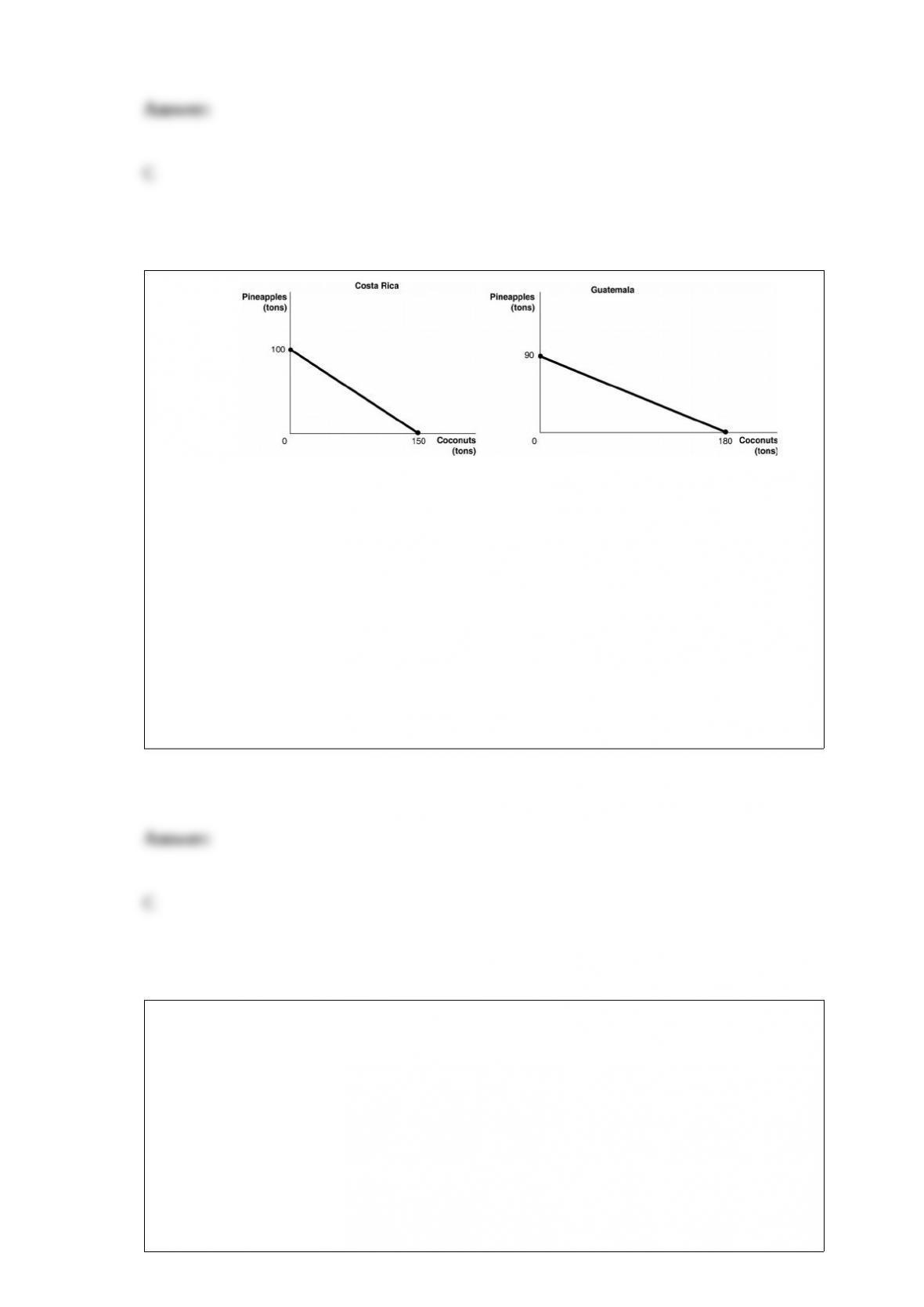
Figure 2-8
Figure 2-8 shows the production possibilities frontiers for Costa Rica and Guatemala.
Each country produces two goods, pineapples and coconuts.
What is the opportunity cost of producing 1 ton of pineapples in Costa Rica?
A) 3/8 of a ton of coconuts
B) 2/3 of a ton of coconuts
C) 1 1/2 tons of coconuts
D) 100 tons of coconuts
Assume the United States is the “domestic” country and Switzerland is the “foreign”
country. Which of the following might decrease the real exchange rate between the
United States and Switzerland?
A) a depreciation of the franc
B) an appreciation of the dollar
C) a decrease in the price level in the United States

D) a decrease in the price level in Switzerland
Electric car enthusiasts want to buy more electric cars at a lower price. All of the
following events would have this effect except
A) technological advancement in the production of electric car batteries.
B) an increase in the number of manufacturers of electric cars.
C) a decrease in the price of lithium, which is used in the electric car batteries.
D) an increase in the price of gasoline.
A nonmonetary opportunity cost is called a(n) ________, while a cost that involves
spending money is called an ________.
A) accounting cost; explicit cost
B) implicit cost; explicit cost
C) accounting profit; economic profit
D) normal rate of return; asset
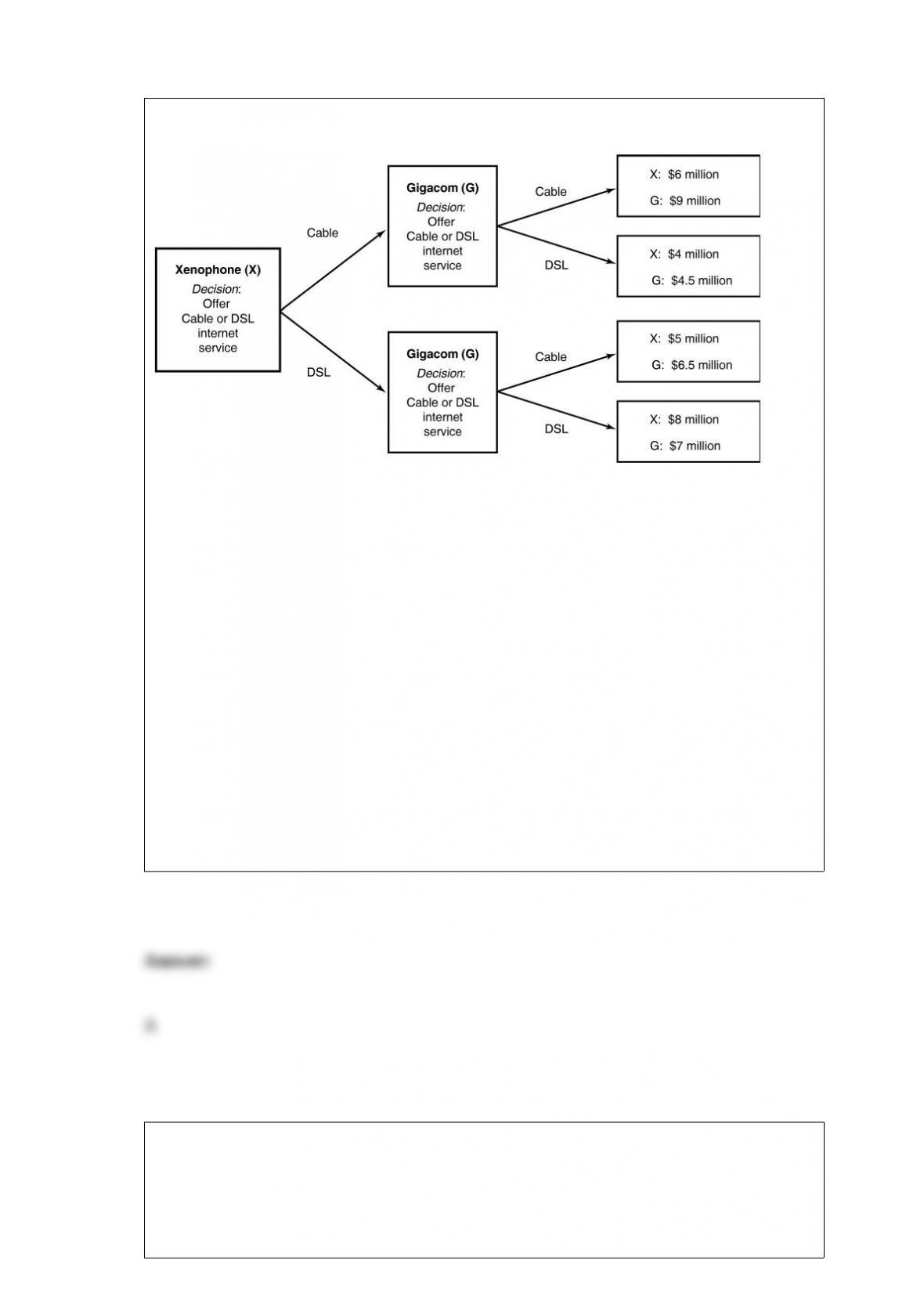
Figure 14-2
The
government of a developing country plans to award two firms, Gigacom and
Xenophone, the exclusive rights to share the market for high speed internet service.
Gigacom and Xenophone can both provide the service either via television cable lines
or via direct subscriber line (DSL). Suppose the government is considering a proposal
to delay one firm’s entry into the market on the grounds that it wants to prevent
“harmful” competition. Figure 14-2 shows the decision tree for this game. If the
government delays Gigacom’s entry and Xenophone moves first, is a threat by Gigacom
that it will provide DSL service if Gigacom provides cable service a credible threat?
A) No, because Gigacom will lose $4.5 million in profits if it carries out its threat.
B) Yes, because Gigacom’s DSL service will drive Xenophone out of business.
C) No, because as a second mover, it has no choice but to abide by the choices of the
first mover.
D) Yes, Xenophone stands to lose $3 million in profit.
Which of the following is nota reason why government officials are willing to impose
entry barriers?
A) to raise revenue

B) to encourage innovation which may improve the standard of living in the long run
C) to increase economic efficiency
D) to promote an equitable distribution of income
Assume a hypothetical case where an industry begins as perfectly competitive and then
becomes a monopoly. As a result of this change,
A) price will be higher, output will be lower and the deadweight loss will be eliminated.
B) consumer surplus will be smaller, producer surplus will be greater and there will be a
reduction in economic efficiency.
C) price will be higher, consumer surplus will be greater and output will be greater.
D) consumer surplus will be smaller and producer surplus will be greater. There will be
a net increase in economic surplus.
Consumption spending is $5 million, planned investment spending is $8 million,
unplanned investment
spending is -$2 million, government purchases are $10 million, and net export spending
is $2 million. What is GDP?
A) $15 million
B) $23 million
C) $25 million

D) $27 million
The money demand curve has a
A) negative slope because an increase in the interest rate decreases the quantity of
money demanded.
B) positive slope because an increase in the interest rate increases the quantity of
money demanded.
C) negative slope because an increase in the price level decreases the quantity of money
demanded.
D) positive slope because an increase in the price level increases the quantity of money
demanded.
As a firm moves to higher isocost lines
A) its profits increase.
B) its revenue increases.
C) its input price ratio increases.
D) its total cost increases.

Which of the following is not a result of imposing a rent ceiling?
A) Some consumer surplus is converted to producer surplus.
B) There is a reduction in the quantity supplied of apartments.
C) There is an increase in the quantity demanded of apartments.
D) The marginal benefit of the last apartment rented is greater than the marginal cost of
supplying it.
The cross-price elasticity of demand between an unlimited texting option and an
unlimited call minutes option offered from a cell phone provider would be
A) positive if subscribers consider the services substitutes for each other.
B) positive if subscribers consider the services complements to each other.
C) negative if subscribers consider the services substitutes for each other.
D) negative no matter if subscribers consider the services substitutes or complements
for each other.
The process of countries becoming more open to foreign trade and investment is known
as
A) autarky.
B) foreign exchange.
C) globalization.
D) protectionism.
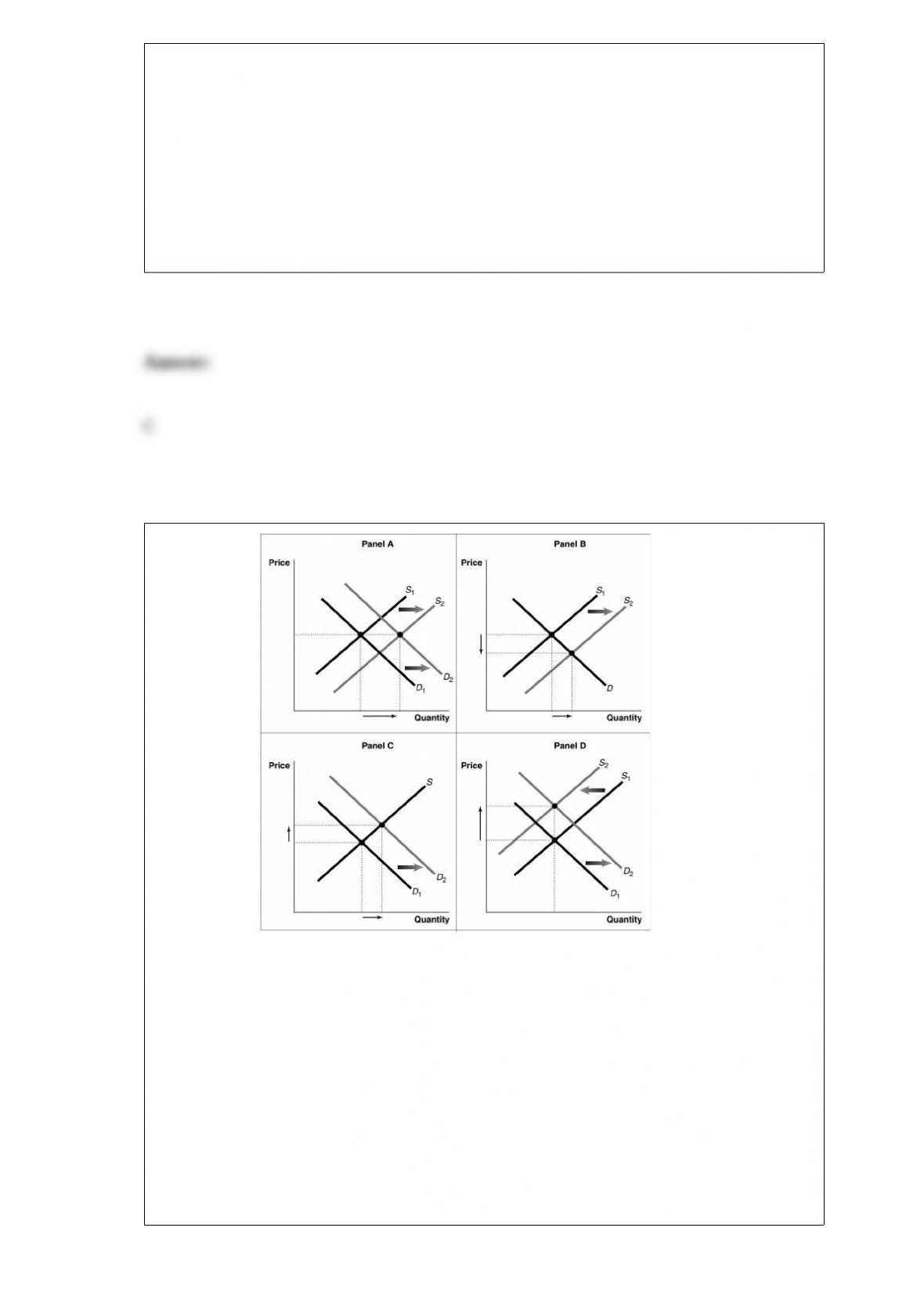
Figure 12-16
Which panel best represents the perfectly competitive organic produce market in which
some firms are experiencing short-run losses, and consumers are displaying an
increased preference for organic produce?
A) Panel A
B) Panel B
C) Panel C
D) Panel D

If you want to know the present value of $10,000 received in one year, and the interest
rate is 4 percent, what formula can you use?
A) Present value equals $10,000 times 0.04.
B) Present value equals $10,000 divided by 1.04
C) Present value equals 1.04 divided by $10,000.
D) Present value equals $10,000 times 1.04.