
1) The theory of rational expectations concludes that:
A.the public’s expectations can influence the outcome of monetary policy, but not of
fiscal policy.
B.the public’s expectations can influence the outcome of fiscal policy, but not of
monetary policy.
C.the public’s expectations as to the effects of economic policies tends to reinforce the
effectiveness of those policies.
D.by reacting in its self-interest to the expected effects of stabilization policy, the public
tends to negate the impact of those policies.
2) Which of the following have substantially equivalent effects on a nation’s volume of
exports and imports?
A.exchange rate appreciation and a decrease in the domestic supply of money
B.exchange rate appreciation and domestic deflation
C.exchange rate depreciation and domestic deflation
D.exchange rate depreciation and domestic inflation
3) approximately what percentage of u.s. consumer spending was for durable goods in
2007?
a.11%
b.24%
c.29%
d.60%
4) The asset demand for money:
A.is unrelated to both the interest rate and the level of GDP.
B.varies inversely with the rate of interest.
C.varies inversely with the level of real GDP.
D.varies directly with the level of nominal GDP.
5) Investment and saving are, respectively:
A.income and wealth.
B.stocks and flows.

C.injections and leakages.
D.leakages and injections.
6) answer the next question(s) on the basis of the following information: only three
goods are produced in an economy in the following amounts: a = 10, b = 30, c = 5. the
current year per unit prices of these three goods are a = $2, b = $3, and c = $1.
(advanced analysis) refer to the above information. if the per unit prices of the three
goods each were $1 in a base year used to construct a gdp price index, then real gdp in
the current year is:
a.$110.
b.$115.
c.$45.
d.$160.
7) a market-based system of buying and selling human organs for transplant would:
a.reduce total health care spending.
b.create a surplus of organs.
c.increase the quantity of organs available for transplant.
d.reduce the price of organs.
8) The substitution effect indicates that a profit-seeking firm will use:
A.more of an input whose price has fallen and less of other inputs in producing a given
output.
B.more of all inputs if production costs fall.
C.more of those inputs whose marginal productivity is the greatest.
D.less of an input whose price has fallen and more of other inputs in producing a given
output.
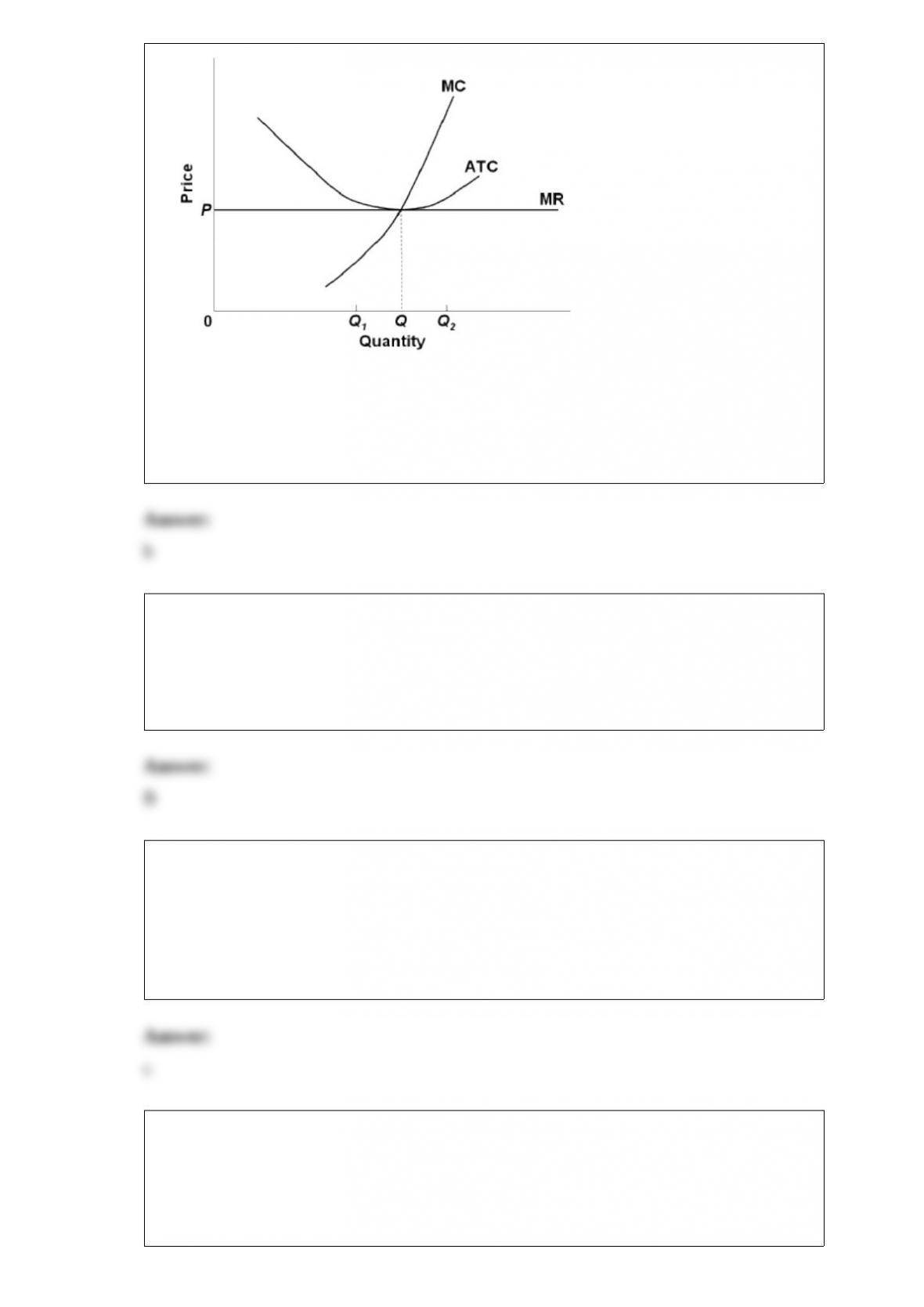
9)
refer to the above diagram. by producing output level q:
a.neither productive nor allocative efficiency are achieved.
b.both productive and allocative efficiency are achieved.
c.allocative efficiency is achieved, but productive efficiency is not.
d.productive efficiency is achieved, but allocative efficiency is not.
10) (Consider This) The “lemon” problem associated with the market for used cars:
A.results from asymmetric information and the moral hazard problem.
B.results from asymmetric information and adverse selection.
C.is an example of the Coase theorem at work.
D.in an example of a spillover benefit.
11) a nation’s production possibilities curve might shift to the left (inward) as a result
of:
a.technological advance.
b.increases in the size of the labor force.
c.the depletion of its soil fertility due to overplanting and overgrazing.
d.investing in more capital goods.
12) Suppose that friends Jennifer, Stephanie, and Megan cannot agree on how much to
spend for a bouquet of flowers to send to a person that allowed them to use their beach
house for the weekend. Jennifer want to buy a moderately priced bouquet, Stephanie
wants to buy an expensive bouquet, and Megan wants to buy a very expensive bouquet.
Assuming no paradox of voting, majority voting will result in decision to buy:
A.an inexpensive bouquet.
B.a very expensive bouquet.
C.a moderately priced bouquet.
D.an expensive bouquet.
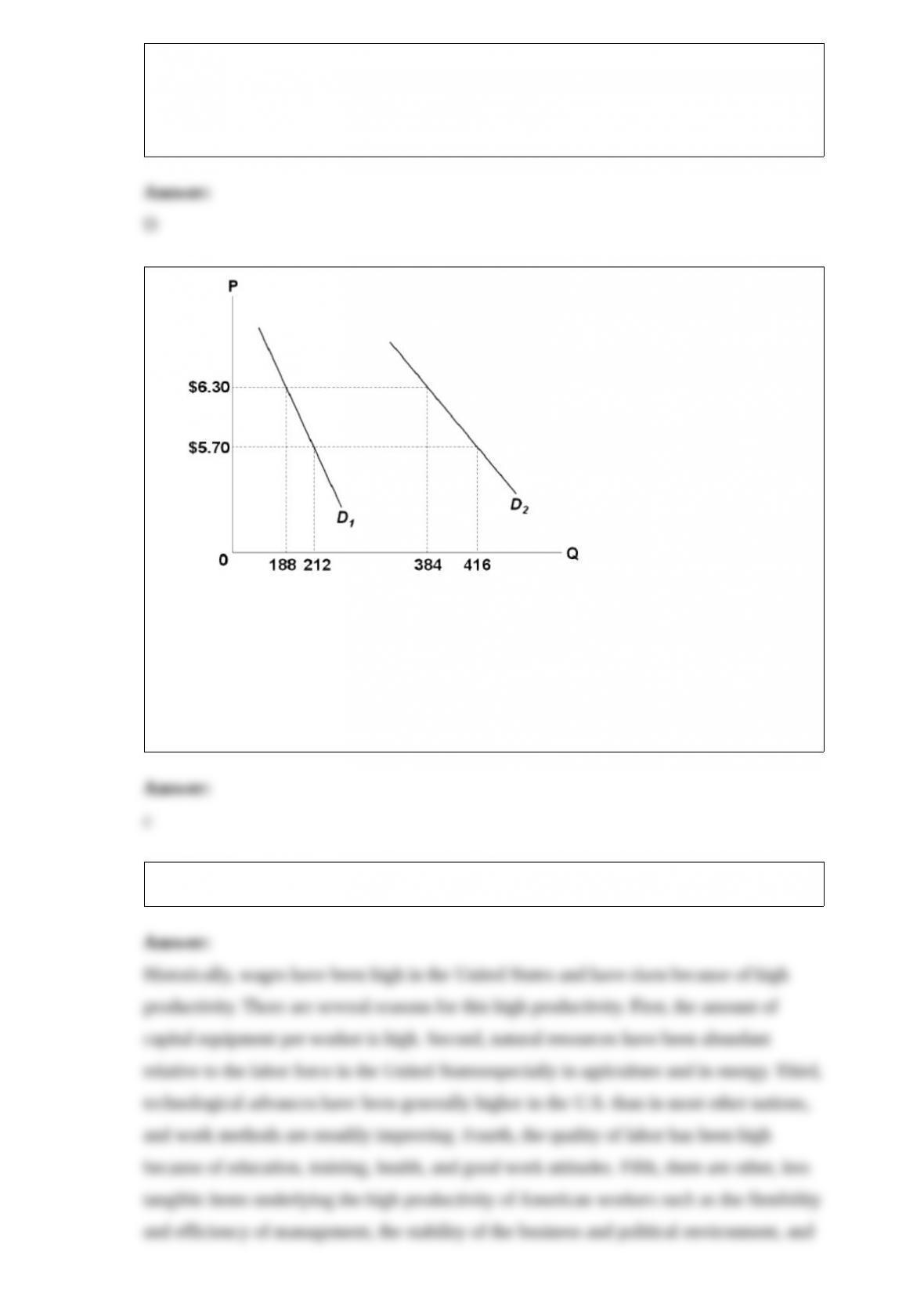
13)
refer to the above diagram and assume a single good. if the price of the good increased
from $5.70 to $6.30 along d1, the price elasticity of demand along this portion of the
demand curve would be:
a.0.8.
b.1.0.
c.1.2.
d.2.0.
14) What factors explain the high level of level of productivity in the United States?

15) (Consider This) Why do small differences in the rate of economic growth produce
large differences in the size of the economy over time? Illustrate with an example.
16) How does NDP differ from GDP?
17) If the population is 267 million, the labor force is 136 million, and the number
measured as unemployed is 6.8 million, what is the rate of unemployment?
18) How does the trading of pollution rights work in the Clean Air Act of 1990?

19) Compare the factors that will cause shifts in the downsloping resource demand and
product demand curves.
20) What is the investment-demand curve?
21) How is a price index computed?

22) (Consider This) How was the practice of clipping coins during feudalism
contributing to inflation? Who benefited from this inflation?