
1) To maximize its profit, a monopolistically competitive firm
a.takes the price as given and chooses its quantity, just as a competitive firm does.
b.takes the price as given and chooses its quantity, just as a colluding oligopolist does.
c.chooses its quantity and price, just as a competitive firm does.
d.chooses its quantity and price, just as a monopoly does.
2) Which of the following statements is correct?
a.Neither economic theory nor evidence from the U.S. economy suggests that there is a
close link between productivity and real wages.
b.Economic theory suggests that there is a close link between productivity and real
wages, but evidence from the U.S. economy fails to confirm that link.
c.Evidence from the U.S. economy suggests a close link between productivity and real
wages, but economic theory provides no basis for such a link.
d.Both economic theory and evidence from the U.S. economy suggest that there is a
close link between productivity and real wages.
3) Which of the following is not an argument made by critics of advertising?
a.Advertising manipulates people’s tastes.
b.Advertising impedes competition.
c.Advertising promotes economies of scale.
d.Advertising increases the perception of product differentiation.
4) Assume the supply curve for cigars is a typical, upward-sloping straight line, and the
demand curve for cigars is a typical, downward-sloping straight line. Suppose the
equilibrium quantity in the market for cigars is 1,000 per month when there is no tax.
Then a tax of $0.50 per cigar is imposed. The effective price paid by buyers increases
from
$1.50 to $1.90 and the effective price received by sellers falls from $1.50 to $1.40. The
government’s tax revenue amounts to $475 per month. Which of the following
statements is correct?
a.The demand for cigars is less elastic than the supply of cigars.
b.The tax causes a decrease in consumer surplus of $390 and a decrease in producer
surplus of $97.50.
c.The deadweight loss of the tax is $12.50.
d.All of the above are correct.
5) Economic profit is greater than or equal to accounting profit.
a.True
b.False
6) For economists, historical episodes
a.are not worthy of study because they offer few insights into current economic events
and problems.
b.are not worthy of study because laboratory experiments provide more reliable data.
c.are worthy of study because economists rely entirely on observation, rather than on
theory.
d.are worthy of study because they serve as valuable substitutes for laboratory
experiments.
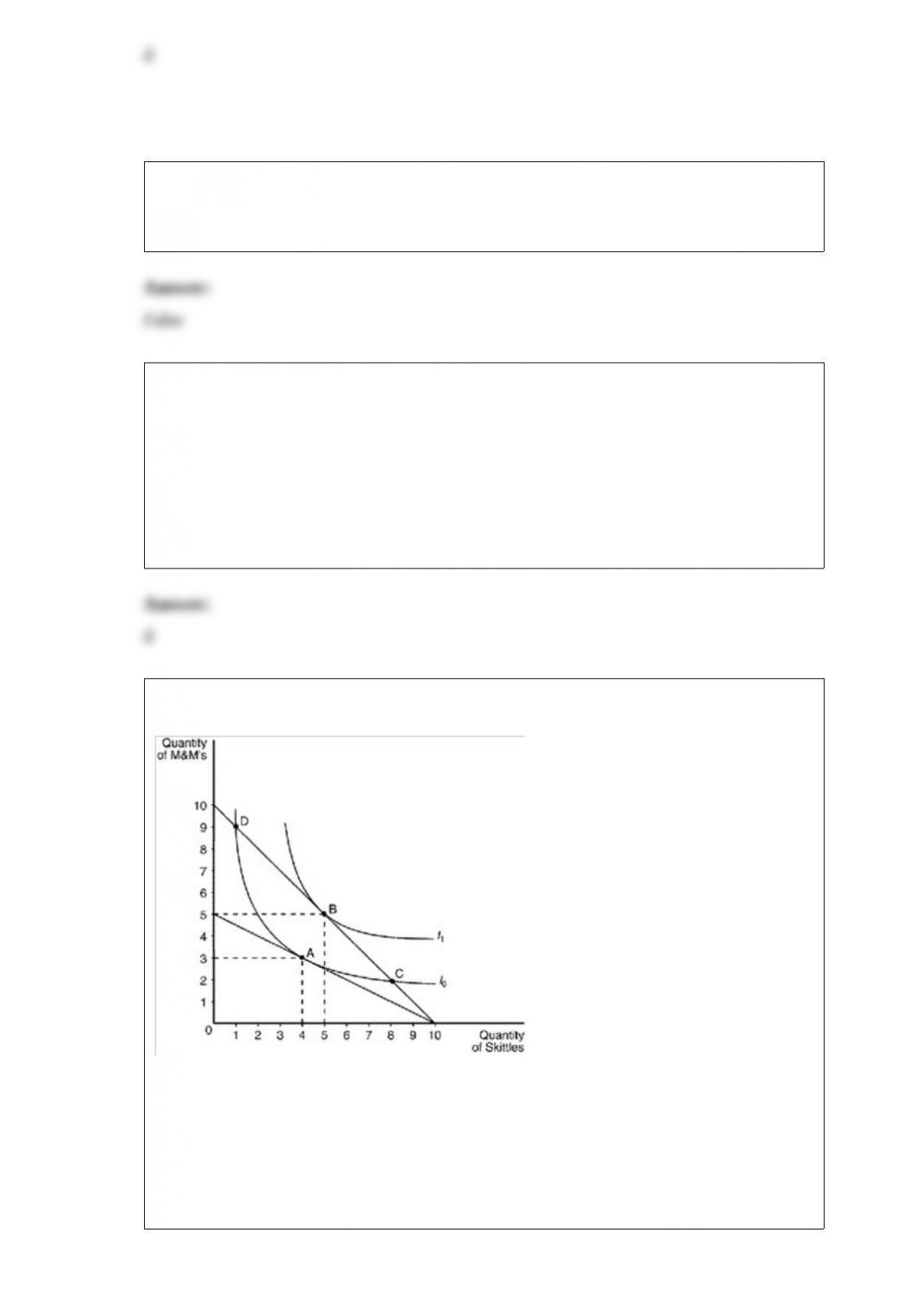
7) Figure 21-19
Refer to Figure 21-19. Assume that the consumer depicted in the figure faces prices and
income such that she optimizes at point B. According to the graph, which of the
following would cause the consumer to move to point A?
a.a decrease in the price of Skittles
b.a decrease in the price of M&M’s
c.an increase in the price of Skittles
d.an increase in the price of M&M’s
8) Rick goes to work 8 hours per day, but while he is at work he spends most of his time
visiting internet sites monitoring his fantasy football teams. This is an example of
a.the Condorcet Paradox.
b.signaling.
c.moral hazard.
d.screening.
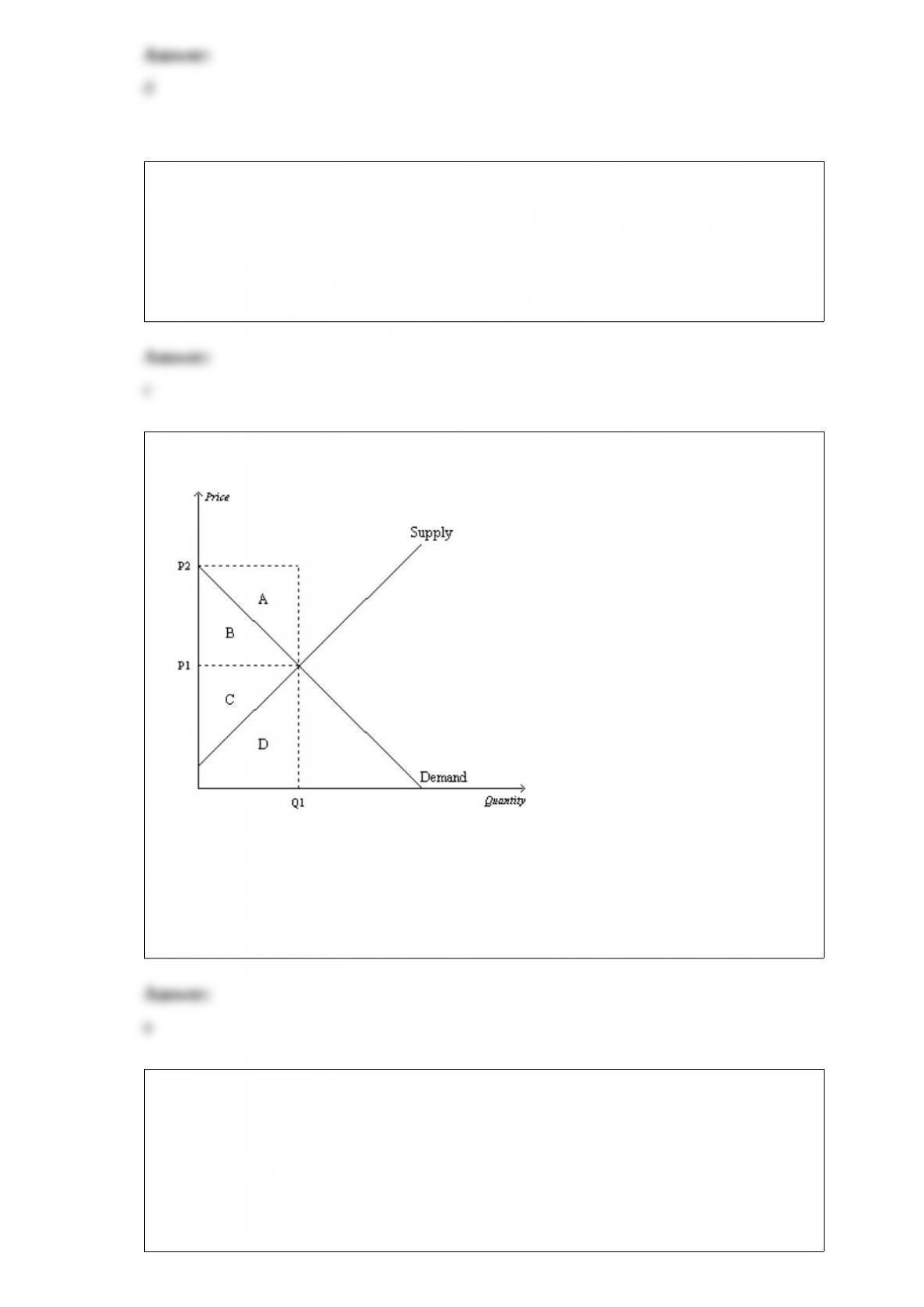
9) Figure 7-21
When the price is P1, area B+C represents
a.total surplus.
b.producer surplus.
c.consumer surplus.
d.None of the above is correct.
10) Over the past several years, the earnings gap between high-skilled and low-skilled
workers has widened because
(i)international trade has altered the relative demand for skilled and unskilled labor.
(ii)changes in technology have altered the relative demand for skilled and unskilled
labor.
(iii)the return to education for men has decreased, whereas the return to education for
women has increased.

a.(i) only
b.(iii) only
c.(i) and (ii) only
d.(i), (ii), and (iii)
11) Scenario 16-7
Consider the problem facing two firms, YumYum and Bertollini, in the frozen food
market. Each firm has just come up with an idea for a new “frozen meal for two”which
it would sell for $9. Assume that the marginal cost for each new product is a constant
$2, and the only fixed cost is for advertising. Each company knows that if it spends $12
million on advertising it will get 1.5 million consumers to try its new product. YumYum
has done market research which suggests that its product does not have any ‘staying”
power in the market. Even though it could get 1.5 million consumers to buy the product
once, it is unlikely that they will continue to buy the product in the future. Bertollini’s
market research suggests that its product is very good, and consumers who try the
product will continue to be consumers over the ensuing year. On the basis of its market
research, Bertollini estimates that its initial 1.5 million customers will buy one unit of
the product each month in the coming year, for a total of 18 million units.
Suppose YumYum has an opportunity to create a cheaper advertising campaign in
newspapers rather than on television for its new product. This campaign will cost $8
million and is expected to result in the same 1.5 million one-time customers. YumYum
should
a.invest in the cheaper campaign because they will earn a profit.
b.invest in the cheaper campaign because they will signal the high quality of their
product.
c.not invest in the cheaper campaign because they will incur a loss.
d.not invest in the cheaper campaign because their brand name will be negatively
affected.
12) The results of a 2008 Los Angeles Times poll suggest that the percentage of
Americans who believe trade is harmful to the economy exceeds the percentage of
Americans who believe trade is beneficial to the economy.
a.True
b.False
13) Suppose that coal producers create a negative externality equal to $5 per ton of
coal. What is the relationship between the equilibrium quantity of coal and the socially
optimal quantity of coal?
a.They are equal.
b.The equilibrium quantity is greater than the socially optimal quantity.
c.The equilibrium quantity is less than the socially optimal quantity.
d.There is not enough information to answer the question.
14) There is general disagreement among economists about the role of advertising, but
there is widespread agreement about the role of brand names on market efficiency.
a.True
b.False
15) Over the past 30 years, the number of jobs in the United States requiring skilled
labor has been declining as foreign countries steal these jobs away from the U.S. As a
result, the domestic demand for skilled labor has been falling and the wage gap between
skilled and unskilled labor has been narrowing.
a.True
b.False
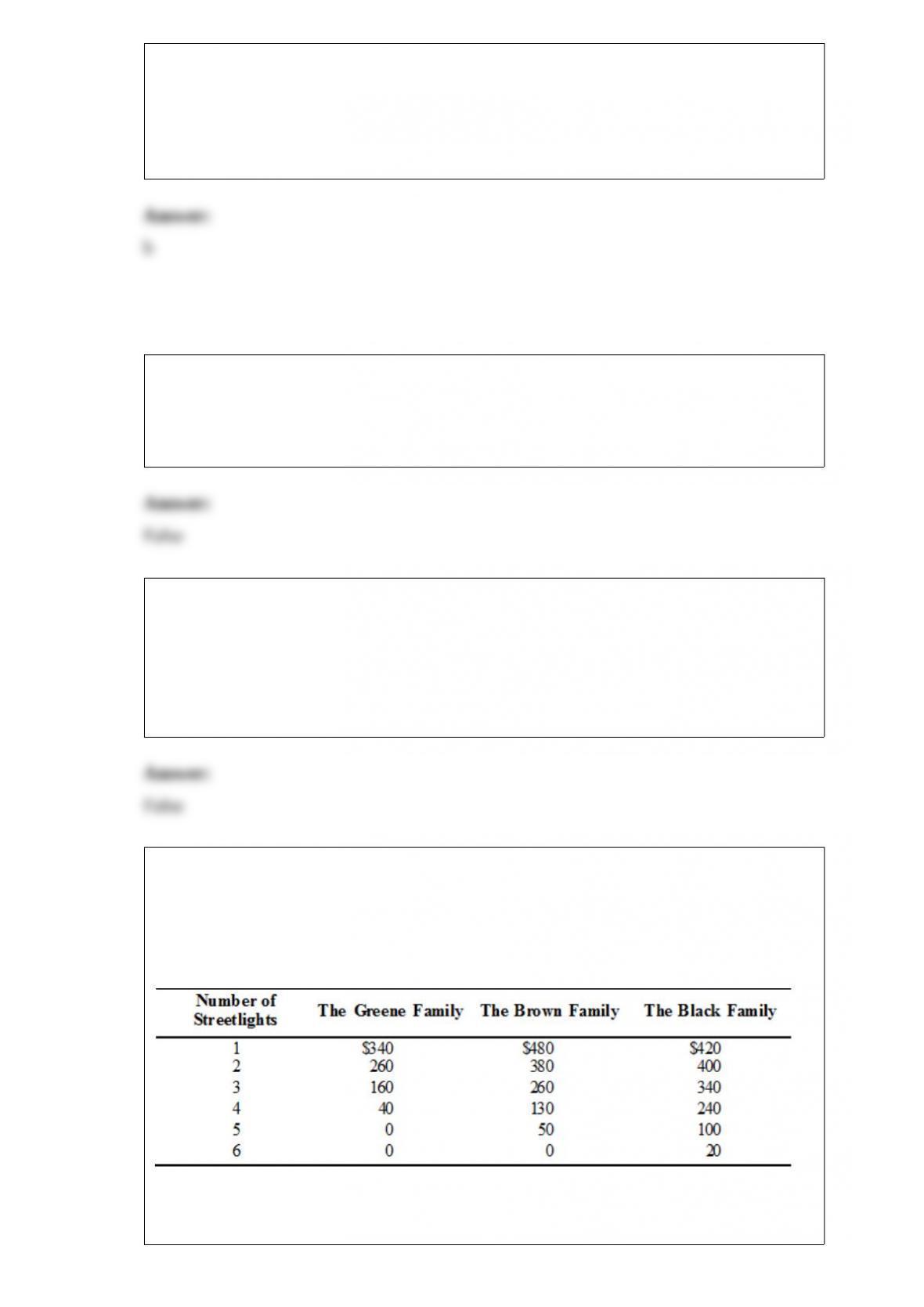
16) Consider a small town with only three families, the Greene family, the Brown
family, and the Black family. The town does not currently have any streetlights so it is
very dark at night. The three families are considering putting in streetlights on Main
Street and are trying to determine how many lights to install. The table below shows
each family’s willingness to pay for each streetlight.
Suppose the cost to install each streetlight is $360. How many streetlights should the
town install to maximize total surplus from the streetlights?
a.1 streetlight
b.2 streetlights
c.3 streetlights
d.4 streetlights
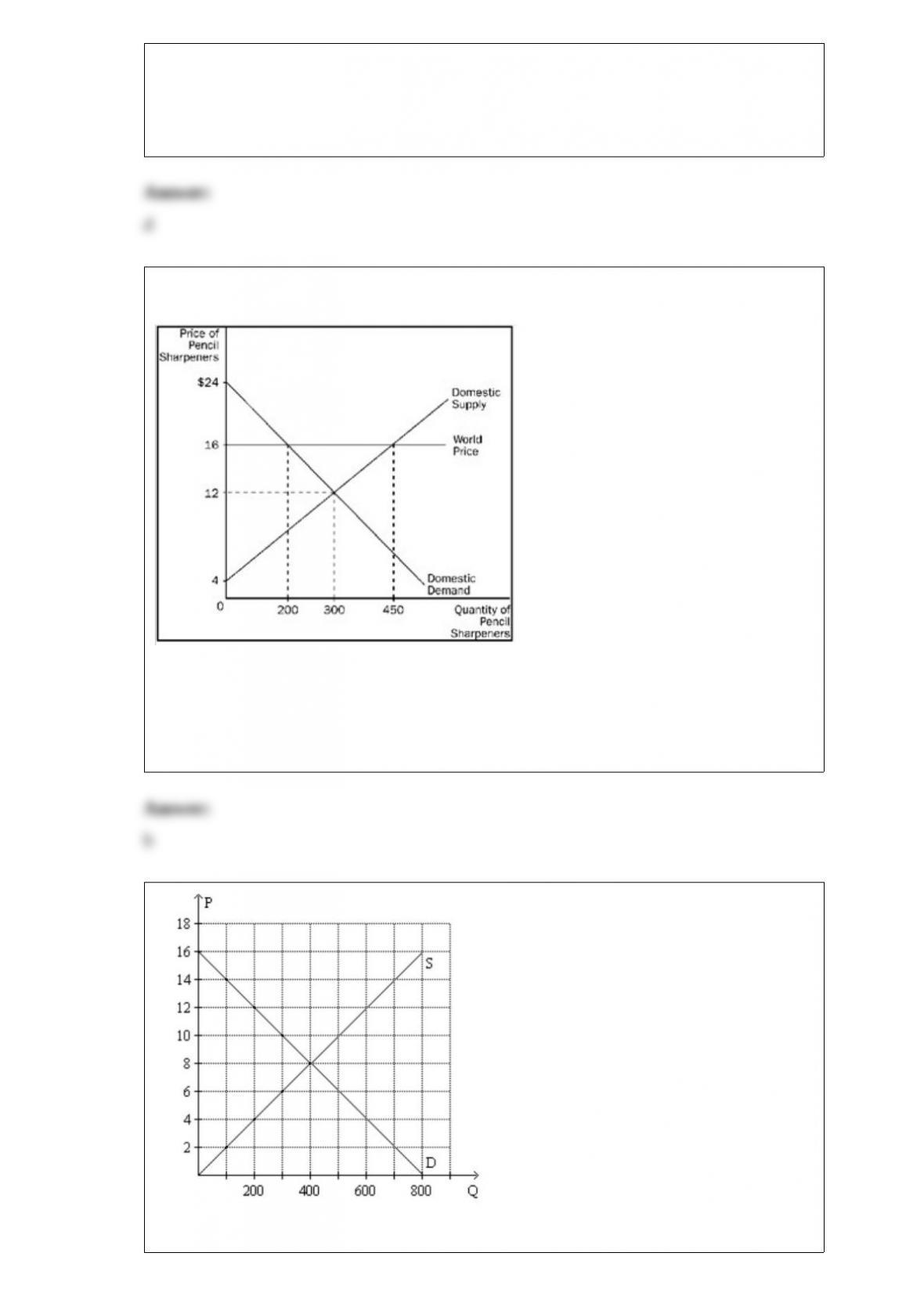
17) Figure 9-3. The domestic country is China.
The increase in total surplus in China when trade is allowed is
a. $400.
b. $500.
c. $600.
d. $750.
18) Figure 7-34
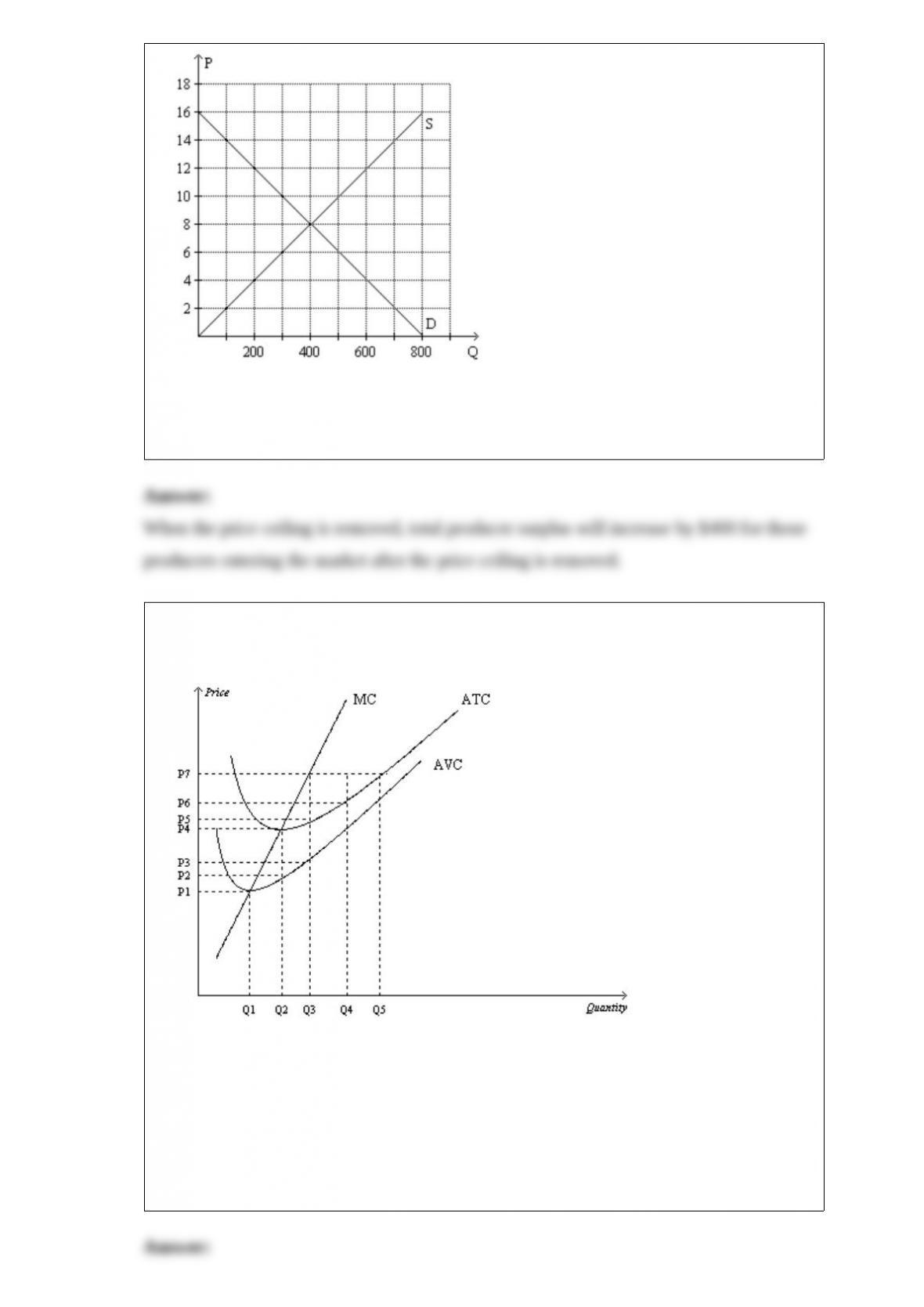
Refer to Figure 7-34. Suppose there is initially a price ceiling set at $4 in this market. If
the government removed the price ceiling, by how much would total producer surplus
increase for those producers entering the market after the price ceiling is removed?
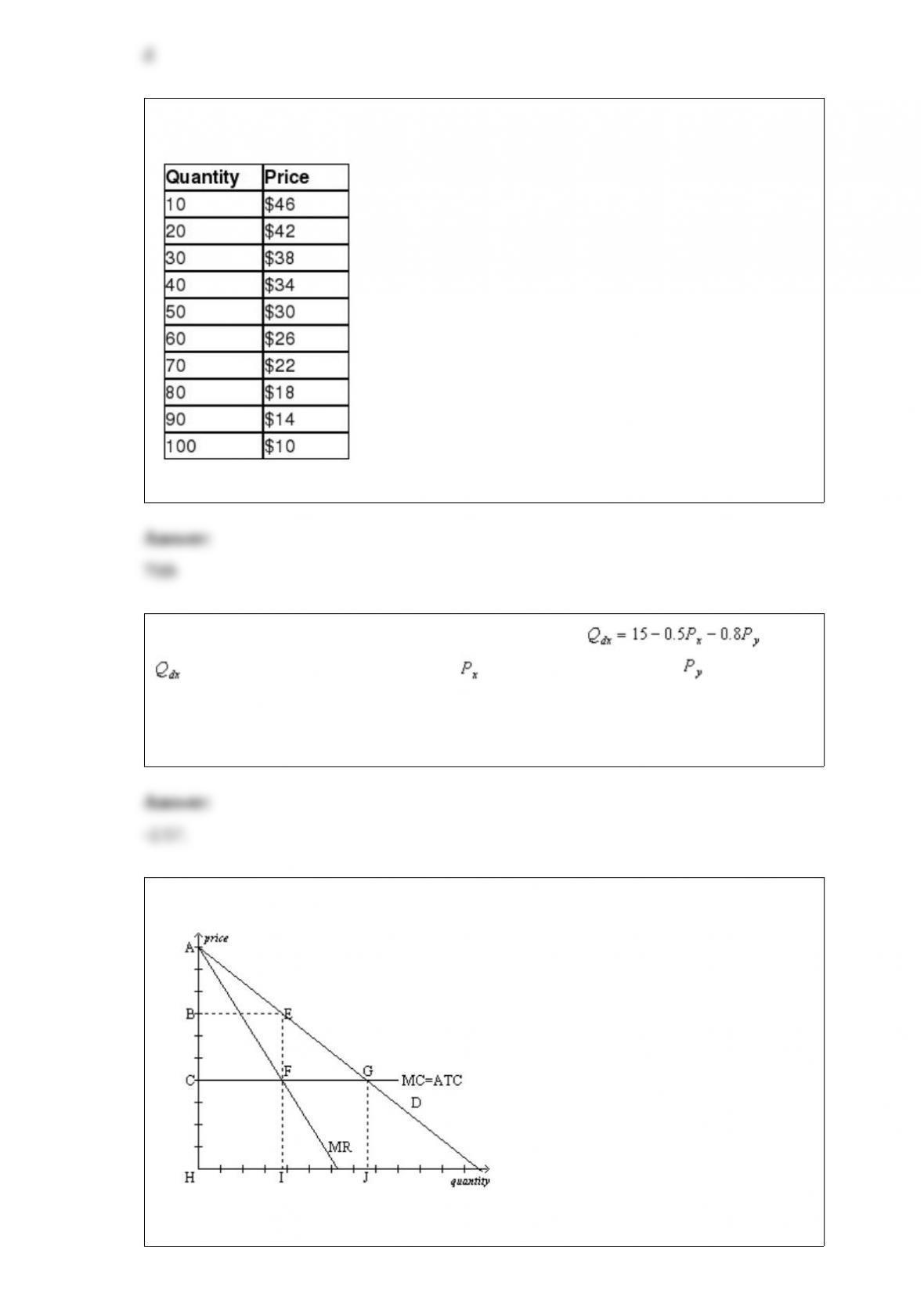
19) Figure 14-5
Suppose a firm operating in a competitive market has the following cost curves:
When market price is P2, a profit-maximizing firm‘s losses can be represented by the
area
a. (P4 – P2) x Q2.
b. (P2 – P1) x (Q2-Q1).
c.At a market price of P2, the firm earns profits, not losses.
d.At a market price of P2 the firm has losses, but the reference points in the figure don‘t
identify the losses.
20) Table 15-22
The marginal revenue becomes negative with the production of which unit of output?
21) Suppose the demand function for good X is given by: where
is the quantity demanded of good X, is the price of good X, and is the price of
good Y, which is related to good X.
Using the midpoint method, if the price of good X is $10 and the price of good Y
increases from $8 to $10, the cross is about
22) Figure 15-24
If this firm were able to perfectly price discriminate, which letter represents the amount
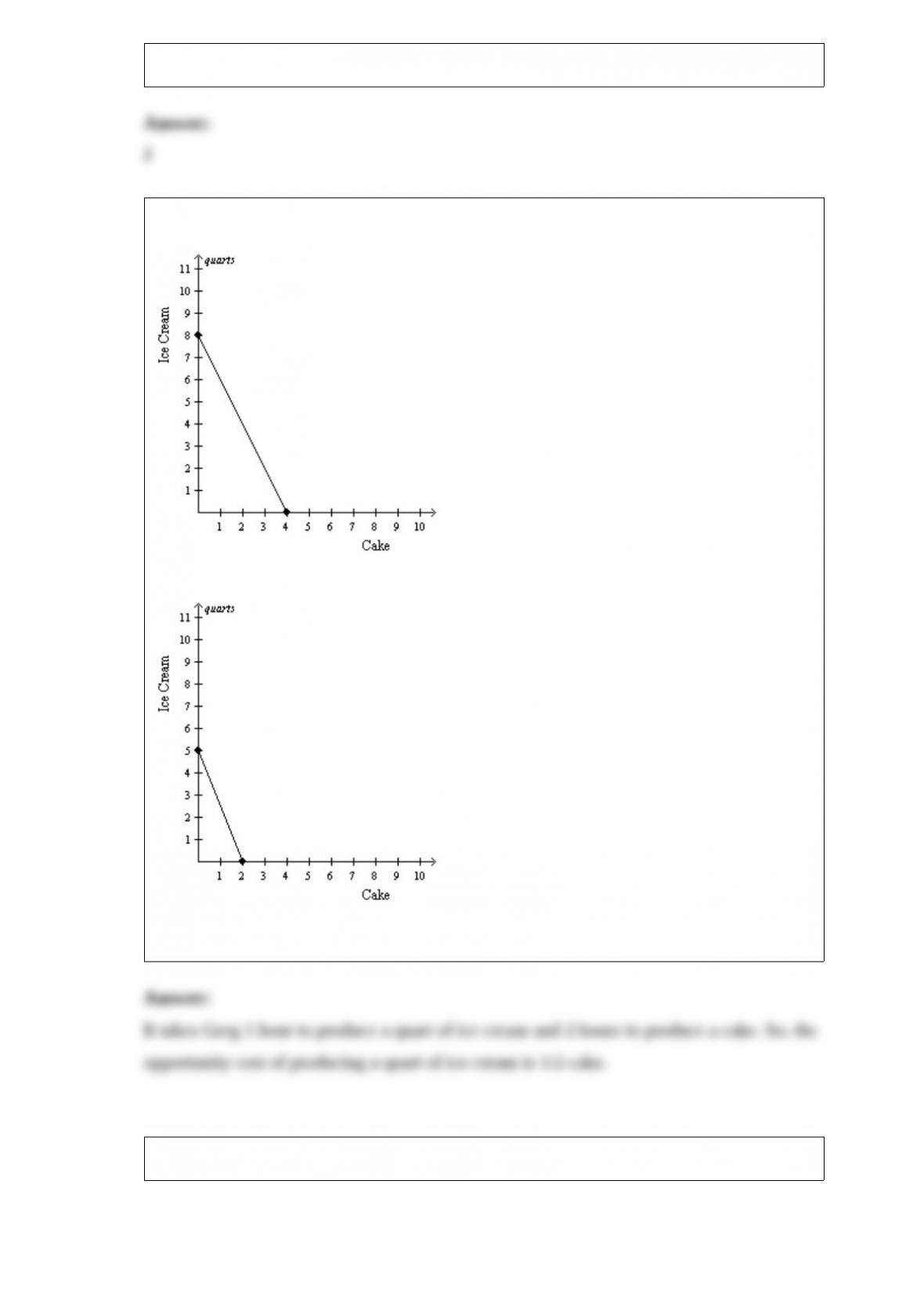
of output it would produce?
23) Greg’s Production Possibilities
Catherine’s Production Possibilities
What is Greg’s opportunity cost of producing ice cream? Explain how you derived your
answer.
24) Table 13-19
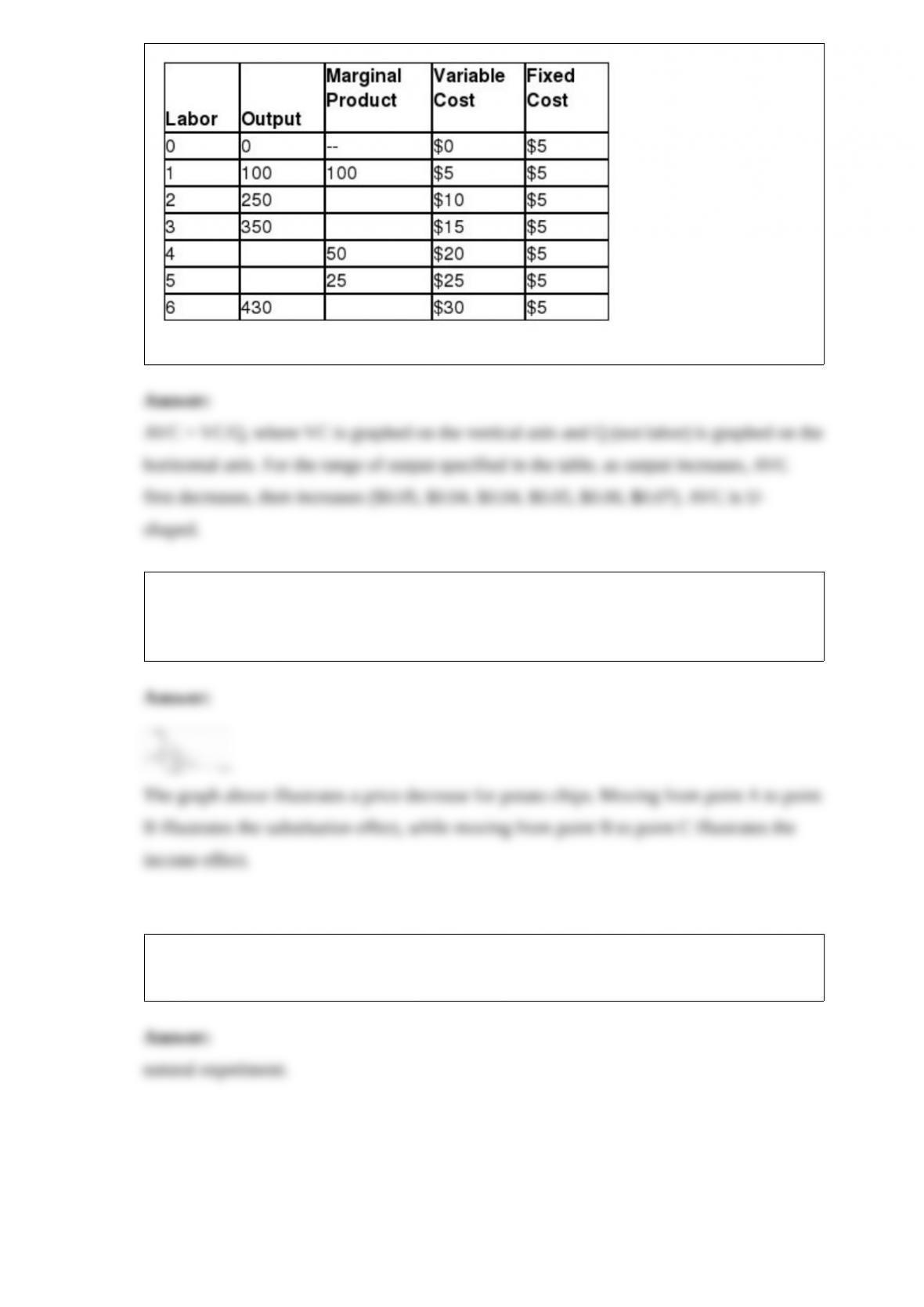
What is the shape of the average-variable-cost curve?
25) Using indifference curves and budget constraints, graphically illustrate the
substitution and income effect that would result from a change in the price of a normal
good.
26) Suppose a war in the Middle East interrupts the flow of crude oil and oil prices
skyrocket around the world. For economists, this historical episode serves as a