1) which of the following definitions is correct?
a.accounting profit + economic profit = normal profit.
b.economic profit – accounting profit = explicit costs.
c.economic profit = accounting profit – implicit costs.
d.economic profit – implicit costs = accounting profits.
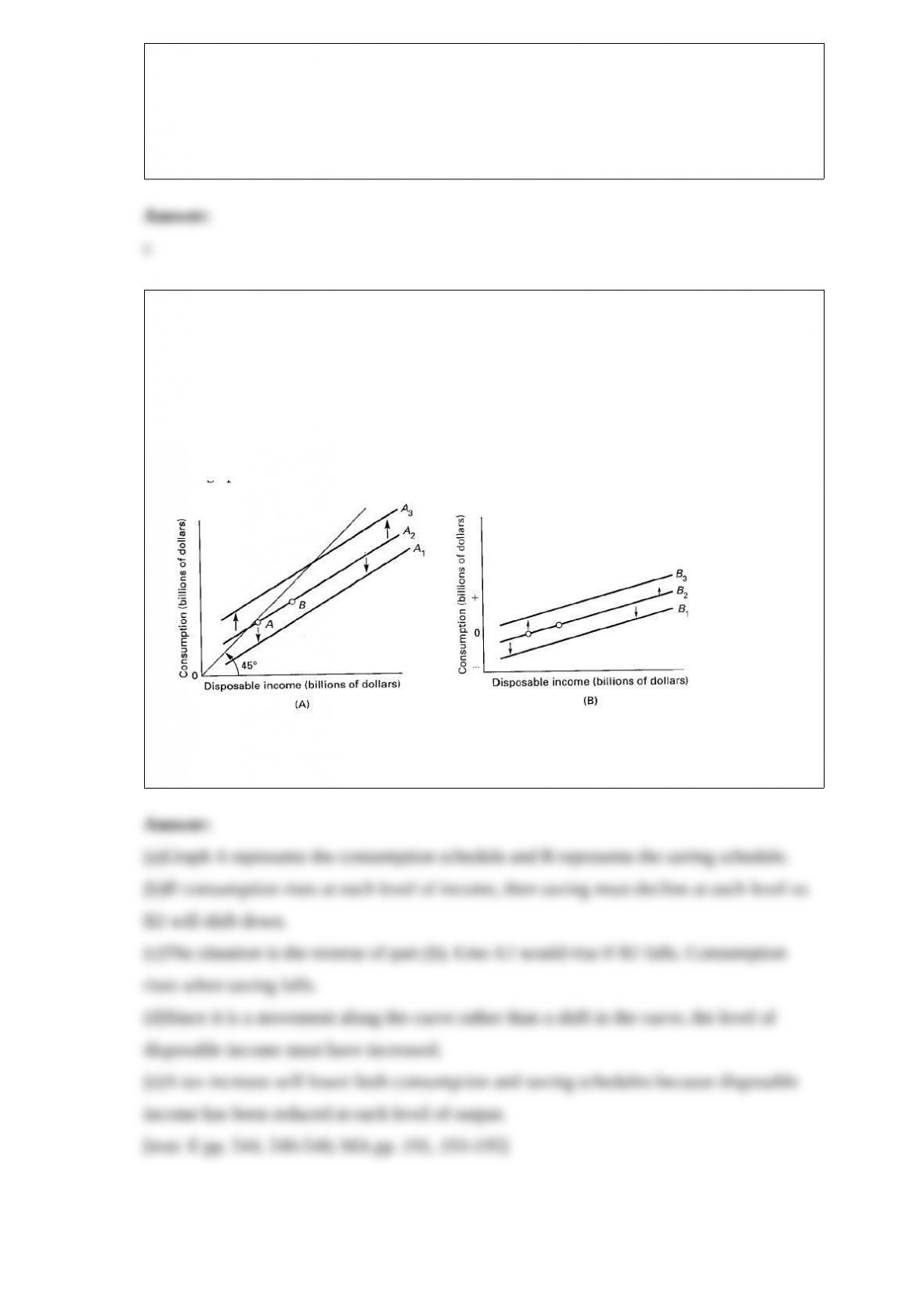
2) Use the graphs below to answer the following questions:
(a)What types of schedules do graphs A and B represent?
(b)If in graph A line A2 shifts to A3 because households consume more and this change
is not due to changing taxes, then in graph B, what would happen to line B2?
(c)If in graph B, line B2 shifts to B1 because households save less, then in graph A,
what will happen to line A2?
(d)In graph A, what has caused the movement from point A to point B on line A2?
(e)If there
is a lump-sum tax increase causing line A2 to shift to A1, then in graph B, what will
happen to B2?

3) which of the following goods (with their respective income elasticity coefficients in
parentheses) will most likely suffer a decline in demand during a recession?
a.dinner at a nice restaurant (+1.8)
b.chicken purchased at the grocery store for preparation at home (+0.25)
c.facial tissue (+0.6)
d.plasma screen and lcd tvs (+4.2)
4) if a firm finds that it can sell $13,000 worth of a product when its price is $5 per unit
and $11,000 worth of it when its price is $6, then:
a.the demand for the product is elastic in the $6-$5 price range.
b.the demand for the product must have increased.
c.elasticity of demand is 0.74.
d.the demand for the product is inelastic in the $6-$5 price range.
5) economic profits in an industry suggest the industry:
a.can earn more profits by increasing product price.
b.should be larger to better satisfy consumers’ desire for the product.
c.has excess production capacity.
d.is the size that consumers want it to be.
6) (last word) which of the following has to do with the problem of distinguishing cause
and effect in economic reasoning?
a.the law of large numbers.
b.the law of averages.
c.the post hoc, ergo propter hoc fallacy.
d.the fallacy of composition.
7) Economic profit affects:
A.the allocation of resources, but not the level of resource use.
B.the level of resource use, but not the allocation of resources.
C.the allocation of resources and the level of resource use.
D.neither the allocation of resources nor the level of resource use.
8) The relationship between the elasticity of product demand and the elasticity of
demand for labor employed in its production is such that, other things being equal:
A.the more elastic the demand for the product, the less elastic the demand for labor.
B.the more elastic the demand for the product, the more elastic the demand for labor.
C.the elasticity of product demand only affects the elasticity of labor demand when the
product market is purely competitive.
D.if product demand is perfectly elastic, labor demand will be perfectly inelastic.
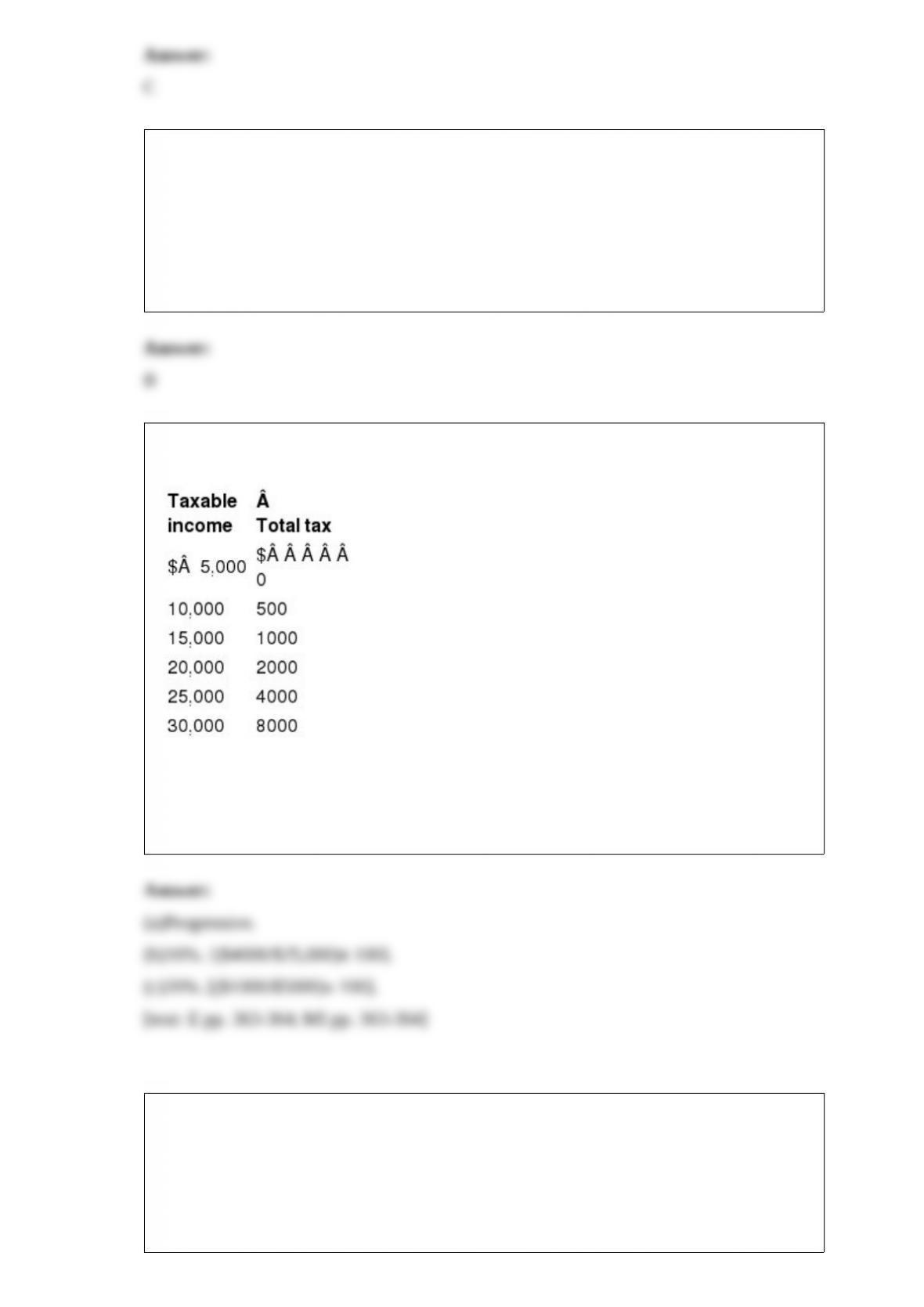
9) Answer the next three questions on the basis of the following data:
(a)What type of tax is represented by the tax schedule?
(b)What will your average tax rate be if your taxable income is $25,000?
(c)If your taxable income increases from $15,000 to $20,000, what will your marginal
tax rate be?
10) Johnny Deer exclusively grew corn in each of the past three years. Under the Food,
Conservation, and Energy Act of 2008, Deer:
A.must grow corn in the current year in order to receive direct payments from the
Federal government.
B.can grow whatever crop he wants to in the current year but will only receive direct
payments from the Federal government if the price of corn falls below a targeted price.
C.will receive countercyclical payments if the price of corn falls below a targeted price,
even though he does not grow corn in the current year.
D.must grow something other than corn to qualify for direct payments from the Federal
government.
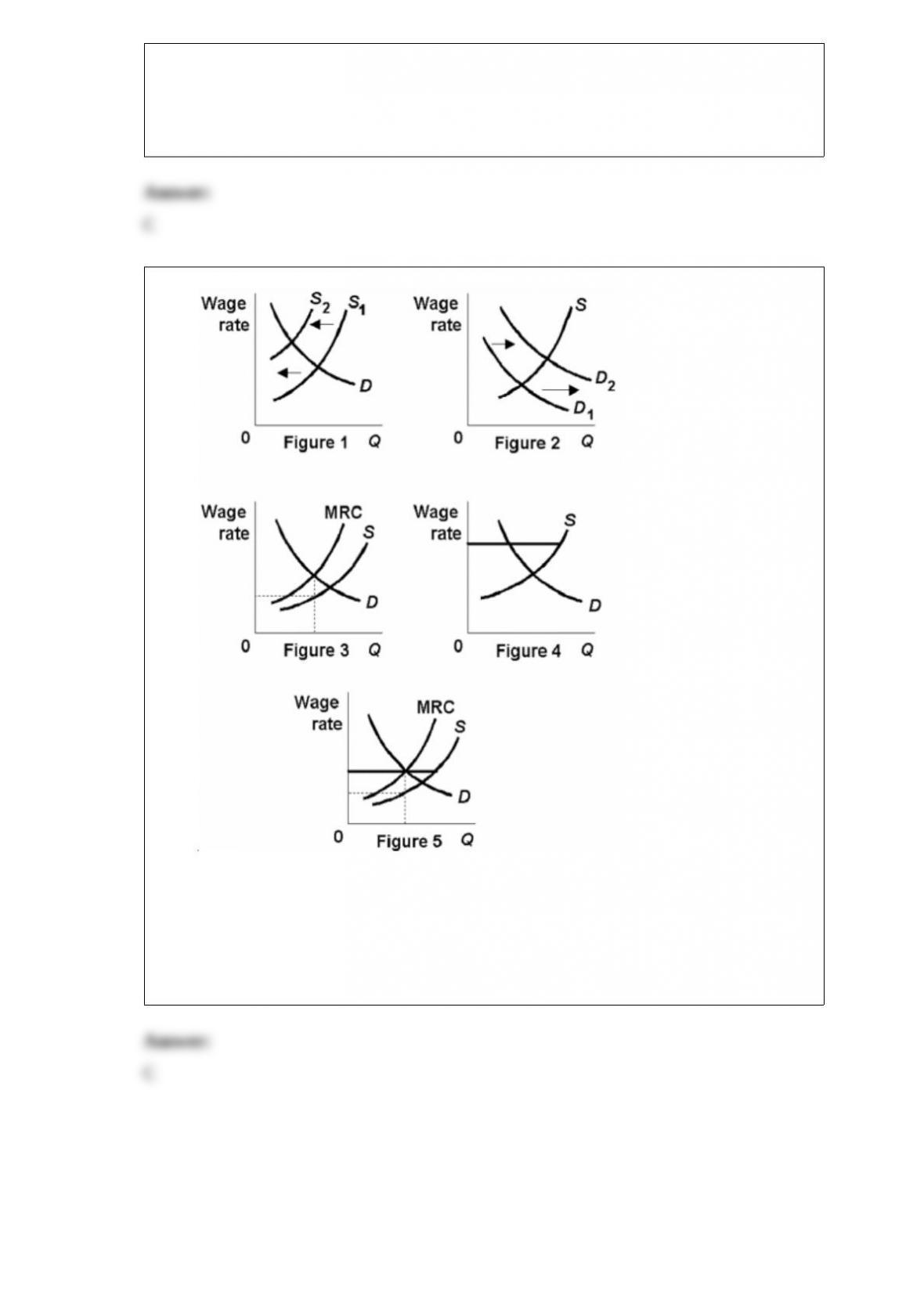
11)
Refer to the above labor market diagrams. The tactics of inclusive unionism are shown
in Figure(s):
A.5 only
B.3 only
C.4 and 5
D.1 and 2