If the market price is $40 in a perfectly competitive market, the marginal revenue from
selling the fifth unit is
A) $8.
B) $20.
C) $40.
D) $200.
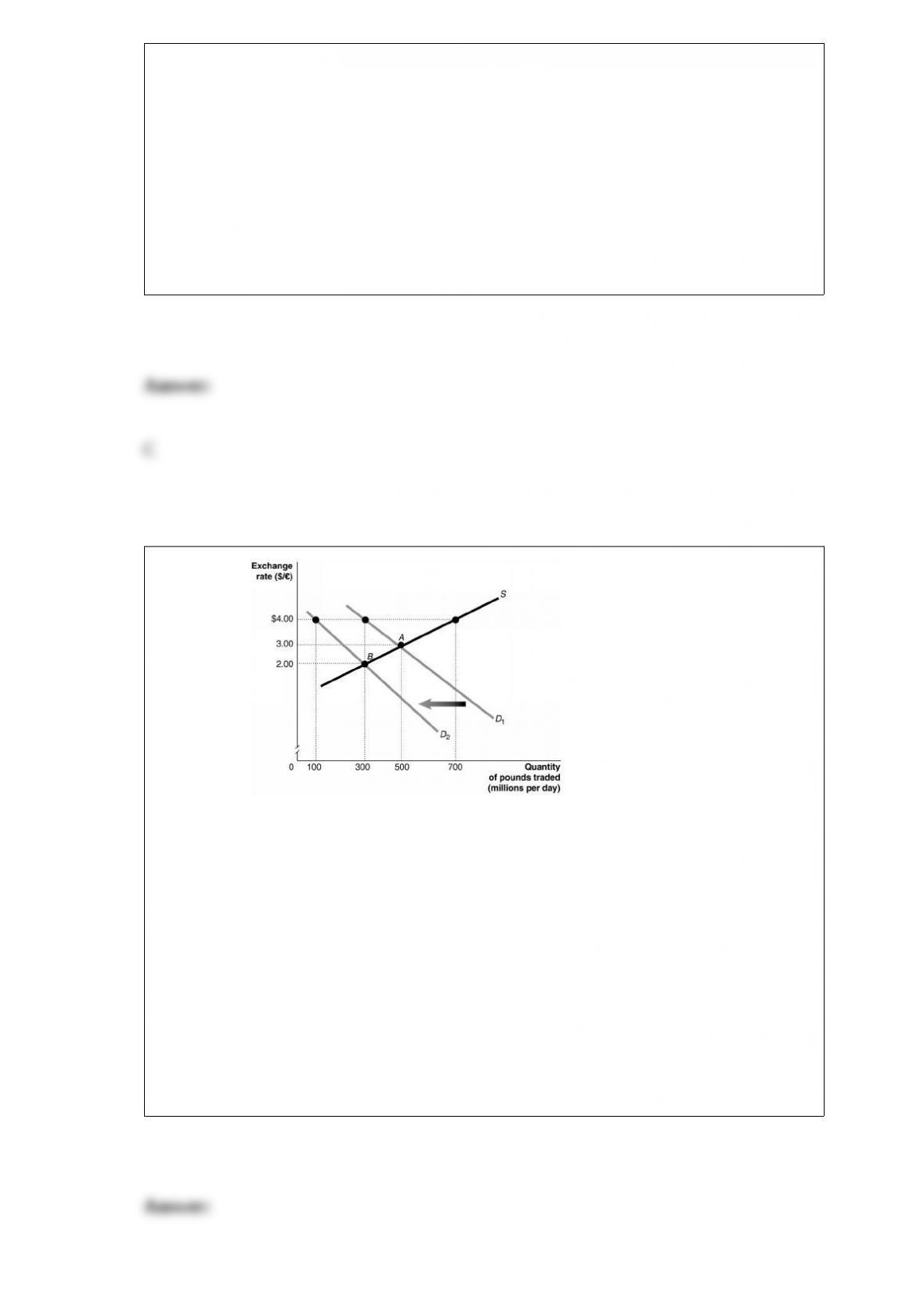
Figure 30-4
The equilibrium exchange rate is originally at A, $3/pound. Suppose the British
government pegs its currency at $4/pound. Speculators expect that the value of the
pound will drop and this shifts the demand curve for pounds to D2. If the government
abandons the peg, the equilibrium exchange rate would be
A) $4/pound.
B) $3/pound.
C) $2/pound.
D) less than $2/pound.

Article Summary. According to the Office for National Statistics in the United
Kingdom, productivity in the UK in 2012 was well below the average of the G7
countries, only faring better than Japan. The G7 is a group of the seven most
industrialized countries, and includes Canada, France, Germany, Italy, Japan, the
United Kingdom, and the United States. Compared to the G7 average, the UK was
16% less productive per hour worked, and output was 19% worse when measured
on a per worker basis. The productivity gap was the largest for the UK since 1994.
Worker productivity has increased in all of the G7 nations except for the UK since
2007, where it has fallen by two percentage points. The most productive workers
were in the United States, where workers were 29 percentage points more
productive per hour worked than in the UK.
Source: “UK workers much less productive than others in the G7,” Guardian,
September 18, 2013.
________ depend on increases in labor productivity.
A) Advances in technology
B) Decreases in the inflation rate
C) Decreases in the unemployment rate
D) Increases in real GDP per capita
Many colleges and universities practice yield management to maximize the revenue
they receive from tuition and
A) to maximize the amount of aid they receive from the federal government.
B) to maximize the amount of their student loans.
C) to maximize the size of their endowments.
D) to increase the academic quality of the students who enroll in their schools.
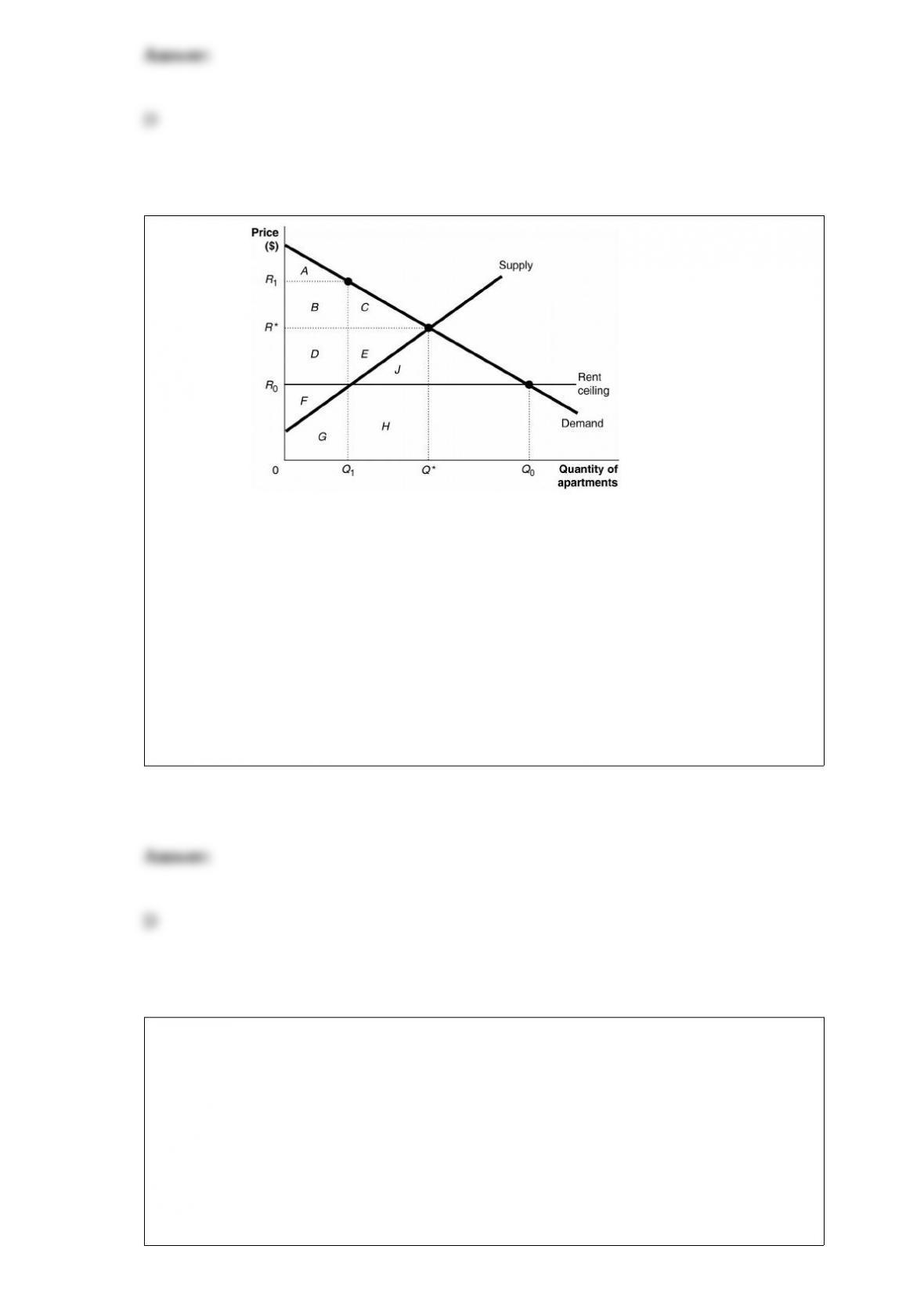
Figure 4-10 Figure 4-10 shows the
market for apartments in Bay City. Recently, the government imposed a rent ceiling at
R0. Suppose that instead of a price ceiling, the government imposed a price floor of R1.
What area represents the deadweight loss after the imposition of the price floor?
A) G + H
B) J + H
C) C + E + J + H
D) C + E
A decrease in the real interest rate will
A) increase consumption and reduce investment.
B) increase saving and investment.
C) decrease investment and government spending.
D) increase consumption and investment.

Economists assume that rational behavior is useful in explaining choices people make
A) because irrational people do not make economic choices.
B) even though people may not behave rationally all the time.
C) because individuals act rationally all the time in all circumstances.
D) even though people rarely, if ever, behave in a rational manner.
Which of the following is an appropriate policy for the Fed to pursue if it wants to
increase the money supply?
A) raise the reserve requirement
B) raise the discount rate
C) buy U.S. Treasury bills
D) lower taxes

A “long-run exploitable Phillips curve” refers to a Phillips curve that in the long run is
________ rather than ________.
A) vertical; horizontal
B) upward sloping; vertical
C) horizontal; upward sloping
D) downward sloping; vertical
Cassie’s Quilts alters, reconstructs and restores heirloom quilts. Cassie has just spent
$800 purchasing, cleaning and reconstructing an antique quilt which she expects to sell
for $1,500 once she is finished. After having spent $800, Cassie discovers that she
would need some special period fabric that would cost her $200 in material and time in
order to complete the task. Alternatively, she can sell the quilt “as is” now for $900.
What should she do?
A) She should cut her losses and sell the quilt now.
B) It does not matter what she does; she is going to take a loss on her project.
C) She should purchase the period fabric, complete the task and then sell the quilt.
D) She should not do anymore work on the quilt because she has already spent too
much time on it and has not been paid for that time.
Economic efficiency is defined as a market outcome in which the marginal benefit to
consumers of the last unit produced is equal to the marginal cost of production, and in
which
A) the sum of consumer surplus and producer surplus is at a maximum.
B) economic surplus is minimized.
C) the sum of the benefits to firms is equal to the sum of the benefits to consumers.
D) the sum of consumer surplus and producer surplus is minimized.
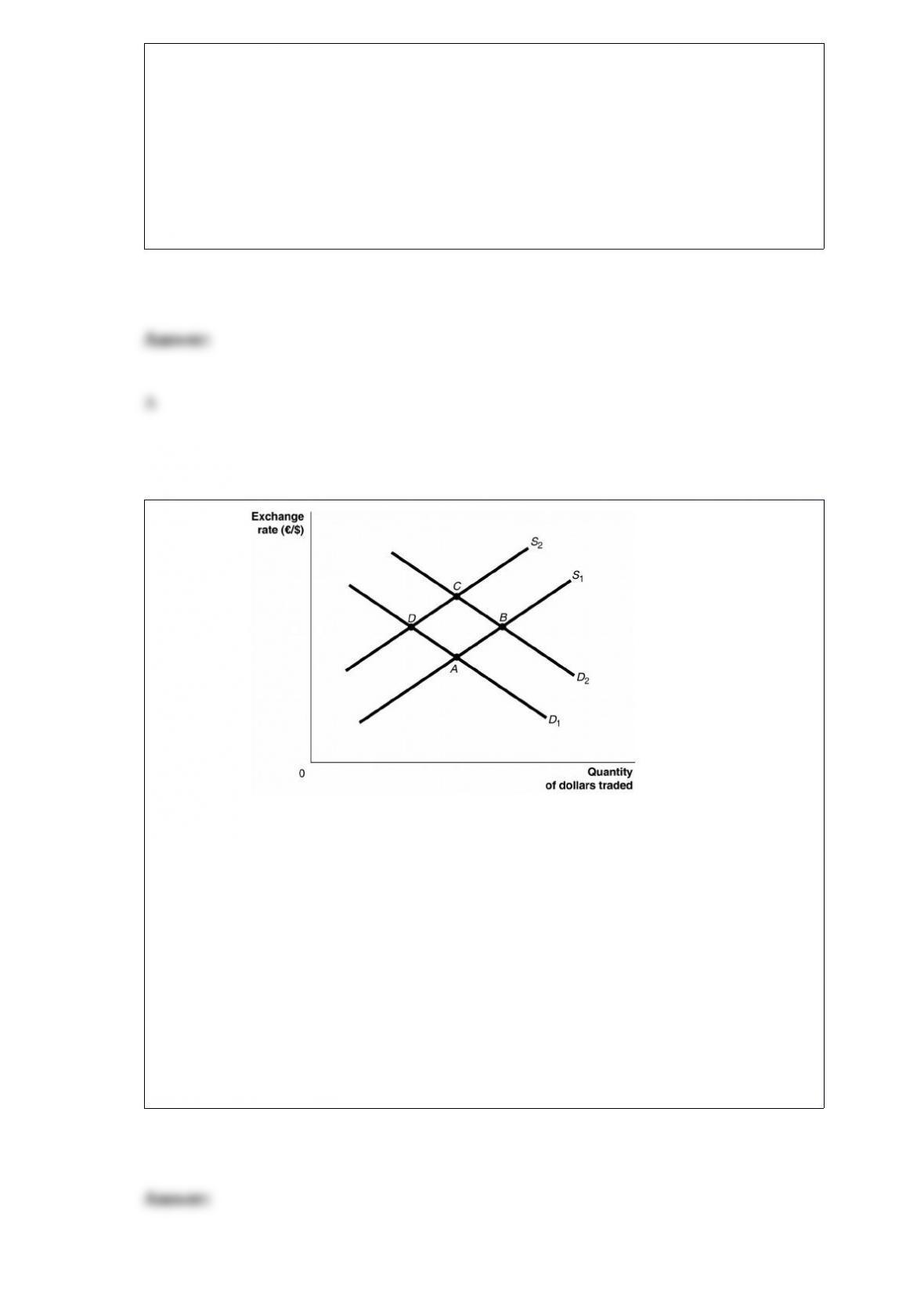
Figure 18-1
Europe suffers a recession. Assuming all else remains constant, this would be
represented as a movement from
A) D to A.
B) C to D.
C) B to C.
D) A to D.
E) A to B.
If Canada has a comparative advantage relative to Mexico in the production of timber,
then
A) the explicit cost of production for timber is lower in Canada than in Mexico.
B) the opportunity cost of production for timber is lower in Canada than in Mexico.
C) the implicit costs of production for timber are lower in Canada than in Mexico.
D) the average cost of production for timber is lower in Canada than in Mexico.
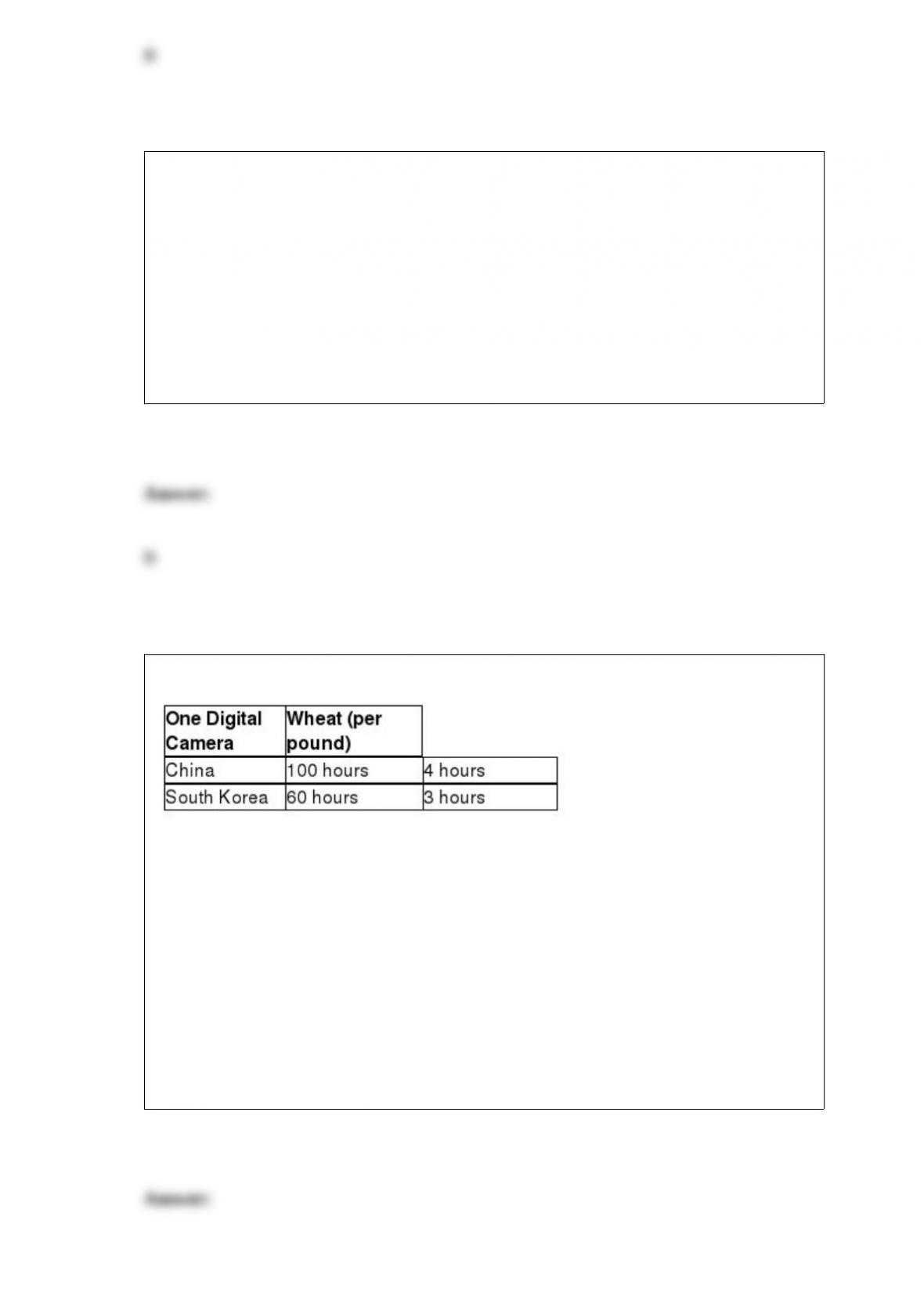
Table 2-11
Table 2-11 shows the number of labor hours required to produce a digital camera and a
pound of wheat in China and South Korea.
What is South Korea’s opportunity cost of producing one digital camera?
A) 0.05 pounds of wheat
B) 20 pounds of wheat
C) 25 pounds of wheat
D) 60 pounds of wheat

An oligopolist differs from a perfect competitor in that
A) there is cutthroat competition in perfect competition but little competition in
oligopoly because firms have significant market power.
B) firms in an oligopoly do not produce homogeneous products while firms in perfect
competition do.
C) the market demand curve for a perfectly competitive industry is perfectly elastic, but
it is downward sloping in an oligopolistic industry.
D) there are no entry barriers in perfect competition but there are entry barriers in
oligopoly.
The United States has ________ social insurance programs, and generally has a
________ unemployment rate, as compared to Canada and Western Europe.
A) less generous; lower
B) less generous; greater
C) more generous; lower
D) more generous; greater

Airlines often engage in last-minute price cutting to fill remaining empty seats on a
flight because this practice will generally
A) prevent rival airlines from competing in that market.
B) increase marginal revenue more than marginal cost.
C) maximize marginal revenue.
D) discourage rivals from matching price cuts.
Which of the following is not part of an oligopolist’s business strategy?
A) deciding on how to manage relations with suppliers
B) choosing what new technologies to adopt
C) selecting which new markets to enter
D) independently setting a product’s price without consideration of its rivals’ pricing
policies