From an initial long-run equilibrium, if aggregate demand grows faster than long-run
and short-run aggregate supply, then Congress and the president would most likely
A) decrease the required reserve ratio.
B) decrease government spending.
C) decrease oil prices.
D) decrease tax rates.
The marginal productivity theory of income distribution states that
A) as more and more units of labor are added to a fixed quantity of capital, eventually
labor’s contribution to a firm’s income will decrease.
B) income distribution is determined by the marginal productivity of the factors of
production that individuals own.
C) factors of production in short supply command higher prices than those available in
abundant quantities.
D) capital owners receive the bulk of a nation’s income because capital-intensive
production generates productivity gains.
All of the following is counted as “capital” in economics except
A) money.
B) machine tools.
C) factory buildings.
D) warehouses.
If the United States has a current account deficit and the capital account is zero, which
of the following must be true?
A) The balance on the financial account must equal the balance on the current account.
B) Net foreign investment must be negative as well.
C) Domestic private saving must be less than net foreign investment.
D) Domestic public saving must be less than net foreign investment.
Studies show that the income elasticity of demand for wine is 5.03 and the income
elasticity of demand for spirits is 1.21. This indicates that
A) wine and spirits are luxury goods.
B) wine is a luxury good and spirits are inferior goods.
C) wine and spirits are highly price elastic.
D) wine is a luxury good and spirits are necessities.
The situation in which short-term interest rates are pushed to zero, leaving the central
bank unable to lower them further is known as
A) the Taylor rule.
B) a liquidity trap.
C) a zero-sum game.
D) an interest rate panic.
A persistent shortage of yen at a given fixed exchange rate (in dollars per yen) is
evidence that the yen is ________ versus the dollar. This shortage can be reduced or
eliminated through a ________ of the yen.
A) undervalued; devaluation
B) undervalued; revaluation
C) overvalued; revaluation
D) overvalued; devaluation
The aggregate expenditure model focuses on the ________ relationship between real

spending and ________.
A) short-run; real GDP
B) short-run; inflation
C) long-run; real GDP
D) long-run; inflation
You explain to your friend Haslina, who runs a catering service called “Meals in a Zip,”
about an economic theory which asserts that consumers will purchase less of a product
at higher prices than they will at lower prices. She contends that the theory is incorrect
because over the past two years she has raised the price of her catered meals and yet has
seen a brisk increase in sales. How would you respond to Haslina?
A) Haslina is right; she has evidence to back her claim. The theory must be erroneous.
B) I will explain to her that she is making the error of reverse causality: it is the
increase in demand that has enabled her to raise her prices.
C) I will explain to her that there are some omitted variables that have contributed to an
increase in her sales such as changes in income.
D) Haslina is making the mistake of assuming that correlation implies causation.
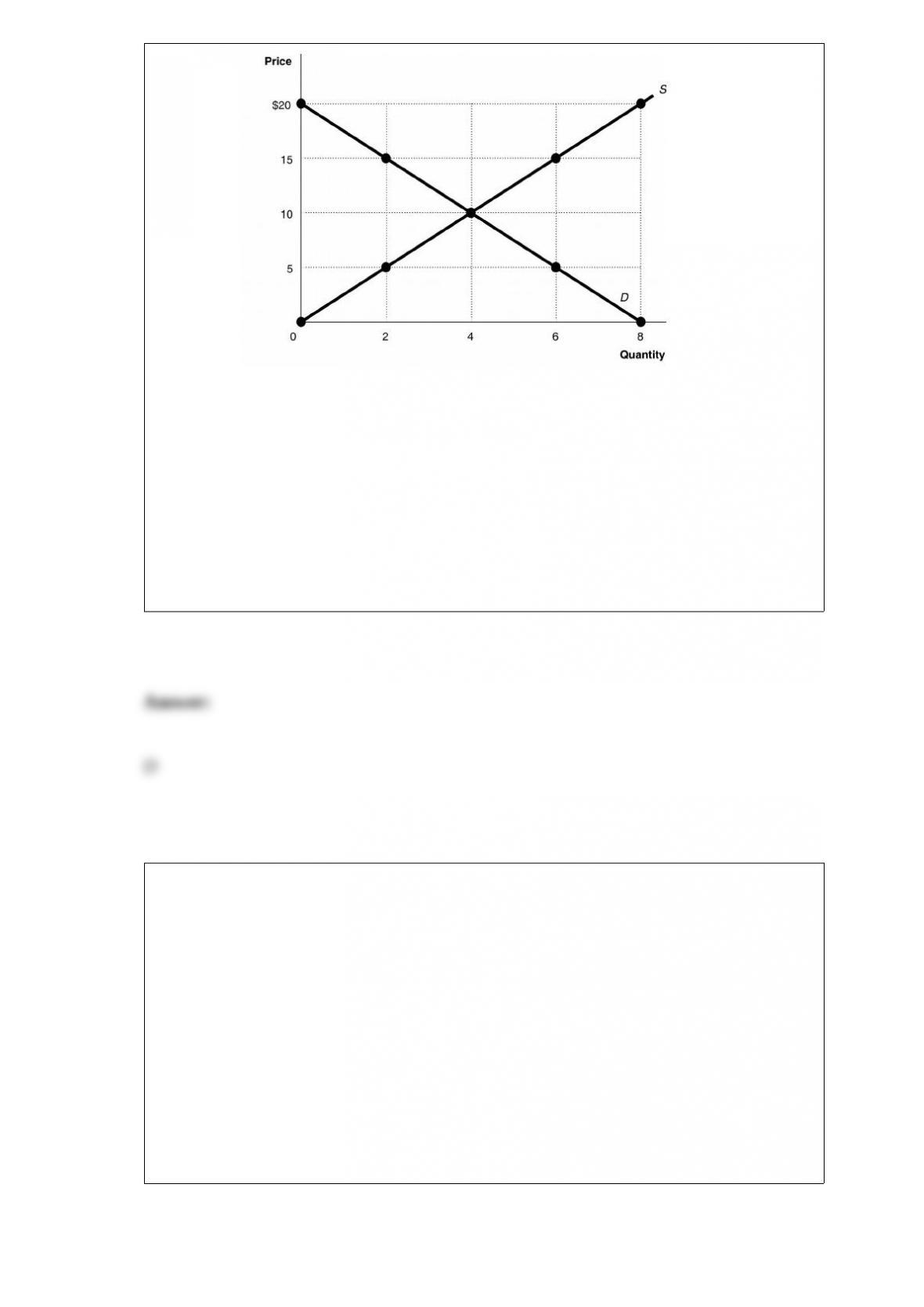
Figure 3-5
At a price of $5,
A) there would be a surplus of 4 units.
B) there would be a scarcity of 4 units.
C) there would be a shortage of 6 units.
D) there would be a shortage of 4 units.
Suppose your expenses for this term are as follows: tuition: $5,000, room and board:
$3,000, books and other educational supplies: $500. Further, during the term, you can
only work part-time and earn $4,000 instead of your full-time salary of $10,000. What
is the opportunity cost of going to college this term, assuming that your room and board
expenses would be the same even if you did not go to college?
A) $5,500
B) $8,500
C) $11,500
D) $14,500
A firm’s net income is also its
A) economic profit.
B) balance sheet.
C) accounting profit.
D) opportunity cost.
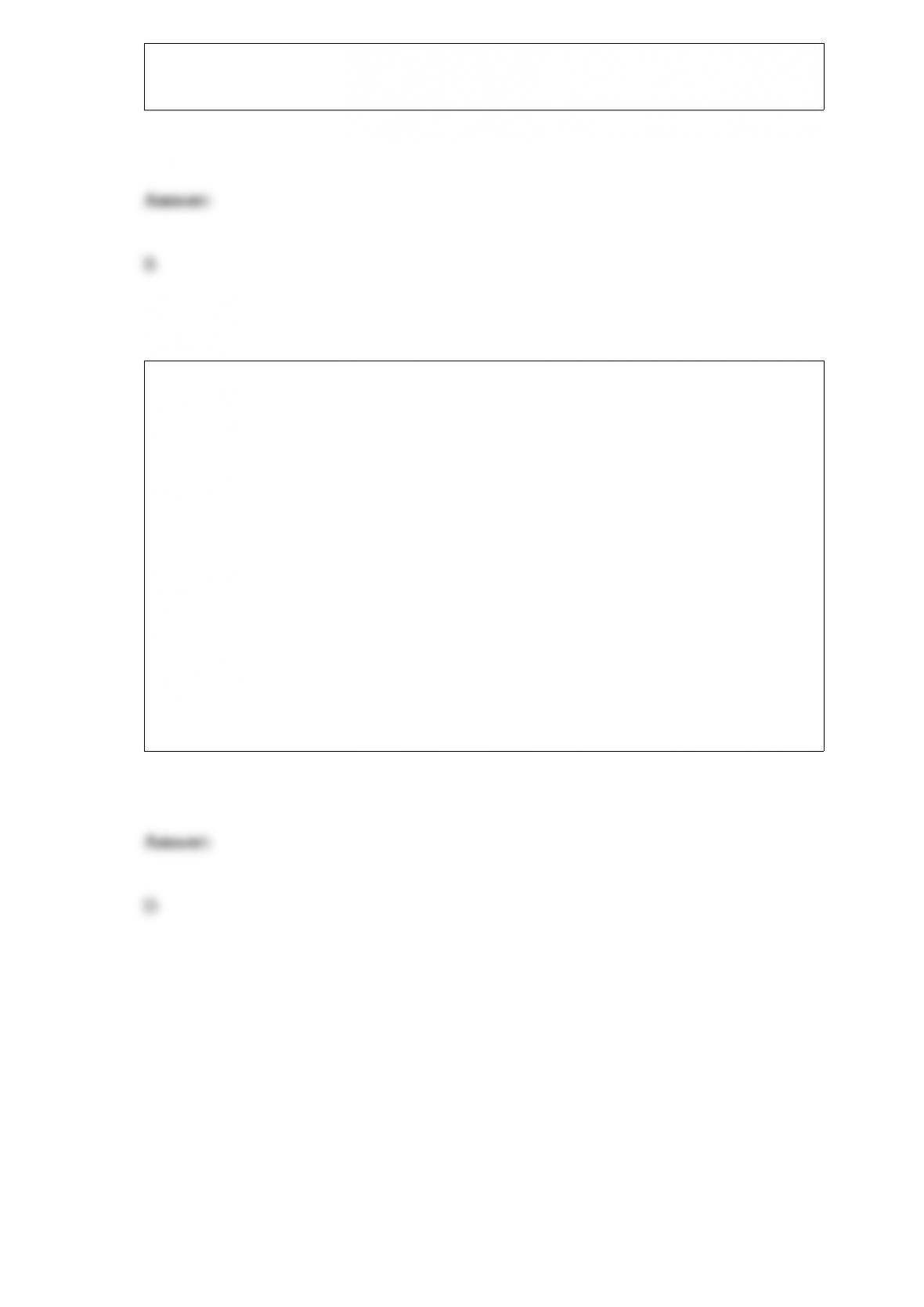
Figure 3-8
The graph in this figure illustrates an initial competitive equilibrium in the market for
motorcycles at the intersection of D2 and S1 (point C). If the price of motorcycle side
cars (a complement to motorcycles) decreases, and the wages of motorcycle workers
increase, how will the equilibrium point change?
A) The equilibrium point will move from C to E.
B) The equilibrium point will move from C to B.
C) The equilibrium point will move from C to A.
D) The equilibrium will first move from C to A, then return to C.
Compare two situations. (A) A firm is not legally responsible for damages that result
from air pollution caused by its production of steel. (B) A firm is legally responsible for
damages that result from its production of steel. Ronald Coase argued that
A) bargaining between the firm and the victims of the air pollution caused by the firm
will result in little reduction of pollution in either situation (A) or (B) because the firm
has greater economic and political power than the victims.
B) bargaining between the firm and the victims of the air pollution caused by the firm
would lead to a greater reduction in pollution in situation (A) than situation (B).
C) bargaining between the firm and the victims of the air pollution caused by the firm
would lead to a smaller reduction in pollution in situation (A) than situation (B).
D) bargaining between the firm and the victims of the air pollution caused by the firm
would lead to an equal reduction in pollution in situation (A) and situation (B).
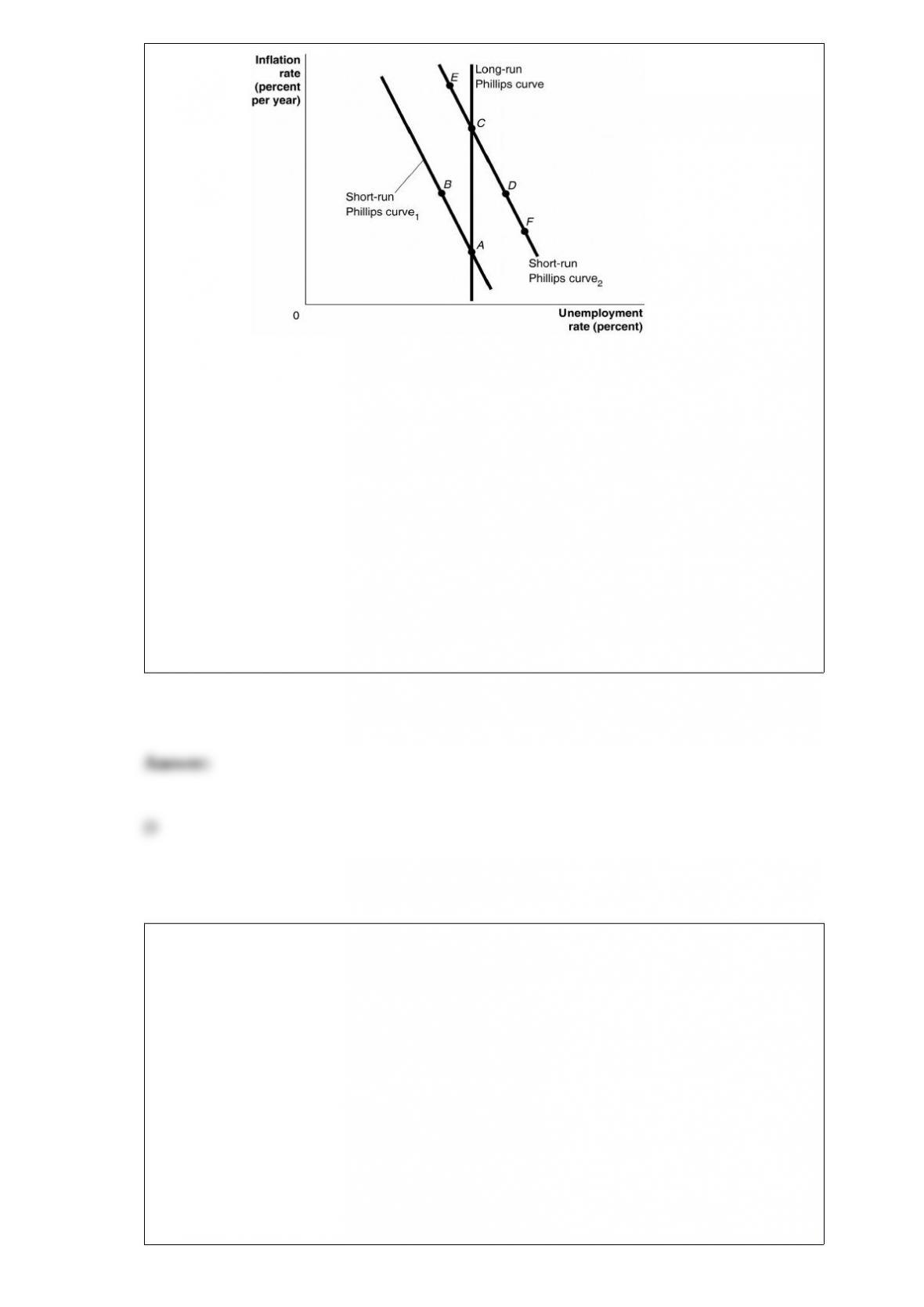
Figure 28-9
A follower of the new classical macroeconomics would argue that a contractionary
monetary policy to lower inflation after a supply shock, like that pursued by Volcker in
1979, would result in a movement from
A) A to D to C.
B) A to B.
C) C to D to A.
D) C to A.
E) A to C.
The Walt Disney Company is in a position to use a two-part tariff by charging for
admission and also charging for rides inside its two theme parks, Disneyland and
Disney World. Which of the following statements regarding Disney’s pricing strategy is
true?
A) At one time, admission fees were charged at both parks but all rides were free.
Disney has since changed its pricing policy; it earns higher profits by charging for both
admission and rides.
B) At one time, customers had to pay for admission and rides at Disneyland and Disney
World. Disney has since changed its pricing policy; it earns higher profits by charging
for admission but not for rides.
C) At one time, customers had to pay for admission and rides at Disneyland and Disney
World. Disney has since changed its pricing policy; it earns higher profits by charging
for rides but not for admission.
D) At one time, fees for admission and rides at both parks were set at their
profit-maximizing levels. Disney has since changed its pricing policy; it uses a
cost-plus pricing strategy for admission and does not charge for rides.