
1)
refer to the above information and assume the stadium capacity is 5,000. the supply of
seats for the game:
a.varies inversely with ticket prices.
b.varies directly with ticket prices.
c.is perfectly inelastic.
d.is perfectly elastic.
2) Profit-maximizing extraction companies will attempt to:
A.extract resources as quickly as possible.
B.delay extraction as long as possible.
C.find rates of extraction that maximize the flow of profits over time.
D.extract resources at a constant rate every year to minimize price fluctuations.
3) (consider this) according to the consider this box on patents and innovation, the cost
for u.s. and european drug companies to research, patent, and safety-test a new drug is
about:
a.$100 million.
b.$750 million.
c.$1 billion.
d.$10 billion.
4) economies of scale are indicated by:
a.the rising segment of the average variable cost curve.
b.the declining segment of the long-run average total cost curve.
c.the difference between total revenue and total cost.
d.a rising marginal cost curve.
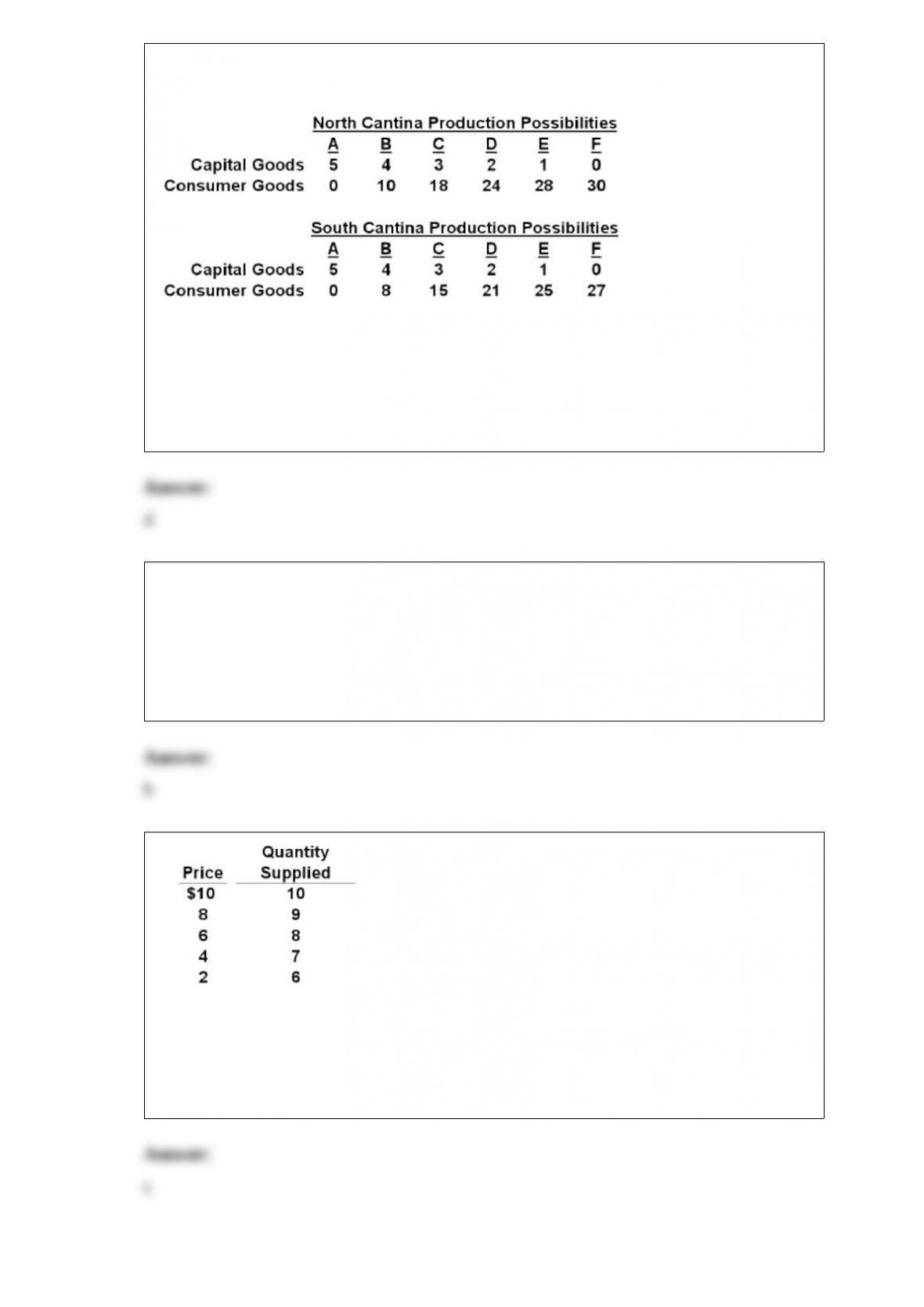
5) answer the next question(s) on the basis of the following production possibilities
tables for two countries, north cantina and south cantina:
refer to the above tables. if north cantina is producing at production alternative b, the
opportunity cost of the eleventh unit of consumer goods will be:
a.10 units of capital goods.
b.1/4 of a unit of capital goods.
c.8 units of capital goods.
d.1/8 of a unit of capital goods.
6) which of the following is associated with macroeconomics?
a.an examination of the incomes of harvard business school graduates
b.an empirical investigation of the general price level and unemployment rates since
1990
c.a study of the trend of pecan prices since the second world war
d.a case study of pricing and production in the textbook industry
7)
over the $10-$8 price range, the elasticity coefficient of supply is:
a.1
b.zero.
c.less than 1
d.greater than 1

8) A total fertility rate of 1.0 will cause the:
A.population to remain stable.
B.population to double in one generation.
C.population to collapse in one generation.
D.next generation to be half the size of the current generation.
9) A profit-maximizing firm will:
A.expand employment if marginal revenue product exceeds marginal resource cost.
B.reduce employment if marginal revenue product exceeds marginal resource cost.
C.expand employment if marginal revenue product equals marginal resource cost.
D.reduce employment if marginal revenue product equals marginal resource cost.
10) Kara and Kyle are competing Sockeye Salmon fishers. Both have been allocated
ITQs that limit their catch to 2,000 tons of Sockeye Salmon each. Kara’s cost per ton is
$8; Kyle’s cost per ton is $12.
Refer to the information above and assume that the market price of Sockeye Salmon is
$15 per ton. If Kara pays Kyle $5 per ton for his ITQs, and if she then catches her new
limit of 4,000, their combined profit would be:
A.$28,000.
B.$22,000.
C.$20,000.
D.$4,000.
11) In 2006, the official poverty line for a household of four in the United States was
about:
A.$20,000.
B.$26,800.
C.$9,800.
D.$29,500.
12) The desire to hold money for transactions purposes arises because:
A.receipts of income and expenditures are not perfectly synchronized.
B.people fear that prices will rise.

C.households want money on hand in case a good financial investment opportunity
arises.
D.low interest rates reduce the opportunity cost of holding money.
13) When economists view technological change as internal to the economy, they mean
that it:
A.occurs randomly.
B.occurs accidentally.
C.arises deliberately from the profit motive and competition.
D.arises mainly from government subsidies.
14) with respect to state finance:
a.estate taxes are the major source of revenue and most expenditures are for health
services.
b.the corporate income tax is the major source of revenue and natural resource
development the major type of expenditure.
c.property taxes are the basic source of revenue and education is the major type of
expenditure.
d.sales and excise taxes are the major source of revenue and education is the major type
of expenditure.
15) Assume that a single commercial bank has no excess reserves and that the reserve
ratio is 20 percent. If this bank sells a bond for $1,000 to a Federal Reserve Bank, it can
expand its loans by a maximum of:
A.$1,000.
B.$2,000.
C.$800.
D.$5,000.
16) (Last Word) The U.S. sugar program:
A.decreases the domestic price of sugar.
B.requires import quotas or tariffs on foreign sugar.
C.increases the export earnings of other sugar-producing countries.
D.aids developing countries that produce sugar.
17) The pure rate of interest is approximated by the:
A.rate which savings and loan associations charge on mortgage loans.
B.rate charged consumers by credit card companies.
C.rate paid on long-term government bonds.
D.announced rate at which commercial banks make business loans.
18) Which among the following is the strongest determinant of an industry’s
technological progressiveness?
A.the scientific character of its industry and the number of technological opportunities
available.
B.the size of the industry concentration ratio; the lower the ratio, the greater the firm’s
technological progressiveness.
C.the Herfindahl index in the firm’s industry; the higher the index value, the greater the
firm’s technological progressiveness.
D.the amount of retained earnings in the industry.
19)
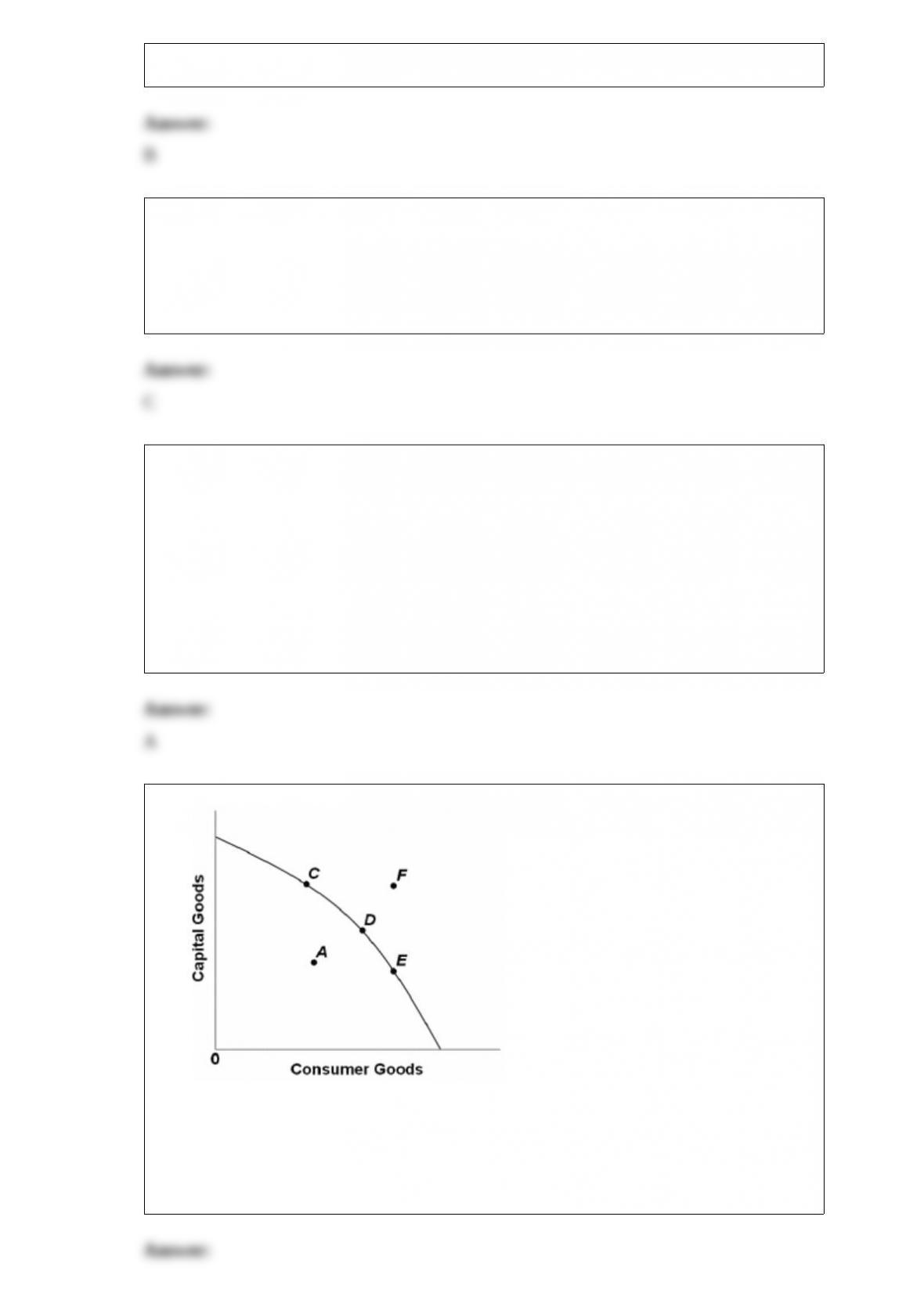
In the above diagram, the elimination of discrimination is best represented by:
A.a move from C to E.
B.an inward shift of the production possibilities curve.
C.a move from A to D.
D.a move from E to C