
In a competitive market equilibrium
A) total consumer surplus equals total producer surplus.
B) marginal benefit and marginal cost are maximized.
C) consumers and producers benefit equally.
D) the marginal benefit equals the marginal cost of the last unit sold.
If taxes are less than transfers plus government spending, then
A) there is positive saving.
B) there is a balanced budget.
C) there is a budget surplus.
D) there is public dissaving.
According to Douglass North, the Industrial Revolution occurred in England because
A) the British Parliament took control of the government and could credibly commit to
upholding property rights.
B) the British monarchy took control of the government and pledged not to raise taxes
arbitrarily.
C) the British courts became tied to the king and began to refuse to enforce property
rights.
D) the British Parliament instituted a command economy structure and implemented a
planned economy.
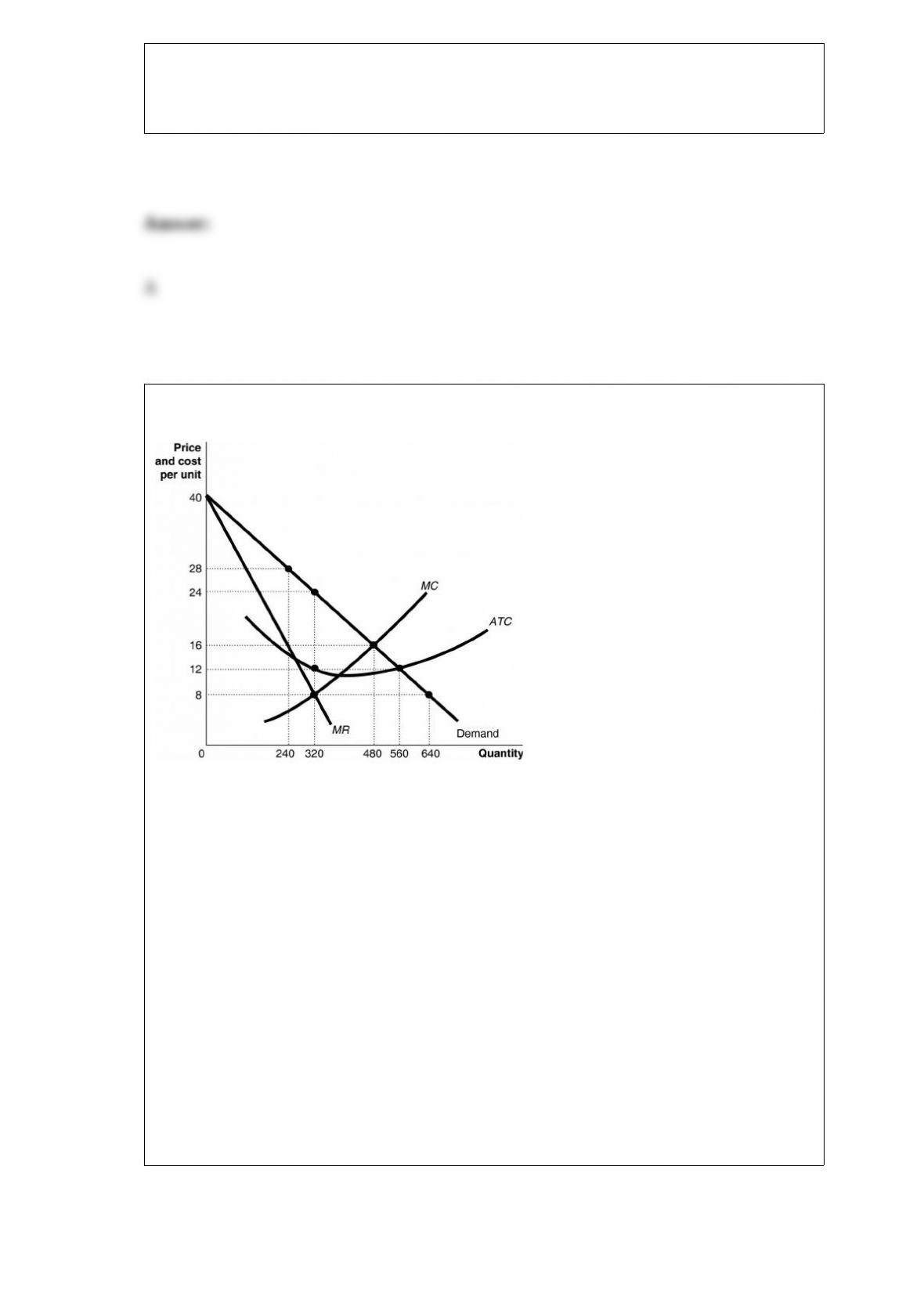
Figure 16-5
Consider the following two pricing strategies:
a. a fixed fee and a per-unit price equal to the monopoly price
b. a fixed fee and a per-unit price equal to the competitive price
The firm represented in the diagram earns a higher profit under strategy ________ and
deadweight loss is eliminated under ________.
A) b; b
B) a; b
C) a; neither strategy
D) b; neither strategy

Assuming no change in the nominal exchange rate, how will a higher rate of inflation in
the United States relative to France affect the real exchange rate between the two
countries? (Assume the United States is the “domestic” country.)
A) The real exchange rate will rise.
B) The real exchange rate will fall.
C) The real exchange rate will be unaffected.
D) The impact on the real exchange rate cannot be predicted.
The demand curve for labor is also
A) the demand curve for the output produced with labor since the demand for labor is a
derived demand.
B) the marginal product of labor curve.
C) the marginal revenue product of labor curve.
D) the supply curve for the output labor is used to produce.

Tomas increased his consumption of potato chips when the price of pistachios
increased. For Tomas, potato chips and pistachios are
A) substitutes in consumption.
B) both inferior goods.
C) complements in consumption.
D) both luxury goods.
Consider a situation in which a utility company emits high levels of sulfur dioxide and
the company is not liable for the damages its pollution causes. According to the Coase
theorem, government action is ________ to achieve an ________ amount of pollution.
A) necessary; equitable
B) necessary; efficient
C) not necessary; equitable
D) not necessary; efficient
If firms do not increase their quantity supplied when price changes, then supply is
A) perfectly elastic.
B) perfectly inelastic.
C) relatively inelastic.

D) elastic.
Which of the following tax systems would help reduce income inequality the most?
A) a regressive tax system
B) a proportional tax system
C) a progressive tax system
D) a consumption tax system
In August 2008, Ethan Nicholas developed the iShoot application for the apple iPhone
3G, and within five months had earned $800,000 from this program. By May 2009,
Nicholas had dropped the price from $4.99 to $1.99 in an attempt to maintain sales.
This example indicates that in a competitive market
A) earning an economic profit in the long run is extremely easy.
B) earning an economic profit in the long run is extremely difficult.
C) it is impossible to earn an economic profit in either the short run or the long run.
D) economic profits are only earned in the long run.

In the circular flow model, households
A) sell goods and services in the input market.
B) and firms spend earnings from resource sales on goods and services in the factor
market.
C) hire resources sold by firms in the factor market.
D) spend earnings from resource sales on goods and services in the product market.
A Big Mac costs $4.56 in the United States and 9.2 zlotys in Poland. If the exchange
rate is 3 zlotys per dollar, what is the dollar cost of a Big Mac in Poland?
A) $1.52
B) $2.02
C) $3.07
D) $4.64
Table 19-4

Consider the data above (in billions of dollars) for an economy: Gross domestic product
(in billions of dollars) for this economy equals
A) $2,200.
B) $2,100.
C) $1,600.
D) $1,400.
For many small firms, providing health insurance for their workers
A) has decreased in cost over the past 10 years.
B) represents their most rapidly increasing cost.
C) costs virtually nothing under the ACA.
D) encourages them to hire more full-time workers.

Of the following U.S. presidents, which was the first to propose a national health
insurance program to Congress?
A) Barack Obama
B) Bill Clinton
C) John F. Kennedy
D) Harry Truman
What are earnings per share equal to?
A) the last dividend payment made
B) total dividend payments plus retained earnings divided by outstanding stock shares
C) the amount by which the stock’s market price has increased in the last year
D) revenues divided by the number of stockholders
Which aggregate supply curve has a positive slope?
A) long run only
B) short run only
C) both long run and short run
D) neither long run nor short run
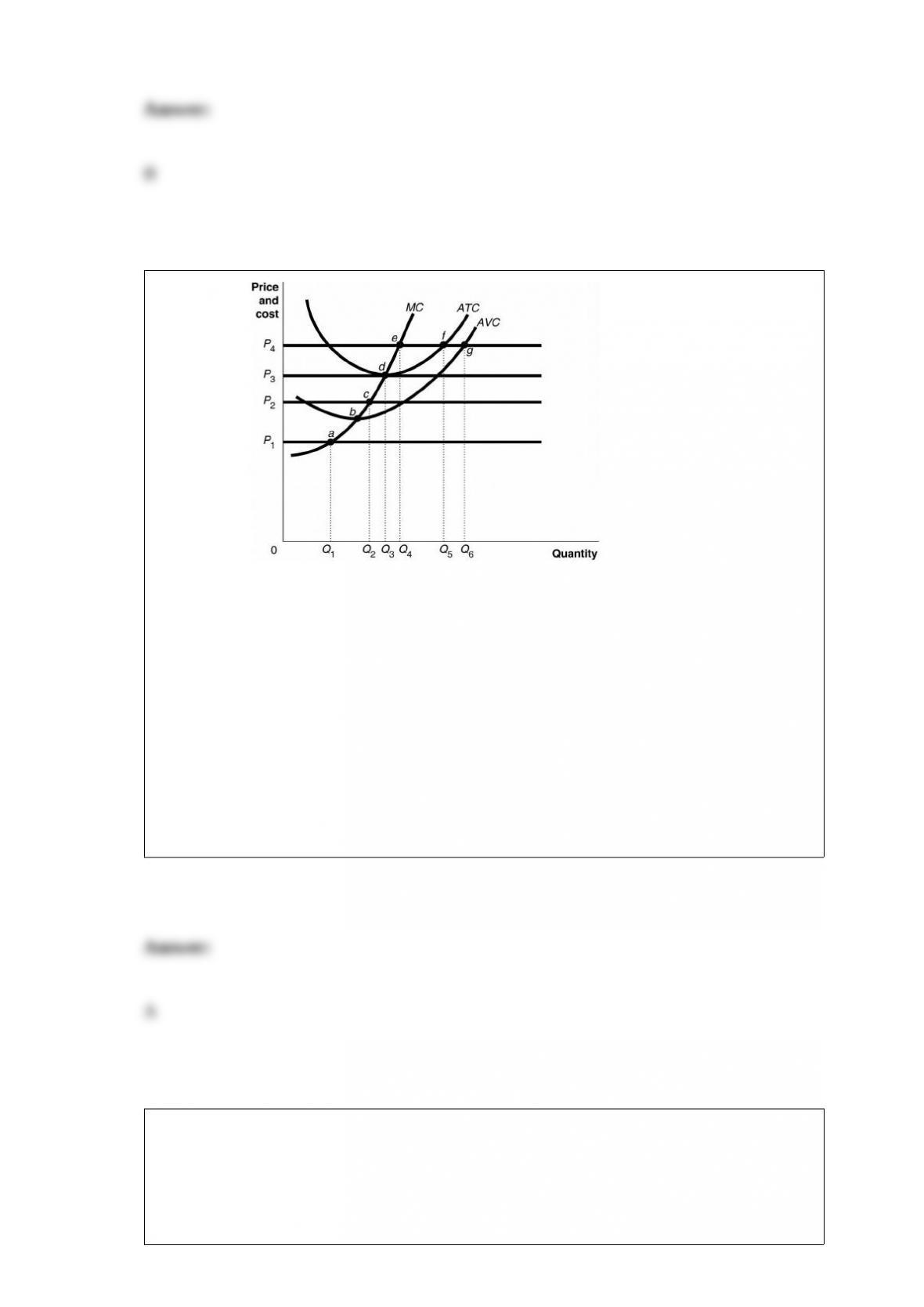
Figure 12-9 Figure 12-9 shows cost and
demand curves facing a profit-maximizing, perfectly competitive firm.
At price P2, the firm would produce
A) Q2 units.
B) Q3 units.
C) Q4 units.
D) zero units.
Select the phrase that correctly completes the following statement. “An increase in input
prices caused a decrease in the supply of baseballs. As a result ________.”
A) the price of baseballs increased and the demand for baseballs decreased

B) the equilibrium quantity of baseballs increased
C) the price of baseballs increased and the quantity demanded of baseballs decreased
D) the price of baseballs increased. The higher price caused the supply of baseballs to
increase