
1) Traveling sales representative Harold Hill only calls on clients four days a week
rather than the five days expected by his employer. This is an example of:
A.equalizing differences.
B.a nonmonetary job disadvantage.
C.shirking.
D.the free-rider problem.
2) (consider this) the main focus of the story about nuclear particle accelerators used for
cancer treatments is:
a.cost-saving medical technology.
b.cost reductions from spreading an overhead expense over many patients.
c.longer-lasting equipment than the equipment being replaced.
d. benefit-producing, but cost-increasing, medical technology.
3) If two nations have straight-line production possibilities curves:
A.then their trading possibilities curves must lie inside the production possibilities
curves.
B.there will be no basis for mutually advantageous trade.
C.there will be a basis for mutually advantageous trade whether the slopes are equal or
not.
D.there will be a basis for mutually advantageous trade provided the slopes differ.
4) Critics of industrial regulation say that such regulation:
A.contributes to X-inefficiency.
B.benefits small firms at the expense of large firms.
C.creates insurmountable principal-agent problems.
D.suffers from the free-rider problem.
5) If MPa/Pa = MPb/Pb and MRPa/Pa = MRPb/Pb>1, this firm is:
A.producing its output with the least costly combination of resources, but is not
producing the profit-maximizing output.
B.maximizing profits, but failing to minimize costs.
C.neither maximizing profits nor minimizing costs.
D.combining resources a and b so as to minimize costs and maximize profits.
6) examples of command economies are:
a.the united states and japan.
b.sweden and norway.
c.mexico and brazil.
d.cuba and north korea.
7)
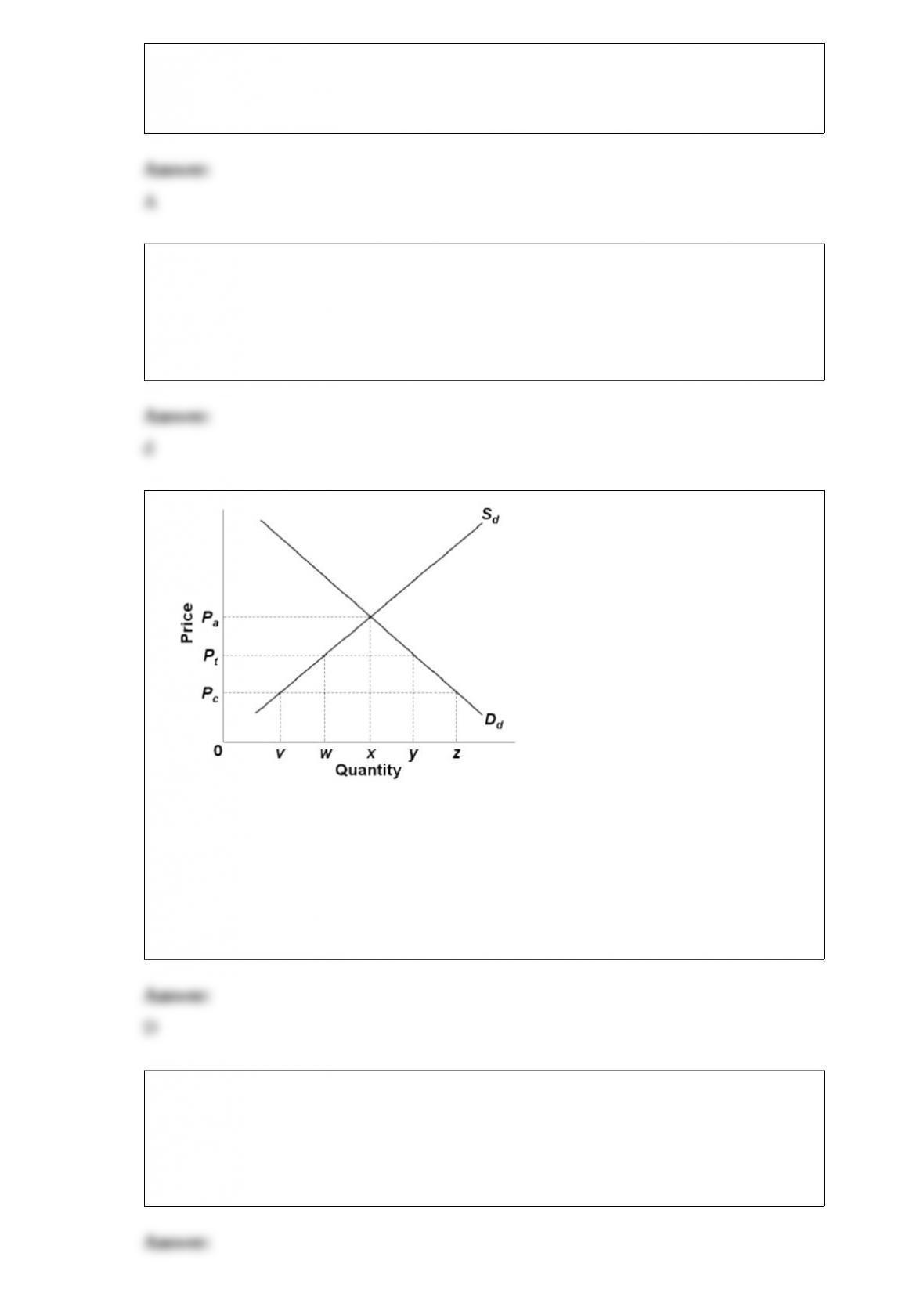
Refer to the above diagram, where Sd and Dd are the domestic supply and demand for a
product and Pc is the world price of that product. With a PcPt per unit tariff, per unit
revenue received by domestic and foreign producers respectively will be:
A.Pc and Pa.
B.Pa and Pc.
C.Pa and Pt.
D.Pt and Pc.
8) limited liability applies to:
a.partnerships.
b.proprietorships.
c.all corporations.
d.financial corporations but not to manufacturing corporations.
9) A checking account entry is money because it:
A.is ensured by the Federal Deposit Insurance Corporation.
B.has been declared as such by the Federal government.
C.performs the functions of money.
D.can be sold for currency.
10)
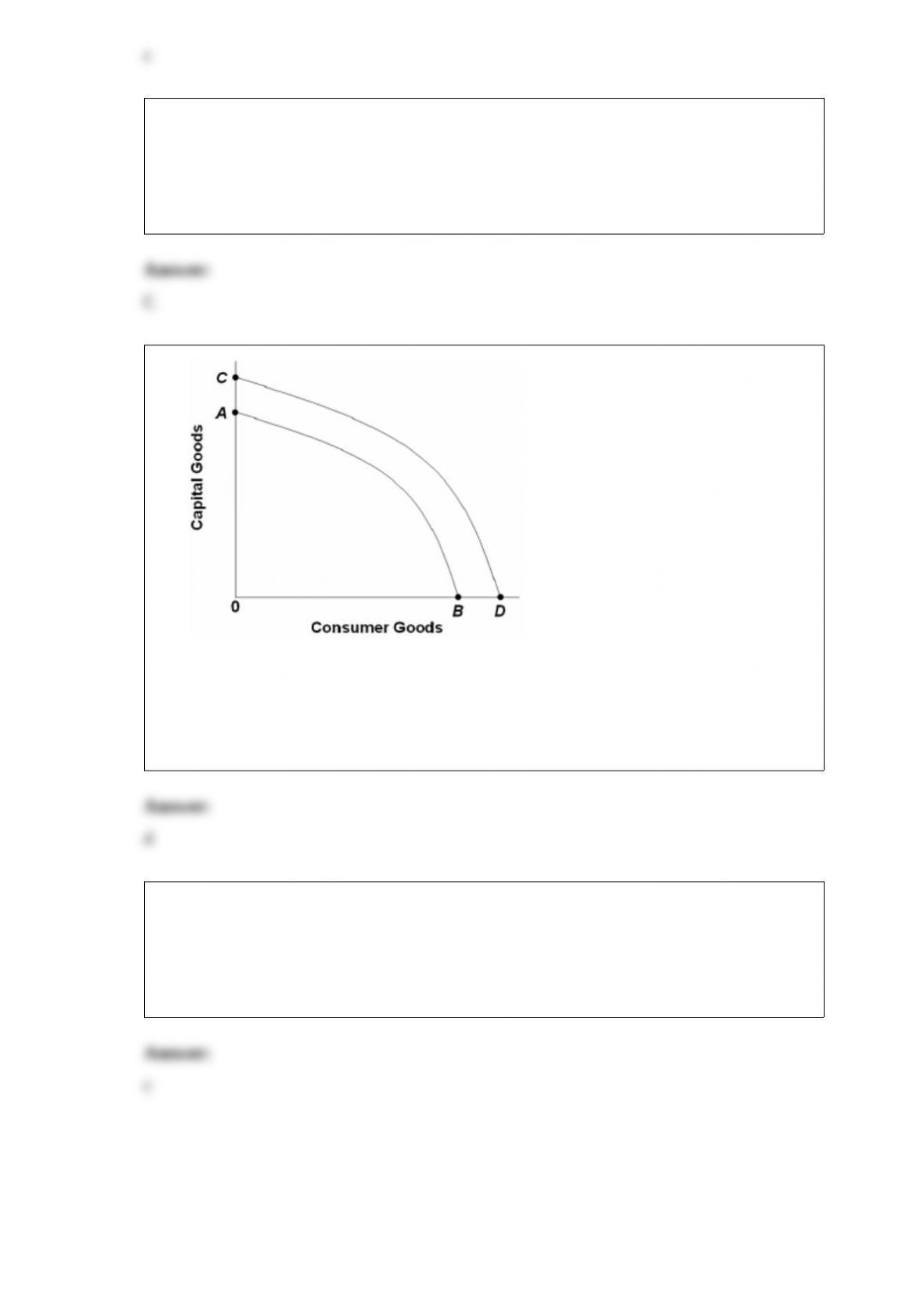
refer to the above graphs. an increase in the economy’s human capital would:
a.move the economy away from point a and toward point b.
b.shift curve cd to ab.
c.move the economy away from point b and toward point a.
d.shift curve ab to cd.
11) there is some evidence to suggest that x-inefficiency is:
a.absent whenever two or more producers are competing with one another.
b.not encountered in either competitive or monopolistic firms.
c.more likely to occur in monopolistic firms than in competitive firms.
d.more likely to occur in competitive firms than in monopolistic firms.