
1) The critical feature of a monopsonistic labor market is that the employer:
A.has a perfectly elastic demand curve for labor.
B.can hire any number of workers it chooses at the going wage rate.
C.faces an upsloping labor supply curve.
D.faces a perfectly inelastic labor supply curve.
2) Melanie and Oli are competing Pacific Halibut fishers. Both have been allocated
ITQs that limit their catch to 1,000 tons of Pacific Halibut each. Melanie’s cost per ton
is $20; Oli’s cost per ton is $28.
Refer to the information above and assume that the market price of Pacific Halibut is
$40 per ton. If Melanie pays Oli $10 per ton for his ITQs and then catches her new limit
of 2,000 tons, their combined profit would be:
A.$28,000.
B.$32,000.
C.$40,000.
D.$54,000.
3) Assume that Brazil and Mexico have floating exchange rates. Other things
unchanged, if the price level is stable in Mexico but Brazil experiences rapid inflation:
A.gold bullion will flow into Brazil.
B.the Brazilian real will depreciate.
C.the Mexican peso will depreciate.
D.the Brazilian real will appreciate.
4) The idea that an economy can get stuck in either an unemployment equilibrium or an
inflation equilibrium is most closely associated with:
A.new classical economics.
B.the real-business-cycle theory.
C.monetarism.
D.the idea of coordination failures.
5) A major purpose of usury laws is to make more funds available to low-income
borrowers. Economic analysis suggests that usury laws:

A.are effective in achieving this goal.
B.allocate available funds to high-income borrowers.
C.have no impact on the allocation of funds between high-income and low-income
people.
D.help low-income people only when the legal interest rate is above the market rate.
6) (Last Word) The use of U.S. dollars in foreign countries:
A.is illegal under international law.
B.helps foreign buyers and sellers overcome problems with their domestic currencies.
C.varies directly (positively) with U.S. interest rates.
D.is less in volume than the use of foreign currencies in the United States.
7) The multiplier associated with a change in government purchases is:
A.always equal to 1.
B.smaller than that associated with an equal change in taxes.
C.the same as that associated with a change in investment.
D.less than that associated with a change in investment.
8) The Fed’s ability to alter the level of reserves in the banking system is the main idea
of the:
A.sponge analogy.
B.squeegee analogy.
C.pushing-on-a-string analogy.
D.hose analogy.
9)
The rent paid for the pasture land used to graze cattle would increase if:
A.the productivity of the land increased.
B.people decided to consume more beef.
C.oil deposits were discovered on the land.
D.any of the above occurred.

10) (Last Word) The dispute over the pay of chief executive officers (CEOs) of U.S.
corporations hinges on whether or not such pay:
A.should be granted for past performance or for current performance.
B.is determined in a competitive labor market or in a monopsonistic labor market.
C.is justified on productivity grounds or mainly reflects an overestimation of CEO
importance by corporate boards of directors.
D.should contain performance incentives such as stock options, stock shares, or
bonuses.
11) a pure monopolist is:
a.any firm realizing all existing economies of scale.
b.any firm whose demand curve is downsloping.
c.any firm which can engage in price discrimination.
d.a one-firm industry.
12) Suppose capital and labor are used in fixed proportions so that each machine
requires only one worker. If a decline in the price of capital occurs, then the demand for
labor will:
A.decline solely because of the substitution effect.
B.increase solely because of the substitution effect.
C.increase solely because of the output effect.
D.decrease solely because of the output effect.
13) Which of the following terms describes a system of subsidized health insurance
available to the aged?
A.Medicare
B.Supplemental Security Income (SSI)
C.Medicaid
D.TANF
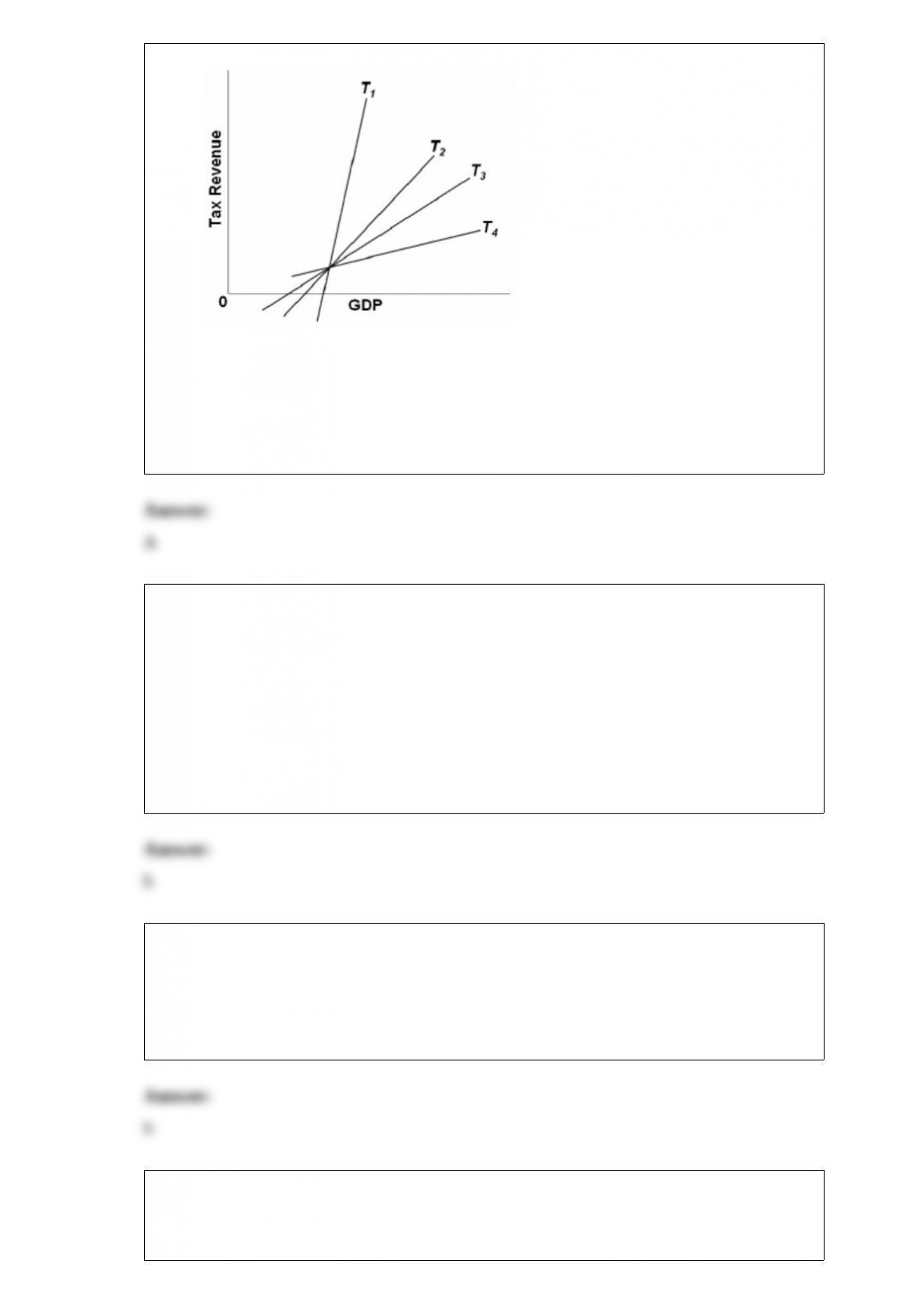
14)
Refer to the above diagram. Which tax system has the least built-in stability?
A.T4
B.T3
C.T2
D.T1
15) which of the following is a correct statement?
a.economic concepts or laws that are valid during depression are necessarily valid
during prosperity.
b.though not quantitatively exact, economic laws are useful because they allow us to
predict and therefore control or adjust to events.
c.economics is as scientific as are physics and chemistry because economic laws are as
quantitatively precise as the laws of physics or chemistry.
d.because economics is concerned with questions of “ought,” it is a branch of applied
ethics and not scientific.
16) most economists agree that the immediate cause of most business cycle variation is:
a.an unexpected change in the productivity of workers.
b.an unexpected change in the level of total spending.
c.the invention of new products.
d.the growth and subsequent bursting of financial bubbles.
17) When the required reserve ratio is decreased, the excess reserves of member banks
are:
A.reduced, but the multiple by which the commercial banking system can lend is

unaffected.
B.reduced and the multiple by which the commercial banking system can lend is
increased.
C.increased and the multiple by which the commercial banking system can lend is
increased.
D. increased and the multiple by which the commercial banking system can lend is
reduced.
18) economic immigrants:
a.are defined as any international migrants that have an impact on the economy.
b.are defined as international migrants motivated by economic gain.
c.only impact the economy if they enter the country legally.
d.include not only people, but also any capital that migrates from another country.
19) The Federal Reserve Banks sell government securities to the public. As a result, the
checkable deposits:
A.of commercial banks are unchanged, but their reserves increase.
B.and reserves of commercial banks both decrease.
C.of commercial banks are unchanged, but their reserves decrease.
D.of commercial banks are both unchanged.
20) Why is the difference between the actual and expected rates of inflation important
for explaining disinflation?
21) How can the aggregate demand curve be derived from the aggregate expenditures
model?
22) How might competition eradicate discrimination? Historically, has this been
observed?
23) Why is money not an economic resource? If it is not productive, then why do
businesses want to obtain or buy it?
24) Contrast the public interest theory of regulation with the legal cartel theory of
regulation.
25) Do protectionist policies benefit producers, consumers, workers, or the
government? Explain.
26) Though wages under bilateral monopoly are logically indeterminate, some wage
rate is actually established in such market situations. Explain those economic and
noneconomic factors that might be pertinent to the establishment of this wage.
27) Which aspects, if any, of monetarist or rational expectations theory have been
integrated into mainstream macroeconomics?
28) Compare and contrast the suitability of different market structure for fostering
technological advance.