
If wages and prices adjust rapidly, we would expect expansionary monetary policy to be
A) more likely to reduce the natural rate of unemployment.
B) more likely to affect the unemployment rate.
C) less likely to affect the unemployment rate.
D) less likely to result in a vertical short-run Phillips curve.
If the United States and other developed nations pay the cost of reducing public
emissions, developing nations such as China could benefit from the reduction while not
contributing to it. In this sense, one can think of reducing carbon emissions as being
like a
A) public good.
B) private good.
C) quasi-private good.
D) quasi-public good.
If a firm expects that the price of its product will be lower in the future than it is today
A) the firm has an incentive to increase supply now and decrease supply in the future.
B) the firm has an incentive to decrease supply now and increase supply in the future.
C) the firm has an incentive to increase quantity supplied now and decrease quantity
supplied in the future.
D) the firm will not change supply until it knows for certain what will happen to its
price.
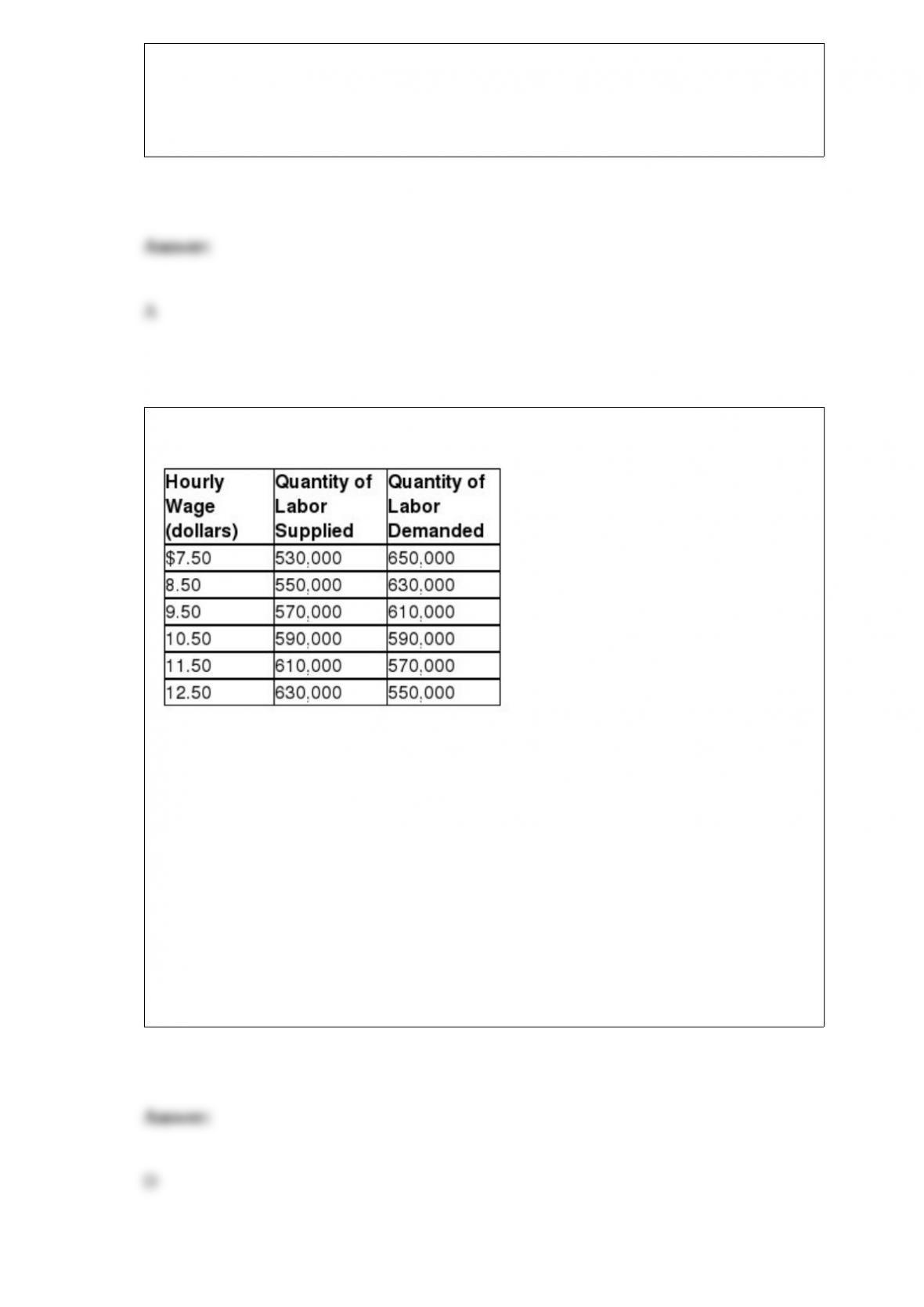
Table 4-7
Table 4-7 shows the demand and supply schedules for labor market in the city of Pixley.
Suppose that the quantity of labor demanded increases by 40,000 at each wage level.
What are the new free market equilibrium hourly wage and the new equilibrium
quantity of labor?
A) W = $8.50; Q = 550,000
B) W = $12.50; Q = 630,000
C) W = $9.50; Q = 570,000
D) W = $11.50; Q = 610,000

When calculating GDP, the Bureau of Economic Analysis revises its quarterly data
A) a total of one time.
B) a total of two times.
C) a total of three times.
D) many times over the next several years.
In a city with rent-controlled apartments, all of the following are true except
A) apartments usually rent for rates lower than the market rate.
B) apartments are often in shorter supply than they would be without rent control.
C) it usually takes more time to find an apartment than it would without rent control.
D) landlords have an incentive to rent more apartments than they would without rent
control.
An externality is
A) a benefit realized by the purchaser of a good or service.
B) a cost paid for by the producer of a good or service.
C) a benefit or cost experienced by someone who is not a producer or consumer of a
good or service.
D) anything that is external or not relevant to the production of a good or service.
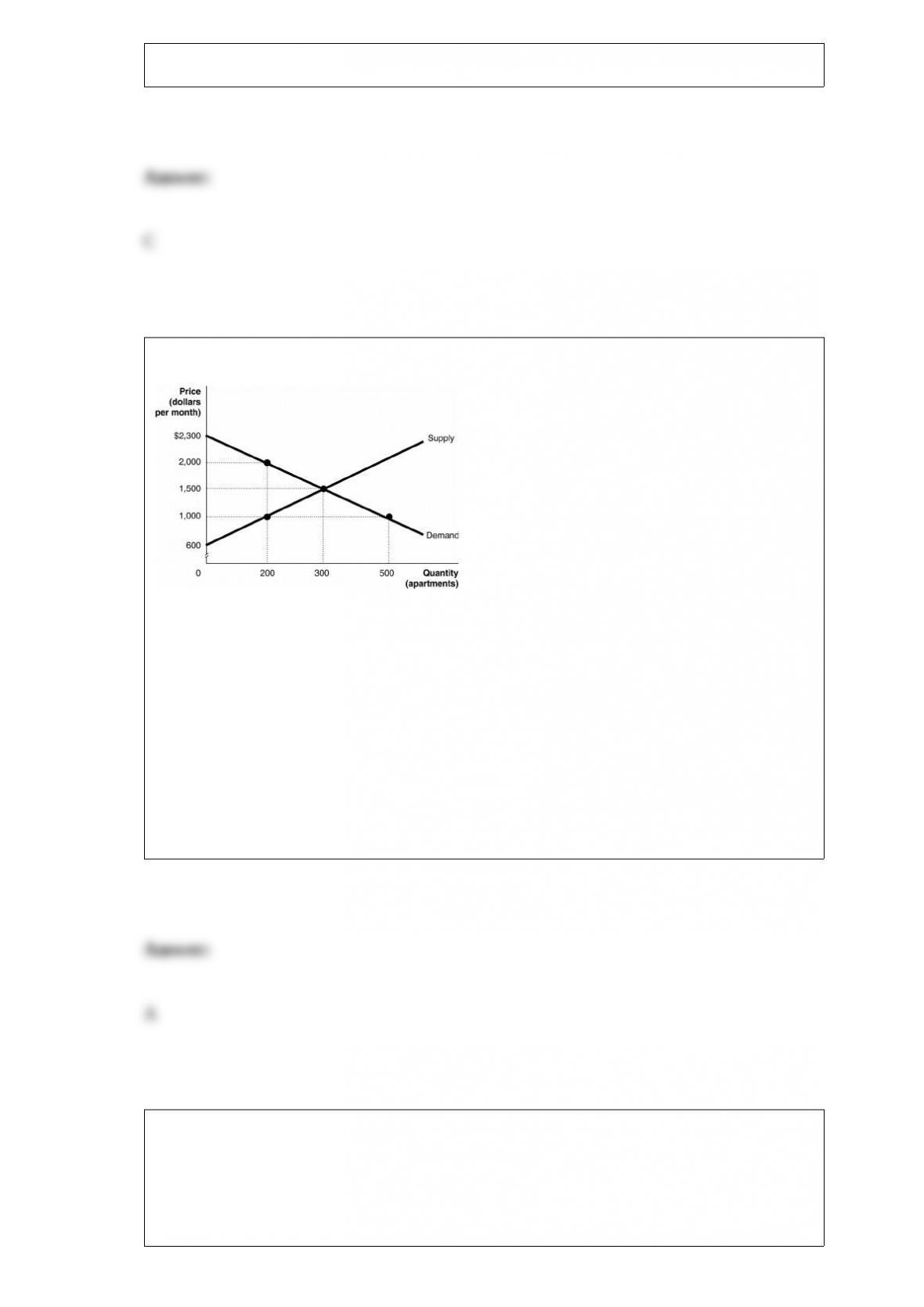
Figure 4-5
Figure 4-5 shows the market for apartments in
Springfield. Recently, the government imposed a rent ceiling of $1,000 per month.
What is the value of the deadweight loss after the imposition of the ceiling?
A) $50,000
B) $125,000
C) $175,000
D) $260,000
a. Distinguish between a tariff and a quota.
b. In what ways are tariffs and quotas similar?
c. In what ways are tariffs and quotas different?
d. Why might a foreign producer prefer a quota rather than a tariff?
Under which of the following circumstances would the government be running a
deficit?
A) G = $5 trillion
T = $5 trillion
TR = $1 trillion
B) G = $5 trillion
T = $7 trillion
TR = $1 trillion
C) G = $7 trillion
T = $7 trillion
TR = $0
D) G = $7 trillion
T = $10 trillion

TR = $3 trillion
A change in consumption spending caused by income changes is ________ change in
spending, and a change in government spending that occurs to improve roads and
bridges is ________ change in spending.
A) an induced; an autonomous
B) an expansionary; a contractionary
C) an autonomous; an induced
D) a contractionary; an expansionary
Which of the following assets is most liquid?
A) money
B) bond
C) savings account
D) stock

According to the horizontal-equity principle of taxation,
A) individuals who receive the benefits of a good or service should bear a greater share
of the tax burden.
B) individuals who are most able to pay should bear a greater share of the tax burden.
C) people in the same economic situation should be treated equally.
D) individuals who are willing to bear a greater share of the tax burden should be
compensated with non-monetary benefits.