
1) Demand is the active and supply the passive determinant of land rent.
2) Thomas Malthus argued that increases in living standards tend to reduce birthrates.
3) the existence of “beaten paths” tends to discourage immigration because of the
perception that job prospects have been exhausted.
4) When the Fed auctions reserves through the term auction facility, the interest rate is
set by the rate offered by the lowest bidder whose bid is accepted.
5) Given supply, the more inelastic the demand for a product, the larger the portion of
an excise tax that is shifted to consumers.
6) Increases in U.S. living standards have matched increases in per capita energy use.
7) the health care industry currently absorbs about 16 percent of u.s. gross domestic
product.
8) Elephants are moving closer to extinction in places where they are treated as private

property.
9) The number of U.S. banks has increased since 1990.
10) Industrial unions are more likely to increase wage rates by restricting the supply of
labor than are craft unions.
11) Although state and local taxes are highly progressive, Federal taxation is
predominantly regressive.
12) The differences in the per capita incomes of the IACs and the DVCs has diminished
sharply since the Second World War because of U.S. aid programs.
13) The optimal quantity of a public good occurs where the marginal benefit of the
citizen who has the highest preference for the good just equals the good’s marginal cost.
14) markets explained on the basis of supply and demand:
a.assume many buyers and many sellers of a standardized product.
b.assume market power so that buyers and sellers bargain with one another.
c.do not exist in the real-world economy.
d.are approximated by markets in which a single seller determines price.
15) Process innovation can be depicted as:
A.an upward shift in a firm’s total product curve.
B.an upward shift in a firm’s marginal cost curve.
C.a downward shift in a firm’s marginal revenue curve.
D.an increase in product demand.
16)
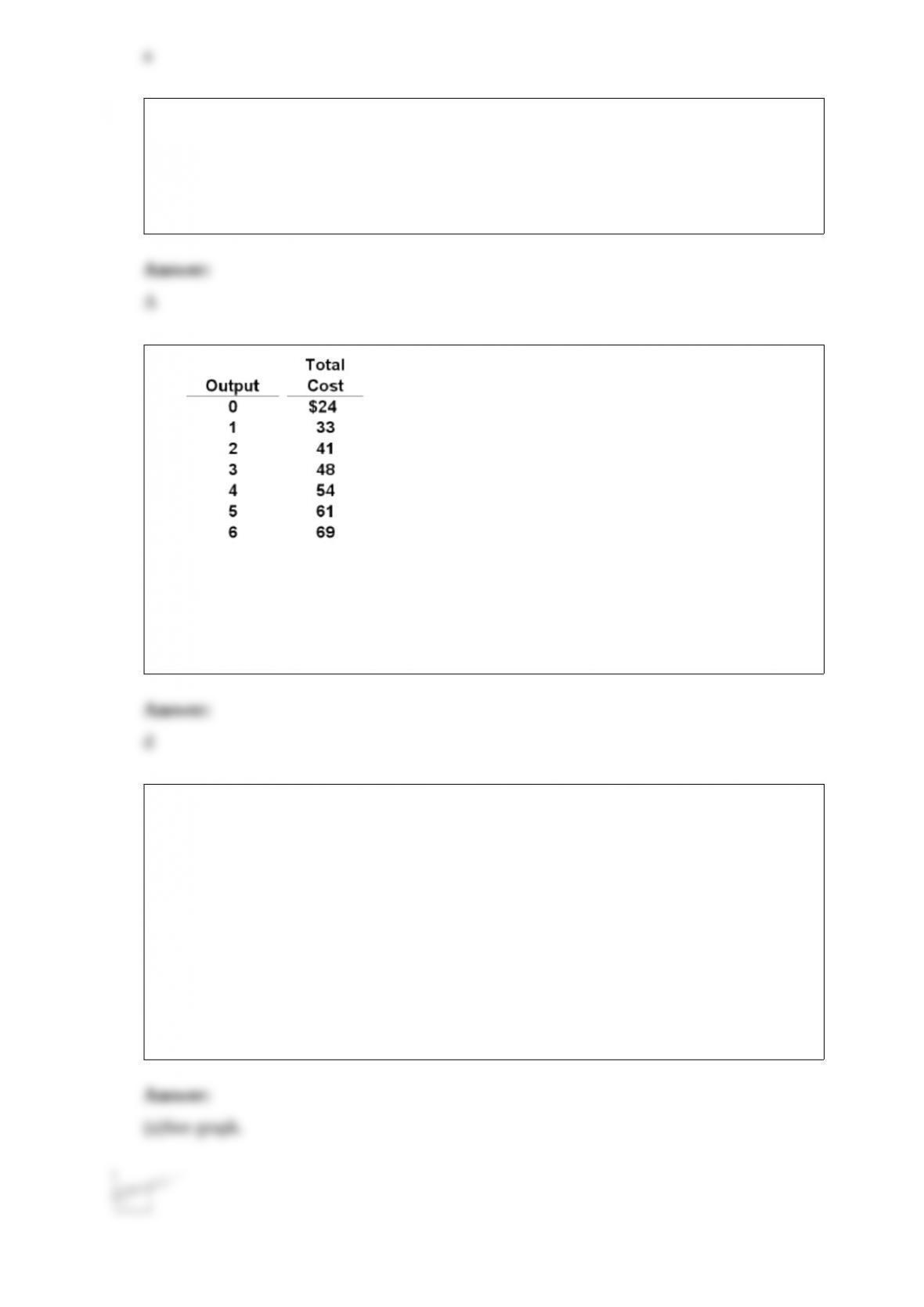
refer to the above data. the profit-maximizing output for this firm:
a.is 3
b.is 4
c.is 5
d.cannot be determined from the information given.
17) Consider the mining of a nonrenewable resource over a two-year period by a
company.
(a)Use a graph to help explain the choice between present and future extraction of a
nonrenewable resource over a two-year period. In the explanation state the difference
between extraction and user cost.
(b)How does the addition of user cost to extraction costs affect the quantity extracted in
the present compared with the future?
(c)How do profit calculations influence the quantity extracted the first year or the
second year?
(d)What will happen to the quantity extracted in the present compared with profitability
increase in the future? Explain the effects on the graph.
18) Since 1960, real hourly compensation in the United States has approximately:
A.remained the same.
B.risen by 40 percent.
C.doubled.
19) Statistical data for the 1970s and 1980s suggest that:
A.the Phillips Curve was stable.
B.the Phillips Curve was unstable.
C.low levels of unemployment were consistently associated with high rates of inflation.
D.the inflation rate was highly stable.

20) A farmer who has fixed amounts of land and capital finds that total product is 24 for
the first worker hired; 32 when two workers are hired; 37 when three are hired; and 40
when four are hired. The farmer’s product sells for $3 per unit and the wage rate is $13
per worker.
Refer to the above information. The marginal product of the second worker is:
A.24
B.8
C.5
D.1
21) suppose that in the clothing market, production costs have fallen, but the
equilibrium price and quantity purchased have both increased. based on this
information we can conclude that:
a.the supply of clothing has grown faster than the demand for clothing.
b.demand for clothing has grown faster than the supply of clothing.
c.the supply of and demand for clothing have grown by the same proportion.
d.there is no way to determine what has happened to supply and demand with this
information.
22) assume a pure monopolist is currently operating at a price-quantity combination on
the inelastic segment of its demand curve. if the monopolist is seeking maximum
profits, it should:
a.retain its current price-quantity combination.
b.increase both price and quantity sold.
c.charge a lower price.
d.charge a higher price.
23) when a pure monopolist is producing its profit -maximizing output, price will:
a.be less than mr
b.equal neither mc nor mr
c.equal mr
d.equal mc

24) Critics of U.S. farm policy:
A.argue that most of the farm subsidies go to high-income farmers.
B.argue that various components of agricultural policy are contradictory and seek
conflicting goals.
C.argue that the cost of farm policies increased sharply in the past two decades.
D.make all of these arguments.
25) other things equal, and given that the elasticity of demand of health care is 0.2, a 10
percent increase in income in the united states will increase the quantity of health care
demanded by:
a.2 percent.
b.6-8 percent.
c.10-15 percent.
d.25 percent.
26) Answer the next question(s) on the basis of the following information: An economy
is employing 2 units of capital, 5 units of raw materials, and 8 units of labor to produce
its total output of 640 units. Each unit of capital costs $10, each unit of raw materials,
$4, and each unit of labor, $3.
Refer to the above information. The per-unit cost of production in this economy is:
A.$0.05.
B.$0.10.
C.$0.50.
D.$1.00.
27) utility:
a.is synonymous with usefulness.
b.is want-satisfying power.
c.is easy to quantify.
d.rarely varies from person to person.
28) the scarcity problem:
a.persists only because countries have failed to achieve continuous full employment.
b.persists because economic wants exceed available productive resources.
c.has been solved in all industrialized nations.
d.has been eliminated in affluent societies such as the united states and canada.
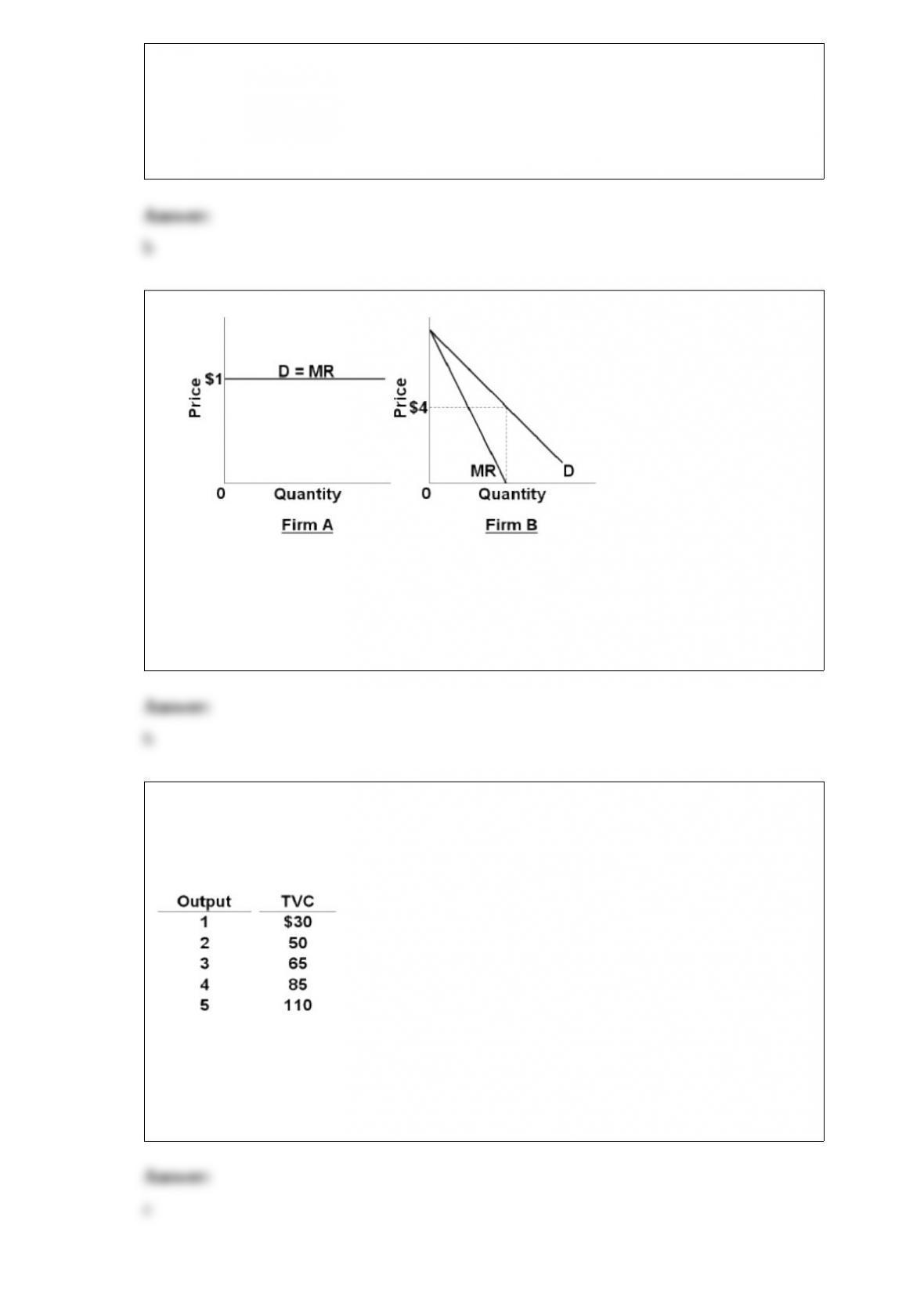
29)
refer to the above diagrams. firm a’s average revenue is:
a.zero.
b.$1.
c.less than $1.
d.more than $1.
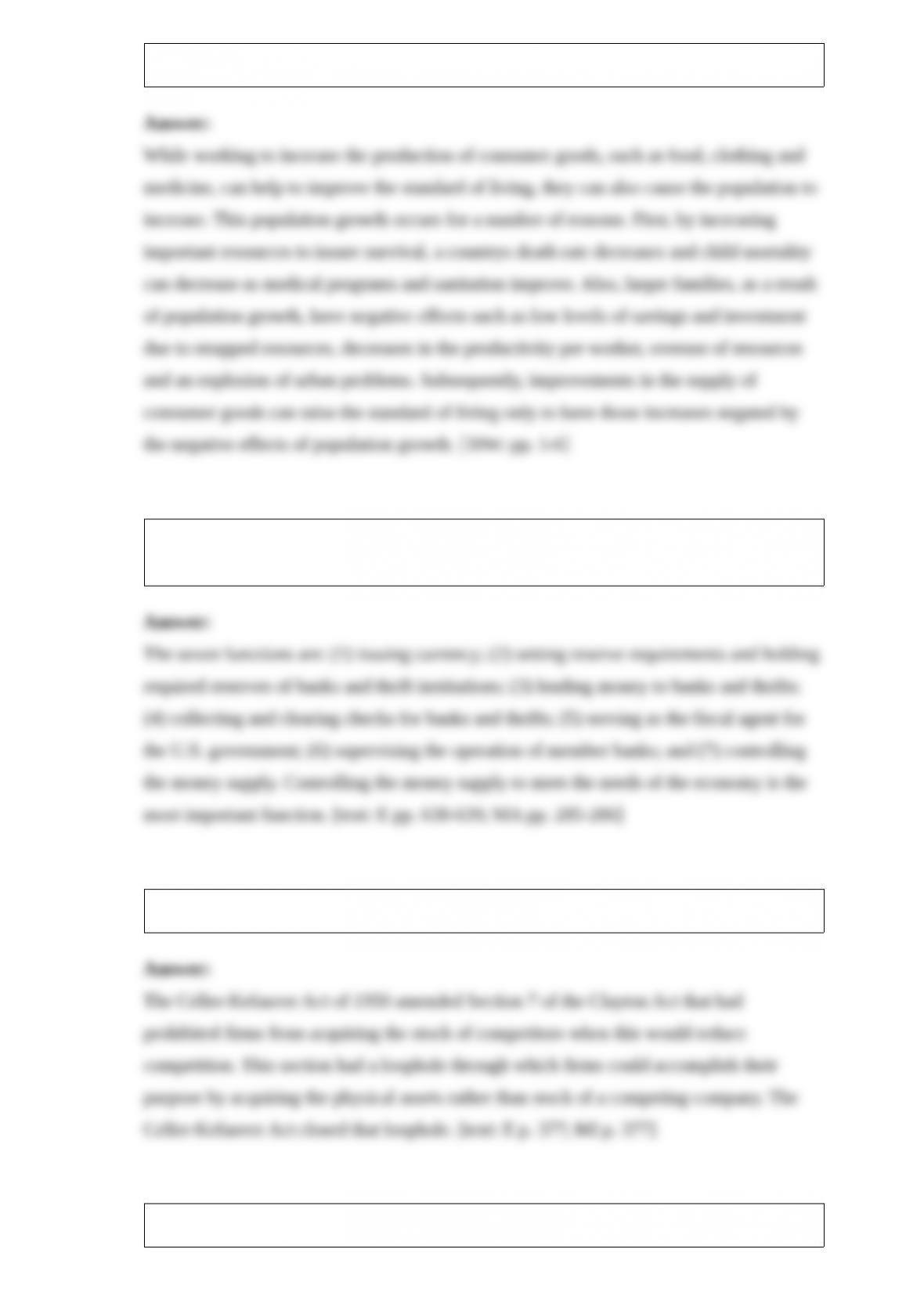
30) the sunshine corporation finds that its costs are $40 when it produces no output. its
total variable costs (tvc) change with output as shown in the accompanying table. use
this information to answer the following question(s).
refer to the above information. the marginal cost of the third unit of output is:
a.$105.
b.$25.
c.$15.
d.$20.
31) Why is working to increase the production of consumer goods a catch 22?
32) What are the seven functions of the Federal Reserve System? Which one is most
important?
33) What was the purpose of the Celler-Kefauver Act of 1950?
34) What is a bilateral monopoly? What is the economic outcome from a bilateral
monopoly? Is a bilateral monopoly a bad situation for society?
35) Explain the effects of the migration of labor from a poorer nation to a richer nation.
Give your answer in terms of the effects on wage rate, domestic output, and business
incomes in the two nations. What are some complications that might qualify the
conclusions?