
Pure economic rent exists only when
a. opportunity costs are negative.
b. opportunity costs are zero.
c. opportunity costs are positive.
d. explicit costs are zero.
e. b and d
The upward-sloping supply of loanable funds curve assumes that
a. the higher the interest rate, the greater the supply of loanable funds.
b. the higher the price for loanable funds, the higher the quantity of loanable funds
supplied.
c. the income effect of a higher interest rate outweighs the substitution effect.
d. supply of loanable funds is perfectly elastic.
Scientists are interested in finding out when their theories are wrong, as well as when
their theories are right.
a. True
b. False

A French firm sells its good at a lower price in England than in France. It follows that
the French firm is necessarily
a. dumping.
b. saving domestic jobs.
c. being subsidized by the French government.
d. part of an infant industry.
e. none of the above
A line is parallel to the horizontal axis. The slope of the line is
a. infinite.
b. indicative of an inverse relationship between two variables.
c. indicative of a direct relationship between two variables.
d. zero.
e. b and d

When negative externalities are connected with the production of a good,
a. market output will be greater than the socially optimal output.
b. private costs and social costs are equal.
c. the government should subsidize the production of the good.
d. there will be a shortage of the good.
If an economy is operating on its production possibilities frontier (PPF), are there any
unemployed resources in the economy?
a. Yes, because if there weren’t any unemployed resources the economy would be
producing beyond its PPF.
b. No, because if there were any unemployed resources the economy would be
producing below its PPF.
c. It depends on whether the economy’s PPF is a concave (downward-sloping) curve or
a straight line.
d. Yes, because there are always some natural resources that are unemployed.
e. The answer is “yes,” but not for any of the reasons specified in answers a through d.

If the coupon payment on a bond is $640 and the coupon rate is 6%, then what is the
face value of the bond?
a. $10,667
b. $10,000
c. $1,067
d. $678.40
e. There is not enough information provided to answer this question.
The monopolist’s demand curve is perfectly inelastic.
a. True
b. False
If AFC is $8 at a quantity of output of 1,000 units, and ATC is $12 at the same level of
output, it follows that
a. marginal cost is $10.
b. AVC is $4,000.
c. total cost is $4,000.
d. marginal cost is $1,000.

e. AVC is $4.
The difference between the highest amount a buyer would be willing to pay for a good
and the amount she actually pays for it is
a. producers’ surplus.
b. consumers’ surplus.
c. marginal revenue.
d. marginal utility.
You turn to the bond market page of a newspaper and look under the column headed
“Net Chg” and see that it says, “-1/4” this indicates that
a. the closing price for the bond on this particular day was $2.50 lower than on the
previous day.
b. the closing price for the bond on this particular day is $0.25 lower than on the
previous day.
c. the yield for the bond has fallen by 0.25% compared to the previous day.
d. the yield for the bond has fallen by 0.25% compared to exactly one year ago.

In your textbook there is an exhibit that shows (for selected industries) the median
weekly earnings of workers represented by labor unions and the median weekly
earnings of workers not represented by labor unions. The point to be made by this
comparison is that in some cases,
a. nonunion workers earn more than union workers (which is different from what most
people expect).
b. nonunion workers and union workers earn the same.
c. union workers earn more than nonunion workers.
d. the number of union workers is greater than the number of nonunion workers.
e. a and c
Production possibilities curves can shift outward but they do not shift inward.
a. True
b. False
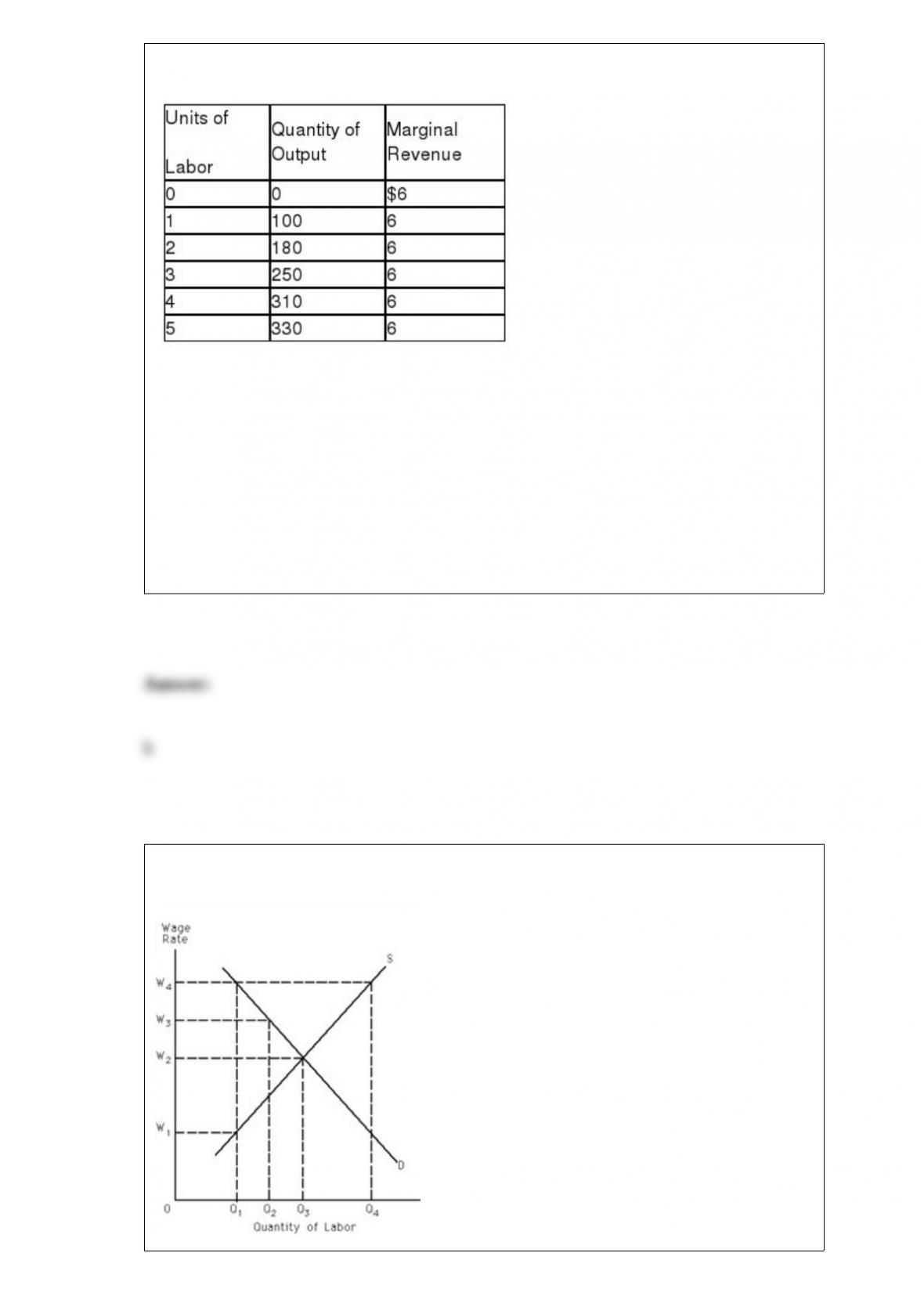
Exhibit 27-5
The data illustrate that the firm in question is a
a. price searcher (monopolist, oligopolist, etc.).
b. price taker (perfectly competitive firm).
c. factor price searcher.
d. factor price taker.
Exhibit 28-4
If a labor union successfully organizes the labor

market and sets the wage rate at W4, the amount of unemployment in this market will
be equal to
a. Q4 – Q3.
b. zero.
c. Q3 – Q1.
d. Q2 – Q3.
e. Q4 – Q1.