
Which of the following is not an example of an economic trade-off that a firm has to
make?
A) whether it is cheaper to produce with more machines or with more workers
B) whether it is to outsource the production of a good or service
C) whether or not consumers will buy its products
D) whether it should produce more of its product
When the United States sends money to Indonesia to help tsunami survivors, in what
account is this transaction recorded?
A) the financial account
B) the capital account
C) the current account
D) the foreign exchange account
Table 2-10
Table 2-10 shows the output per month of two people, Fred and Barney. They can either

devote their time to making pogo sticks or making unicycles. What is Barney’s
opportunity cost of making a unicycle?
A) 1/2 pogo stick
B) 2 pogo sticks
C) 1.75 unicycles
D) 2.8 pogo sticks
When large firms in oligopoly markets cut their prices,
A) rival firms will also cut their prices to avoid losing sales.
B) rival firms will not change their prices because most of their customers have signed
contracts that commit them to doing business with the same firms for the life of their
contracts.
C) we don’t know for sure how rival firms will respond.
D) rival firms will not cut their prices because they fear that the federal government will
accuse them of collusion.
Table 18-1
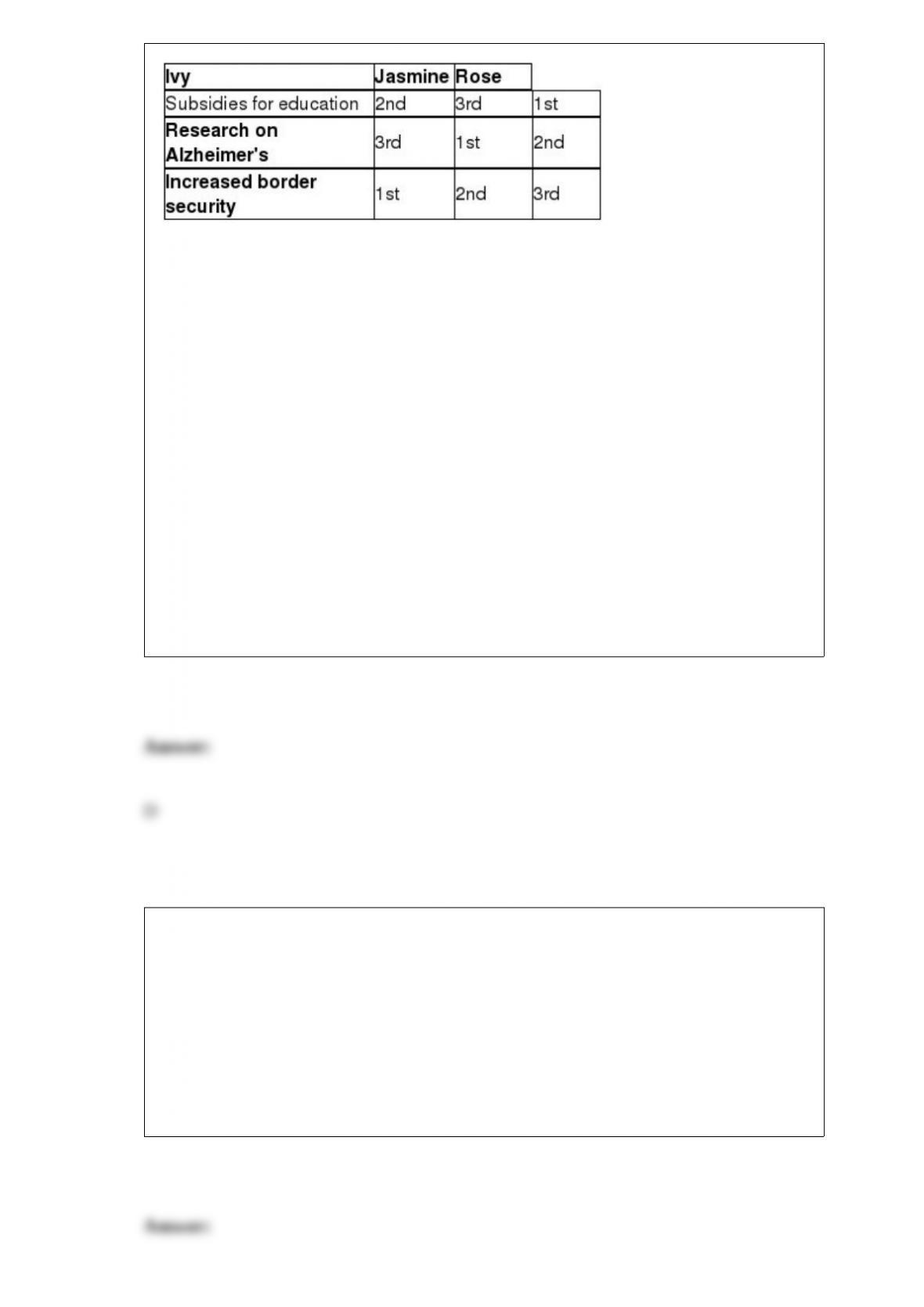
Suppose $1 billion is available in the budget and Congress is considering allocating the
funds to one of the following three alternatives: 1) Subsidies for education, 2) Research
on Alzheimer’s or 3) Increased border security. Table 18-1 shows three voters’ rankings
of the alternatives. Suppose a series of votes are taken in which each pair of alternatives
is considered in turn. If the vote is between allocating funds to education subsidies and
increased border security,
A) Ivy and Jasmine vote for education subsidies, Rose votes for increased border
security, and education subsidies wins.
B) Ivy and Rose vote for increased border security, Jasmine votes for education
subsidies, and increased border security wins.
C) Jasmine and Rose vote for education subsidies, Rose votes for increased border
security, and education subsidies wins.
D) Jasmine and Ivy vote for increased border security, Rose votes for education
subsidies, and increased border security wins.
Dividing the dividend payment by the stock’s closing market price determines the
A) coupon payment.
B) dividend yield.
C) price-earnings ratio.
D) selling price of the stock.
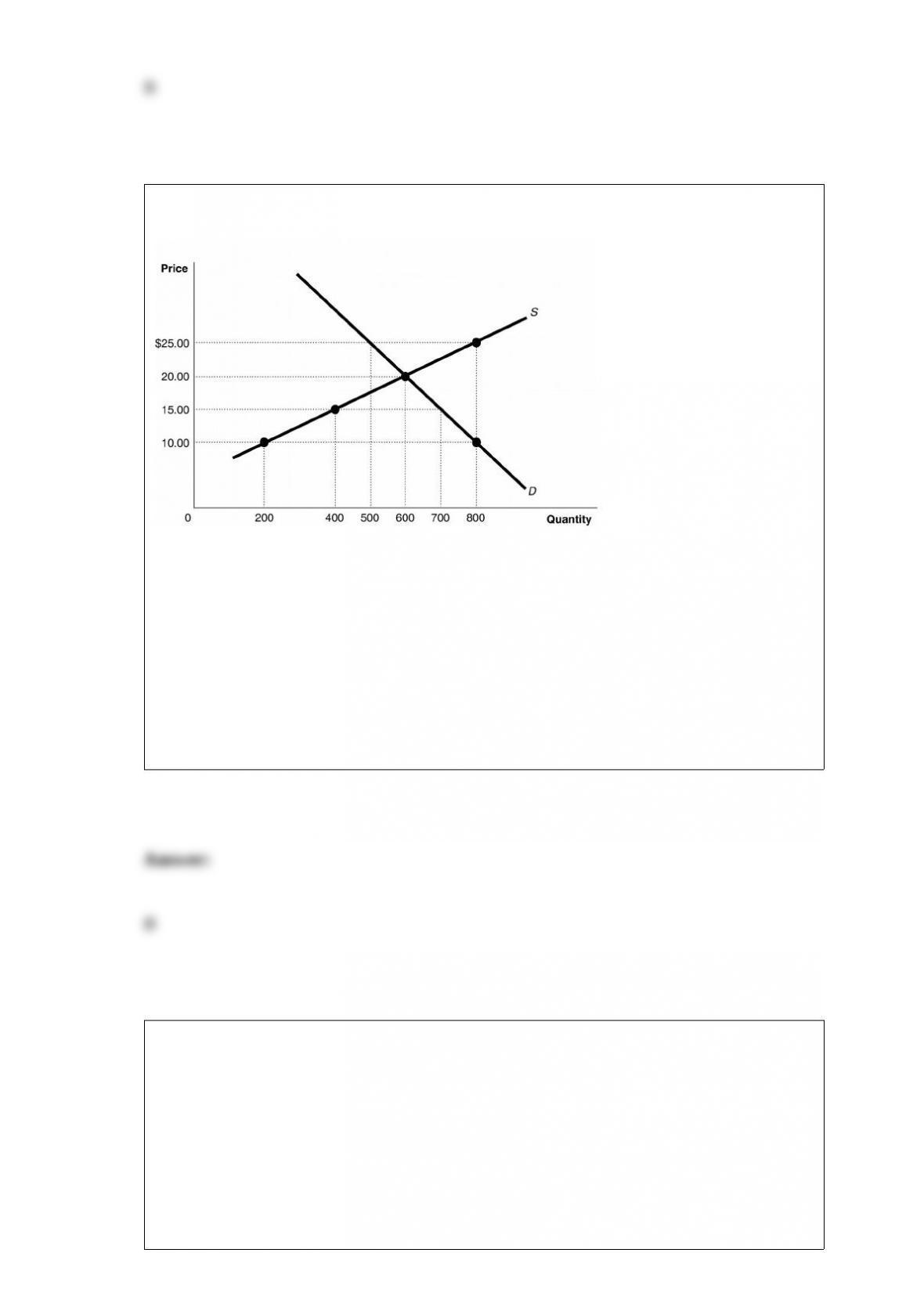
Figure 3-4
At a price of $25, how many units will be sold?
A) 400
B) 500
C) 600
D) 800
Foreign purchases of stocks and bonds issued by U.S. corporations ________ between
1995 and 2007 and ________ in 2012.
A) increased at a slow but steady pace; increased dramatically
B) remained stagnant; declined sharply
C) increased dramatically; declined sharply

D) decreased slightly; increased slightly
The United States has ________ social insurance programs, and generally has a
________ unemployment rate, as compared to Canada and Western Europe.
A) less generous; lower
B) less generous; greater
C) more generous; lower
D) more generous; greater
The study of how people make decisions in situations where attaining their goals
depends on their interactions with others is called
A) Nash equilibrium.
B) the prisoner’s dilemma.
C) game theory.
D) dominant strategy equilibrium.

When the value of a currency is determined ________, the exchange rate system is
defined as managed float.
A) only by supply and demand
B) by its issuing government
C) mostly by supply and demand, but with occasional government intervention
D) by its issuing government, with occasional readjustments in value
Which of the following statements about rent seeking is false?
A) Rent seeking often involves governments because governments transfer huge
amounts of funds that economic agents must compete for.
B) A person is engaging in rent seeking behavior when he uses the political process to
acquire ownership of a resource that belongs to the public.
C) Because rent seeking redistributes society’s resources, anyone engaging in such
behavior is violating the law.
D) If a firm can benefit from government intervention in the economy, it is more likely
to spend resources attempting to secure this intervention than toward innovating its
product to gain a competitive edge in the market.