
Moral hazard occurs when the parties on once side of the market, who have information
not known to others, self select in a way that adversely affects the parties on the other
side of the market.
a. True
b. False
Assuming the demand for their products is inelastic, farmers (as a group) have an
incentive to
a. increase the supply of what they sell.
b. agree among themselves to decrease the supply of what they sell.
c. spend at least 10 percent of their budgets to advertise their products.
d. b and c
e. a and c
Exhibit 31-5
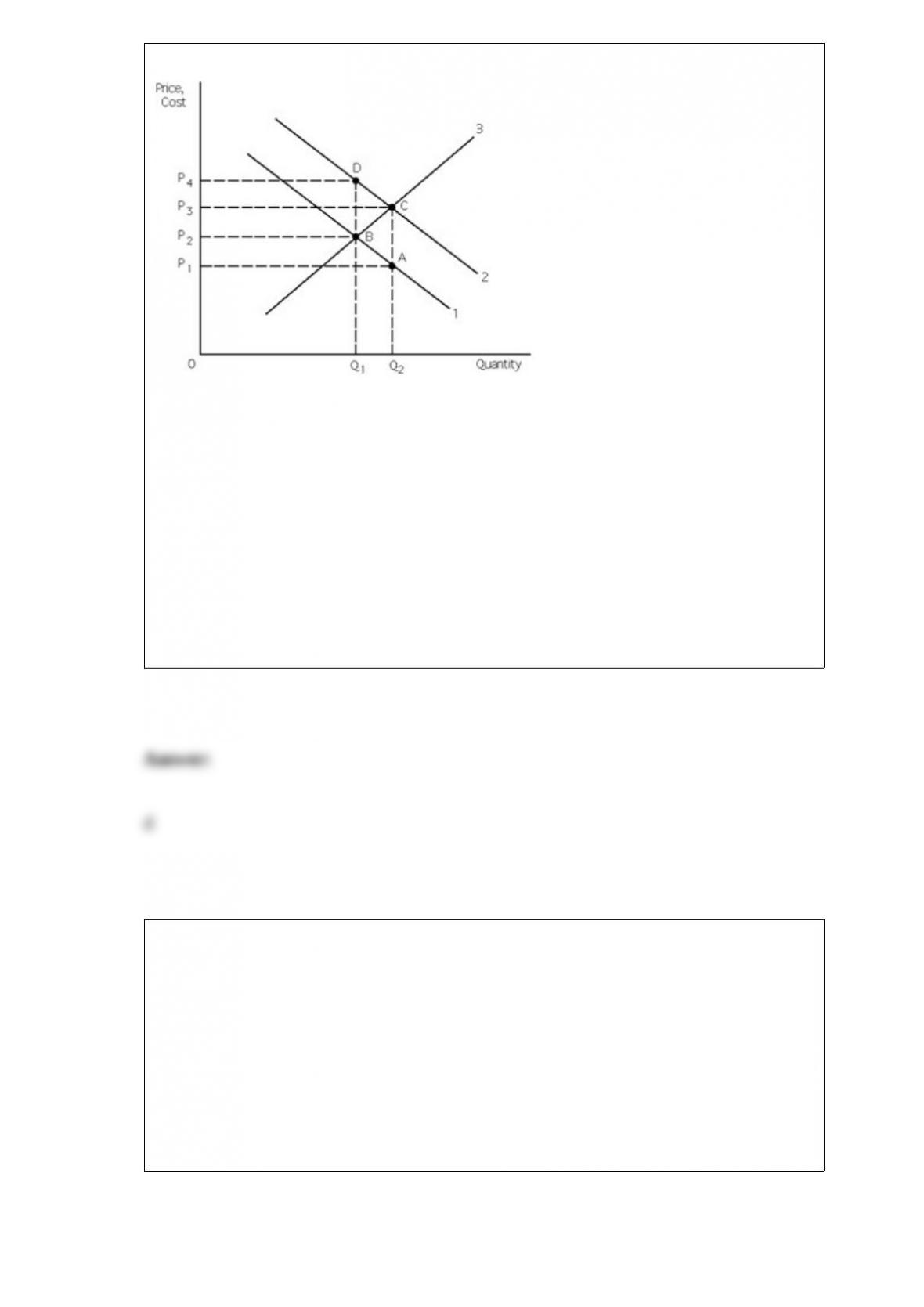
If a positive externality exists, then the market ____________ output by the amount
________________.
a. underproduces; Q1
b. overproduces; Q2
c. overproduces; Q2 – Q1
d. underproduces; Q2 – Q1
Which of the following statements is false?
a. The higher the labor cost-total cost ratio, the higher the elasticity of demand for labor.
b. The more substitutes for labor, the higher the elasticity of demand for labor.
c. The higher the elasticity of demand for the product, the higher the elasticity of
demand for the labor that produces the product.
d. A change in the MFC of a factor leads to a change in the MRP of a factor.

The Robinson-Patman Act of 1936
a. made conspiracy in the restraint of trade illegal.
b. made price discrimination, exclusive dealing, tying contracts, and the acquisition of
competing companies’ stock illegal when they ‘substantially lessen competition or tend
to create a monopoly.”
c. declared “unfair methods of competition in commerce” illegal.
d. attempted to decrease the failure rate of small businesses by protecting them from the
competition of large and growing chain stores.
e. banned anticompetitive mergers that occurred as a result of one company acquiring
the physical assets of another company.
Smith and Jones work at very similar jobs, but Smith earns almost 30 percent more a
day than Jones. This is a case of __________ discrimination.
a. gender
b. religious
c. wage
d. ethnic
e. There is not enough information to answer the question.

“Exclusive dealing” is
a. a situation in which sellers provide only high-quality, name-brand goods.
b. selling to a retailer on the condition that the retailer not resell the product to another
business.
c. selling to a retailer on the condition that the retailer not carry any rival products.
d. when a union’s leadership deals only with the firm’s managers and vice versa, so that
individual workers cannot “cut their own deal.”
You turn to the bond market page of a newspaper and look under the column headed
“Bonds” and see that it says, “Alpha 7 1/2 25” this information indicates that
a. the coupon rate on this bond is 7.5 percent.
b. the year this bond matures is 2025.
c. the current yield on this bond is 7.5 percent.
d. the current yield on this bond has risen 0.25 percent since the previous trading day.
e. a and b

A perfectly competitive market is initially in long-run competitive equilibrium. Then,
market demand increases. As a result, existing firms in the market begin to
__________. By the time all adjustments have been made, profits will __________.
a. earn positive economic profit, rise even higher
b. earn positive economic profit; be back at zero
c. produce more output; be less than zero
d. produce less output; rise
e. earn positive economic profit; turn into losses
An increase in the number of buyers in a particular market for a good will result in a
___________________ for that good.
a. movement up along the demand curve
b. movement down along the demand curve
c. leftward shift in the demand curve
d. rightward shift in the demand curve
If the wage rate increases from $12 to $13 and, as a result, the quantity demanded of
labor decreases from 400 workers to 380 workers, then the absolute value of the
elasticity of demand for labor is
a. 0.78.

b. 2.30.
c. 0.435.
d. 0.64.
e. 1.56.