1) if the u.s. government pursued a “knowledge-based growth policy,” it would
subsidize particular firms to help them compete in the world economy.
a.true
b.false
2) according to staffan linder, trade between two countries tends to be most pronounced
when the countries:
a.find their tastes and preferences to be quite harmonious
b.experience economies of large-scale production over large output levels
c.face dissimilar relative abundances of the factors of production
d.find their per capita income levels to be approximately the same
3) smaller nations may seek safe haven trading arrangements with larger nations when
future access to that market seems uncertain. this was reason for the formation of:
a.wto
b.gatt
c.nafta
d.none of these
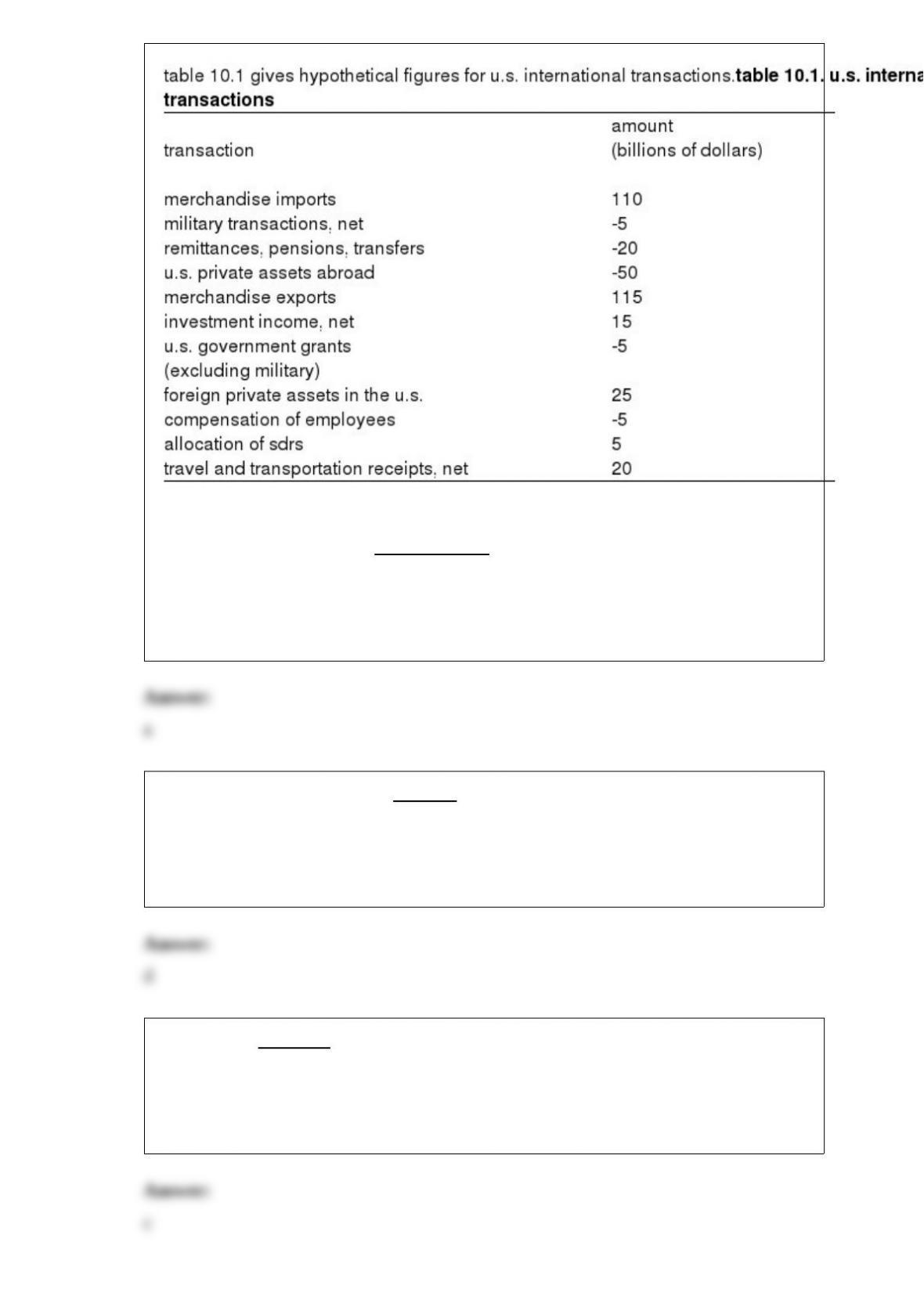
4) referring to table 10.1, the current account balance equals:
a.$5 billion
b.$10 billion
c.$15 billion
d.$20 billion
5) the mercantilists would have objected to:
a.export promotion policies initiated by the government
b.the use of tariffs or quotas to restrict imports
c.trade policies designed to accumulate gold and other precious metals
d.international trade based on open markets
6) a potential limitation of freely floating exchange rates is that:
a.countries require a larger amount of international reserves than otherwise
b.countries are unable to initiate economic policies to combat unemployment
c.exchange rates may experience wide and frequent fluctuations
d.demand tends to be highly sensitive to price movements

7) suppose the exchange rate between the u.s. dollar and the japanese yen is initially 90
yen per dollar. according to purchasing-power parity, if the price of traded goods rises
by 10 percent in the united states and remains constant in japan, the exchange rate will
become
a.72 yen per dollar
b.81 yen per dollar
c.99 yen per dollar
d.108 yen per dollar
8) with an international gold standard, if a country ended up with a deficit from the
balances on its current and capital accounts, it would:
a.import gold to settle the balance
b.export gold to settle the balance
c.officially decrease the price of gold
d.officially increase the price of gold
9) suppose that the production of $500,000 worth of steel in the united states requires
$100,000 worth of iron ore. the u.s. nominal tariff rates for importing these goods are
15 percent for steel and 5 percent for iron ore. given this information, the effective rate
of protection for the u.s. steel industry is approximately:
a.6 percent
b.12 percent
c.18 percent
d.24 percent
10) changes in a “large” country’s economic conditions or trade policies can affect the
terms at which it trades with other countries.
a.true
b.false
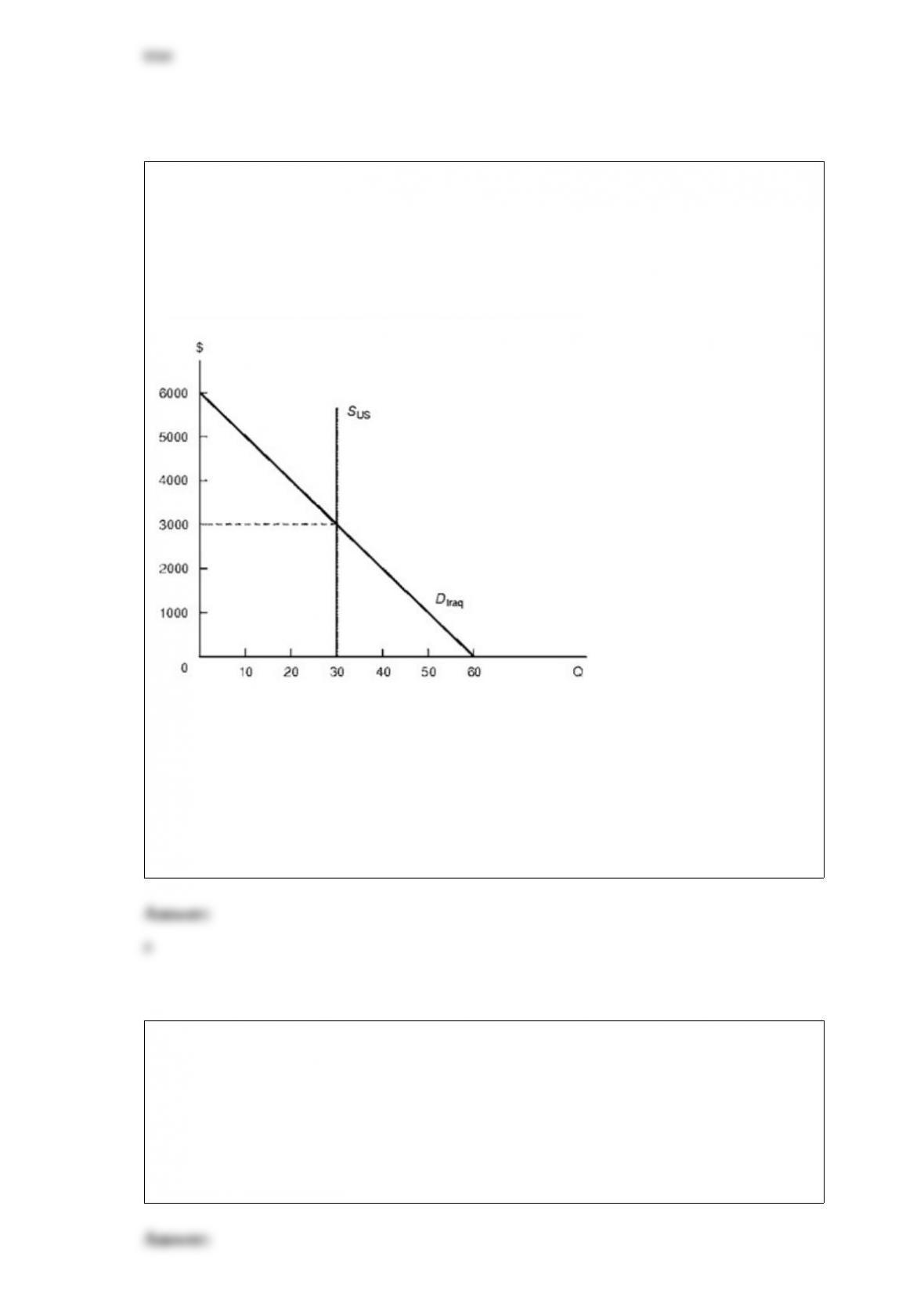
11) figure 6.3 represents the iraqi computer market. assume iraq purchases all of its
computers from the united states.
figure 6.3 iraqi computer market and economic sanctions
consider figure 6.3. in response to iraq’s armed invasion of neighboring countries,
suppose the united states imposes a partial embargo that limits exports to iraq to 10
computers. the export quota leads to an increase/decrease in the price of computers
equal to $____, and an increase/decrease in consumer surplus equal to $____.
a.increase, $2000, decrease, $40,000
b.increase, $4000, decrease, $60,000
c.decrease, $2000, increase, $40,000
d.decrease, $4000, increase, $60,000
12) assume you are an american exporter and expect to receive 50 pounds sterling at the
end of 60 days. you can remove the risk of loss due to a devaluation of the pound
sterling by:
a.selling sterling in the forward market for 60-day delivery
b.buying sterling now and selling it at the end of 60 days
c.selling the dollar equivalent in the forward market for 60-day delivery
d.keeping the sterling in britain after it is delivered to you
13) according to the theory of overlapping demands, trade in manufactured goods
would be greater among two wealthy countries than among a wealthy country and a
poor country.
a.true
b.false
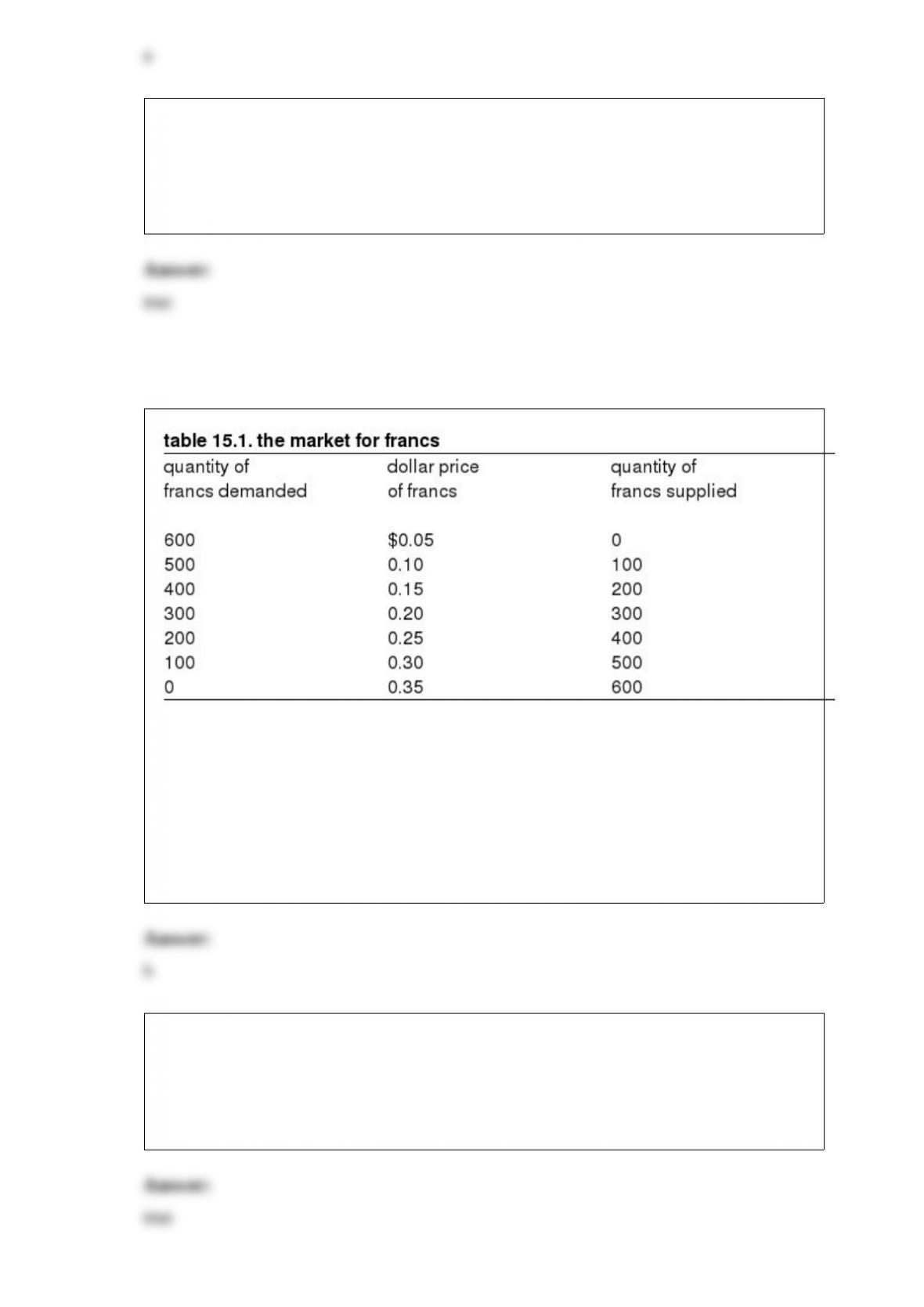
14) refer to table 15.1. if monetary authorities fix the exchange rate at $0.10 per franc,
there would be a:
a.shortage of 200 francs
b.shortage of 400 francs
c.surplus of 200 francs
d.surplus of 400 francs
15) because a large number of international transactions fail to get recorded,
statisticians insert a residual, known as statistical discrepancy, to ensure that total debits
equal total credits.
a.true
b.false
16) which of the following terms-of-trade concepts is calculated by dividing the change
in a country’s export price index by the change in its import price index between two
points in time, multiplied by 100 to express the terms of trade in percentages?
a.commodity terms of trade
b.marginal rate of transformation
c.marginal rate of substitution
d.autarky price ratio
17) the purchasing- power-parity theory predicts that if the u.s. inflation rate exceeds
the japanese inflation rate by 4 percent, the dollar’s exchange value will appreciate by 4
percent against the yen.
a.true
b.false
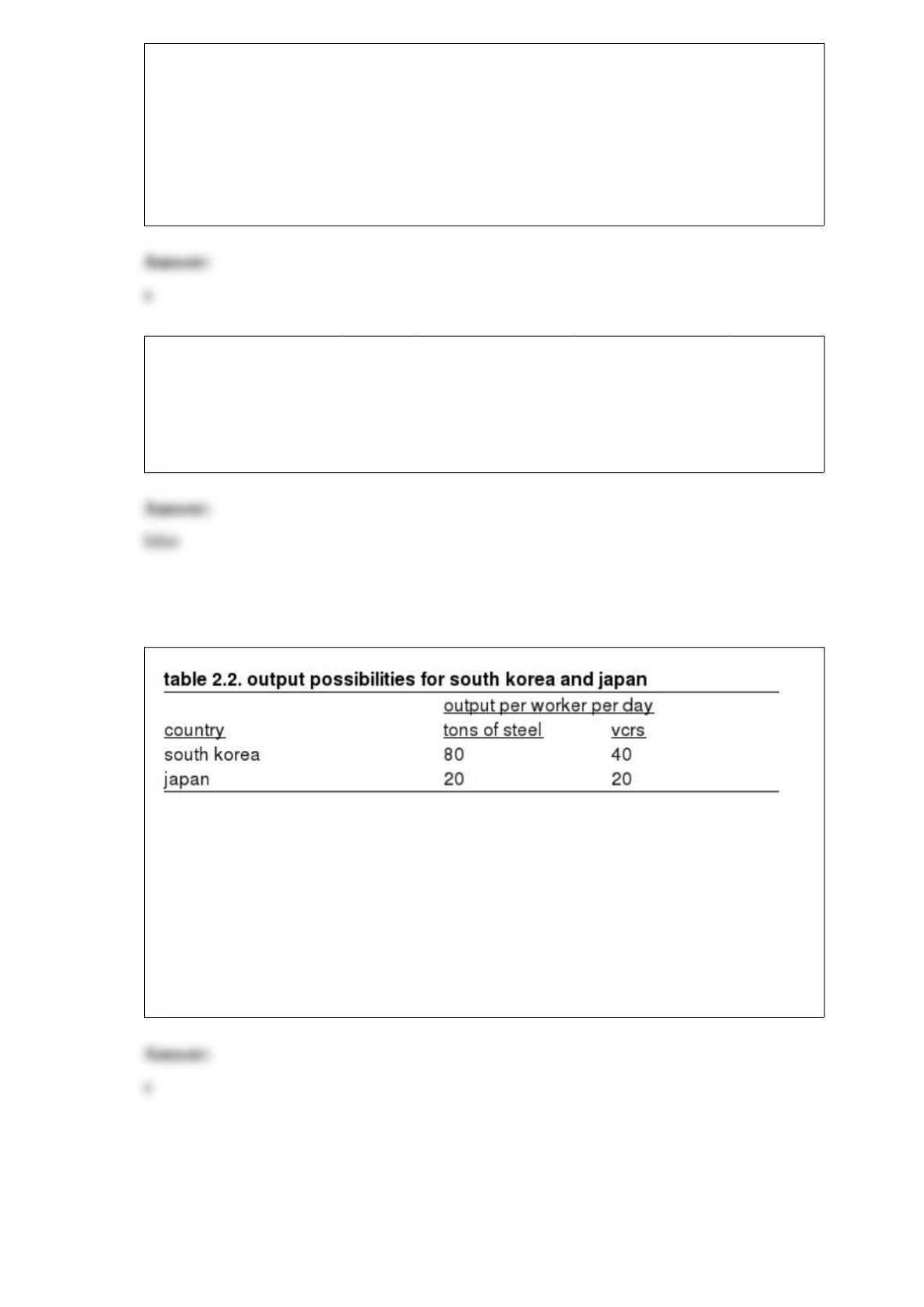
18) refer to table 2.2. with international trade, what would be the maximum number of
vcrs that japan would be willing to export to south korea in exchange for each ton of
steel?
a.1 vcr
b.2 vcrs
c.3 vcrs
d.4 vcrs