According to the median voter model, a candidate (in a two-person race) is more likely
to label himself or herself a “middle-of-the-roader” than a conservative or liberal
because
a. the terms “conservative” and “liberal” are offensive to many people in today’s world.
b. the terms “conservative” and “liberal” are considered terms used of people who are in
the “wings” or “extremes” of the political distribution, and a candidate can only win an
election by being perceived as closer to the center of the political distribution than his
or her opponent.
c. they receive better treatment by the press.
d. it is customary and it has become a tradition in American politics.
e. none of the above
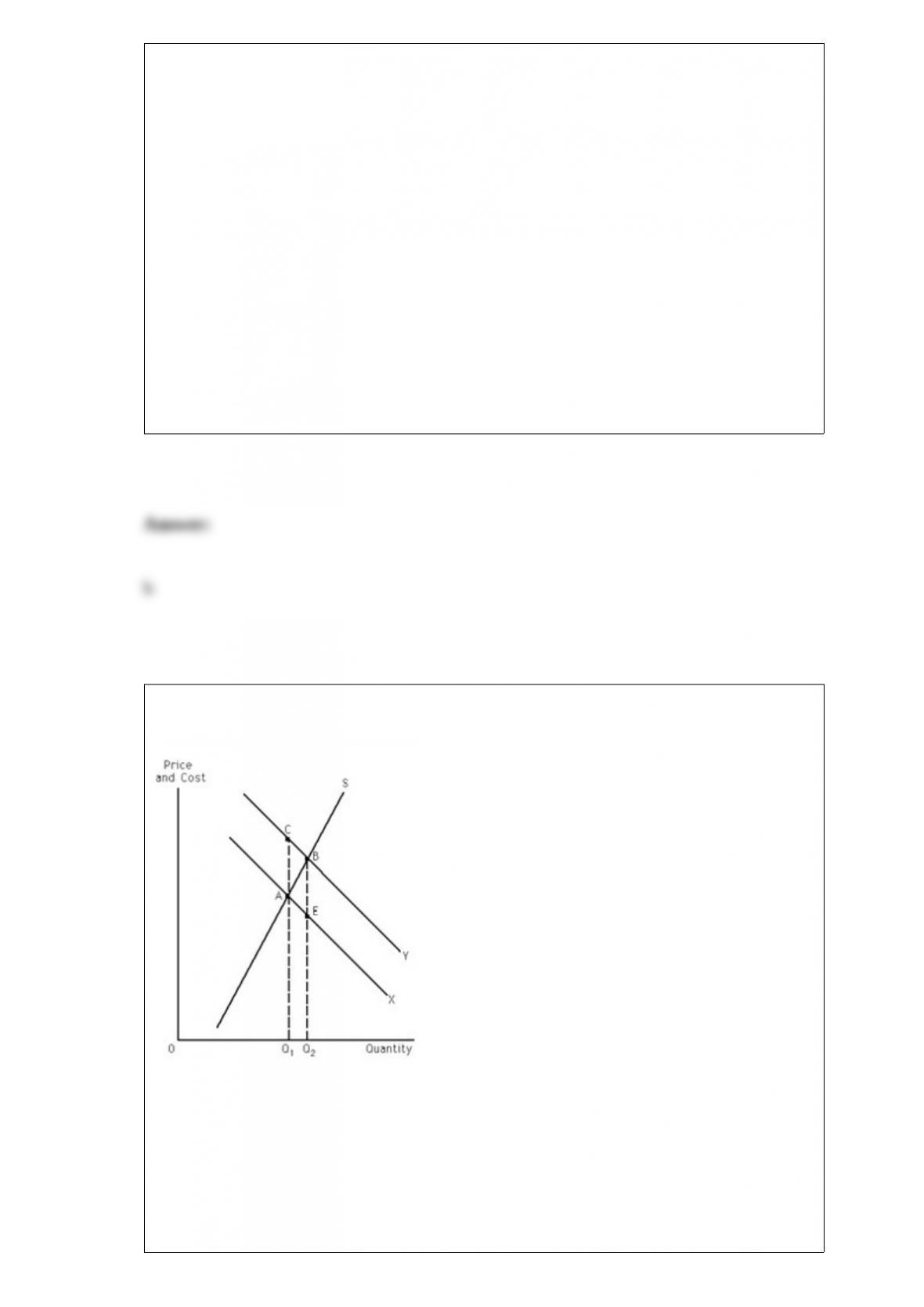
Exhibit 31-2
If the exhibit represents a positive externality situation, the private benefit of expanding
output from Q1 to Q2 is the area of
a. Q1ABQ2.
b. Q1AEQ2.

c. Q1CBQ2.
d. ABE.
In long-run competitive equilibrium P = SRATC, because if P > SRATC
a. losses in the industry would cause some existing firms to exit the industry.
b. positive economic profit would attract firms to the industry in order to obtain the
profits.
c. firms would not be producing the quantity of output at which MR = MC.
d. firms would not be covering total fixed costs.
e. none of the above
If the price of good X rises and the demand for good X is elastic, then the percentage
__________ in quantity demanded is __________ the percentage rise in price, and total
revenue __________.
a. fall; greater than; rises
b. fall; less than; falls
c. fall; equal to; remains constant
d. rise; greater than; falls

e. fall; greater than; falls
The economy can produce 15X and 15Y, 10X and 20Y, 5X and 25Y, or OX and 30Y. It
follows that the production possibility frontier (PPF) is
a. a downward-sloping straight line.
b. an upward-sloping straight line.
c. a downward-sloping convex curve.
d. a downward-sloping concave curve.
The market demand curve in a perfectly competitive market is
a. downward sloping.
b. upward sloping.
c. perfectly horizontal.
d. perfectly vertical.
e. downward or upward sloping depending upon the type of product offered for sale.

Some economists have found that U.S. imports of Chinese goods and resources
a. lower the price of goods for U.S. consumers.
b. lower the cost of inputs for U.S. firms.
c. increase the variety of products in U.S. markets.
d. may enhance productivity of U.S. firms.
e. all of the above
A monopolistic competitive firm differentiates its product (from similar products) in the
minds of the buying public. As a result, the firm
a. may earn positive economic profits, even with easy entry into the industry.
b. will definitely earn positive economic profits.
c. will be able to lower its costs below that of its competitors.
d. finds that its fixed costs are sunk costs.
e. a and c
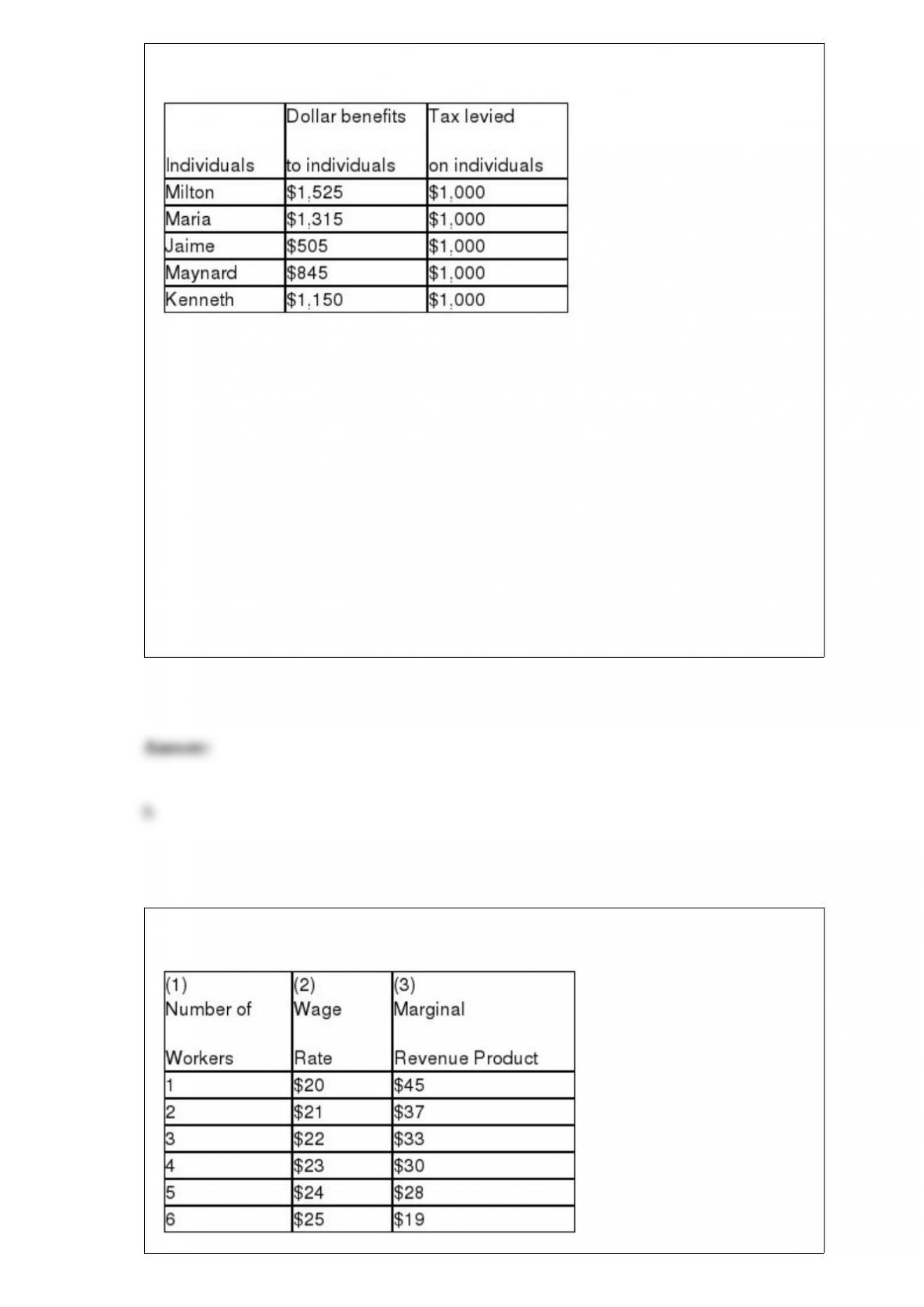
Exhibit 32-3
The exhibit shows the breakdown of benefits and costs for a five-person community
considering whether to purchase a $5,000 statue of Adam Smith to put in the center of
the public square. If simple majority voting determines the outcome, the statue
_______________ be purchased, and the total costs are ______________ the total
benefits of the statue.
a. will; greater than
b. will; less than
c. will not; greater than
d. will not; less than
Exhibit 28-12

As the firm increases employment from 3 to 4 workers, its marginal factor cost (MFC)
is
a. $7.50.
b. $26.
c. $48.
d. $13.
Positive economics is concerned with
a. value judgments.
b. cause-effect relationships.
c. observations that cannot be proved.
d. both b and c
Which of the following combinations of factors comes closest to describing the
situation in agriculture?
a. elastic demand for agricultural products and large swings in supply

b. elastic demand for agricultural products and small swings in supply
c. inelastic demand for agricultural products and constant supply
d. inelastic demand for agricultural products and large swings in supply
e. none of the above
The only resource that cannot earn economic rent is labor.
a. True
b. False
A nonexcludable public good is
a. rivalrous in consumption and nonexcludable
b. nonrivalrous in consumption and excludable
c. nonrivalrous in consumption and nonexcludable
d. rivalrous in consumption and excludable
e. none of the above
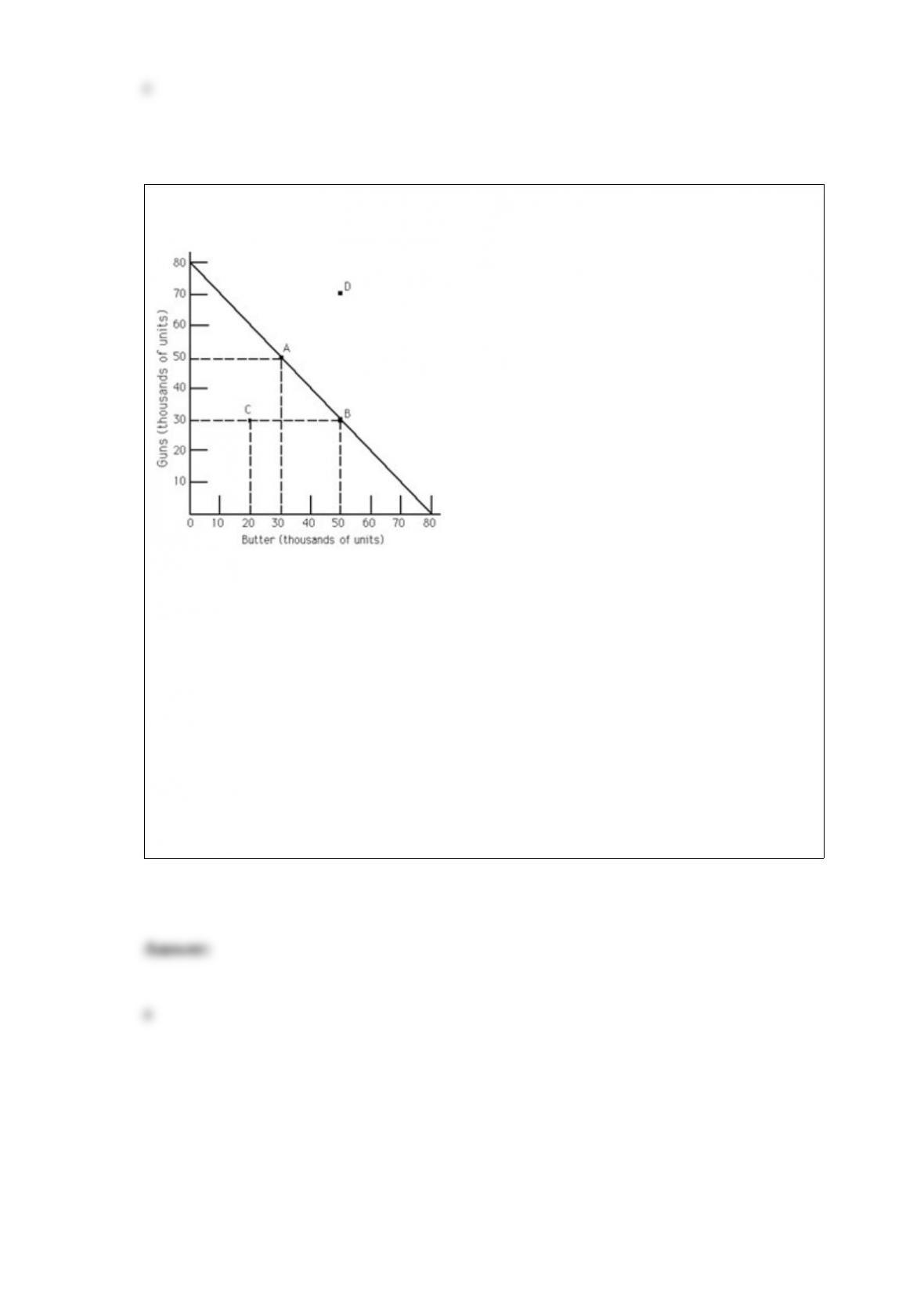
Exhibit 2-1
If the economy is at point C, it follows that
a. more guns and more butter could be produced with available resources than are
currently being produced.
b. only more guns could be produced with available resources than are currently being
produced.
c. only more butter can be produced with available resources than are currently being
produced.
d. C is an unattainable point.