
1) the state legislature has cut gigantic state university’s appropriations. gsu’s board of
regents decides to increase tuition and fees to compensate for the loss of revenue. the
board is assuming that the:
a.demand for education at gsu is elastic.
b.demand for education at gsu is inelastic.
c.coefficient of price elasticity of demand for education at gsu is unity.
d.coefficient of price elasticity of demand for education at gsu is greater than unity.
2) The assumption that the legal reserve ratio is 20 percent. Suppose that the Fed sells
$500 of government securities to commercial banks (paid for out of commercial bank
reserves) and buys $500 of securities from individuals, who deposit the cash in
checking accounts.
As a result of the above transactions, excess reserves in the banking system will:
A.remain unchanged.
B.rise by $100.
C.fall by $100.
D.rise by $1,000.
3) if a monopolist were to produce in the inelastic segment of its demand curve:
a.total revenue would be at a maximum.
b.marginal revenue would be negative.
c.the firm would be maximizing profits.
d.it would necessarily incur a loss.
4) in the short run a pure monopolist’s profit:
a.will be maximized where price equals average total cost.
b.may be positive, zero, or negative.
c.are always positive.
d.will be zero.
5)
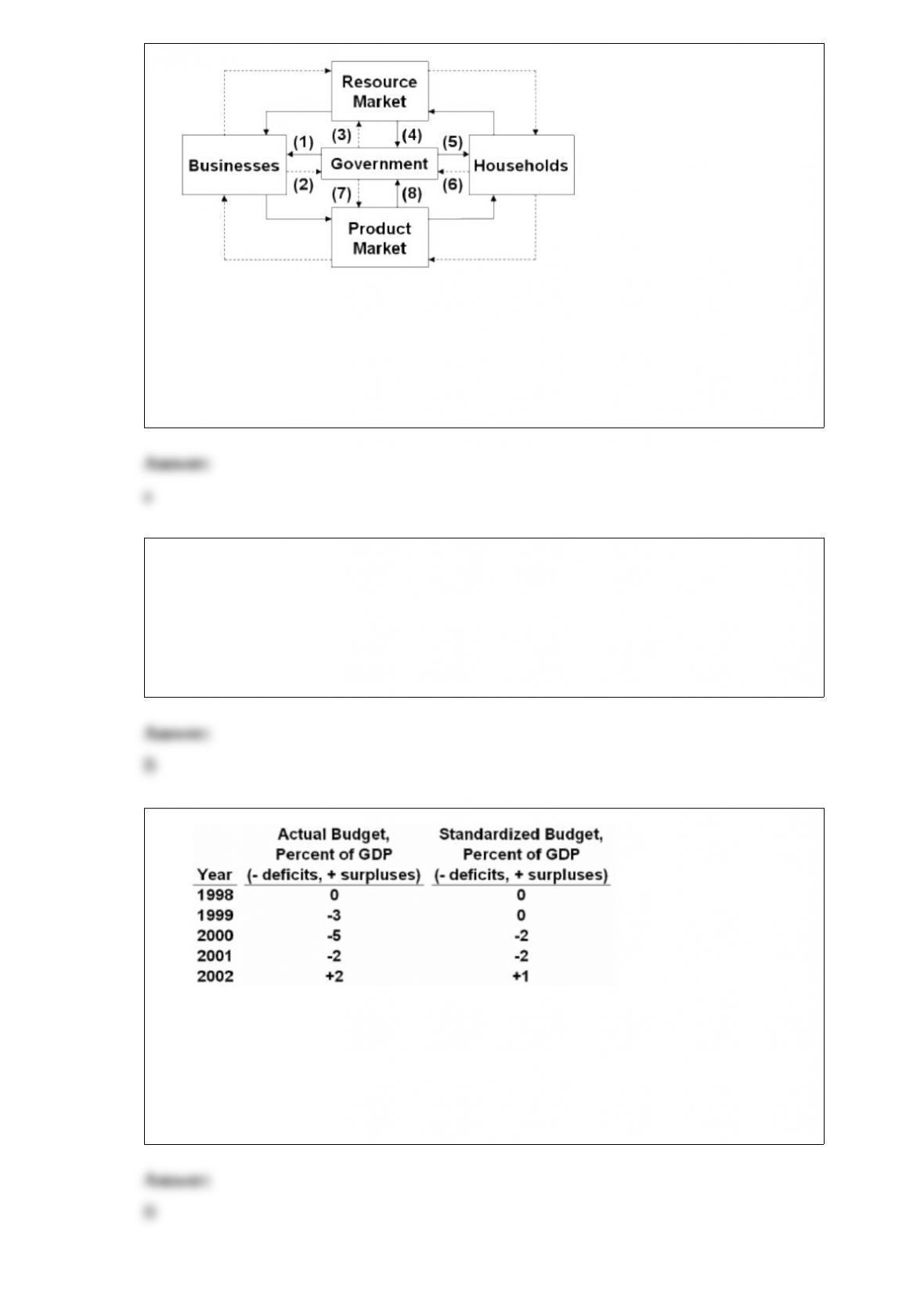
refer to the above diagram, in which solid arrows reflect real flows; broken arrows are
monetary flows. flow (6) might represent:
a.the payment of payroll taxes by households.
b.corporate income tax payments.
c.the purchase of basketballs by the ogallala school district.
d.the purchase of armored personnel vehicles by government.
6) The output effect occurs:
A.only when wage elasticity of demand is greater than 1.
B.because a change in the price of a resource will alter costs and therefore the
equilibrium output.
C.only when the inputs being employed are substitutes.
D.only when the inputs being employed are complementary.
7)
Refer to the above data for a fictional economy. The changes in the budget conditions
between 1999 and 2000 best reflect:
A.demand-pull inflation.
B.an expansionary fiscal policy.
C.a tax increase.
D.a contractionary fiscal policy.
8)
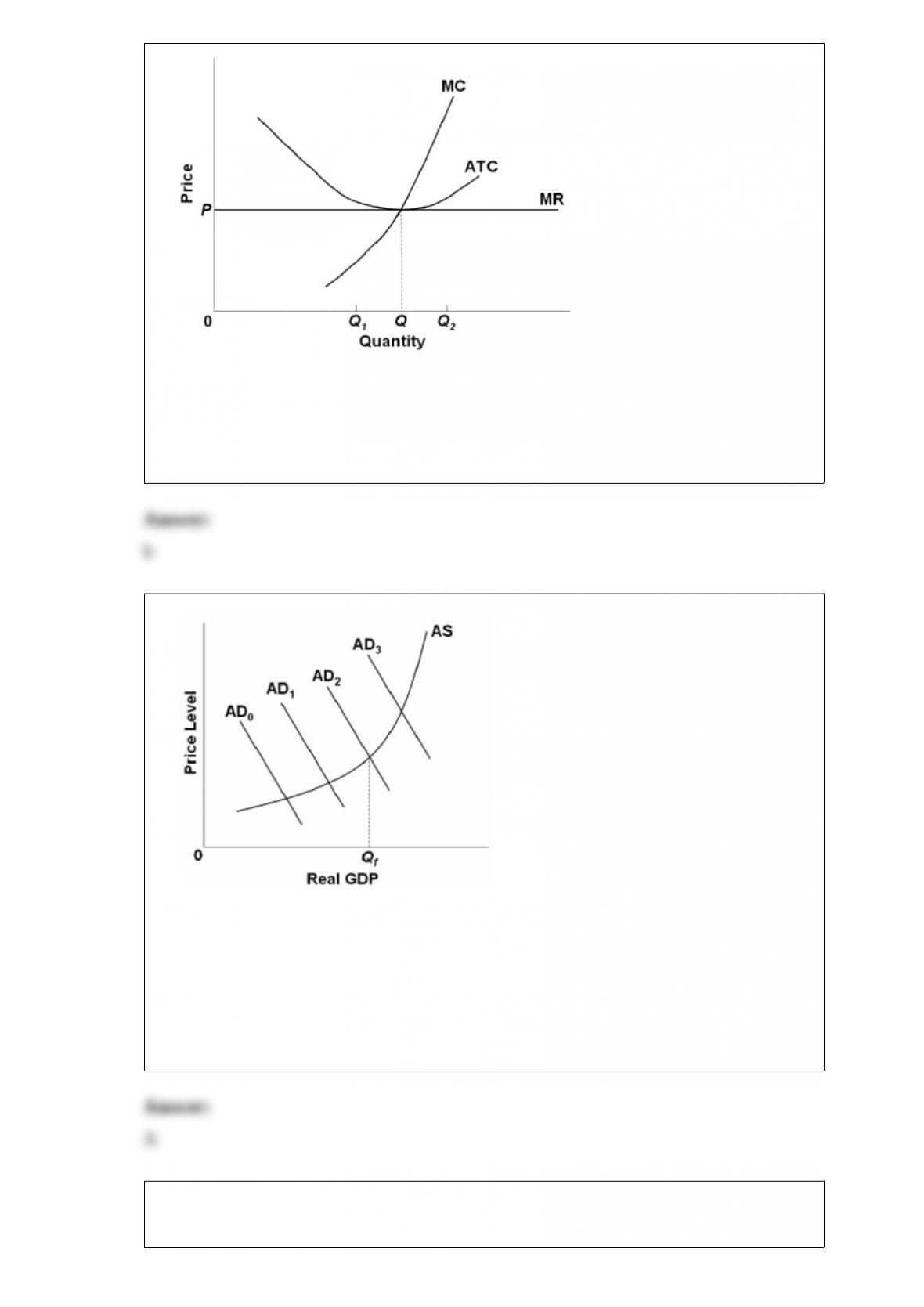
refer to the above diagram. if this competitive firm produces output q, it will:
a.suffer an economic loss.
b.earn a normal profit.
c.earn an economic profit.
d.achieve productive efficiency, but not allocative efficiency.
9)
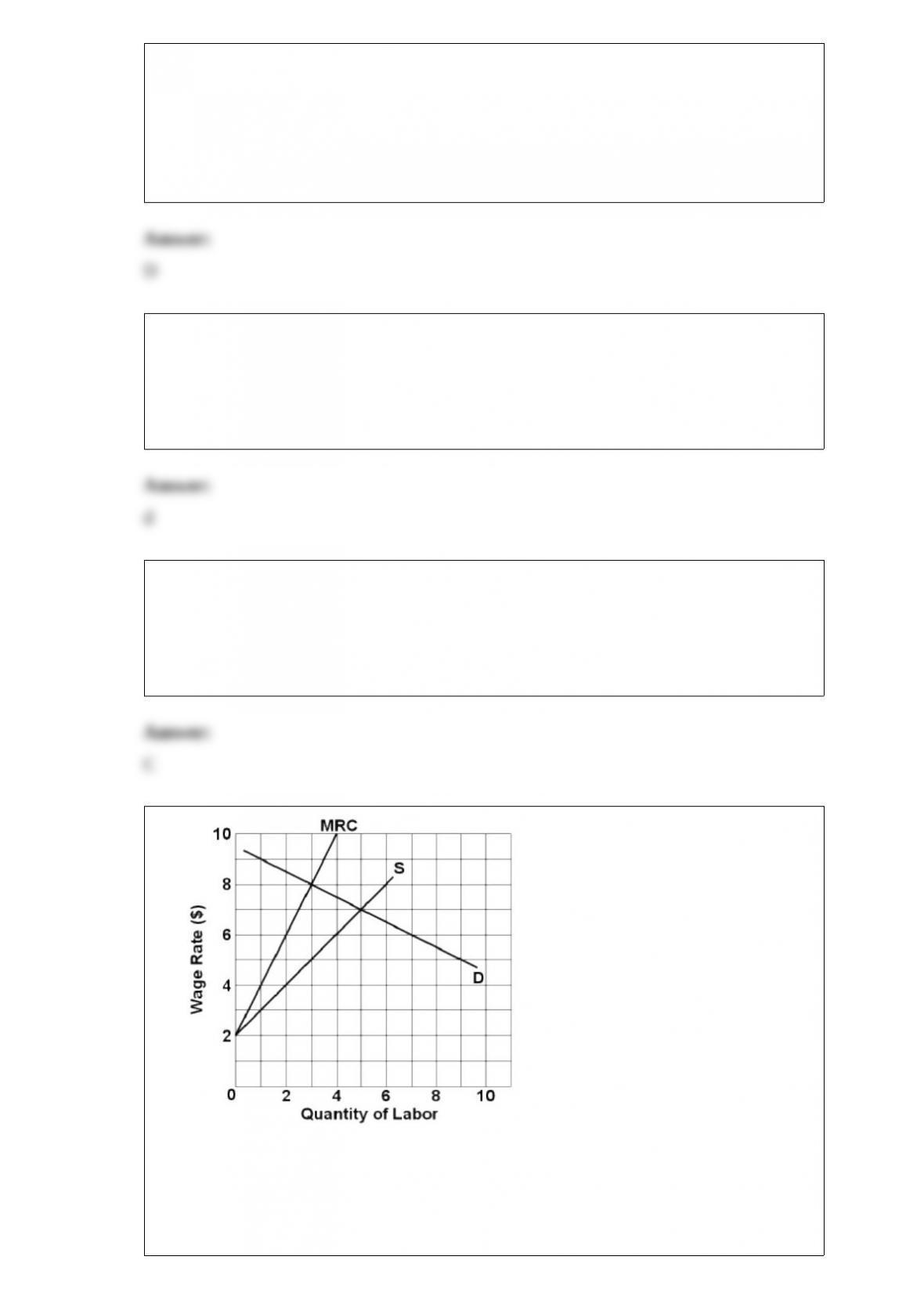
Refer to the above diagram, in which Qf is the full-employment output. An
expansionary fiscal policy would be most appropriate if the economy’s present
aggregate demand curve were at:
A.AD0.
B.AD2.
C.AD3.
D.None of the above.
10) Research involving industrially advanced countries suggests that:
A.the more independent the central bank, the lower the average annual growth of real
GDP.
B.the more independent the central bank, the higher the average annual growth of real
GDP.
C.there is no relationship between the degree of independence of a country’s central
bank and the growth rate of its real GDP.
D.the less independent the central bank, the higher the average annual rate of inflation.
11) if the economy’s real gdp doubles in 18 years, we can:
a.not say anything about the average annual rate of growth.
b.conclude that its average annual rate of growth is about 5.5 percent.
c.conclude that its average annual rate of growth is about 2 percent.
d.conclude that its average annual rate of growth is about 4 percent.
12) Which of the following unions best represents the exclusive unionism model?
A.the mine workers
B.the teamsters
C.the carpenters
D.the steelworkers
13)
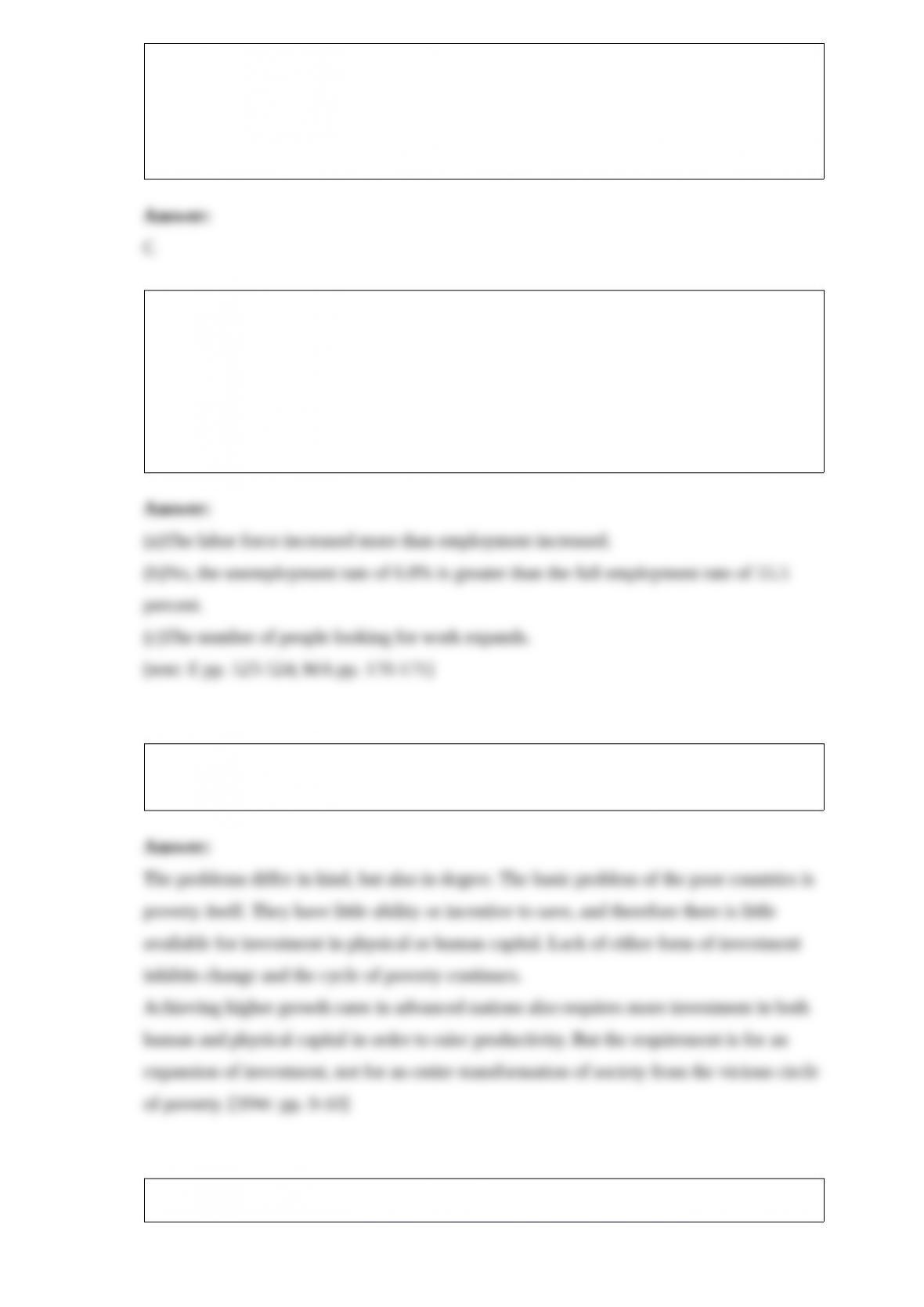
Refer to the above labor market diagram where D is the labor demand curve, S is the
labor supply curve, and MRC is the marginal resource (labor) cost curve. If an inclusive
union was able to get the monopsonist to pay a $6 wage rate, then:
A.the supply curve would be perfectly elastic for the first four workers, but the MRC
curve would be unaffected.
B.the supply curve would be perfectly elastic for all workers and the MRC curve would
coincide with it.
C.the supply curve would be perfectly elastic for the first four workers and the MRC
would be $6 for the first four workers.
D.eight workers would be hired.
14) In the table below are statistics showing the labor force and total employment
during year 1 and year 5. Make the computations necessary to complete the table.
(Number of persons is in thousands.)
(a)How is it possible that both employment and unemployment increased?
(b)Would you say that year 5 was a year of full employment?
(c)Why is the task of maintaining full employment over the years more than just a
problem of finding jobs for those who happen to be unemployed at any given time?
15) Compare the problems in achieving growth in an advanced nation with those of a
developing nation. Do these problems differ in degree or in kind? Explain.
16) Why are modern coins not made of precious metals?
17) To what factors do demographers attribute the decline in birthrates? How has the
economic view of children changed?
18) Assume that an economy has 2000 workers, each working 3000 hours per year. The
average real output per worker-hour is $10. What will the total output or real GDP be?
Explain.
19) Explain the logic behind the fact that if the Federal Reserve raises the risk-free
interest rate, return rates of other assets must rise by the same amount? Is the same true
when the risk-free interest rate is lowered?
20) Describe R&D expenditures in the United States. What percentage of spending goes
for invention, innovation, and diffusion?
21) Calculate the multiplier when the MPC is .5, .75, .90. What is the relationship
between MPC and the multiplier?
22) Both Federal Reserve Banks and commercial banks buy and sell government
securities, but for substantially different reasons. Explain.
23) What are the basic characteristics of oligopoly? How does oligopoly compare with
the other market structures?