1)
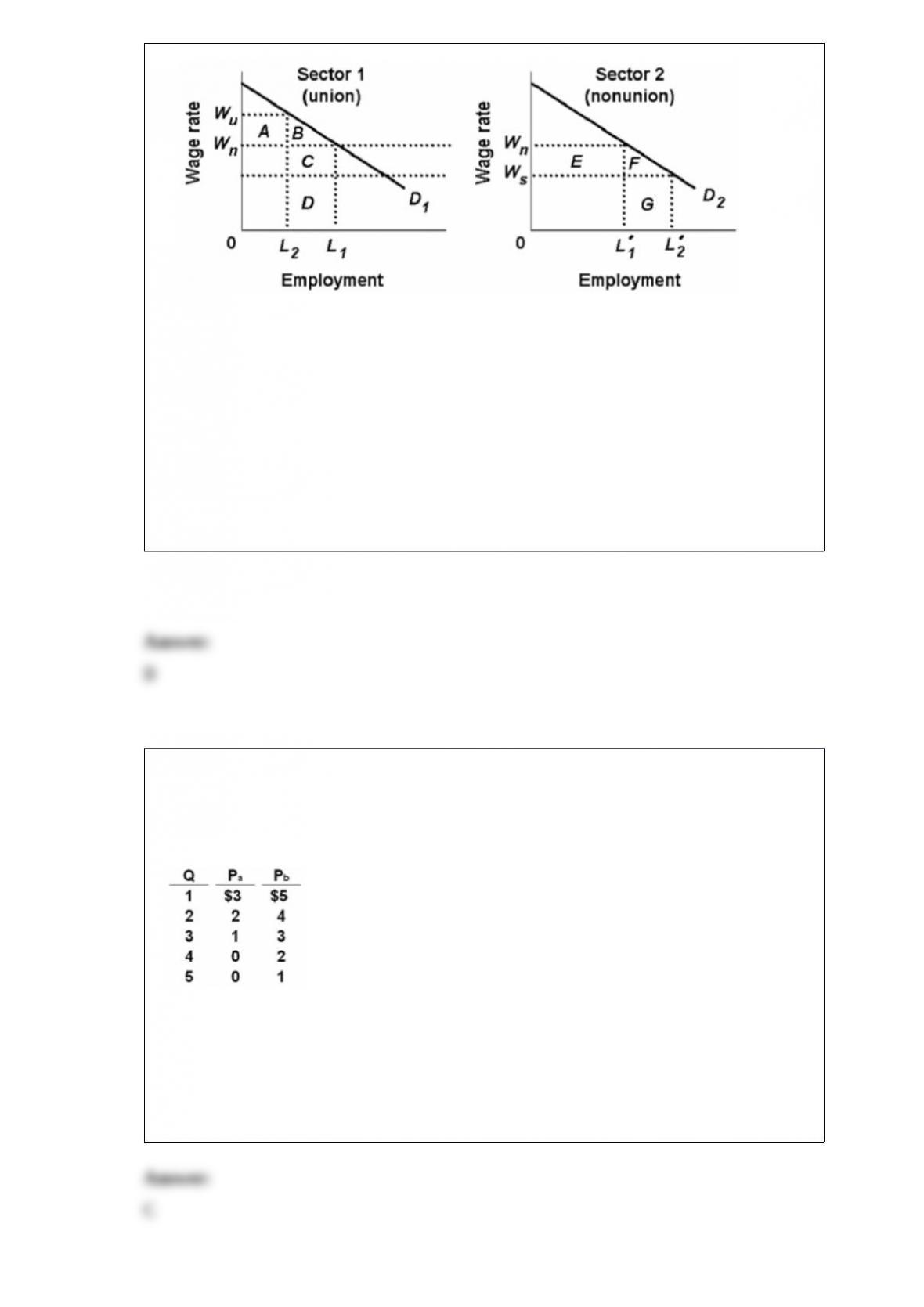
Assumptions: These two graphs show two sectors of the labor market for a particular
kind of labor. Relevant product markets are competitive. The two labor demand curves
are identical and initially the quantities of labor employed in the two sectors are L1and
L’1and the wage rate in each sector is Wn.
Refer to the above diagrams and assumptions. The change in employment in sector 1 to
which a Wn to Wu union wage increase gives rise will cause output in that sector to:
A.decrease by A + B.
B.decrease by B + C + D.
C.decrease by C + D.
D.increase by A + B.
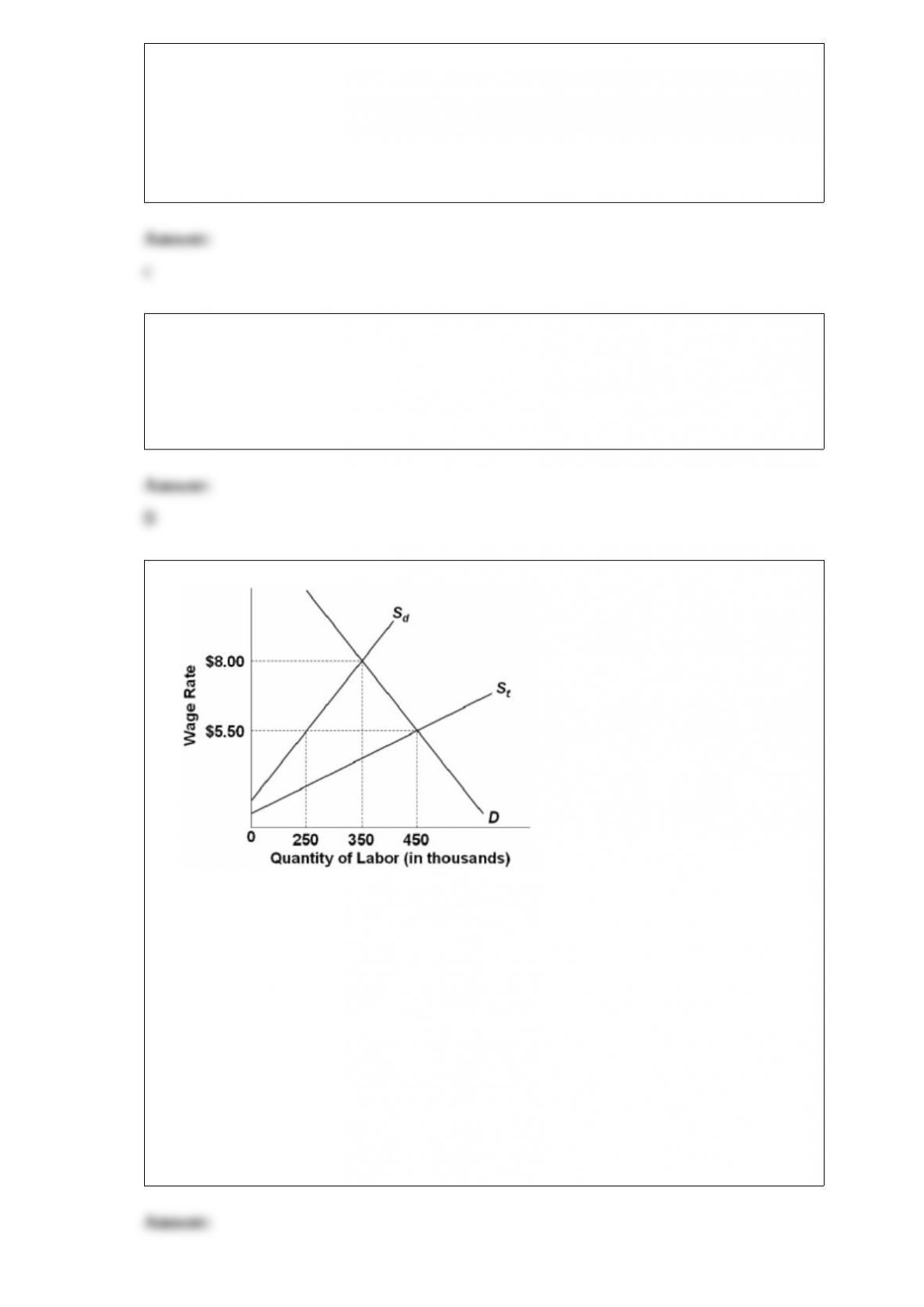
2) Pa and Pb are the prices that individuals A and B are willing to pay for the last unit of
a public good, rather than do without it. These people are the only two members of
society.
Refer to the above data. If the marginal cost of this good at the optimal quantity is $4,
the optimal quantity must be:
A.1 unit.
B.2 units.
C.3 units.
D.4 units.
3) other things equal, the voluntary relocation of employable migrants from low-paying
nations to high-paying nations will:
a.increase business or capitalist incomes in the low-paying nations.
b.reduce real output in the world.
c.increase business or capitalist incomes in the high-paying nations.
d.reduce wage rates in the low-paying nations.
4) The benefits-received principle of taxation is most evident in:
A.inheritance taxes.
B.excise taxes on gasoline.
C.the personal income tax.
D.the corporate income tax.
5)
assumptions: 1) employers in this market are willing and able to ignore minimum wage
laws; 2) sd represents the supply of domestically-born (and legal immigrant) workers;
3) st represents the total supply of workers in this labor market (sd plus illegal
immigrants); and 4) unless otherwise stated, illegal immigration is not effectively
blocked by the government.
refer to the above figure. if the government effectively prevents illegal immigrants from
working in this labor market, the equilibrium wage and level of employment are,
respectively:
a.$5.50 and 250,000
b.$5.50 and 350,000
c.$8 and 350,000
d.$5.50 and 450,000

6) The antitrust laws are based on the:
A.creative destruction view of competition.
B.idea that competition leads to greater economic efficiency than does monopoly.
C.view that nonprice competition should be strictly regulated by government.
D.view that all negative externalities should be eliminated by government action.
7) Some nations are increasing the amount of land covered by forests, while others are
experiencing rapid deforestation. According to economists, this is largely because:
A.different nations have different ethical views regarding treatment of the environment.
B.nations with increasing forest cover have poorly enforced or non-existent property
rights.
C.nations with declining forest cover treat forests as private property or strictly
regulated government property.
D.nations with increasing forest cover treat forests as private property or strictly
regulated government property.
8) for an imperfectly competitive firm:
a.total revenue is a straight, upsloping line because a firm’s sales are independent of
product price.
b.the marginal revenue curve lies above the demand curve because any reduction in
price applies to all units sold.
c.the marginal revenue curve lies below the demand curve because any reduction in
price applies to all units sold.
d.the marginal revenue curve lies below the demand curve because any reduction in
price applies only to the extra unit sold.
9) the following production possibilities tables for countries alpha and beta:
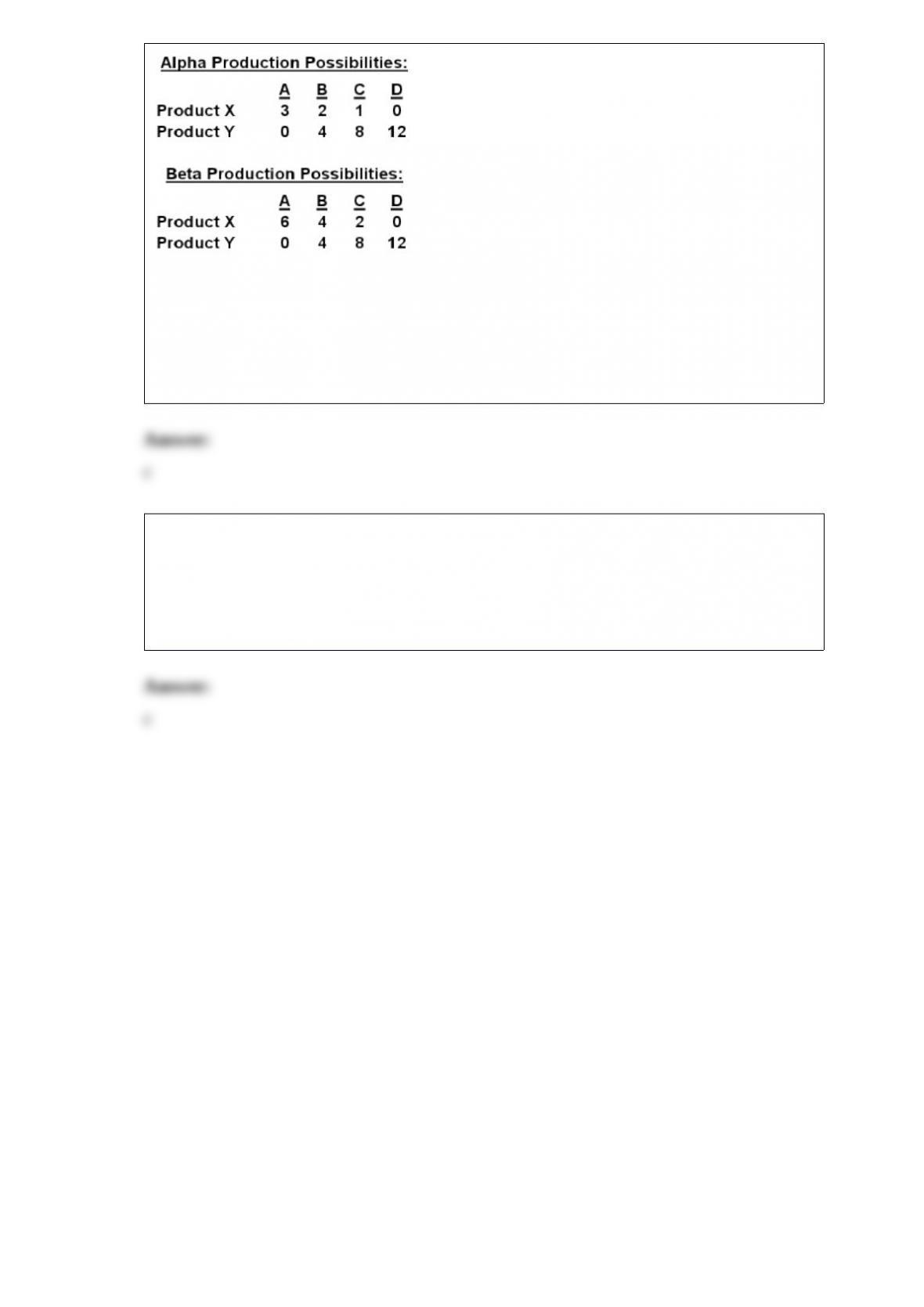
refer to the above tables. assume that before specialization both nations chose to
produce alternative b. the gains from specialization and trade would be:
a.2 units of x and 2 units of y
b.4 units of x
c.4 units of y
d.6 units of x and 3 units of y
10) tom atoe grows tomatoes for home consumption. this activity is:
a.excluded from gdp in order to avoid double counting.
b.excluded from gdp because an intermediate good is involved.
c.productive but is excluded from gdp because no market transaction occurs.
d.included in gdp because it reflects production.