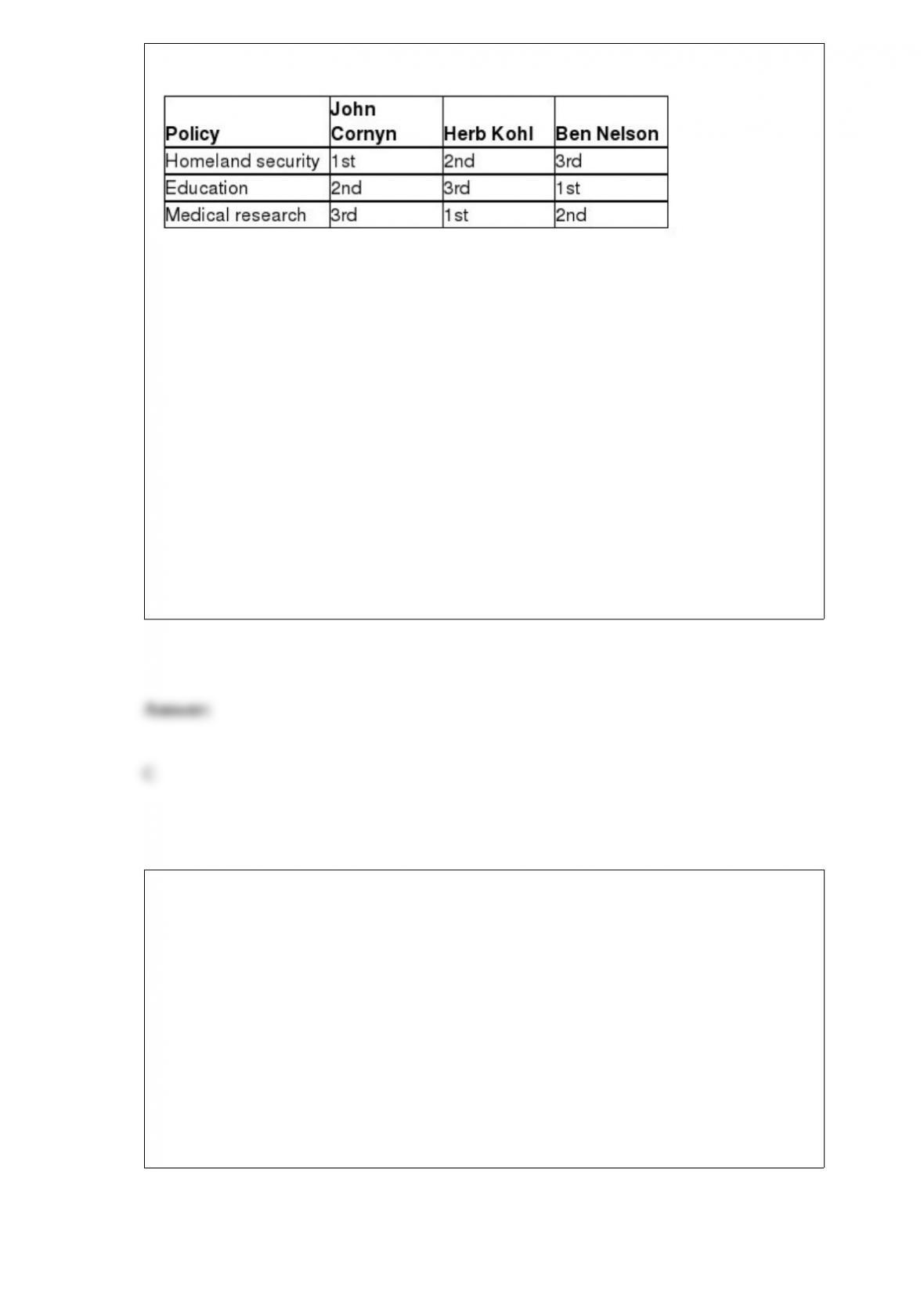
Table 18-2
The table above lists three policy alternatives that the U.S. Senate will vote on, along
with the ranking of these alternates. The Senate must decide which of these alternatives
should receive an additional $1 billion of funding, and there is enough money in the
federal budget for only one of these alternatives. If a series of votes is taken in which
each pair of alternatives is considered (homeland security and education; homeland
security and medical research; education and medical research) which of the following
will result from these votes?
A) When the vote is between homeland security and education, the Senators will vote
for education to receive funding.
B) The Senators’ votes will demonstrate transitivity.
C) The results will illustrate the voting paradox.
D) The results from the voting will illustrate the median voter theorem.
In the past the federal government often employed what is called a “command and
control” approach to the reduction of pollution emissions. Many economists are critical
of this approach because
A) it does not lead to significant reductions in pollution.
B) they believe a market-based approach will reduce pollution more efficiently.
C) the “command and control” approach is designed to help firms at the expense of
consumers.
D) the “command and control” approach leads to negative externalities.

The income effect of a price change refers to the impact of a change in
A) income on the price of a good.
B) demand when income changes.
C) the quantity demanded when income changes.
D) the price of a good on a consumer’s purchasing power.
An increase in ________ shifts the production function ________, and makes it
possible to produce a higher level of GDP with ________ capital per hour worked.
A) technology; down; the same amount of
B) technology; up; the same amount of
C) consumption; up; a lesser amount
D) labor productivity; down; the same amount of
Table 16-4

An oligopoly between two firms is called
A) a biopoly.
B) an oligopoly; there are no special terms used for oligopolies with different numbers
of firms.
C) a dual-firm oligopoly.
D) a duopoly.
Crowding out will be greater
A) the less sensitive consumption spending is to changes in the interest rate.
B) the further equilibrium GDP is below potential GDP.
C) the more sensitive investment spending is to changes in the interest rate.
D) if the economy is in recession, rather than at full employment.
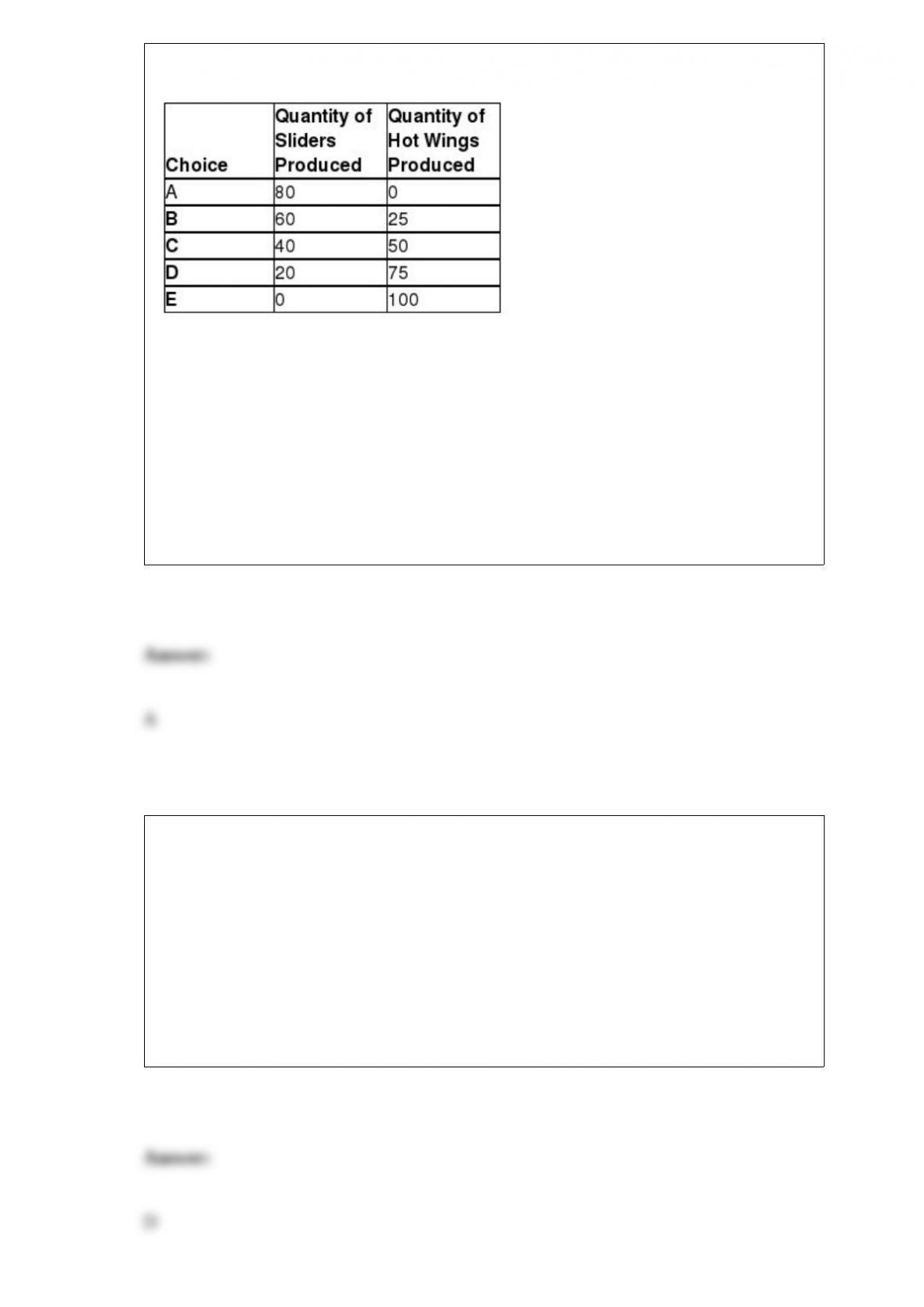
Table 2-1 Production Choices for Dina’s Diner
Assume Dina’s Diner only produces sliders and hot wings. A combination of 60 sliders
and 25 hot wings would appear
A) along Dina’s production possibilities frontier.
B) inside Dina’s production possibilities frontier.
C) outside Dina’s production possibilities frontier.
D) at the vertical intercept of Dina’s production possibilities frontier.
Organizing a successful firm in a market economy has become ________ over the last
century.
A) legally impossible
B) politically impossible
C) less Difficult
D) more Difficult

Which of the following would occur if the United States switched from income taxes to
consumption taxes?
A) Consumption would increase.
B) The supply of loanable funds would decrease.
C) Saving would increase.
D) Tax revenues would rise.
In the United States today, the Federal Reserve will give you ________ in exchange for
$1.
A) 1/35 of an ounce of gold
B) $1 worth of gold (based on the market price of an ounce of gold at the time you
redeem the gold)
C) 1 ounce of gold
D) no gold
If the exchange rate changes from $1.45 = 1 euro to $1.37 = 1 euro, then
A) both the euro and dollar have appreciated.

B) both the euro and dollar have depreciated.
C) the euro has appreciated and the dollar has depreciated.
D) the euro has depreciated and the dollar has appreciated.
An increase in the price level causes
A) the money demand curve to shift to the left.
B) the money demand curve to shift to the right.
C) a movement up along the money demand curve.
D) a movement down along the money demand curve.
When Congress passed a law that imposed a tax designed to fund its Social Security
and Medicare programs it wanted employers and workers to share the burden of the tax
equally. Most economists who have studied the incidence of the tax have concluded
A) the tax is not high enough to cover the future costs of Social Security and Medicare.
B) the tax on employers is too high because it reduces the employment of low-skilled
workers.
C) the burden of the tax falls almost entirely on workers.
D) the tax rate should be greater for high income workers than for low income workers.