
1) a rational consumer will try to achieve the highest indifference curve that his or her
income will allow.
2) Other things equal, an expansionary monetary policy will shift the economy’s
aggregate demand curve to the right.
3) antiques tend to have highly inelastic supply curves.
4) in the short run a competitive firm will always choose to shut down if product price
is less than the lowest attainable average total cost.
5) In the extended AD-AS model, the long-run aggregate supply curve is vertical.
6) The Celler-Kefauver Act outlawed interlocking directorates.
7) extensive network effects may drive a market toward natural monopoly because
consumers tend to choose a common, standard product that everyone else is using.
8) The percentage of the United States’ domestic output that is derived from
international trade is higher than that for any other industrially advanced nation.
9) limited liability means all members of a partnership are liable for the debts incurred
by one another.
10) diseconomies of scale stem primarily from the difficulties in managing and
coordinating a large-scale business enterprise.
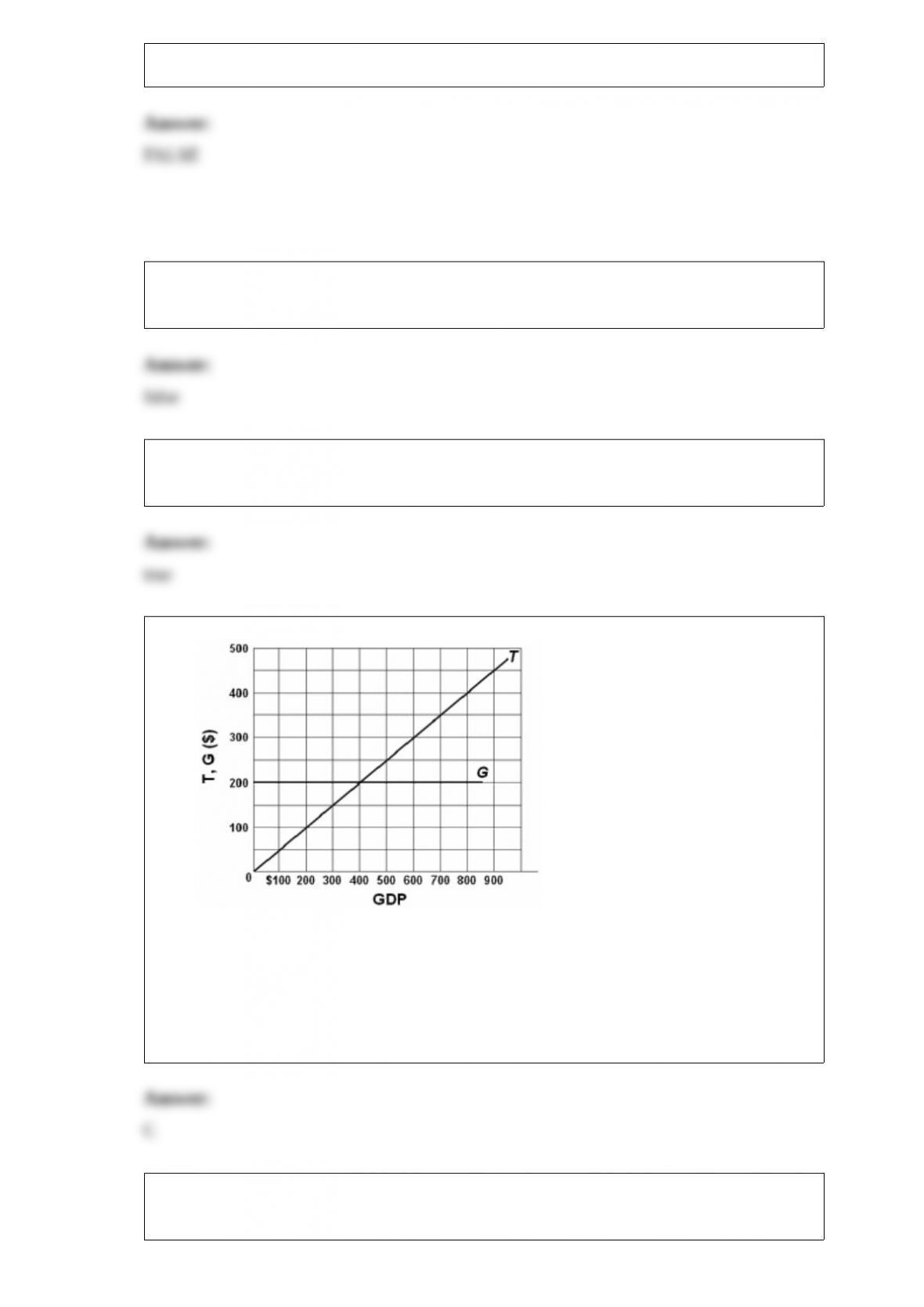
11)
Refer to the above diagram in which T is tax revenues and G is government
expenditures. All figures are in billions. The budget will entail a deficit:
A.at all levels of GDP.
B.at any level of GDP above $400.
C.at any level of GDP below $400.
D.only when GDP is stable.
12) (Last Word) Chief executive officers (CEOs) of large American corporations:
A.have higher average salaries than CEOs of similar-size firms in other industrial
nations.
B.have similar salaries, on average, to CEOs of same-size firms in other industrial
nations.
C.are, on average, older than CEOs of same-size firms in other industrial nations.
D.are, on average, younger than CEOs of same-size firms in other industrial nations.
13) the division of u.s. businesses into the categories of proprietorships, partnerships,
and corporations is based on:
a.generally accepted accounting principles.
b.legal considerations.
c.the judgment of the american economic association.
d.an executive order of the president.
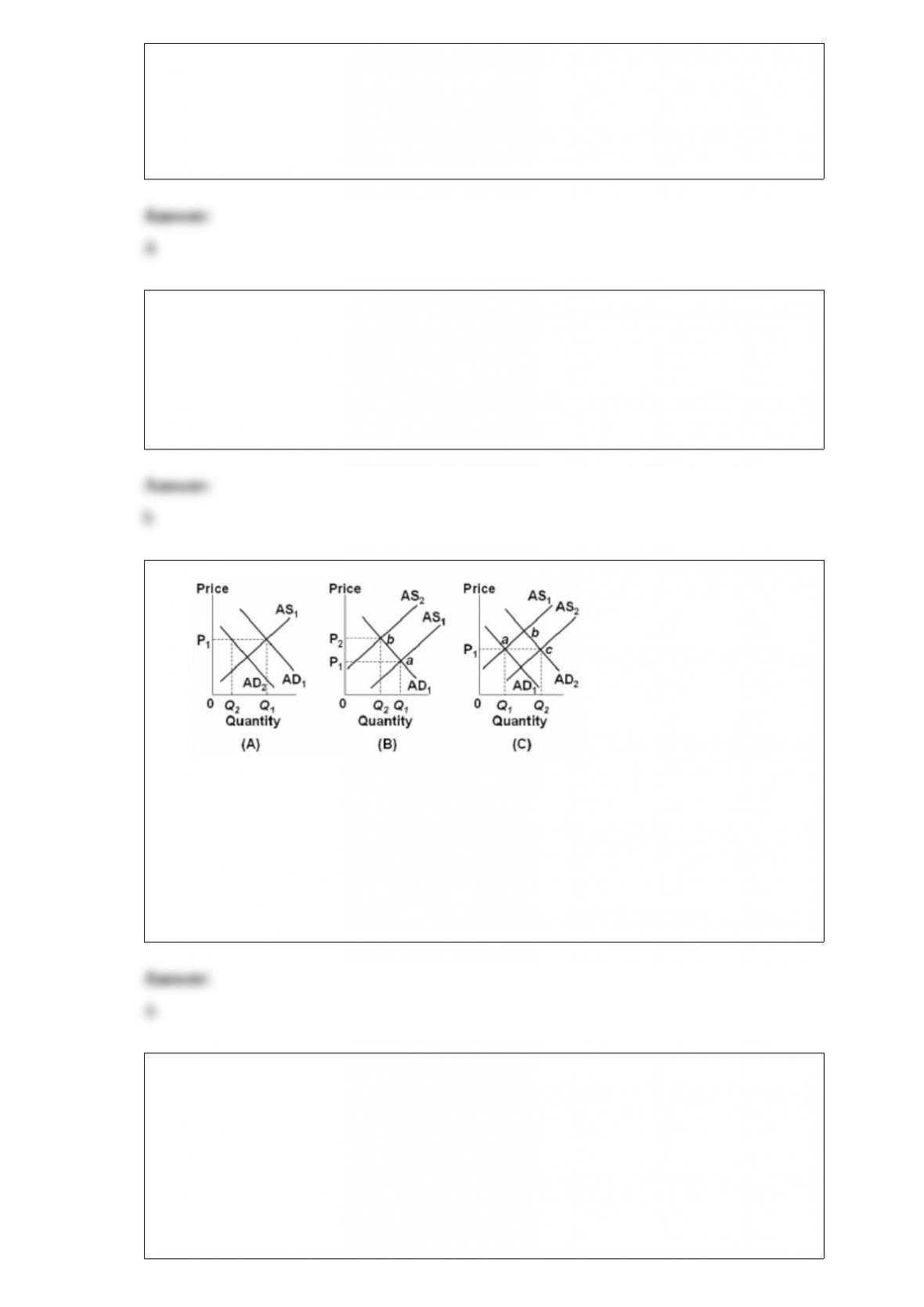
14)
Refer to the above diagrams, in which AD1 and AS1 are the “before” curves and AD2
and AS2 are the “after” curves. Other things equal, a decline in net exports caused by a
change in incomes abroad is depicted by:
A.panel (A) only.
B.panel (B) only.
C.panel (C) only.
D.panels (B) and (C).
15) Suppose Copernicus Corporation hires Damon Danielson rather than Elmer Ellison,
simply because Damon is a graduate of an Ivy League school while Elmer is a graduate
of a small public university. Elmer is actually more qualified than Damon. This is an
example of:
A.statistical discrimination.
B.irrational behavior.
C.monopsony exploitation.
D.human-capital discrimination.
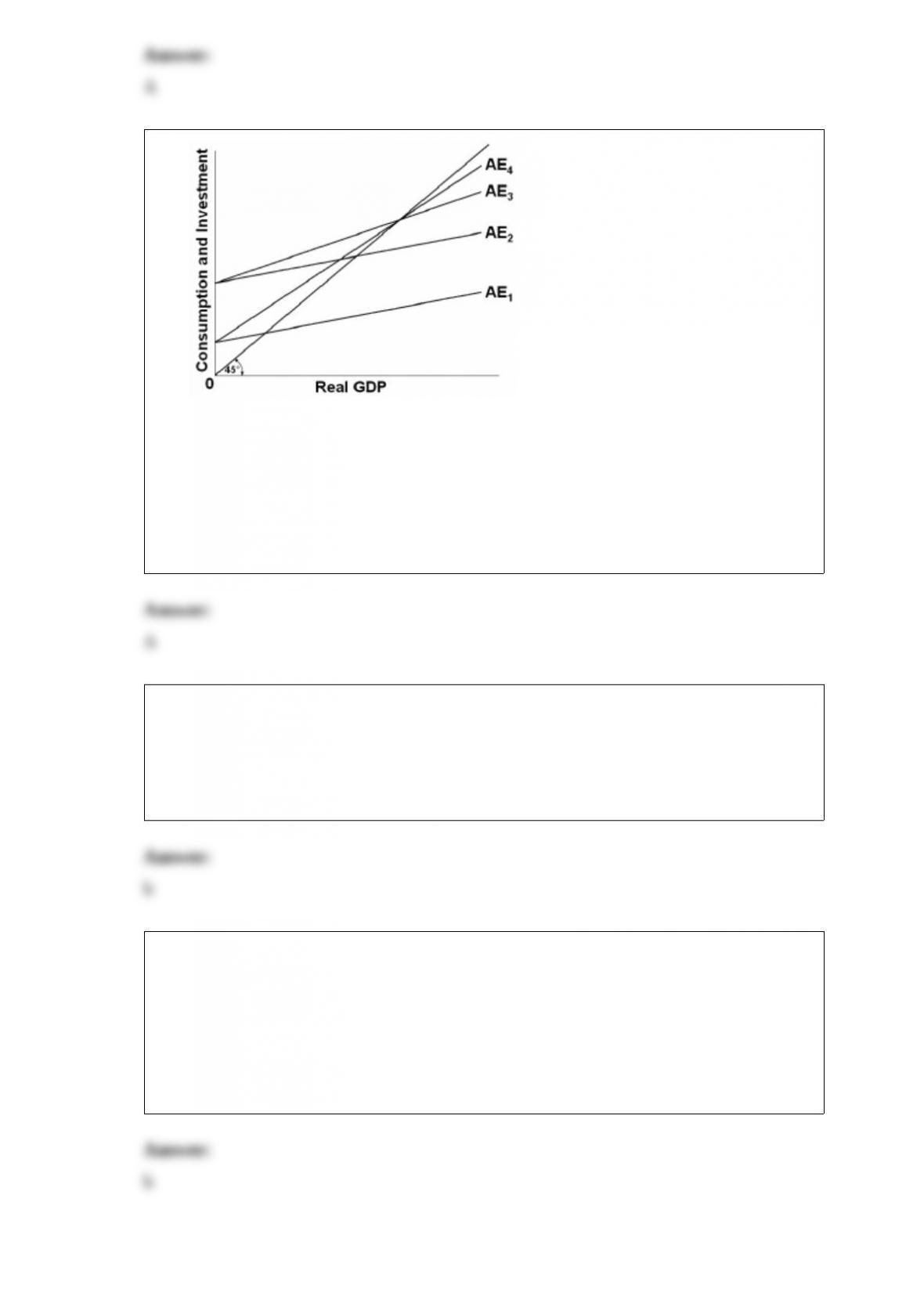
16)
Which aggregate expenditure schedule AE in the above diagram for a private closed
economy implies the largest MPC, assuming investment is the same at each level of
income?
A.AE4
B.AE3
C.AE2
D.AE1
17) which of the following is a distinguishing feature of a command system?
a.private ownership of all capital.
b.central planning.
c.heavy reliance on markets.
d.wide-spread dispersion of economic power.
18) suppose an excise tax is imposed on product x. we would expect this tax to:
a.increase the demand for complementary good y and decrease the demand for
substitute product z.
b.decrease the demand for complementary good y and increase the demand for
substitute product z.
c.increase the demands for both complementary good y and substitute product z.
d.decrease the demands for both complementary good y and substitute product z.
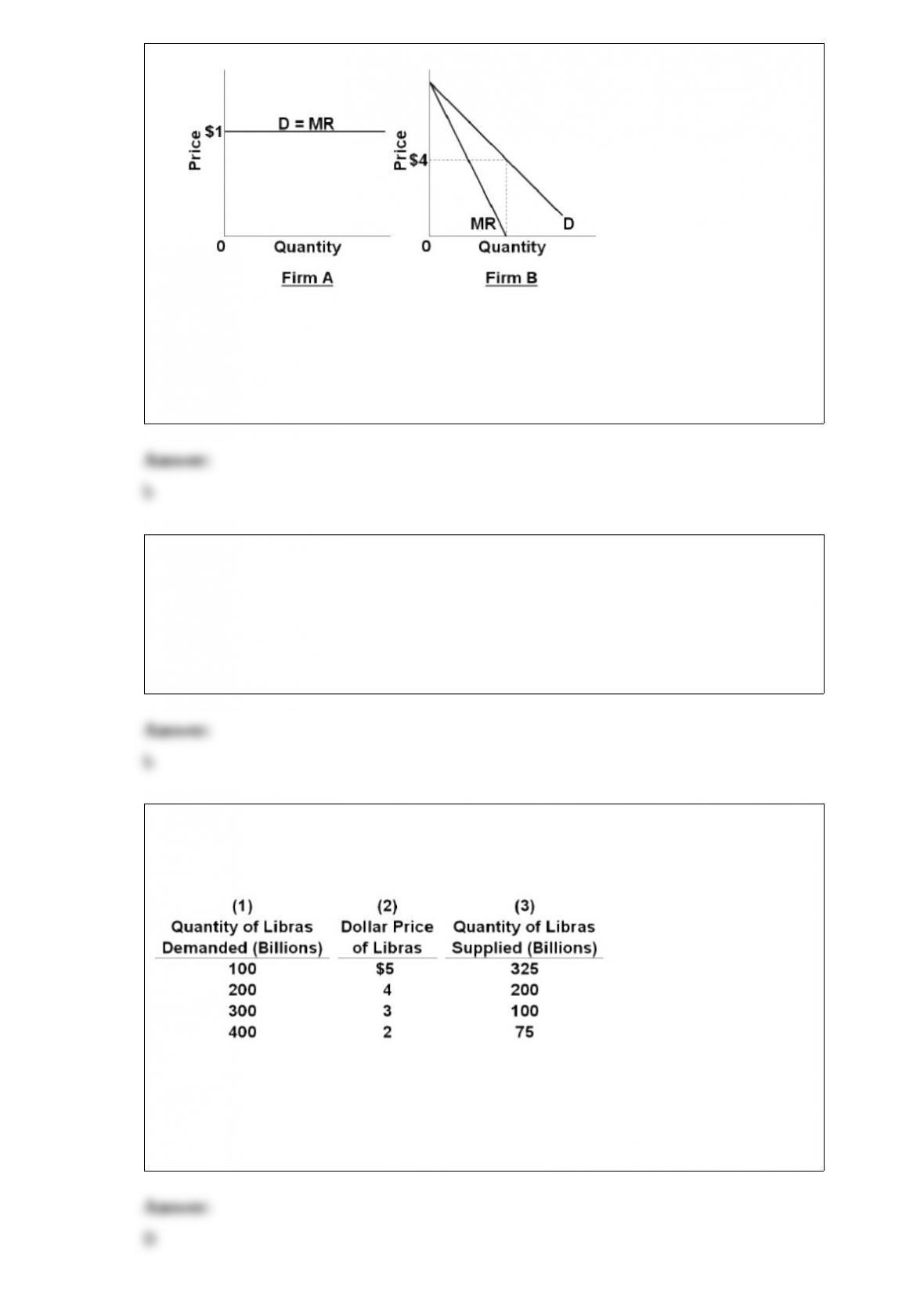
19)
refer to the above diagrams. firm a’s average revenue is:
a.zero.
b.$1.
c.less than $1.
d.more than $1.
20) assume that the size of the underground economy increases both absolutely and
relatively over time. as a result:
a.real gdp will rise more rapidly than nominal gdp.
b.gdp will tend to increasingly understate the level of output through time.
c.gdp will tend to increasingly overstate the level of output through time.
d.the accuracy of gdp will be unaffected through time.
21) The following table which indicates the dollar price of libras, the currency used in
the hypothetical nation of Libra. Assume that a system of freely floating exchange rates
is in place.
Refer to the above table. The exchange rate is:
A.4 libras for one dollar.
B..25 libras for one dollar.
C..40 libras for one dollar.
D.3 libras for one dollar.
22) Reserves borrowed at the Federal funds rate are usually repaid:
A.in one year.
B.in five years.
C.at the end of the month.
D.the next day.
23) An economist who favors smaller government would recommend:
A.tax cuts during recession and reductions in government spending during inflation.
B.tax increases during recession and tax cuts during inflation.
C.tax cuts during recession and tax increases during inflation.
D.increases in government spending during recession and tax increases during inflation.
24)
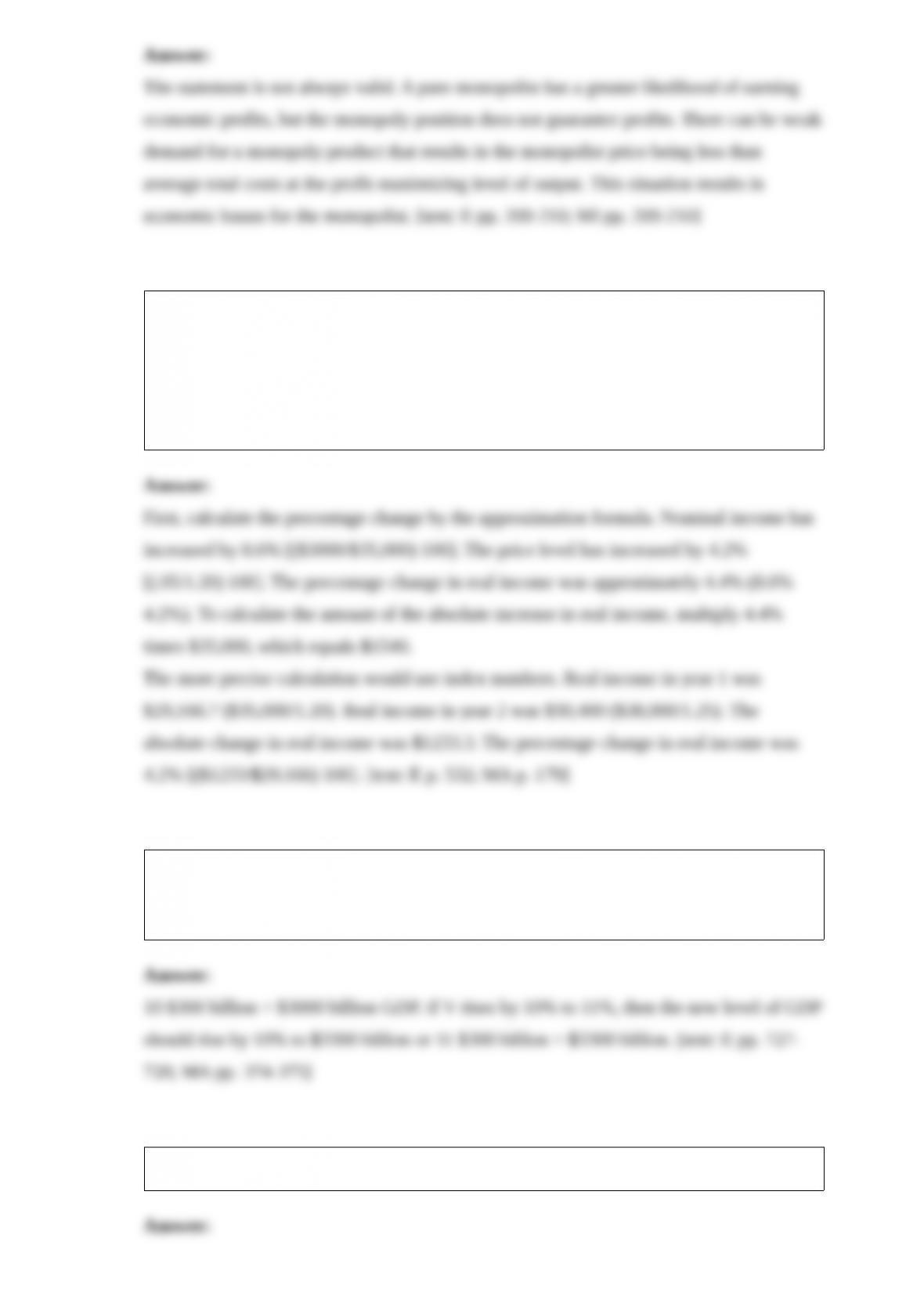
which of the above diagrams correctly portray a nondiscriminating pure monopolist’s
demand (d) and marginal revenue (mr) curves?
a.a
b.b
c.c
d.d
25)
Renewable resources:
A.can never be exhausted permanently.
B.can be exhausted if harvest rates exceed replenishment rates for an extended period.
C.can be exhausted if replenishment rates exceed harvest rates for an extended period.
D.will tend to be over-harvested when they are private property.
26) Explain the problems with exchange rate controls.
27) What factors might cause the interest rates to differ? Explain.
28) Pure monopoly guarantees economic profits. Discuss whether this is a valid
statement.
29) Assume that nominal income is $35,000 and the price index is 1.20 in year 1. In
year 2, nominal income rises to $38,000 and the price index rises to 1.25. What was the
percentage change in real income from year 1 to year 2? What was the absolute amount
of increase in real income? Make your calculations of the percentage change in real
income and the absolute change in real income using the approximation formula and
using the more precise method with index numbers.
30) Assume that M is $300 billion and V is 10. What is the level of nominal GDP
according to the monetarist equation? If V rises by 10%, then according to the
monetarist equation, what will be the new level of nominal GDP?
31) Why study the economics of agriculture in the United States? Give five reasons.
32) What is the Federal funds rate and how does the Fed target it?