Answer the following questions.
a. Define economies of scope using these cost functions: TC(Q1,Q2), TC(Q1,0), and
TC(0,Q2).
b. Why do economies of scope arise?
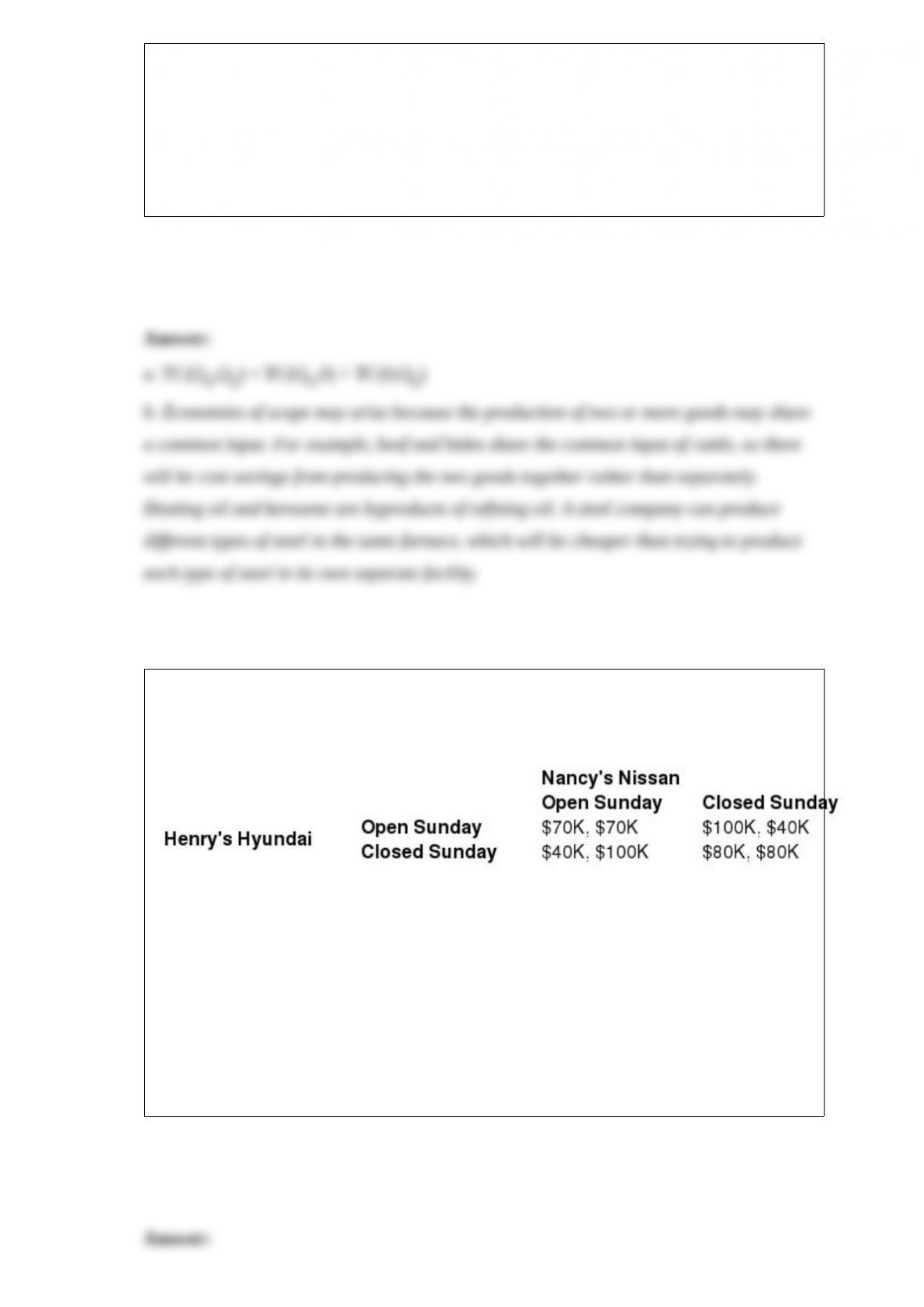
Table 11.1
Payoffs: Henry’s Monthly Profit, Nancy’s Monthly Profit
(Table 11.1) If car dealerships are legally allowed to be open on Sunday, what is the
Nash equilibrium?
A) Henry earns $70K and Nancy earns $70K.
B) Henry earns $100K and Nancy earns $100K.
C) Henry earns $80K and Nancy earns $80K.
D) There is no Nash equilibrium in this market.
Answer the following questions.
a. What are the assumptions of Bertrand competition with identical goods?
b. Suppose that two firms are engaged in Bertrand competition with identical goods,
and each firm has a marginal cost of $33. What is the Nash equilibrium?
c. In Bertrand competition with identical goods, Firm A charges a price of $10 and
FirmBcharges a price of $8. What is the market share of Firm A and of Firm B?
A perfectly competitive industry has two types of firms operating in long-run
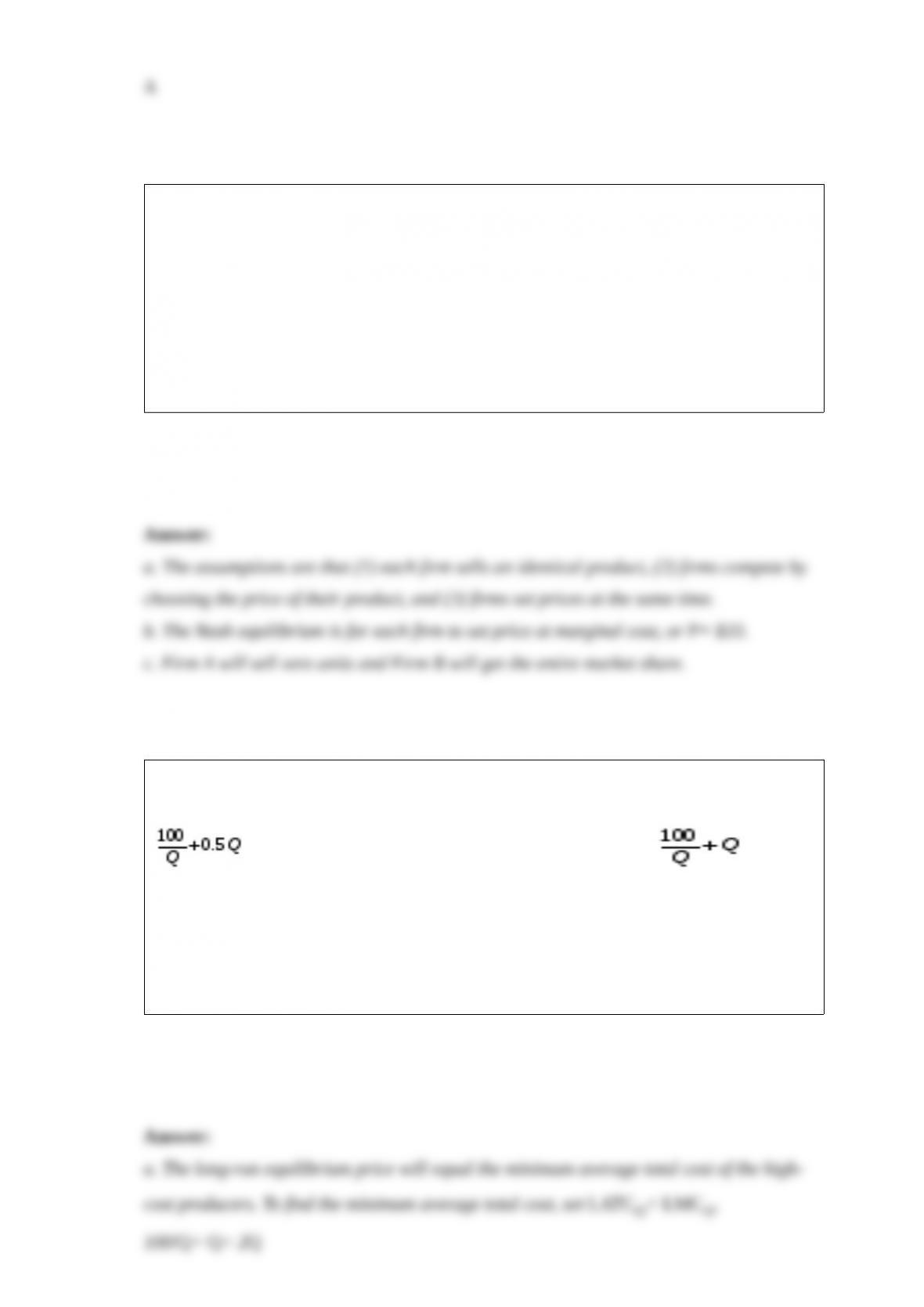
equilibrium: low-cost and high-cost producers. For the low-cost producers, LATCL =
and LMCL = Q. For the high-cost producers, LATCH = and
LMCH = 2Q.
a. What’s the long-run equilibrium price?
b. How much economic rent does a low-cost producer earn?
An increase in the price of computer chips causes a decrease in the total revenue of
computer chip manufacturers. The price elasticity of demand for computer chips is:
A) positive and elastic.
B) inelastic.
C) elastic.
D) positive and inelastic.
Which of the following statements is TRUE?
I. The Lerner index is zero for a perfectly competitive firm.
II. If P = $80 and MC = $60, the Lerner index = 0.25.
III. If the price elasticity of demand is 1.25, the Lerner index is 0.80.

IV. A higher price elasticity of demand leads to a higher price markup over marginal
cost.
A) I, II, and III
B) I, II, III, and IV
C) II and IV
D) III only
An economist sent out numerous résumés to businesses; all were identical except that
some of the résumés had “African American’sounding” names and others
“white’sounding” names. The economist was interested to see whether a person’s name
affected the callback rate. This study is an example of a:
A) field experiment.
B) contrived experiment.
C) natural experiment.
D) clinical trial.
The field of economics that examines how human psychology affects economic
decision making is called:

A) behavioral economics.
B) Freudianomics.
C) psychonomics.
D) forensic economics.
If a firm is using a lot of capital and just a little labor, the marginal product of labor is:
A) low relative to the marginal product of capital, making it more difficult to substitute
labor for capital.
B) high relative to the marginal product of capital, making it easier to substitute labor
for capital.
C) high relative to the marginal product of capital, making it more difficult to substitute
labor for capital.
D) low relative to the marginal product of capital, making it easier to substitute labor
for capital.
In each of the following cases, predict what will happen to the equilibrium price and
quantity in the market.
a. More sellers enter the market and consumer income decreases. The good is a normal
good.
b. The price of a substitute good increases and sellers’ options in other markets become
less profitable.
c. A drought reduces the cotton harvest and cotton clothing falls out of favor with
consumers.
d. The price of inputs in production rises and the price of a complement good falls.
Consider the production function Q = Af(K, L). Which of the following statements is/are
TRUE?
I. An increase in total factor productivity growth is represented by an increase in K or L.
II. An increase in total factor productivity growth means that the same amount of output
can be produced using fewer inputs. III. If A increases by 10%, the amount of output
produced will increase by 10%, holding the quantity of inputs fixed.
I. An increase in total factor productivity growth is represented by an increase in K or L.
II. An increase in total factor productivity growth means that the same amount of output
can be produced using fewer inputs.
III. If A increases by 10%, the amount of output produced will increase by 10%,
holding the quantity of inputs fixed.
A) II only
B) I, II, and III
C) II and III
D) I only
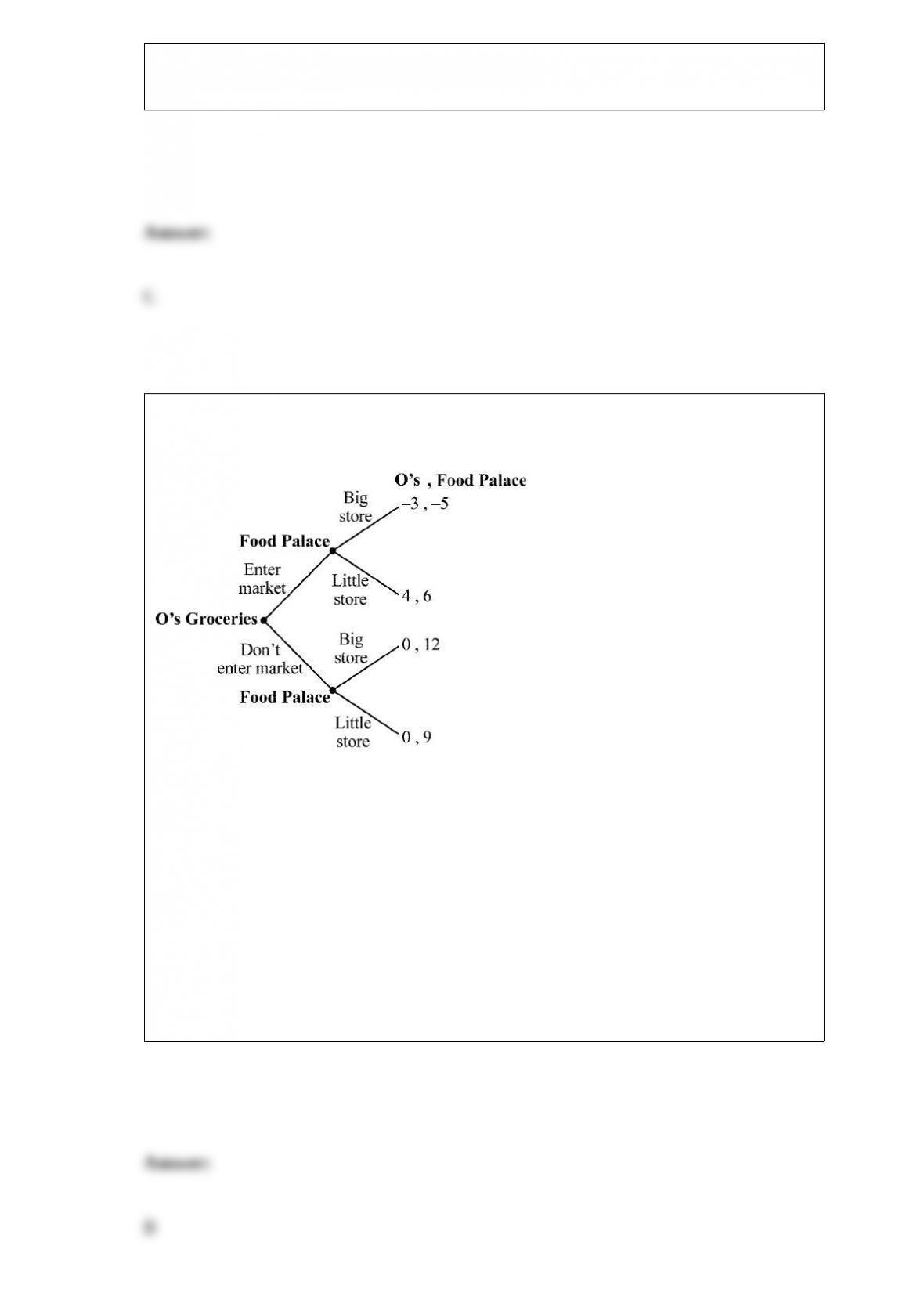
Figure 12.8
(Figure 12.8) Which of the following is an example of a noncredible threat?
A) O’s Groceries tells the Food Palace that it is committed to entering the market.
B) Food Palace tells O’s Groceries that it will build a large store regardless of whether
O’s Groceries enters the market.
C) Food Palace tells O’s Groceries that it will build a small store if O’s Groceries enters
the market.
D) O’s Groceries tells the Food Palace that it will not enter the market.
Suppose the long-run equilibrium price in a perfectly competitive market is currently
$100. What happens to the long-run equilibrium price when there is an increase in
product demand?
A) If it is a decreasing-cost industry, the long-run equilibrium price will rise to reflect a
lower long-run average total cost.
B) If it is an increasing-cost industry, the long-run equilibrium price will rise to reflect a
lower long-run average total cost.
C) If it is a decreasing-cost industry, the long-run equilibrium price will fall to reflect a
lower long-run average total cost.
D) If it is an increasing-cost industry, the long-run equilibrium price will fall to reflect a
higher long-run average total cost.
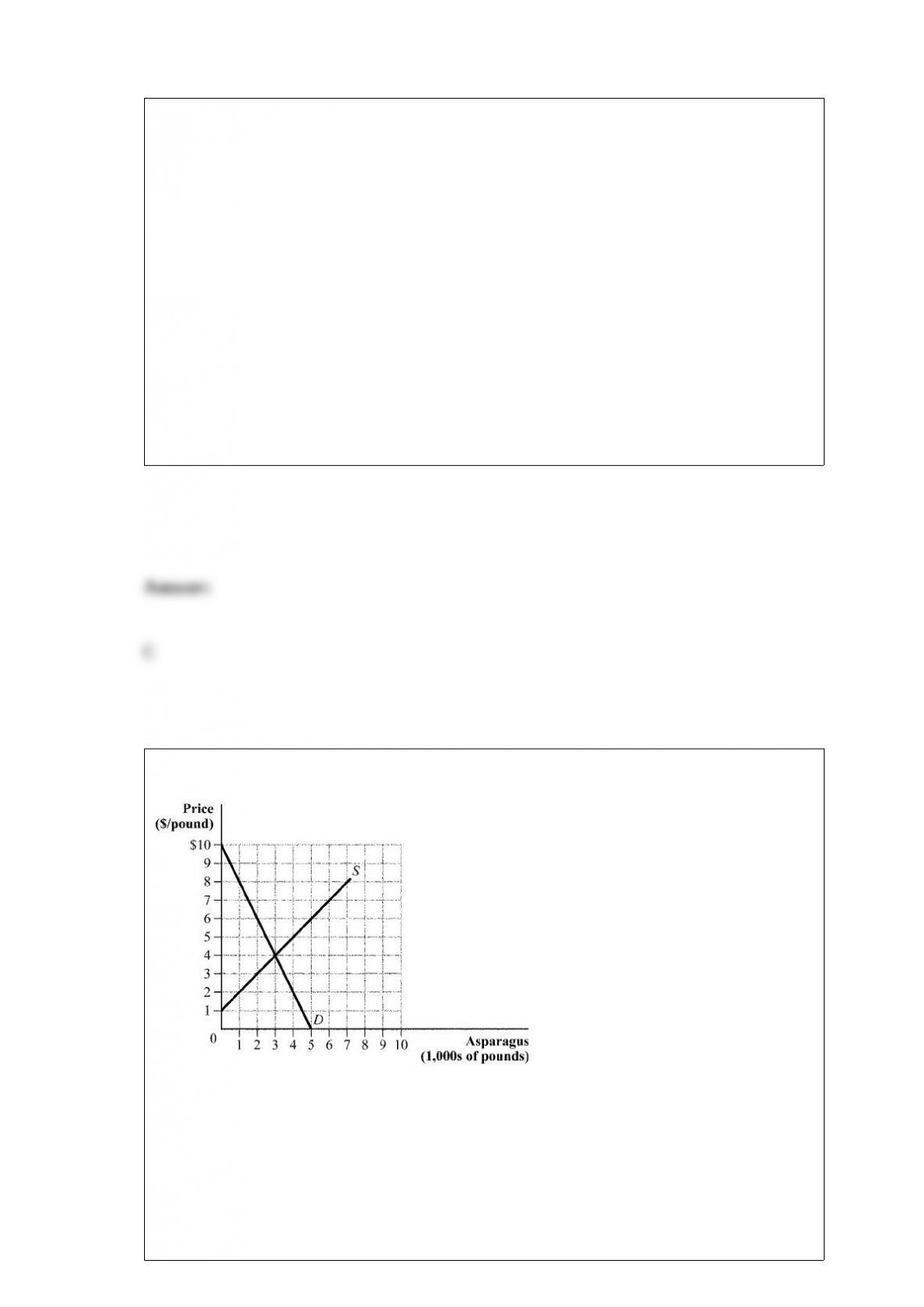
Figure 2.4
(Figure 2.4) An excess supply of 3,000 pounds occurs at a price of:
A) $2.
B) $5.
C) $6.
D) $8.
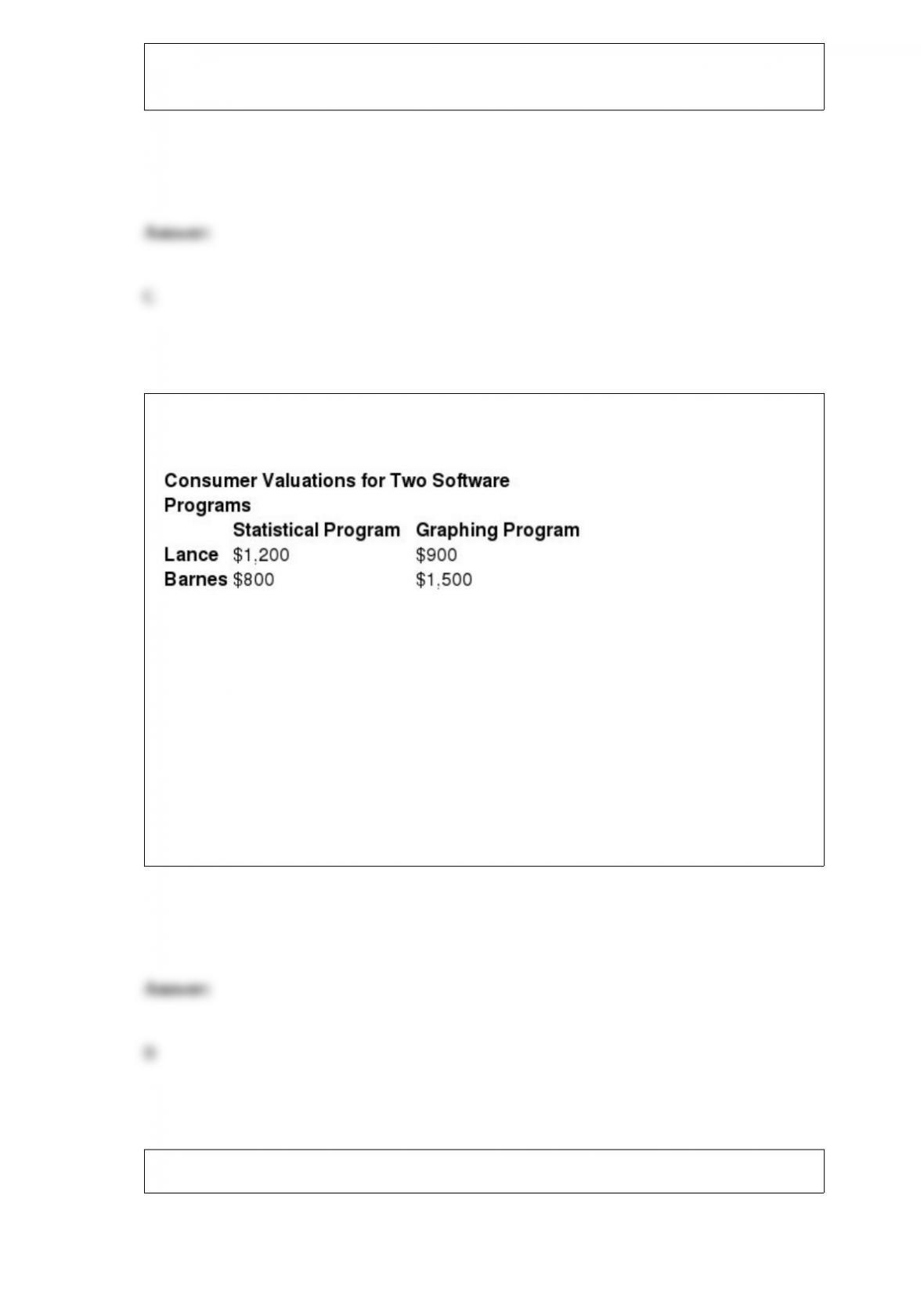
Table 10.6
(Table 10.6) Assume that the marginal cost of producing software programs is zero. The
most profitable bundling strategy would be to sell the statistical and graphical programs
together for:
A) $2,000.
B) $2,100.
C) $2,200.
D) $2,300.
Figure 15.5
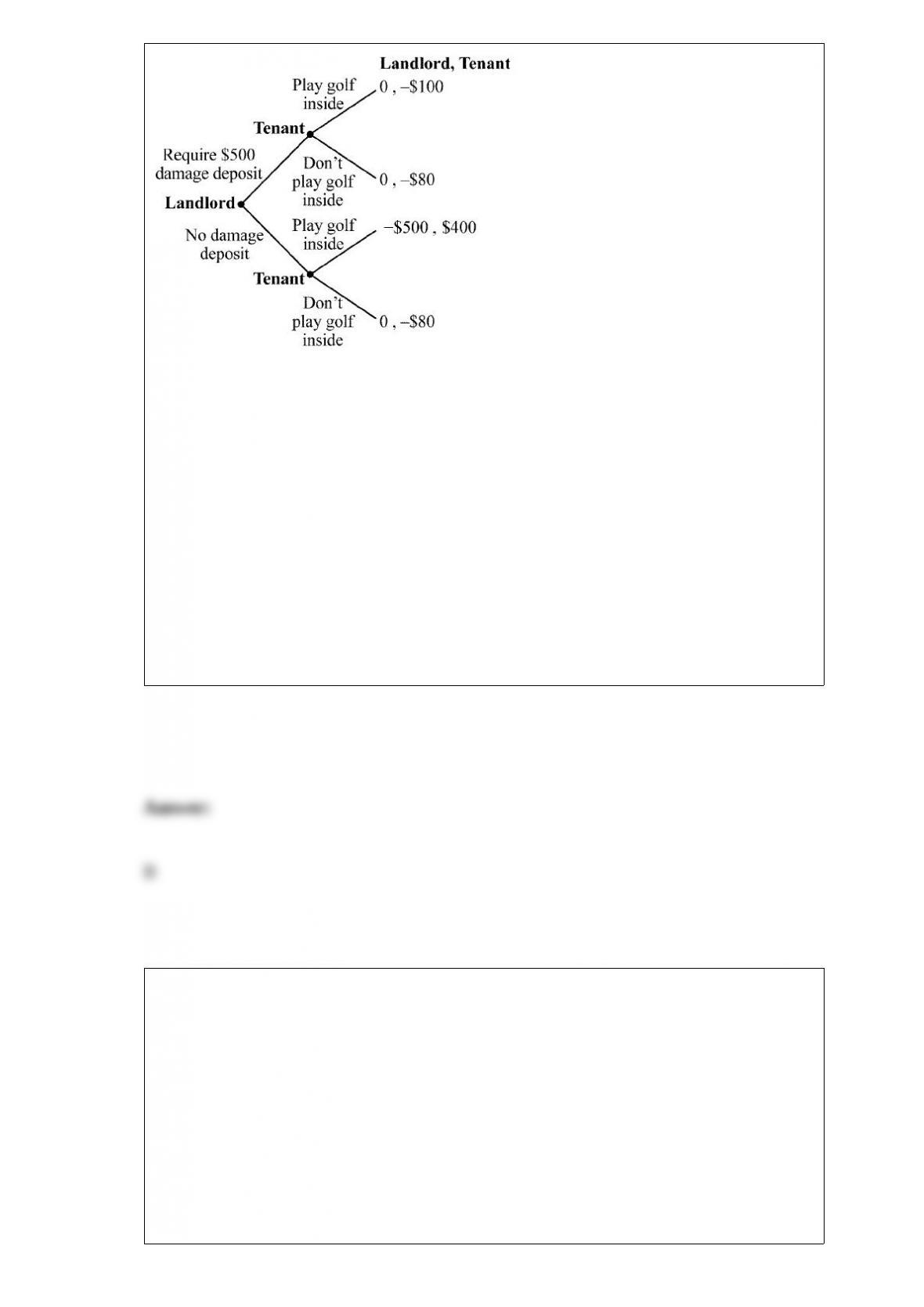
(Figure 15.5) What is the likely outcome of this game?
A) The landlord will not require a $500 damage deposit, and the tenant will not play
golf inside.
B) The landlord will require a $500 damage deposit, and the tenant will not play golf
inside.
C) The landlord will require a $500 damage deposit, and the tenant will play golf
inside.
D) The landlord will not require a $500 damage deposit, and the tenant will play golf
inside.
Stan started a lawn-fertilizing business and is considering purchasing a powered
fertilizer spreader or a self-propelled spreader. The powered spreader has a fixed cost of
$4,000 for the season, whereas the self-propelled spreader has a fixed cost of only $100
for the season. The variable costs of fertilizing a lawn with the powered spreader and
self-propelled spreader are $7 and $15, respectively.
a. Draw the total cost curves of fertilizing lawns using the powered spreader and the
self-propelled spreader.
b. If Stan is expected to fertilize 400 lawns for the season, which production method
should he choose?
c. How many lawns does Stan have to fertilize for it to make sense to use the powered
spreader?
An amusement park faces a demand curve of Q = 40 ” 0.4P and marginal cost of MC =
1.25Q, where Q is measured in hundreds of customers.
a. Calculate the amusement park’s profit-maxizing output level.
b. Calculate the amusement park’s profit-maximizing price.
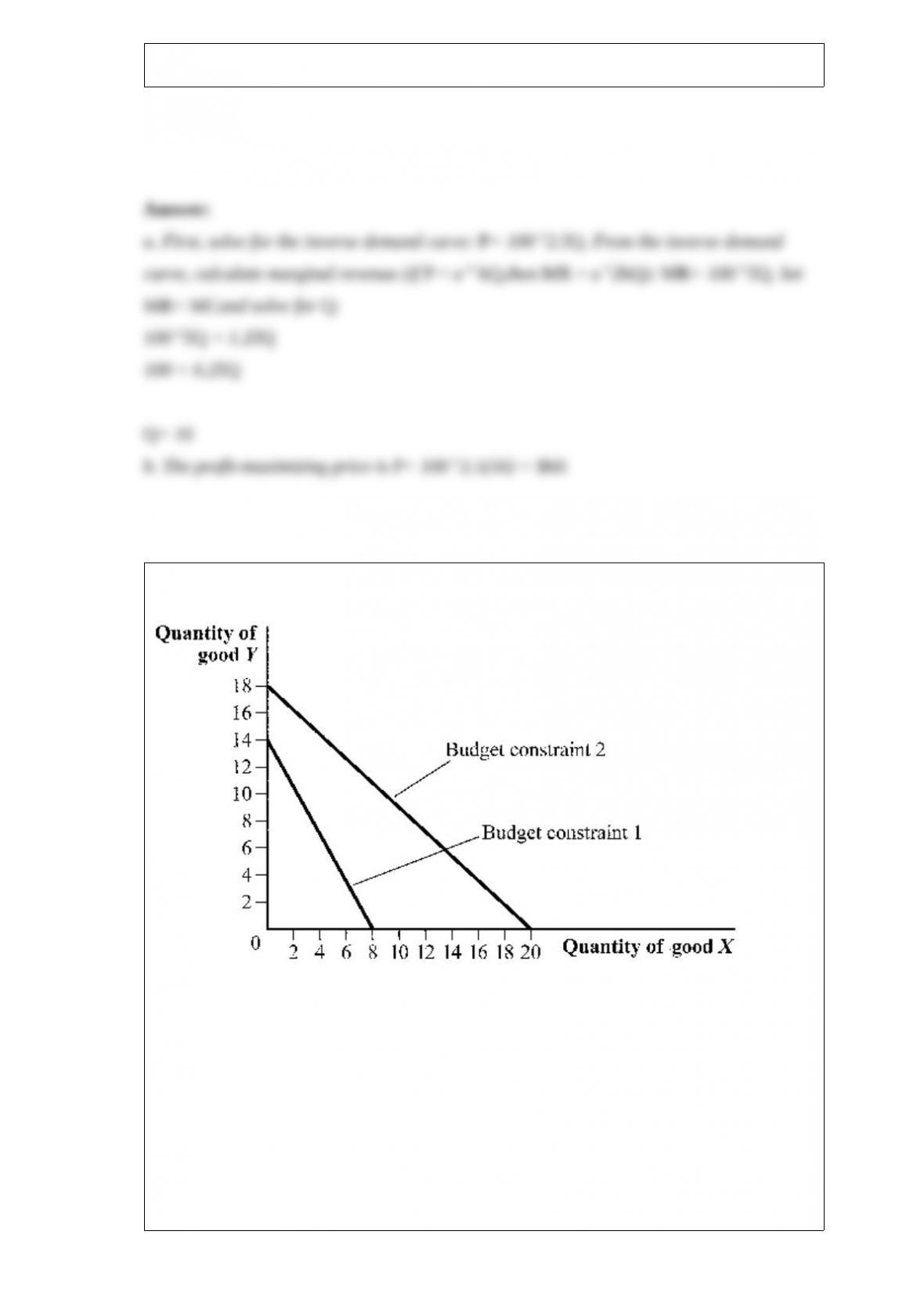
Figure 4.14
(Figure 4.14) For Budget constraint 2, suppose that the price of good Y is $90 per unit.
What is the price of good X?
A) $92
B) $88
C) $81
D) $102.24
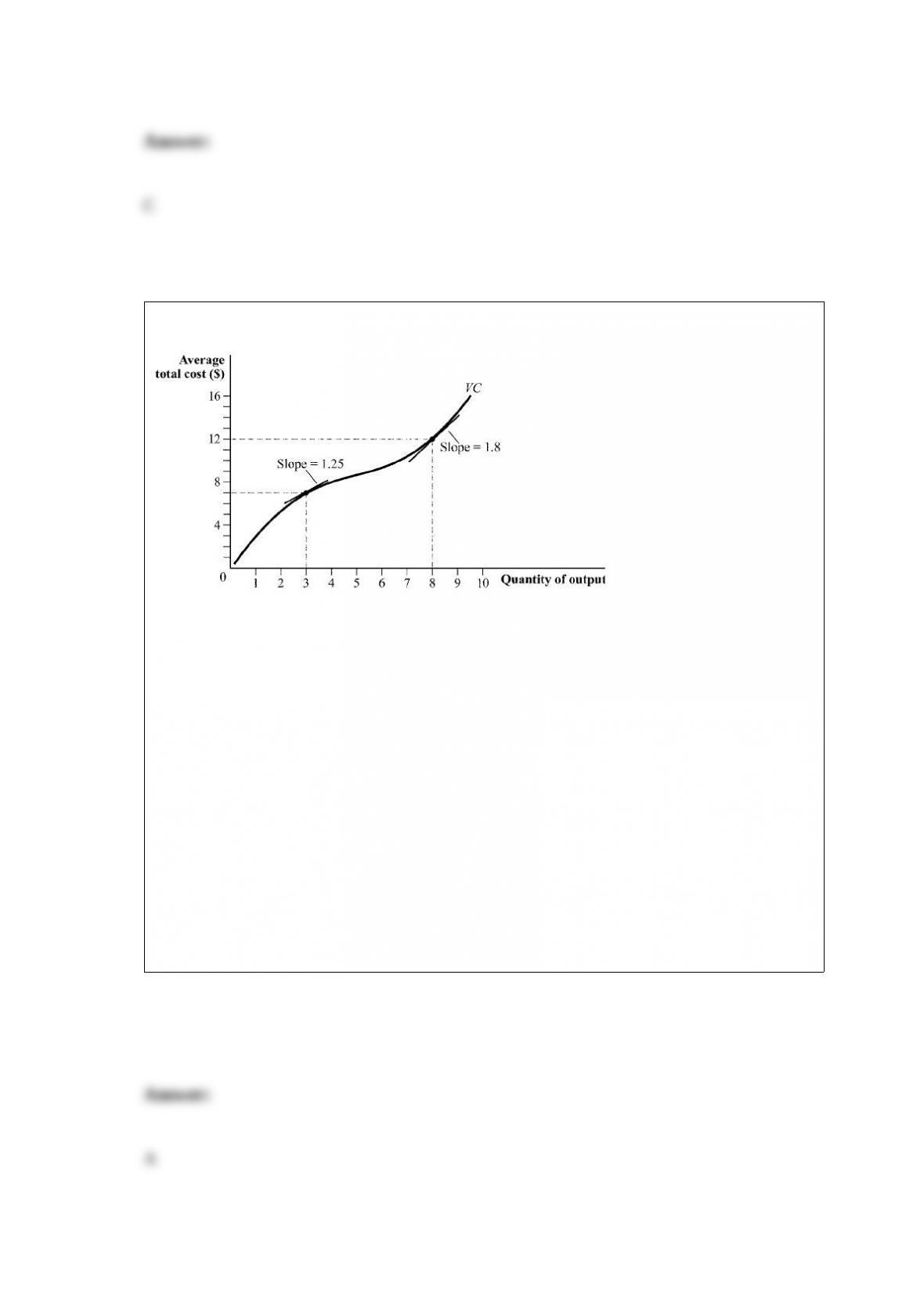
Figure 7.7
(Figure 7.7) Which of the following statements is TRUE?
I. At Q = 3, the marginal cost is $2.33.
II. At Q = 8, the marginal cost is $1.80.
III. The slope of the total cost (TC) curve at Q = 3 is $2.33.
A) II only
B) I and III
C) II and III
D) I only

In an experiment, students were asked to consider the last two digits of their social
security number. Next, students were asked to submit bids for a product. It was found
that there was a positive correlation between the size of the bid and the last two digits of
a student’s social security number. This experiment highlights the behavioral economic
issue of:
A) vertical thought.
B) metering.
C) fleeting.
D) anchoring.
Which of the following statements is TRUE?
A) A demand curve shows the relationship between a product’s price and how many
units consumers want to buy at each price, assuming there are no changes in other
factors affecting demand.
B) A demand curve shows the relationship between consumer income and the quantity
purchased of some product.
C) A demand curve shows the relationship among consumer income, price of a product,
quantity supplied, and how many units consumers want to buy of that product.
D) A demand curve is drawn with the assumption that demand equals supply.
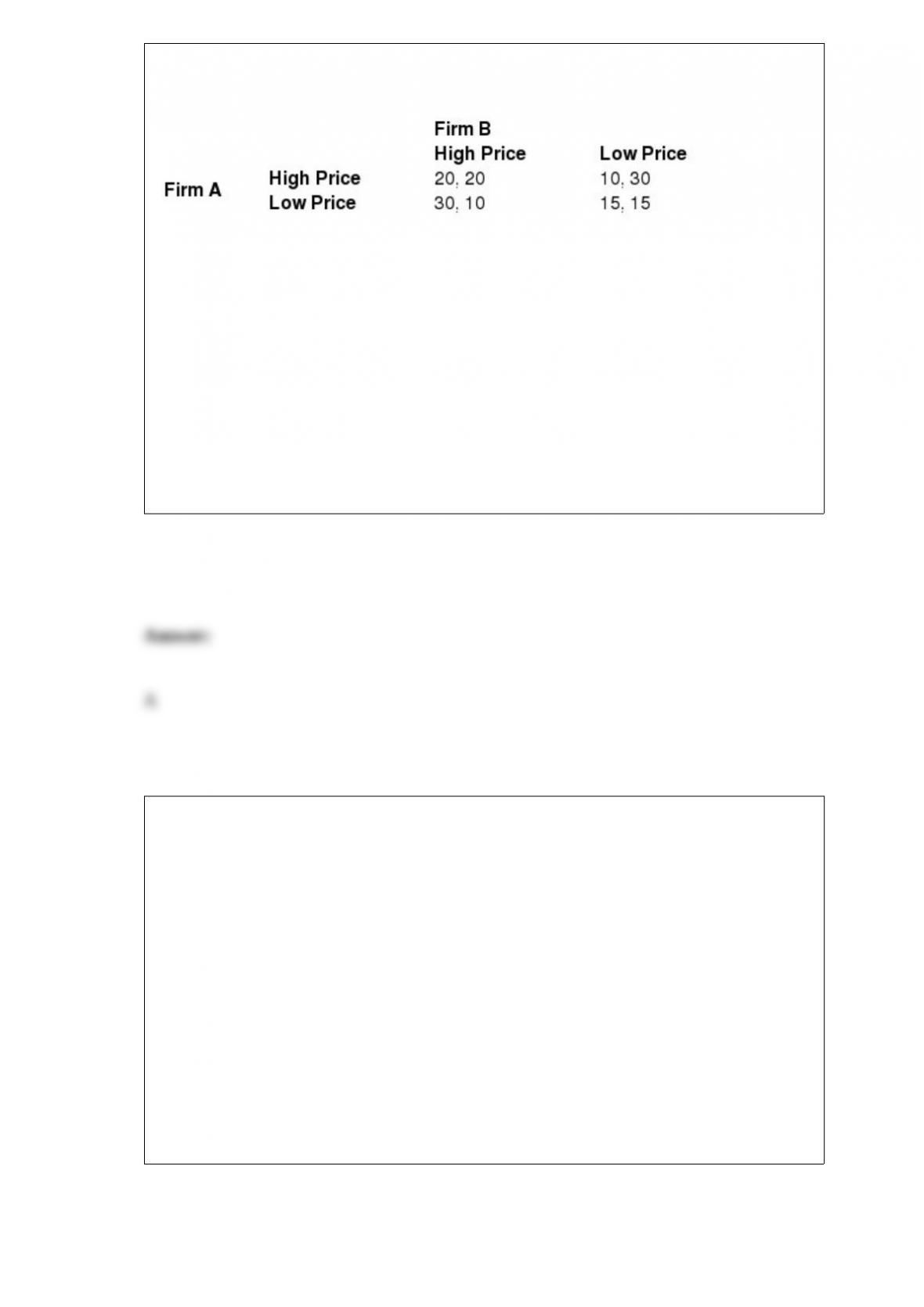
Table 12.16
(Table 12.16) In the table, the payoffs represent profits measured in thousands of
dollars. Suppose that Firm A and Firm B are playing an infinitely repeated game. In
period 6, Firm B decides to no longer cooperate with Firm A. If Firm A is using a grim
trigger strategy, Firm A will choose:
A) a low price in period 7 and all future periods.
B) a low price in period 7 and a high price in all future periods.
C) to set price below marginal cost and drive Firm B out of the market.
D) to maintain a high price in all future periods.
Two boxers, Brutus and Floyd, are training to fight each other. Each boxer is
considering whether to take steroids to improve his chance of winning the fight.
Assume that the boxing association does not have a policy against steroid use. If both
boxers take steroids, neither has an advantage and the payoffs (net of health costs) are
$3 million per boxer. If both boxers don’t take steroids, the payoffs are $4 million per
boxer. If one boxer takes steroids and the other doesn’t, the boxer taking the steroids
receives a payoff of $6 million (net of health costs) and the other boxer receives a
$1-million payoff.
a. Represent the preceding information in a normal form game.
b. What is the Nash equilibrium?
c. Would the boxers be better off if the boxing association banned steroids and tested
each boxer for steroids prior to a fight?
For the following situations, use the Coase theorem to explain how a socially efficient
solution may arise.
a. An adult bookstore, with a legal right to operate, creates psychic discomfort of
$250,000 for a nearby church. The adult bookstore owner values his business at
$200,000.
b. A church has purchased a building that houses several businesses that lease storefront
property. The church must decide whether to allow the businesses to renew their leases.
One of the businesses is an adult bookstore, whose owner values his business location
at $450,000. The continued operation of the adult bookstore would create $250,000 of
psychic discomfort to the church.
At one time, tobacco companies vigorously fought lawsuits by their current and former
smokers, even though the cost of defending the lawsuits exceeded the amount of money
demanded by the smokers. What type of strategic behavior were tobacco companies
using?
A) excess capacity
B) reputation
C) grim reaper
D) MAD
Table 10.14
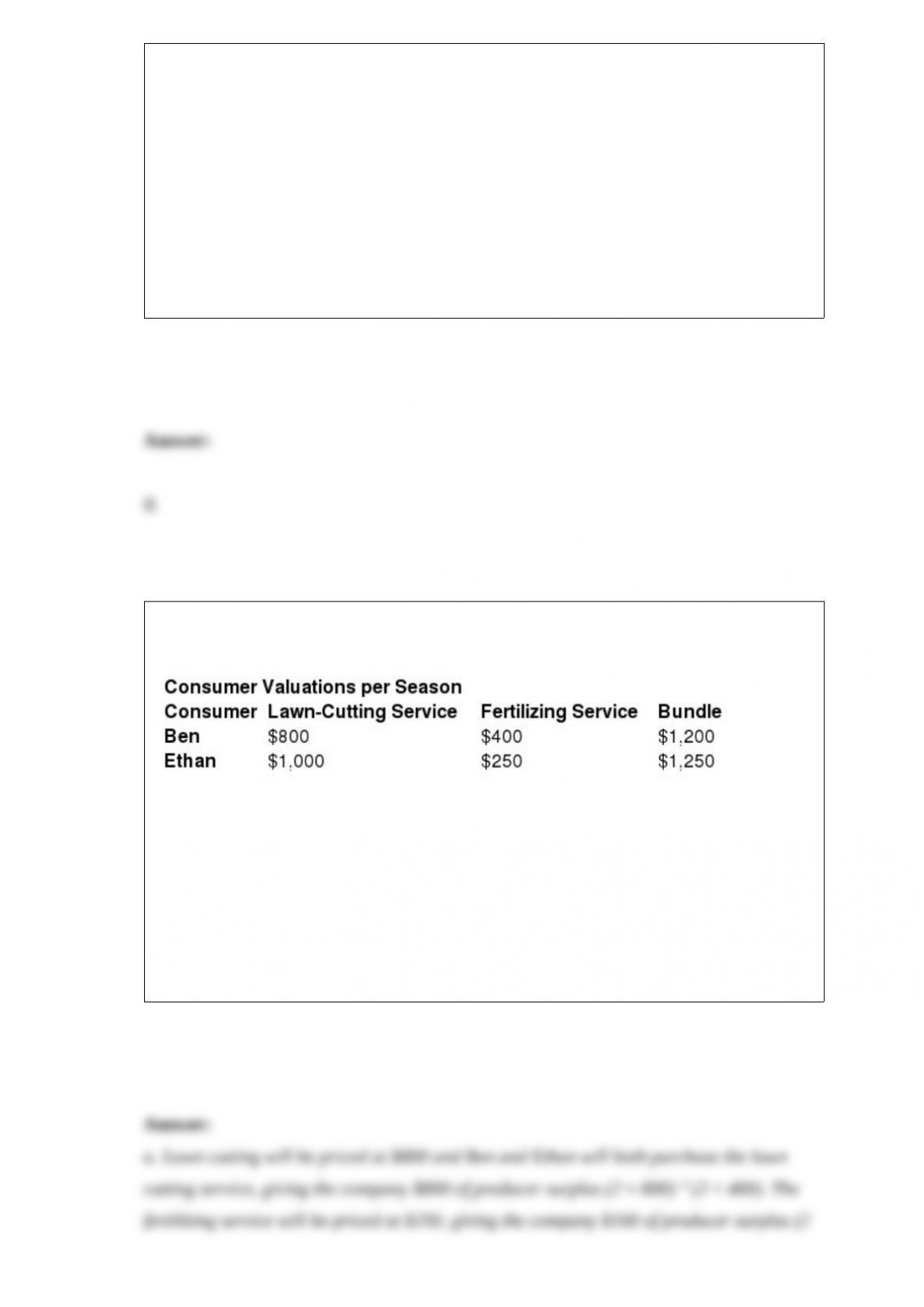
(Table 10.14) The table shows customer valuations for different lawn services. The
marginal cost of lawn cutting is $400 and the marginal cost of fertilizing is $200.
a. Suppose the lawn service company prices its services separately. How much should
the company charge for lawn cutting and how much for fertilizing? How much
producer surplus does the company earn by pricing its services separately?
b. Now suppose the company offers lawn cutting and fertilizing as a bundle. What is the
bundle price? How much producer surplus is earned using bundling?

The costs of obtaining a college degree for high-productivity and low-productivity
workers are as follows:
High productivity: CH = $20,000y
Low productivity: CL= $40,000y
where y is years in college. In an economy, workers with a college degree are paid a
lifetime income of $600,000, and workers without a college degree are paid a lifetime
income of $450,000. For low-productivity workers, the net benefit of four years of
college is ______, while the net benefit of not going to college is ______.
A) $500,000; $150,000
B) $440,000; $450,000
C) $150,000; $40,000
D) $600,000; $120,000
Consider two firms engaged in Bertrand competition with differentiated goods and zero
marginal costs:
Firm A’s demand curve: qA = 120 ” 3PA+ 2PB
Firm B’s demand curve: qB= 120 ” 3PB + 2PA
In a Nash equilibrium, what is each firm’s price?
A) PA = $5; PB = $5
B) PA = $10; PB = $10
C) PA = $30; PB = $30
D) PA = $20; PB = $20
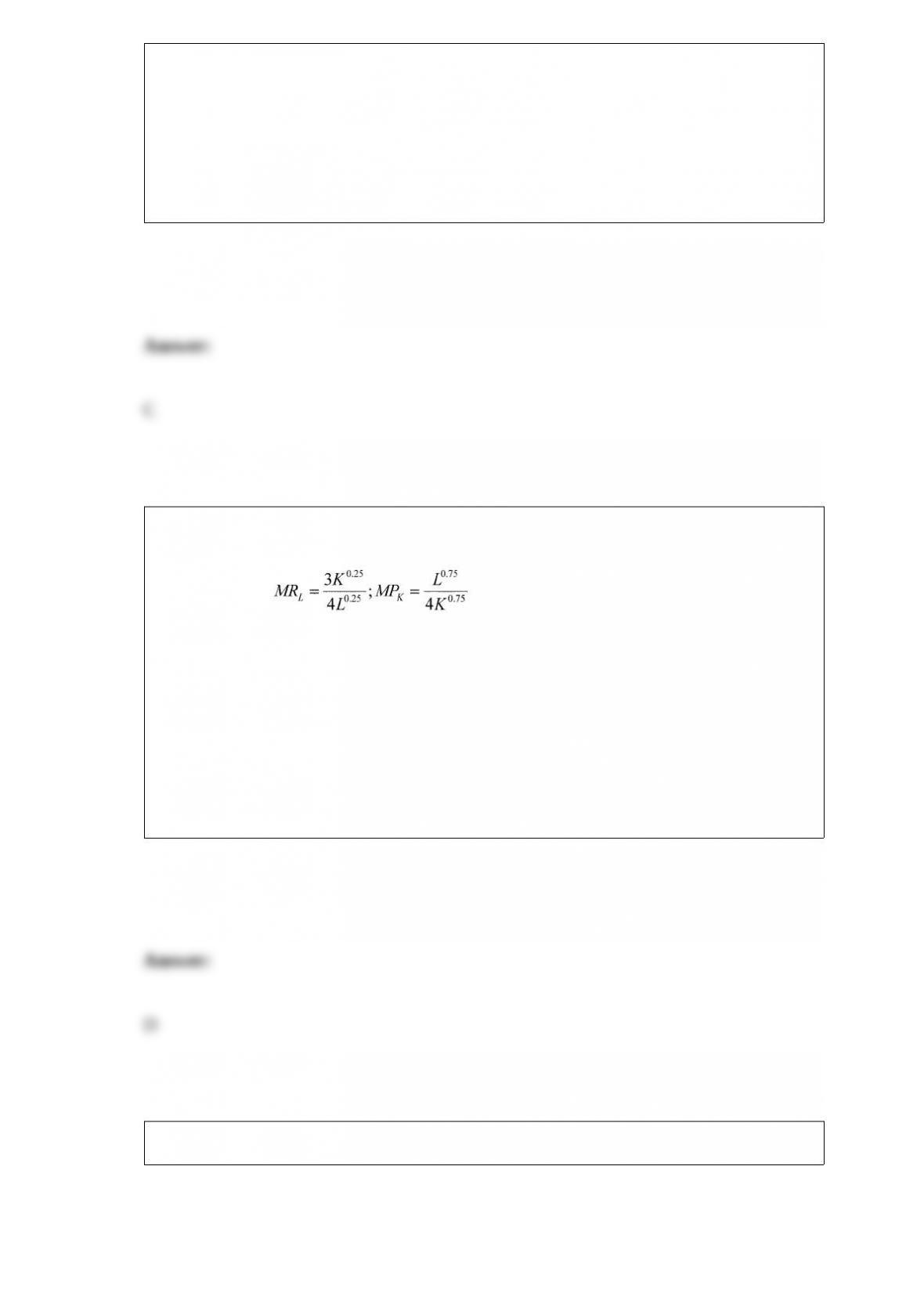
Suppose a firm with a production function given by Q = 4K0.25L0.75 produces 100 units
of output. The firm pays a wage of $30 per units and pays a rental rate of capital of $10
per unit. (Note: ). The minimum cost of producing
100 units of output is:
A) $3,000.
B) $2,250.
C) $800.
D) $1,000.
Figure 5.17
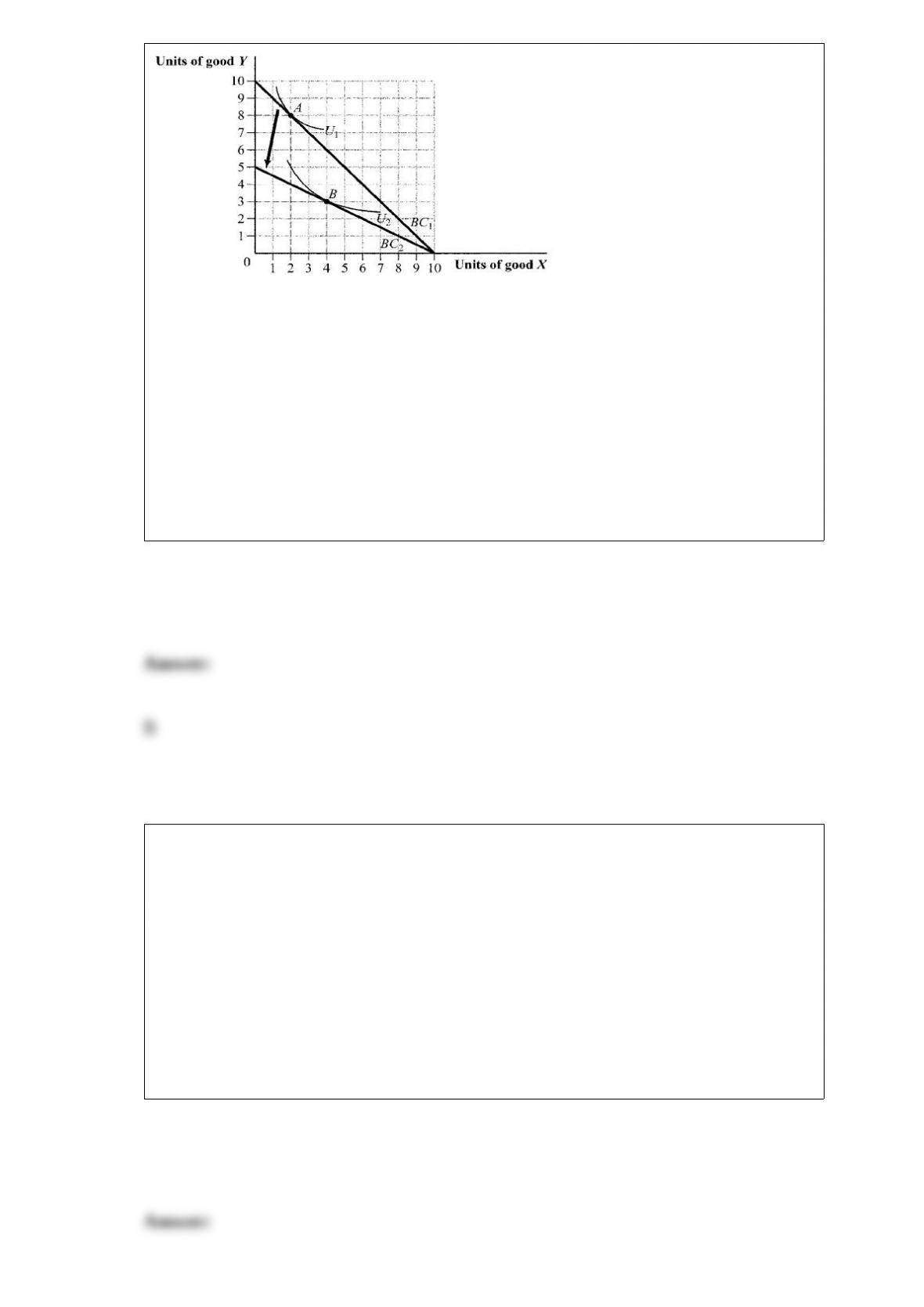
(Figure 5.17) Given the change in the budget constraint, which of the following
statements is TRUE?
A) The demand curve for good Y shifted inward.
B) The demand curve for good X shifted outward.
C) Good X is an inferior good.
D) Good X and good Y are complement goods.
Blaze has $200 to spend on fishing equipment and fast-food burgers. Fishing equipment
is priced at $10 per unit and fast-food burgers are priced at $4 per burger.
a. Graph Blaze’s budget constraint, placing fishing equipment on the vertical axis and
fast-food burgers on the horizontal axis. Using an indifference curve, show Blaze’s
optimal consumption bundle at 10 units of fishing equipment and 25 burgers.
b. Suppose that Blaze’s income increases by $50. Adding a new budget constraint and
indifference curve to your original graph, show Blaze’s new optimal consumption
bundle, assuming fishing equipment is a normal good and fast-food hamburgers are an
inferior good.
In Bertrand competition with differentiated goods, the demand curve for bags of Wilson
tennis balls is qW= 80 ” 4PW+ 2PD , and the demand curve for bags of Dunlop tennis
balls is qD = 80 ” 2PD+ PW. Two firms both have zero marginal costs. How many bags
of tennis balls does each firm produce?
A) qW= 44; qD = 44
B) qW = 64; qD = 48
C) qW = 16; qD = 24
D) qW = 38; qD= 32
The new Camaro SS has a 6.2-liter V8 engine that puts out over 400 horsepower. At the
racetrack, the Camaro runs the quarter-mile in an impressive 12.9 seconds at 117 mph.
General Motors provides a three-year warranty on the Camaro. How might the factory
warranty create moral hazard? What could General Motors do to mitigate the moral
hazard problem?
Suppose that a firm’s potential customers succumb to the endowment effect. Explain
how a firm could take advantage of this bias.
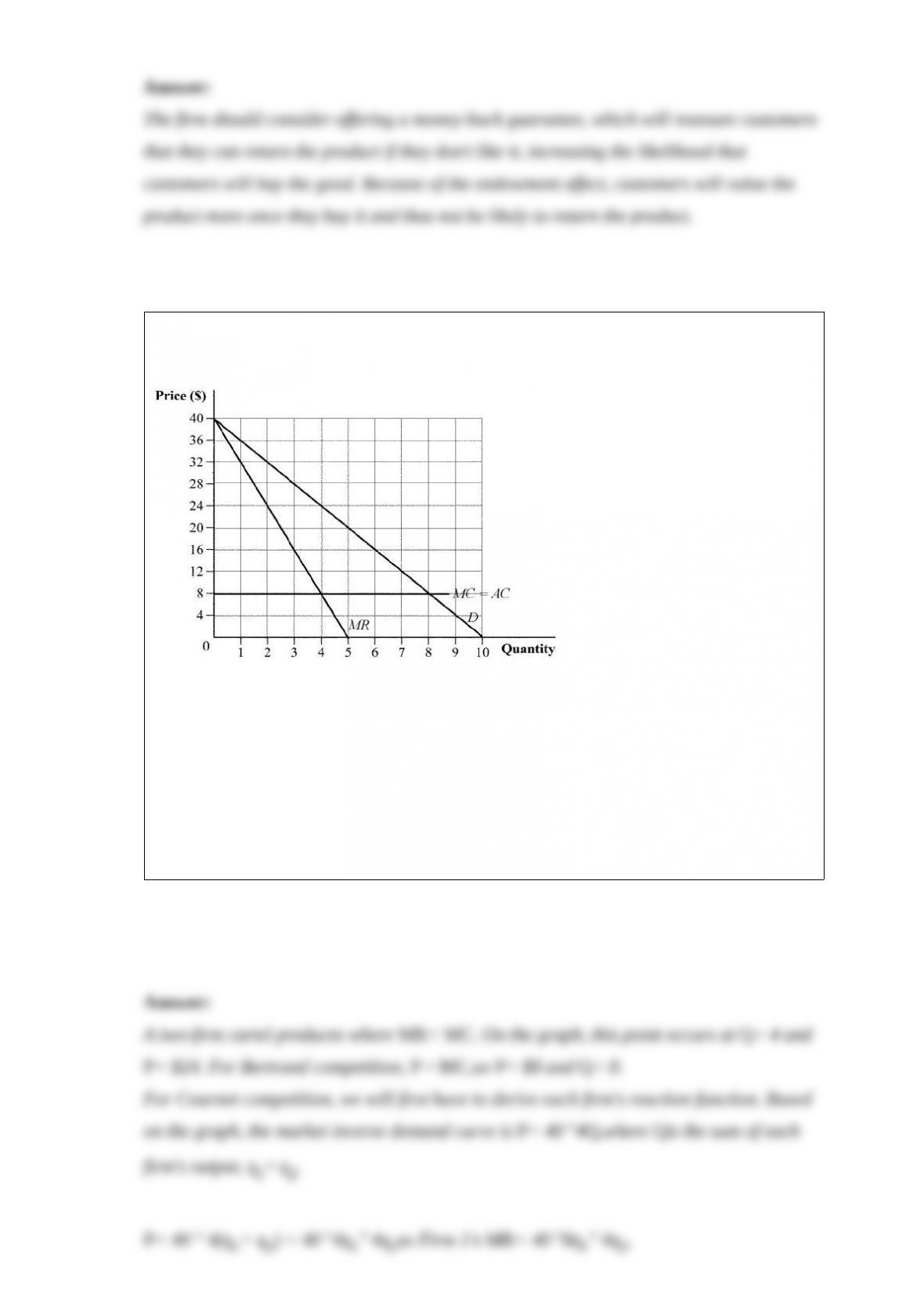
Figure 11.7
(Figure 11.7) The graph shows the market demand curve. What is the equilibrium price
and market output under the following market structures?
a two-firm cartel
Bertrand competition with identical goods
Cournot duopoly with identical goods
Phil’s utility function is U = XY, where MUX= Y and MUY= X. In Lancaster,
Pennsylvania, Phil’s income would equal $500, and the prices of good X and good Y are
$5 and $5, respectively. In Washington, D.C., Phil’s income would equal $800, and the
prices of good X and good Y are $8 and $10, respectively. Where should Phil live?
Show your work!
Figure 14.10
(Figure 14.10) at Point G, the marginal rate of transformation from pancakes to cereal is
3. What does this mean?
A) Consumers prefer pancakes to cereal by a 3-to-1 margin.
B) Consumers prefer cereal to pancakes by a 3-to-1 margin.
C) The economy must give up producing 3 pancakes to make another bowl of cereal.
D) The economy must give up producing 1 pancake to make 3 more bowls of cereal.
Alec has $40 of weekly income to spend on restaurant meals (priced at $10 per meal)
and bowling (priced at $2 per game).
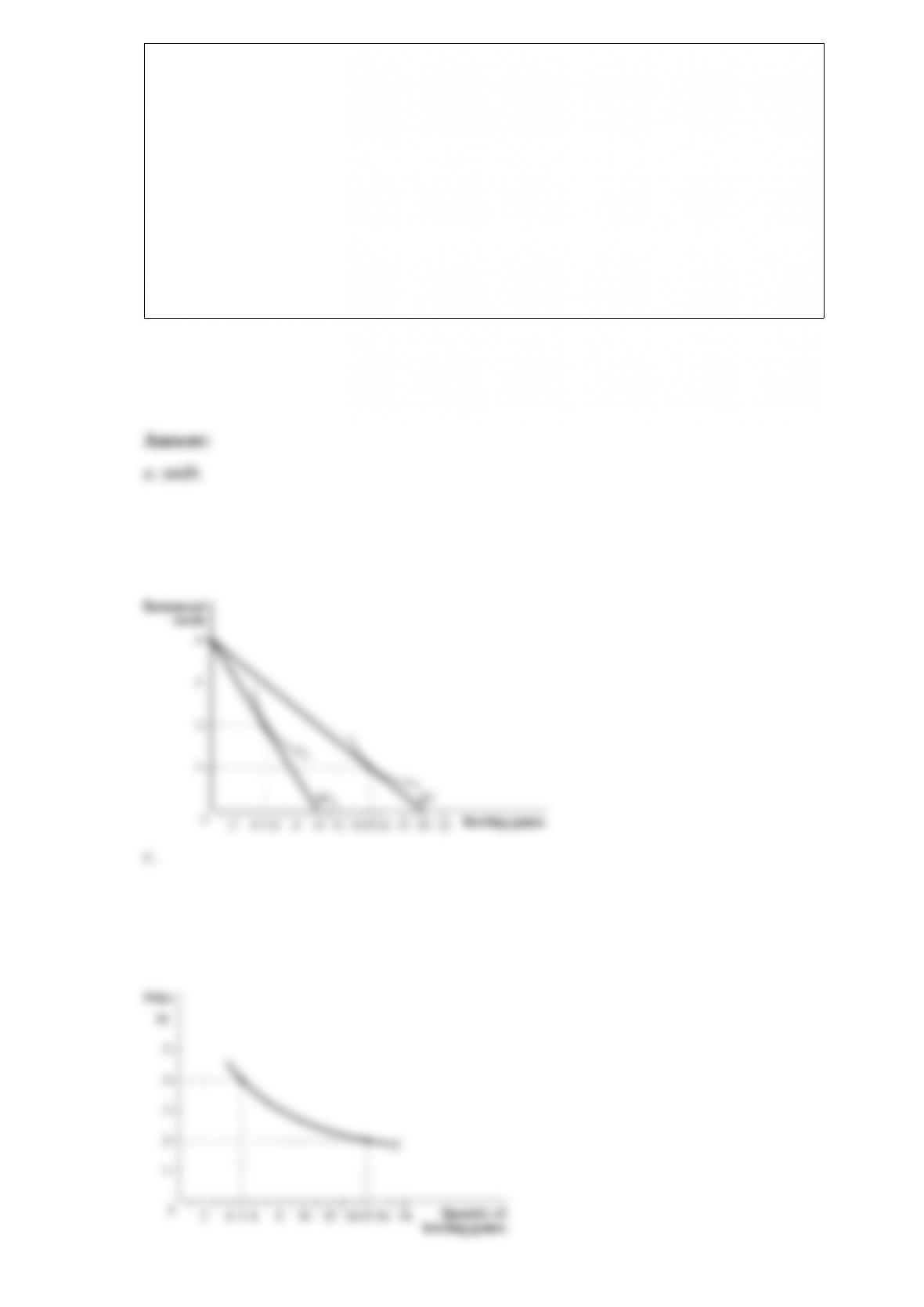
a. Graph Alec’s budget constraint, placing restaurant meals on the vertical axis and
bowling games on the horizontal axis. Illustrate Alec’s optimal consumption bundle,
comprised of 1 restaurant meal and 15 games of bowling.
b. Suppose that the price of bowling increases to $4 per game. Illustrate Alec’s new
budget constraint along with his new optimal consumption bundle, comprised of 2
restaurant meals and 5 games of bowling.
c. Draw Alec’s demand curve for bowling, indicating his quantities demanded at $2 and
$4.
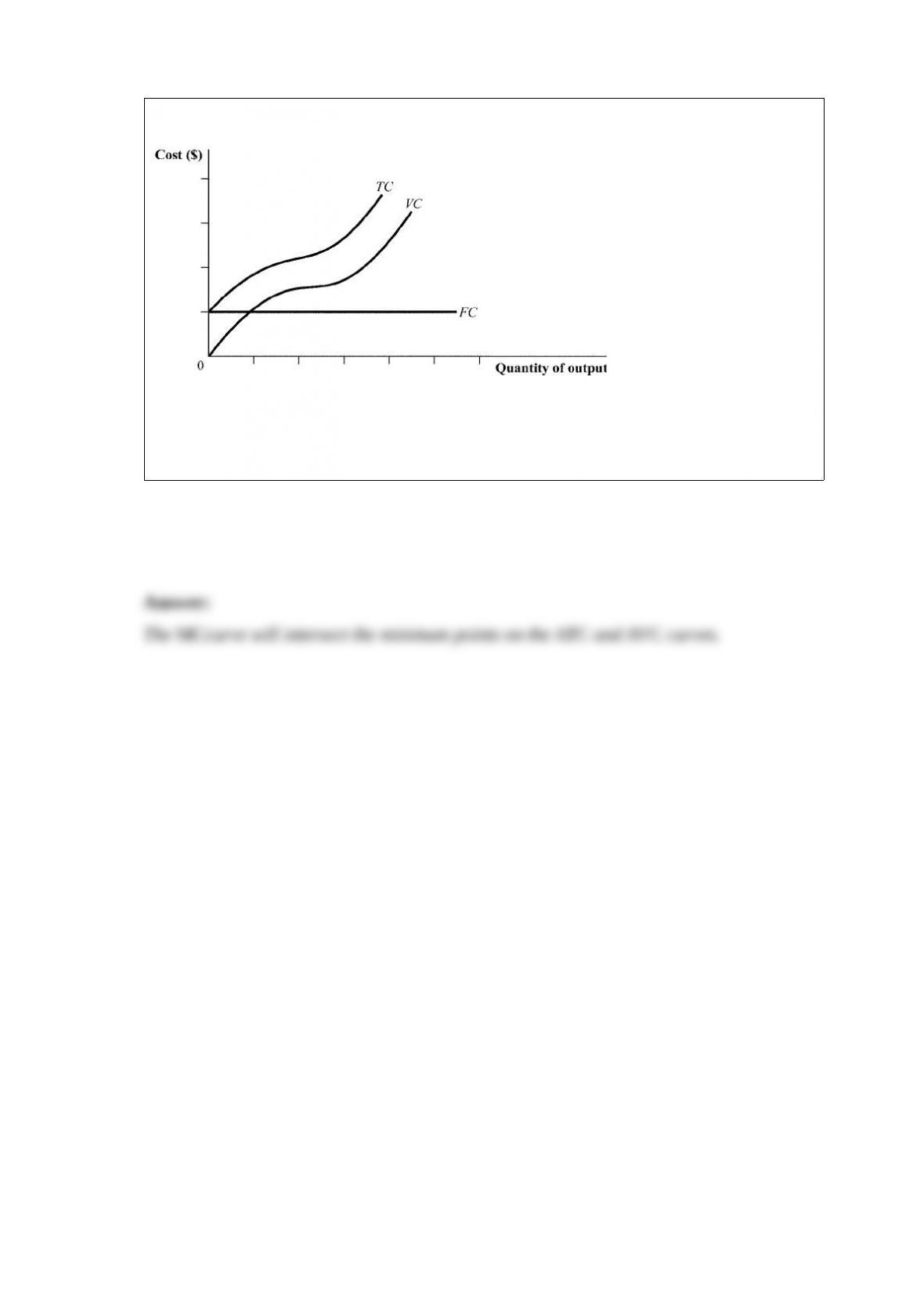
Figure 7.17
(Figure 7.17) Graphically illustrate the firm’s MC, ATC, and AVC curves in one
diagram. You should indicate the minimum points on the AVC and ATC curves. In a
separate diagram, show the firm’s AFC curve.
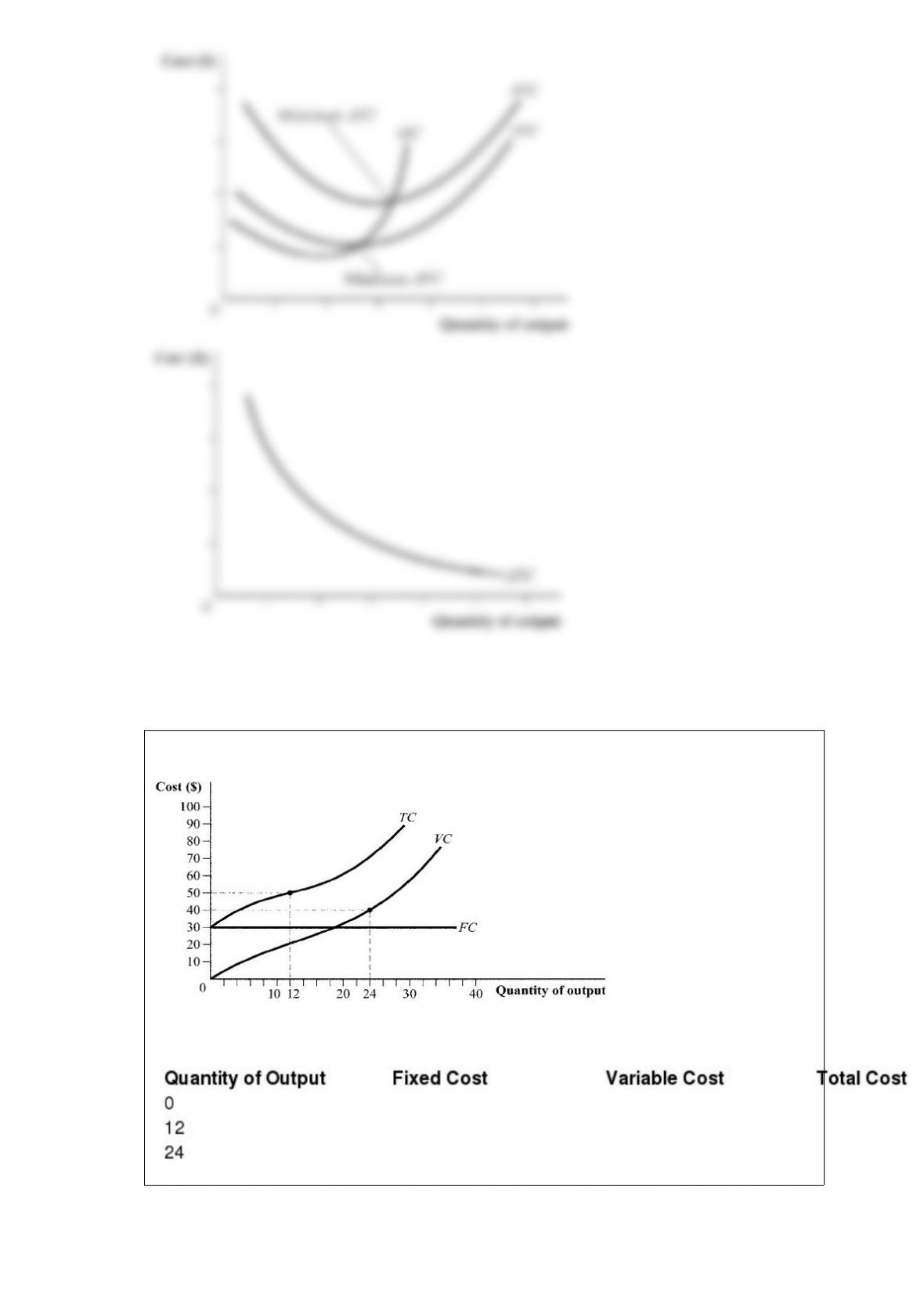
Figure 7.14
(Figure 7.14) Complete the following table:
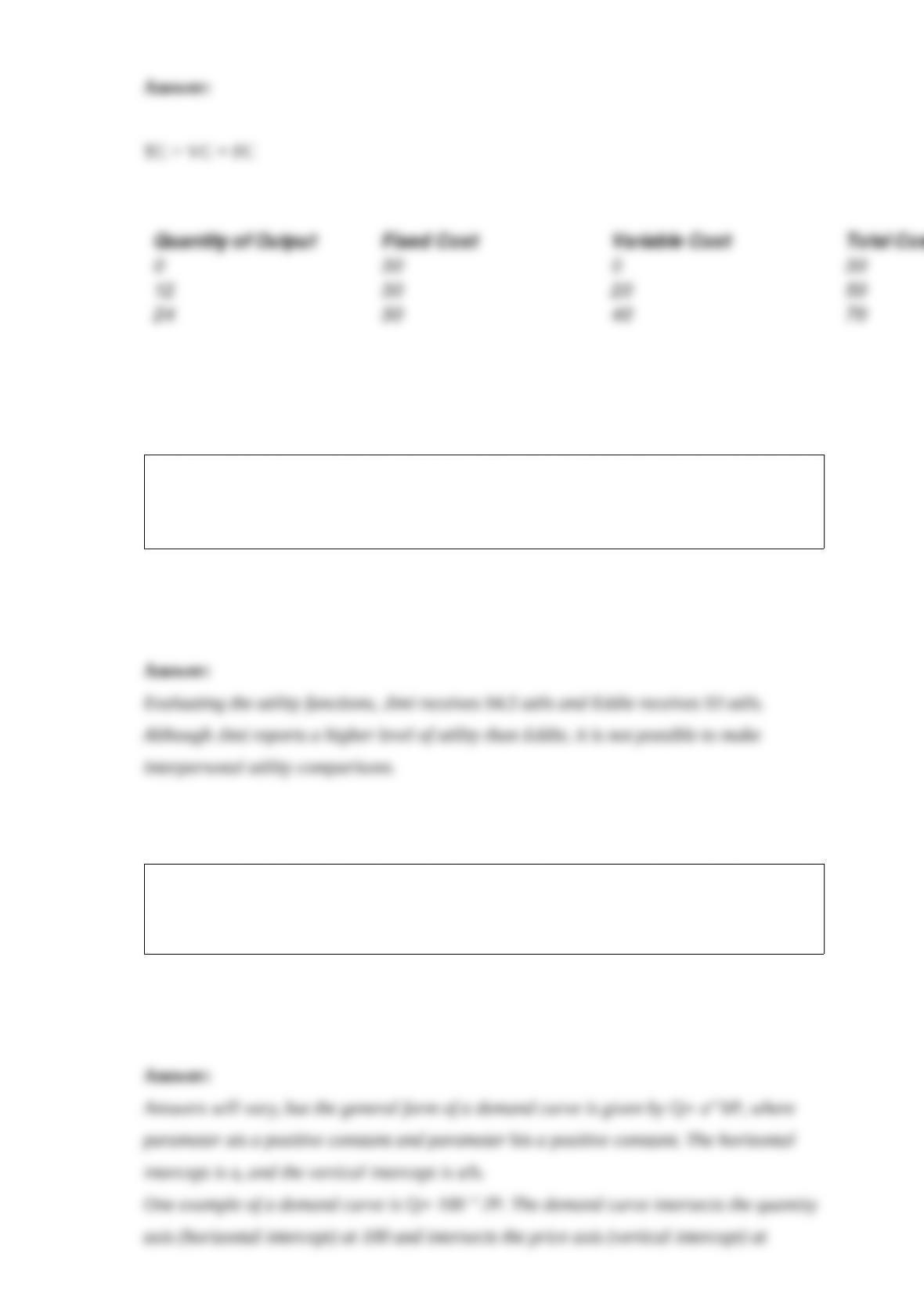
Jimi’s utility function for guitars (G) and haircuts (H) is U = 1.05GH. Eddie’s utility
function for guitars and haircuts is U = GH + H0.5. Does Jimi or Eddie receive more
satisfaction from consuming 10 guitars and 9 haircuts?
Write out your own equation for a downward-sloping linear demand curve. Next, graph
this demand curve on a well-labeled diagram, showing the numerical values of the
vertical and horizontal intercepts.
A furniture store offers customers no payments for one year on all new furniture
purchases. Spendthrift Sam takes advantage of the promotion and buys a new bedroom
set, despite only being able to make minimal monthly payments on his credit card
balances. What behavioral bias is Sam displaying?
A monopolist serves market A with an inverse demand curve of P = 12 ” Q. The
marginal cost is constant at $2. Suppose the monopolist uses a two-part tariff pricing.
What price does the monopolist set? What is the entrance fee? What is the size of the
deadweight loss? What is the level of consumer surplus?
Figure 14.10
(Figure 14.10) Which of the following statements is TRUE at point I?
I. The economy is achieving input efficiency.
II. The economy is achieving exchange efficiency.
III. The economy is achieving output efficiency because the marginal rate of
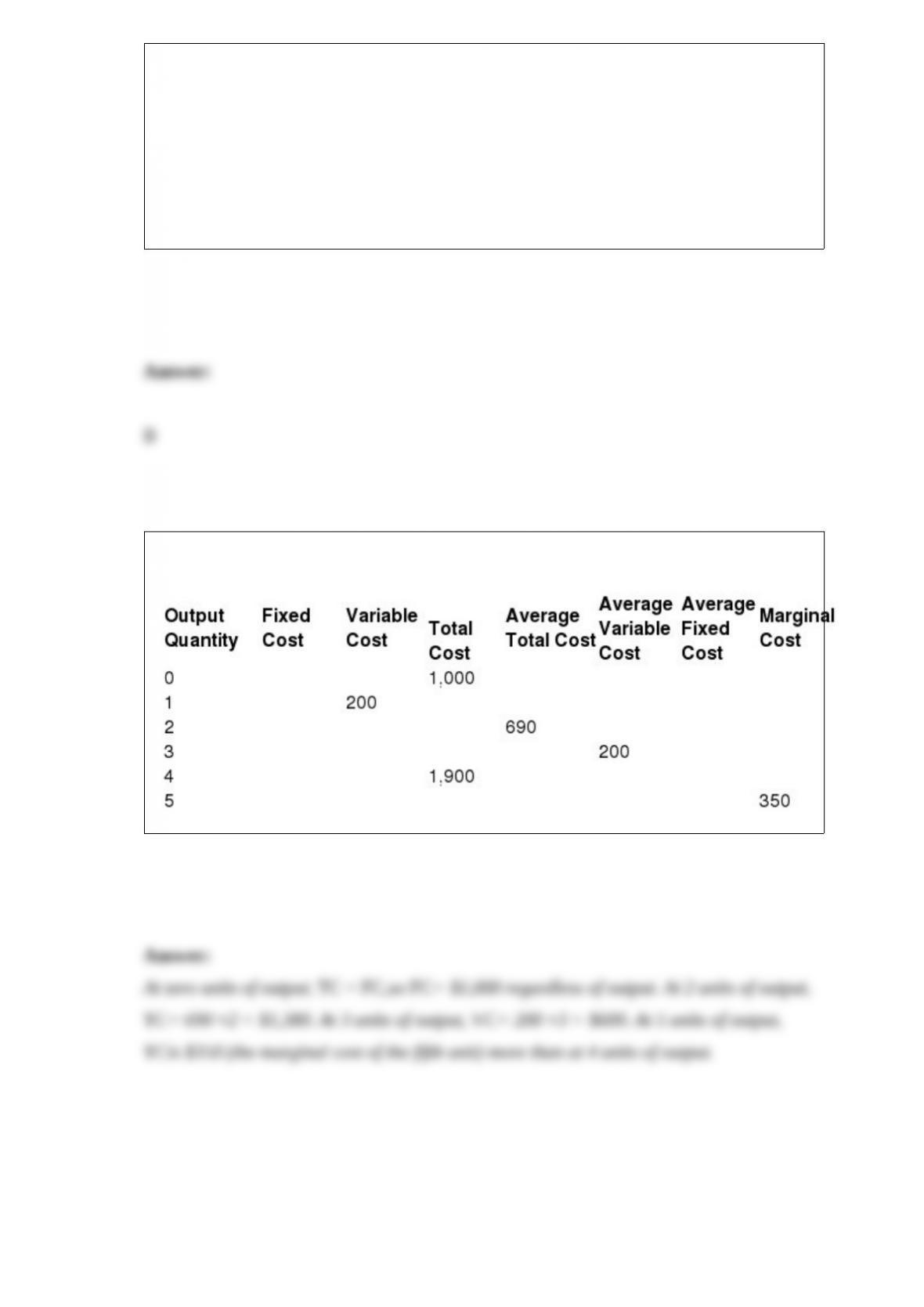
substitution equals the marginal rate of transformation.
A) III only
B) I and II
C) I, II, and III
D) II only
Complete the following table.
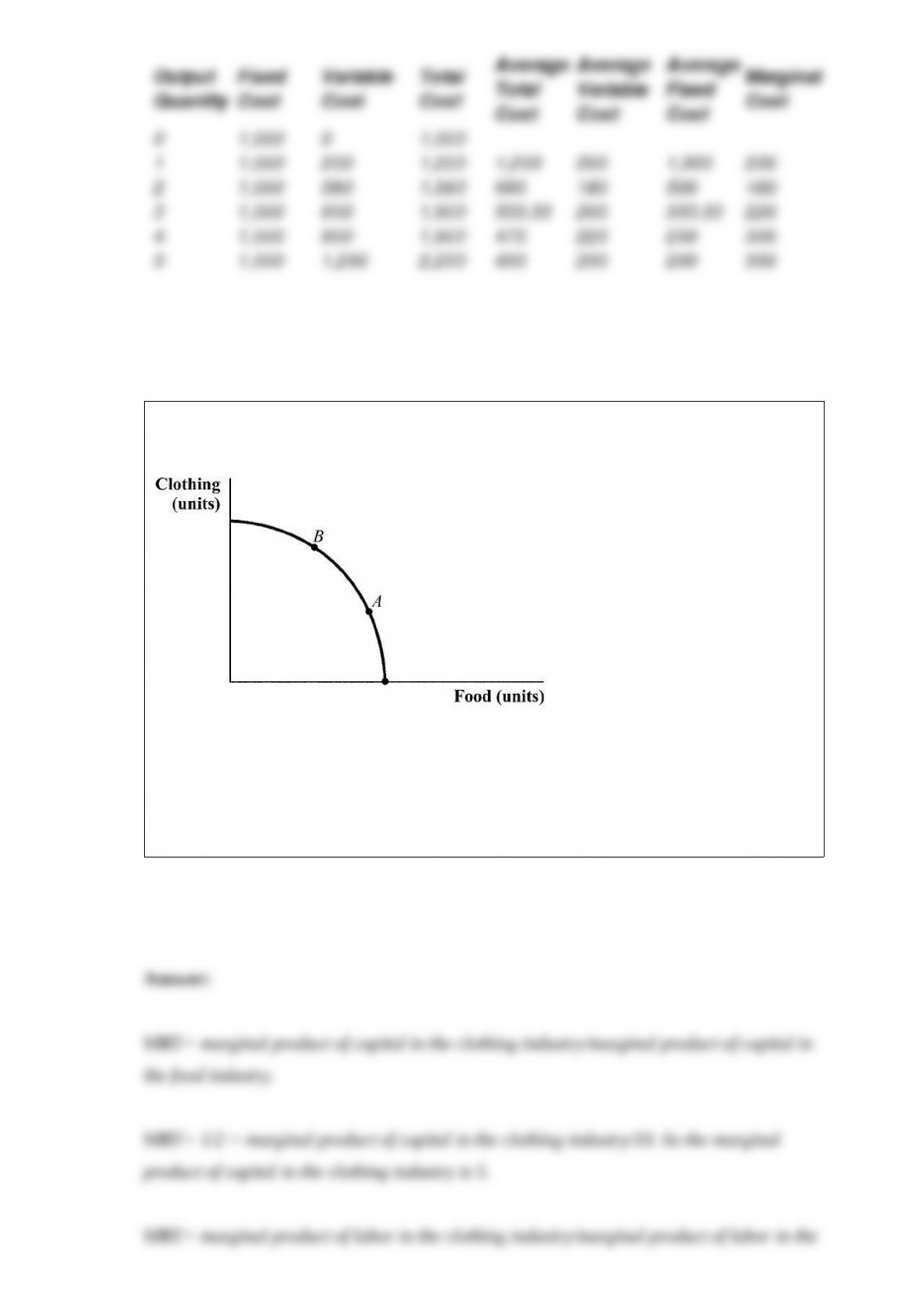
Figure 14.14
(Figure 14.14) Suppose the marginal rate of transformation at point B is 1/2, and the
marginal product of capital in the food industry is 10, what is the marginal product of
capital in the clothing industry? Now suppose the marginal rate of transformation at
point A is 2, and the marginal product of labor in the clothing industry is What is the
marginal product of labor in the food industry?
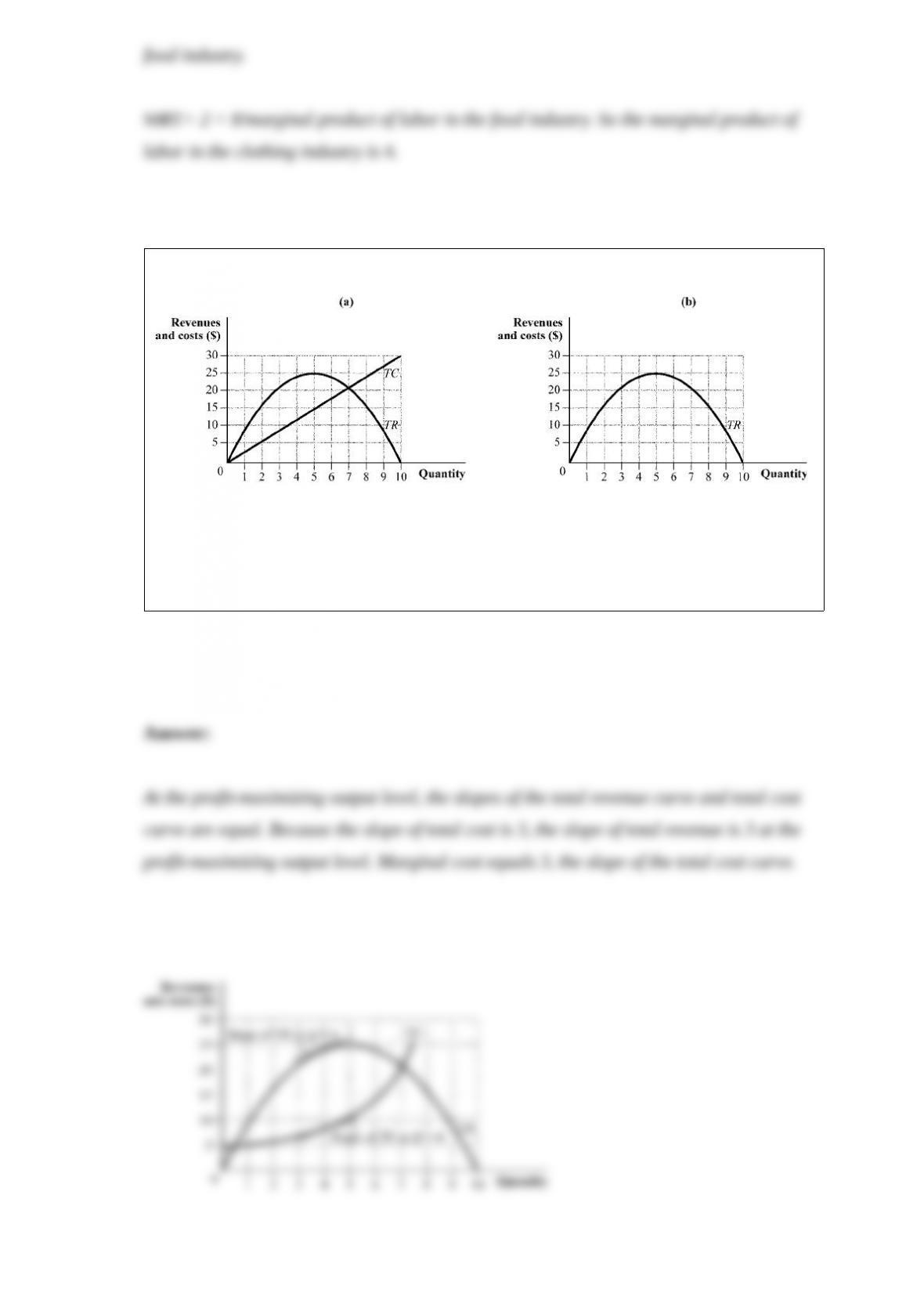
Figure 8.20
(Figure 8.20) What is TRUE about the slopes of the total revenue and total cost curves
at the firm’s profit-maximizing output level? What is the actual slope of the total
revenue curve at the profit- maximizing output level? What is the firm’s marginal cost at
the profit-maximizing output level?
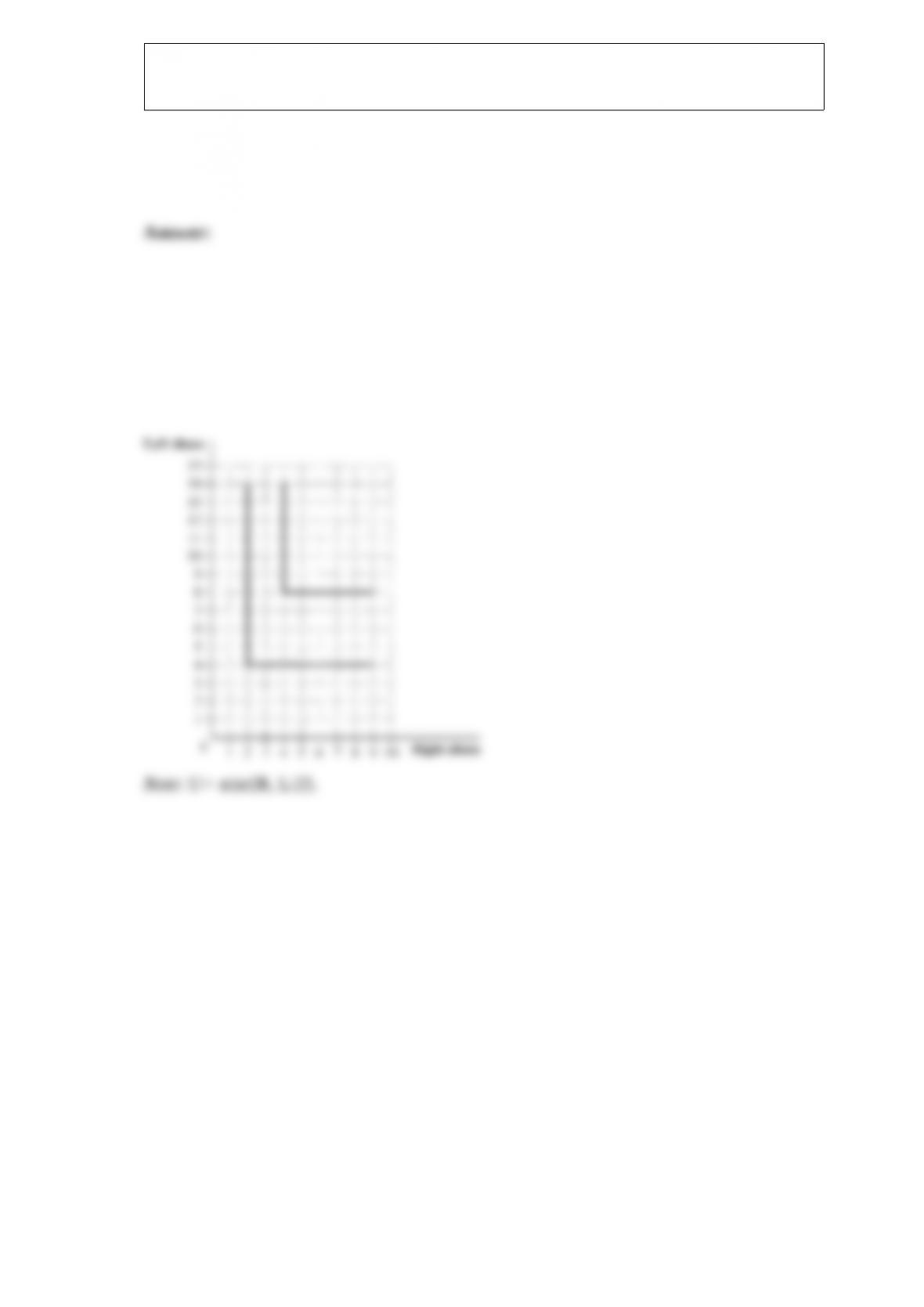
The three-legged Ork, a space creature from the universe Warhammer, wears 1 right
shoe and 2 left shoes. Draw the Ork’s indifference curves.