
Which of the following is a positive economic statement?
a. Government control of rent is a fair way to help poor people afford housing.
b. Government control of rent keeps landlords from charging too much rent.
c. Government control of rent decreases the number of new apartments constructed.
d. Government control of rent is an injustice.
According to the law of comparative advantage, both individuals and nations will be
able to produce a larger joint output if each productive activity is undertaken by
a. the high opportunity cost producer.
b. the low opportunity cost producer.
c. the producer who is able to hire workers at the lowest wage.
d. the party that can complete the productive activity most rapidly.
An increase in the money supply
a. lowers the interest rate, causing a decrease in investment and an increase in GDP.
b. lowers the interest rate, causing an increase in investment and a decrease in GDP.
c. lowers the interest rate, causing an increase in investment and an increase in GDP.
d. raises the interest rate, causing an increase in investment and an increase in GDP.

e. raises the interest rate, causing a decrease in investment and a decrease in GDP.
Data indicate that the large increase in government spending on income transfers that
started with the War on Poverty during the latter half of the 1960s has resulted in
a. a substantial reduction in the poverty rate.
b. a more equal distribution of income.
c. fewer single-parent families because a married couple receives benefits twice as
large.
d. little change in the official poverty rate.
Use the figure below to answer the following question(s).
Figure 4-11
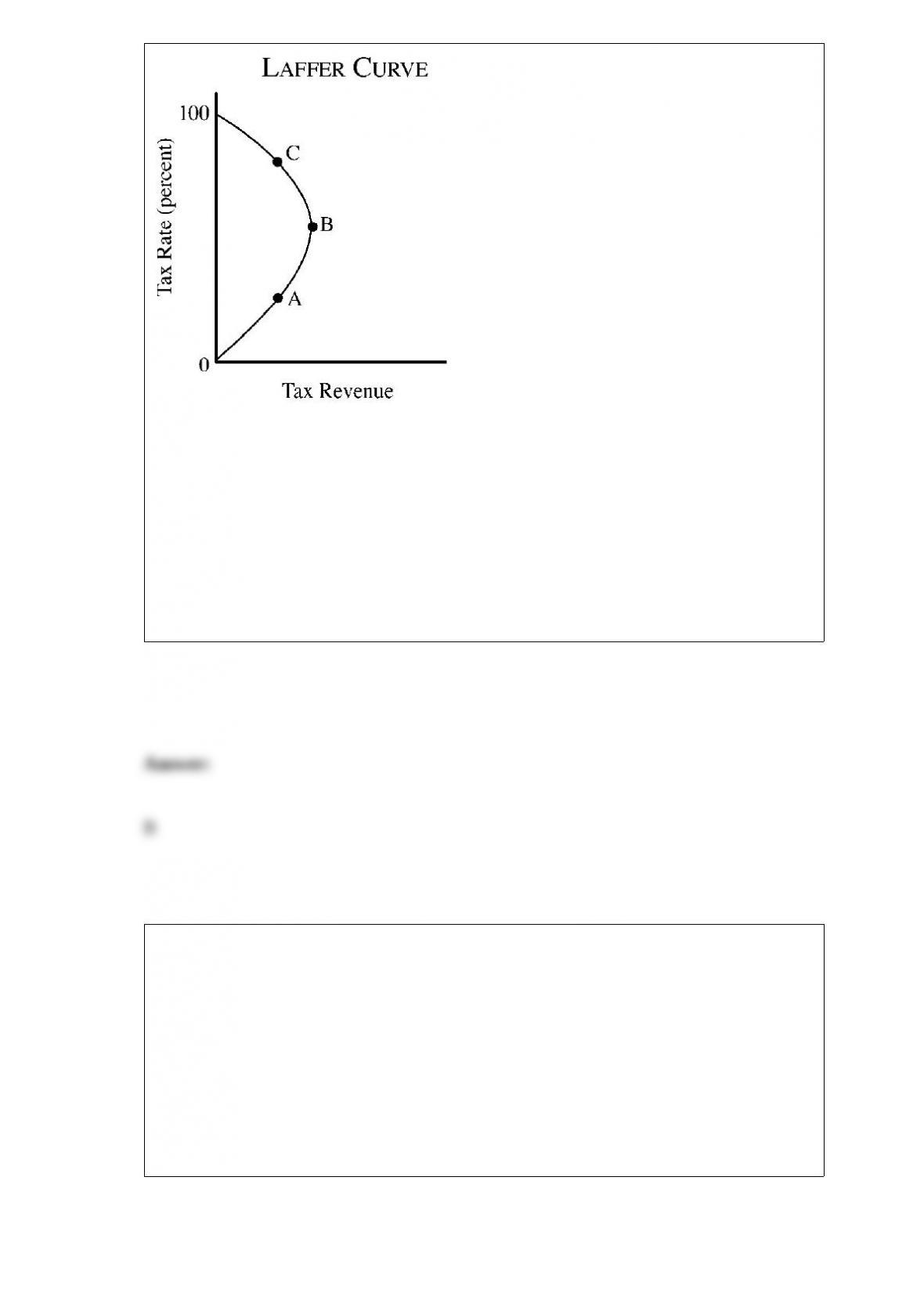
Refer to Figure 4-11. On the Laffer curve shown, tax revenue could be increased by
a. decreasing the marginal tax rates if we were currently at point A.
b. decreasing the marginal tax rates if we were currently at point C.
c. increasing the marginal tax rates if we were currently at point B.
d. increasing the marginal tax rates if we were currently at point C.
The recent growth records of Japan and Hong Kong during the last fifty years indicate
that a nation can grow rapidly without
a. securely defined property rights.
b. adopting modern technology.
c. significant capital formation.
d. abundant domestic natural resources.

With respect to the average cost curves, the marginal cost curve
a. intersects average total cost, average fixed cost, and average variable cost at their
minimum points.
b. intersects average total cost, average fixed cost, and average variable cost at their
maximum points.
c. intersects both average total cost and average variable cost at their minimum points.
d. intersects average total cost where it is increasing and average variable cost where it
is decreasing.
e. intersects only average total cost at its minimum point.
An appreciation in the U.S. dollar would
a. encourage foreigners to make investments in the United States.
b. discourage foreign consumers from buying U.S. goods.
c. increase the number of dollars it would take to buy a Swiss franc.
d. encourage foreigners to buy more U.S. goods.

One bag of flour is sold for $1.50 to a bakery, which uses the flour to bake bread that is
sold for $4.00 to consumers. A second bag of flour is sold to a consumer in a grocery
store for $2.00. Taking these three transactions into account, what is the effect on GDP?
a. GDP increases by $1.50.
b. GDP increases by $3.50.
c. GDP increases by $6.00.
d. GDP increases by $7.50.
In the short run, an unanticipated shift to a more restrictive monetary policy is most
likely to result in
a. a decrease in short-term interest rates.
b. a reduction in the growth rate of real GDP.
c. an increase in the rate of inflation.
d. an increase in employment.
Compared with the recovery from the recession of 1981-82, the recovery from the
recession of 2008-09 was characterized by
a. more rapid growth of real GDP.
b. a more rapid decline in the rate of unemployment.
c. larger increases in both government spending and budget deficits as a share of GDP.
d. higher interest rates and a more restrictive monetary policy.

The demand for salt is
a. inelastic because there are few substitutes for salt and it represents a large percentage
of a consumer’s budget.
b. inelastic because there are many substitutes for salt and it represents a large
percentage of a consumer’s budget.
c. inelastic because there are few substitutes for salt and it represents a small percentage
of a consumer’s budget.
d. elastic because there are no substitutes for salt and it represents a large percentage of
a consumer’s budget.
e. elastic because there are many substitutes for salt and it represents a large percentage
of a consumer’s budget.
Suppose that the federal government levies a 50 cent excise tax on gasoline and that the
demand for gasoline is highly inelastic while the supply is highly elastic. Under these
circumstances, the burden of the tax
a. will fall primarily on producers.
b. will fall primarily on consumers.
c. will be split equally between consumers and producers.
d. cannot be determined because the burden of a tax is not influenced by the elasticities
of supply and demand.
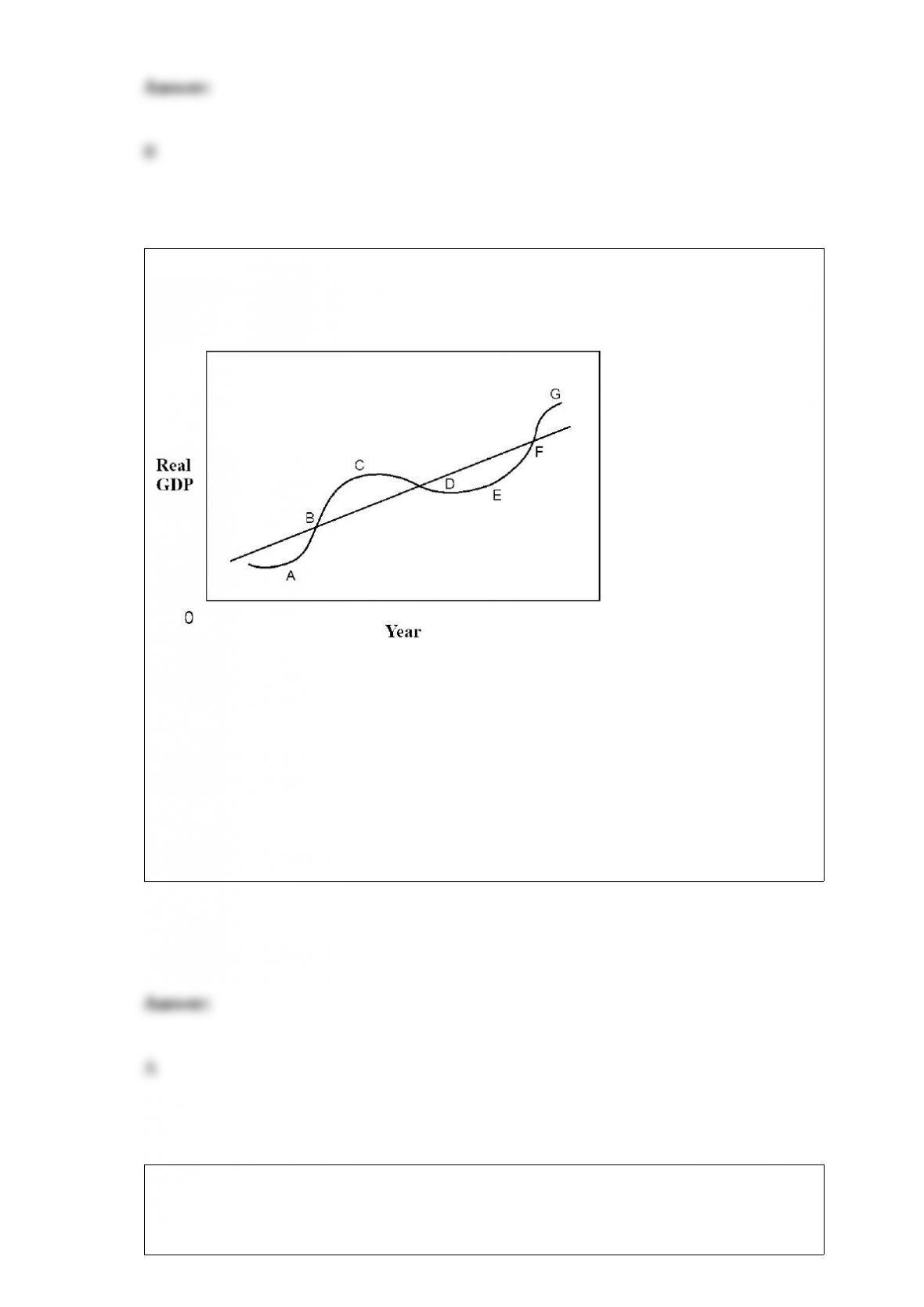
Figure 8-1
In Figure 8-1, the recession phase of the business cycle can be represented by point(s):
a. CDE.
b. BCD.
c. EFG.
d. A and E.
When health insurance is purchased primarily through one’s employer,
a. direct purchase of health insurance becomes cheaper.

b. the benefits of the healthcare insurance are fully taxable.
c. it is more costly for employees to switch jobs and move to areas where jobs are
available.
d. the overall number of people without health insurance decreases.
During the last two decades, the number of women preparing for careers as
professionals has ____, and the proportion of those completing college degrees has
____.
a. increased; decreased
b. increased; increased
c. decreased; decreased
d. decreased; increased
When the price of a resource goes up and firms seek other suitable resources, this is
called the
a. substitution in production effect.
b. substitution in demand effect.

c. elasticity effect.
d. inelasticity effect.
During 1980-2010, the per-capita incomes of less-developed countries (LDCs)
a. grew rapidly.
b. declined.
c. were virtually unchanged.
d. registered a mixed growth record; some grew rapidly while others stagnated.
If the Federal Reserve sells bonds, the short-run effects will be
a. an increase in the money supply and lower real interest rates.
b. a decrease in the money supply and lower real interest rates.
c. an increase in the money supply and higher real interest rates.
d. a decrease in the money supply and higher real interest rates.

Which of the following will most likely cause a decrease the natural rate of
unemployment?
a. an increase in the minimum wage
b. an increase in unemployment benefits
c. an increase in experienced workers aged 25 and over as proportion of the labor force
d. an increase in the labor force participation rate of teenagers
If Emma has a positive rate of time preference, she will
a. value the receipt of $10,000 twenty years from now just as much as she would value
receipt of the $10,000 now.
b. value the receipt of $10,000 twenty years from now more than she would value
receipt of the $10,000 now.
c. value the receipt of $10,000 twenty years from now less than she would value receipt
of the $10,000 now.
d. prefer to receive any amount of money now to the $10,000 twenty years from now.

Competition as a dynamic process implies that individual firms in a market
a. seek to utilize a variety of techniques, such as product, style, and convenience of
location, to win the dollar vote of consumers, but they never use price to compete.
b. use price competition as well as other forms of competition to gain the dollar votes of
consumers.
c. produce a homogeneous product.
d. cooperate, attempting to establish a price and output structure so each firm can
survive and continue to serve the consumer.
During an extended inflationary period, the money rate of interest will usually be
a. lower than the real rate of interest.
b. equal to the real rate of interest.
c. greater than the real rate of interest.
d. inversely related to changes in the inflation rate.
What is the best test of an economic theory?
a. its eloquence
b. the plausibility of its assumptions
c. its ability to predict real-world events, patterns, and changes

d. whether it produces implications that are favored by the researcher
According to the Keynesian model, which of the following policies would be most
appropriate during a period of rapid inflation?
a. a tax cut
b. a budget deficit
c. a budget surplus
d. an increase in the money supply
Millionaires tend to be older than the general population because
a. older workers generally have more education than younger workers.
b. many achieve millionaire status by saving from a relatively modest income, and this
will take a lengthy period of time.
c. the earnings of most people peak during the retirement phase of life.
d. older people have less to do, and therefore, they have more time to come up with
innovative ideas.

A local Krispy Kreme doughnut shop reduced the price of its doughnuts from $4 per
dozen to $3.50 per dozen, and as a result, the daily sales increased from 300 to 400
dozen. This indicates that the price elasticity of demand for the doughnuts was
a. elastic.
b. inelastic.
c. of unitary elasticity.
d. indeterminate; more information is needed to determine the price elasticity of
demand.
Suppose, in dollar terms, nominal GDP increased approximately 4 percent during a
given year, and real GDP decreased 1 percent. Which of the following best explains
these events?
a. The money supply increased approximately 4 percent.
b. Prices decreased approximately 3 percent.
c. Prices increased approximately 4 percent.
d. Prices increased approximately 5 percent.

The law of comparative advantage applies to exchange between
a. individuals.
b. regions.
c. nations.
d. all of the above.
Suppose land suitable for wheat production is highly inelastic. An increase in the
demand for wheat bread will most likely
a. cause the prices of bread and wheat to increase but not affect the incomes paid to
owners of wheat-growing land.
b. shift the demand curve for bread to the right and the supply curve for wheat to the
left.
c. raise the price of land suitable for wheat production.
d. depress the incomes of owners of wheat growing land.
At year-end 2014, the national debt of the United States was approximately
a. 5 percent of GDP.

b. 25 percent of GDP.
c. 77 percent of GDP.
d. 107 percent of GDP.
How do high marginal tax rates affect the economic prosperity of a nation?
a. They reduce the incentive of individuals to earn reported income.
b. They encourage the nation’s most productive citizens to emigrate to countries where
taxes are lower.
c. They discourage foreigners from investing in the country.
d. All of the above are correct.