
A perfectly elastic demand curve is shown as a:
A) horizontal line.
B) vertical line.
C) positively sloped line.
D) negatively sloped line.
When computing percentage changes, using the simple approach results in increases
and decreases which are:
A) identical.
B) symmetric.
C) not symmetric.
D) more accurate than using the midpoint method.
Diminishing returns occurs because:
A) not enough people have jobs.
B) one of the inputs to the production process is fixed.

C) consumers do not buy enough of the products produced.
D) people have not satisfied their self-interests.
College students who increase their human capital by acquiring the skills required for
certain occupations typically earn higher incomes than high school graduates. This is
called:
A) the learning effect of a college education.
B) the signaling effect of a college education.
C) the discriminatory effect of a college education.
D) none of the above
Which type of profit maximizing firm will choose to produce where price equals
marginal cost?
A) perfect competition
B) perfect competition and monopolistic competition
C) monopolistic competition
D) all types of firms

Refer to Table 4.1, which shows Flo’s and Rita’s individual supply schedules for frozen
latte-on-a-stick. Assuming Flo and Rita are the only suppliers in the market, if the
market quantity supplied is 18, the price must be:
Quantity of Frozen Latte-On-A-Stick Supplied
Table 4.1
A) $2.
B) $3.
C) $4.
D) $5.
Refer to Figure 9.6. At a market price of $15, this perfectly competitive profit
maximizing firm should:
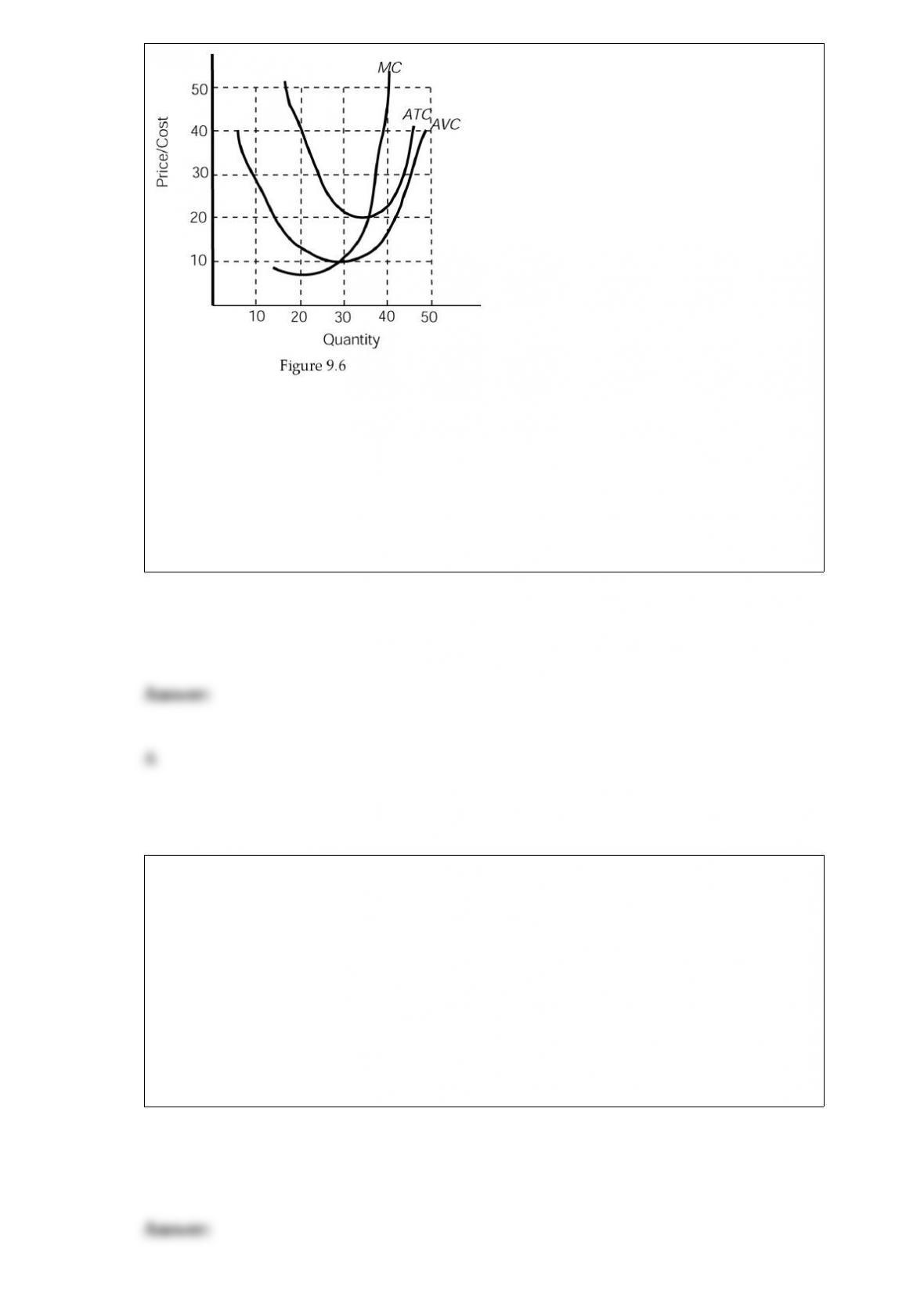
A) operate in the short run.
B) shut down in the short run.
C) realize a normal profit in the short run.
D) operate in the long run.
If in the market for used bikes only sellers can distinguish between good quality and
bad quality used bikes, then in that market there exists:
A) perfect information.
B) asymmetric information.
C) public information.
D) duopoly information.

Assume that a minimum wage is created and imposed above the equilibrium wage in an
otherwise perfectly competitive labor market. Which of the following will NOT occur
as a result of this new law?
A) The quantity of labor seeking jobs will rise.
B) The unemployment rate will rise.
C) The level of employment will increase.
D) None of the above will occur.
Recall the Application. On average, apprentices in Major League Baseball tend to be
paid a salary ________ their marginal revenue product.
A) significantly higher than
B) significantly lower than
C) close to
D) unrelated to
When dealing with a pollution problem, pollution permits are more efficient than taxes
or command-and-control policies because:
A) firms with low costs of abatement can buy more permits.
B) the government will generate more revenue from the sale of permits than through a
pollution tax.
C) firms with high costs of abatement can buy more permits.
D) a pollution permit system will lead to all firms producing less pollution.
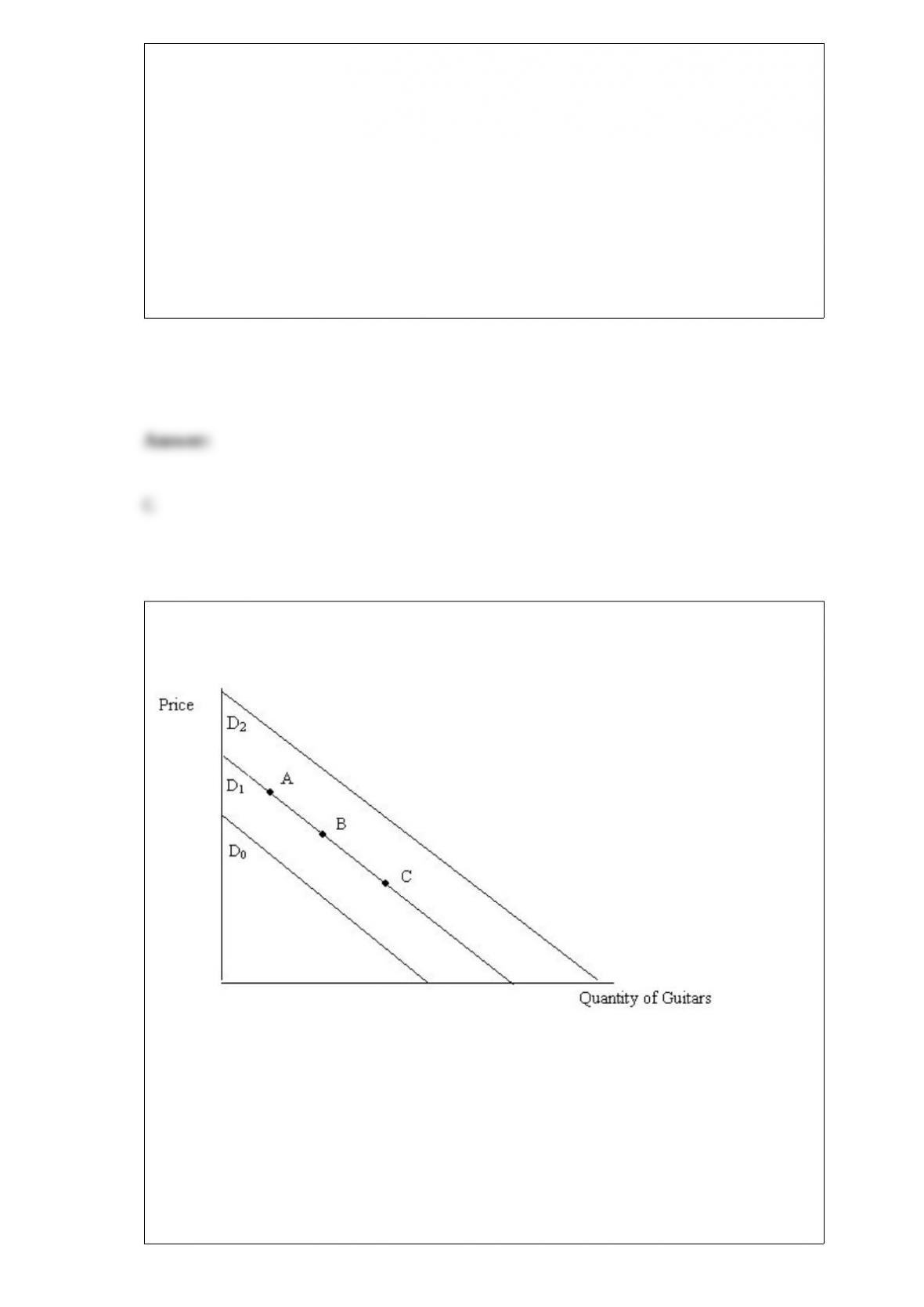
Figure 4.4 illustrates the demand for guitars. An increase in the number of guitar
players in the market would bring about a movement from:
Figure 4.4
A) point B to point C.
B) point B to point A.
C) D1 to D0.

D) D1 to D2.
The extra benefit resulting from a small increase in some activity is called the:
A) marginal cost.
B) marginal benefit.
C) marginal value.
D) marginal equilibrium.
If the market demand decreases for a good sold in a perfectly competitive market, firms
in the market:
A) will be able to charge a higher price for their product.
B) will receive a lower price for their product.
C) will not be able to change their price.
D) will not be affected by the change in demand.

If the government imposes a price ceiling that is above the equilibrium price, then the
market will experience:
A) an equilibrium.
B) a shortage.
C) an excess supply.
D) no scarcity.
Suppose that you observe that as a TV manufacturer increases its price its total revenue
decreases. This could be due to:
A) demand being price inelastic.
B) demand being price elastic.
C) demand being unitary elastic.
D) demand being perfectly price inelastic.
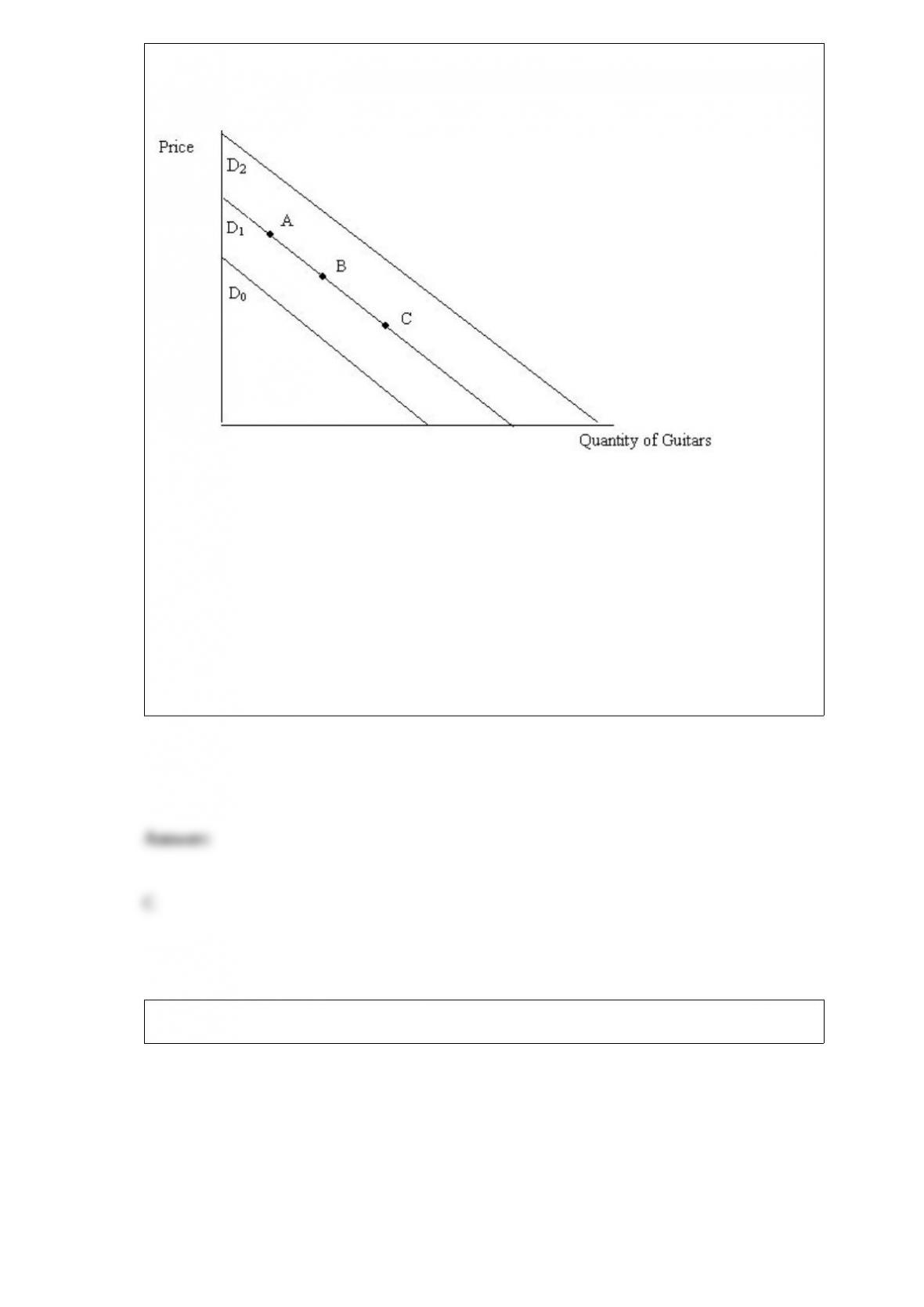
Figure 4.4 illustrates the demand for guitars. If people expect the price of guitars to
decrease in the near future, this would most likely bring about a movement from:
Figure 4.4
A) point B to point C.
B) point B to point A.
C) D1 to D0.
D) D1 to D2.
Figure 12.8 depicts an advertising game between two stores. “No advertising” is:

A) a dominant strategy for Store A but not for Store B.
B) a dominant strategy for Store B but not for Store A.
C) a dominant strategy for both stores.
D) a dominant strategy for neither store.
If the market demand increases for a good sold in a perfectly competitive market,
individual firms in the market:
A) will be able to charge a higher price for their product.
B) will need to lower price in order to remain competitive.
C) will not be able to change their price.
D) will begin earning economic losses.
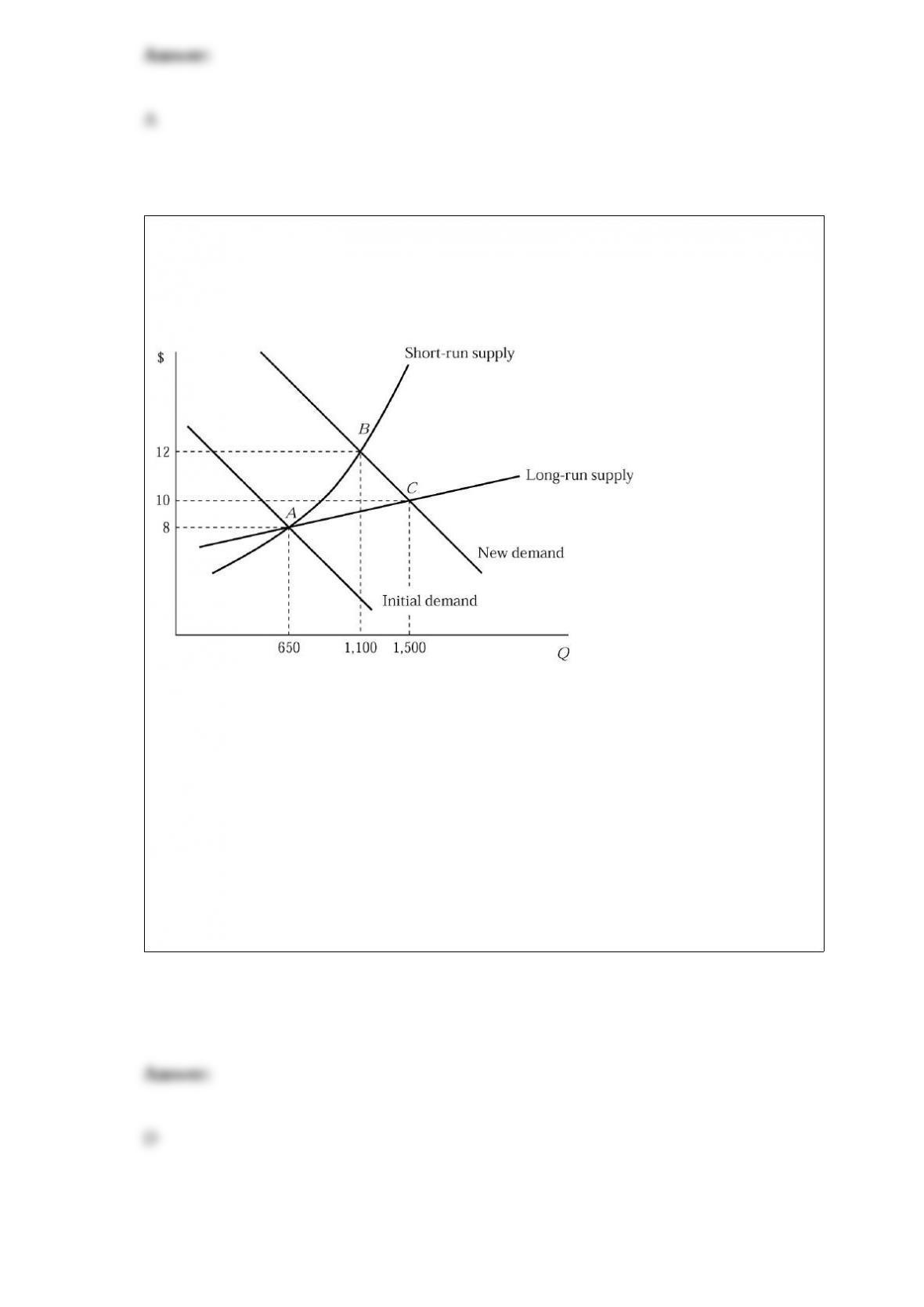
Figure 9.5 shows the short-run and long-run effects of an increase in demand of an
industry. The market is in equilibrium at point A, where 100 identical firms produce 6
units of a product per hour. If the market demand curve shifts to the right, which of the
following statements is true in the short run?
Figure 9.5
A) The market price rises to $12, which is greater than the average total cost.
B) Each existing firm maximizes its profit by producing the output where marginal cost
equals $12.
C) Each existing firm produces two more units per hour, compared to its initial profit
maximizing output level at point A.
D) all of the above

All of the below are examples of negative effects of imposing rent control EXCEPT:
A) persons who get a place to live pay lower rent.
B) renters must pay non-refundable security deposits.
C) producer surplus decreases.
D) some people who would have rented apartments before rent control will not rent.
The period of time when a firm is able to change all of inputs, or factors of production,
is called the:
A) economic term.
B) short run.
C) accounting term.
D) long run.
Refer to Figure 17.2. If the supply of labor increases, then equilibrium wage will
________ and equilibrium quantity of hours will ________.
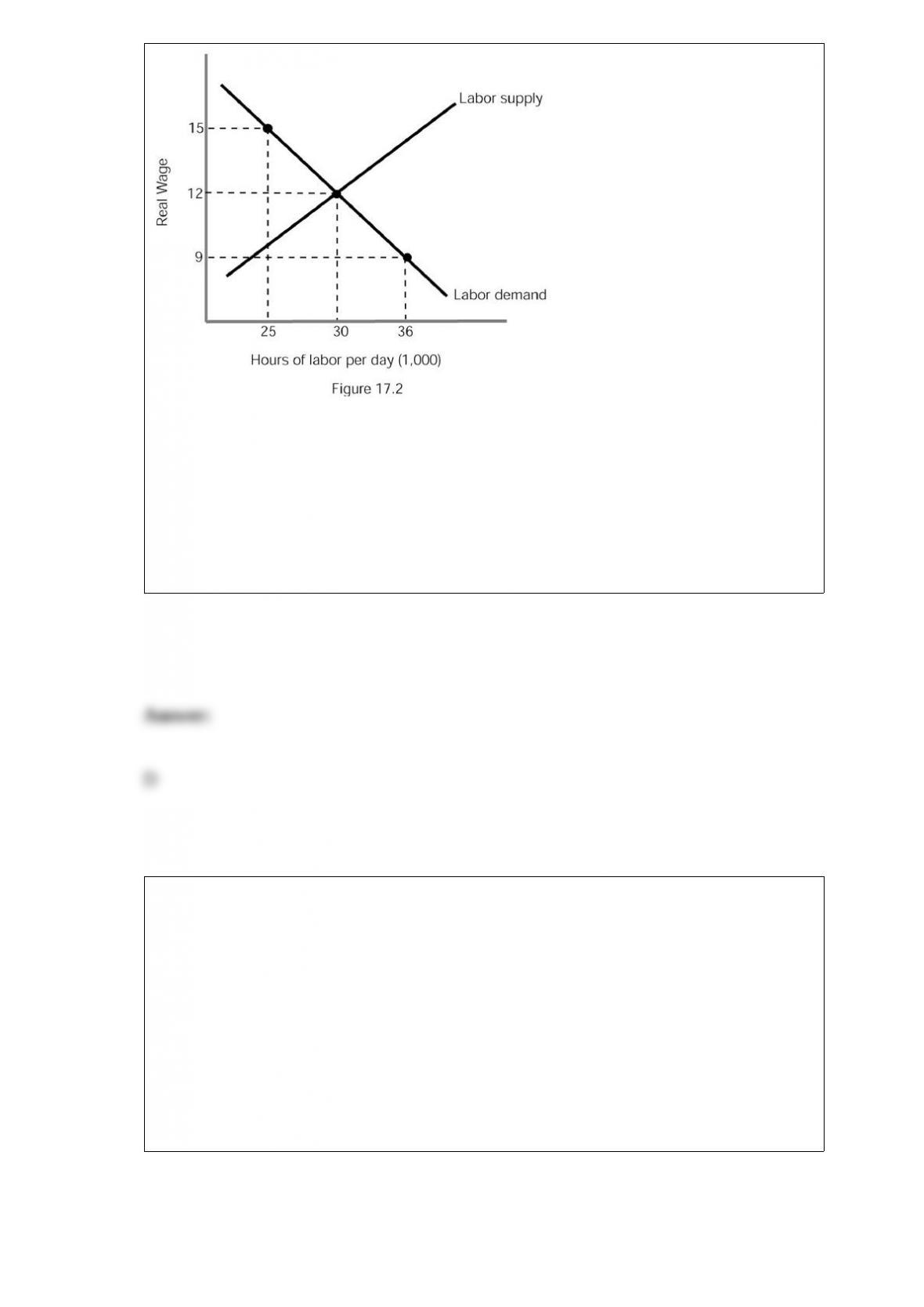
A) rise; fall
B) fall; fall
C) rise; rise
D) fall; rise
A seller’s verbal assurances that a used car is a plum (high-quality car):
A) is not effective at reducing the problems associated with asymmetric information.
B) is an effective way for sellers to prove that the good they are selling is of high
quality.
C) is a more efficient way to prove high quality than a money-back guarantee because it
does not cost the seller any money to make the assurance.
D) provides the same protection against adverse selection than does a repair guarantee.

The external cost of congestion arises because:
A) travel time increases when there are more cars on the road.
B) young drivers take more driving risks than do older drivers.
C) crowded highways deteriorate more quickly than do less-traveled highways.
D) toll booths slow traffic.
An economy in which government bureaucracy decides how much of a good to
produce, how to produce the good, and who gets the good is known as a:
A) mixed economy.
B) centrally planned economy.
C) laissez-faire economy.
D) market economy.

Additional Application
From 1992 to 2003 the number of milk producers in Florida has fallen from 300 to 190.
In those same 10 years the number of dairy farms nationwide has decreased by more
than 44,000. Why? The market price in a perfectly competitive industry is not
determined by the individual sellers, but rather the market supply and demand. While
the Florida dairy industry might not be “perfectly” competitive due to the certain USDA
policies, its behavior does approximate one. If prices are not high enough to maintain
some level of normal profit, firms will leave the industry. And this is what has been
happening in the dairy industry. In the months after September 11, 2001 the demand for
milk fell, causing the price of 100 pounds of milk to decrease from about $19 to about
$14, a 25-year low. In addition to falling prices, the costs of operating dairy farms have
risen. Increased property taxes and environmental compliance permits have made dairy
farming less viable. The average dairy farm in Florida is small with only about 700
cows. This further prevents a single supplier from being able to influence the market
price. Many farmers view this business as a family operation and one they would like to
pass on to their children. But continued low milk prices and profits make the likelihood
of such an inheritance unlikely.
Greg C. Bruno. “Milk Industry Turns Sour,” The Gainesville Sun, January 22, 2004, pp.
1, 4.
Which one of the following characteristics is NOT true of the milk industry?
A) many sellers
B) a homogeneous product
C) sellers are price takers
D) large barriers to entry
Recall the Application. Based on its strategy to deter entry into its key markets,
Microsoft would be considered:
A) a pure monopolist.
B) a cartel monopolist.

C) an insecure monopolist.
D) a government-protected monopolist.
Refer to Table 5.3. After calculating the price elasticity of demand for computers, we
can say the demand for computers is:
Table 5.3
A) upward sloping.
B) inelastic.
C) unitary elastic.
D) elastic.
The study of the choices made by individual households, firms, and government is
called:
A) macroeconomics.
B) microeconomics.
C) managerial economics.
D) market economics.
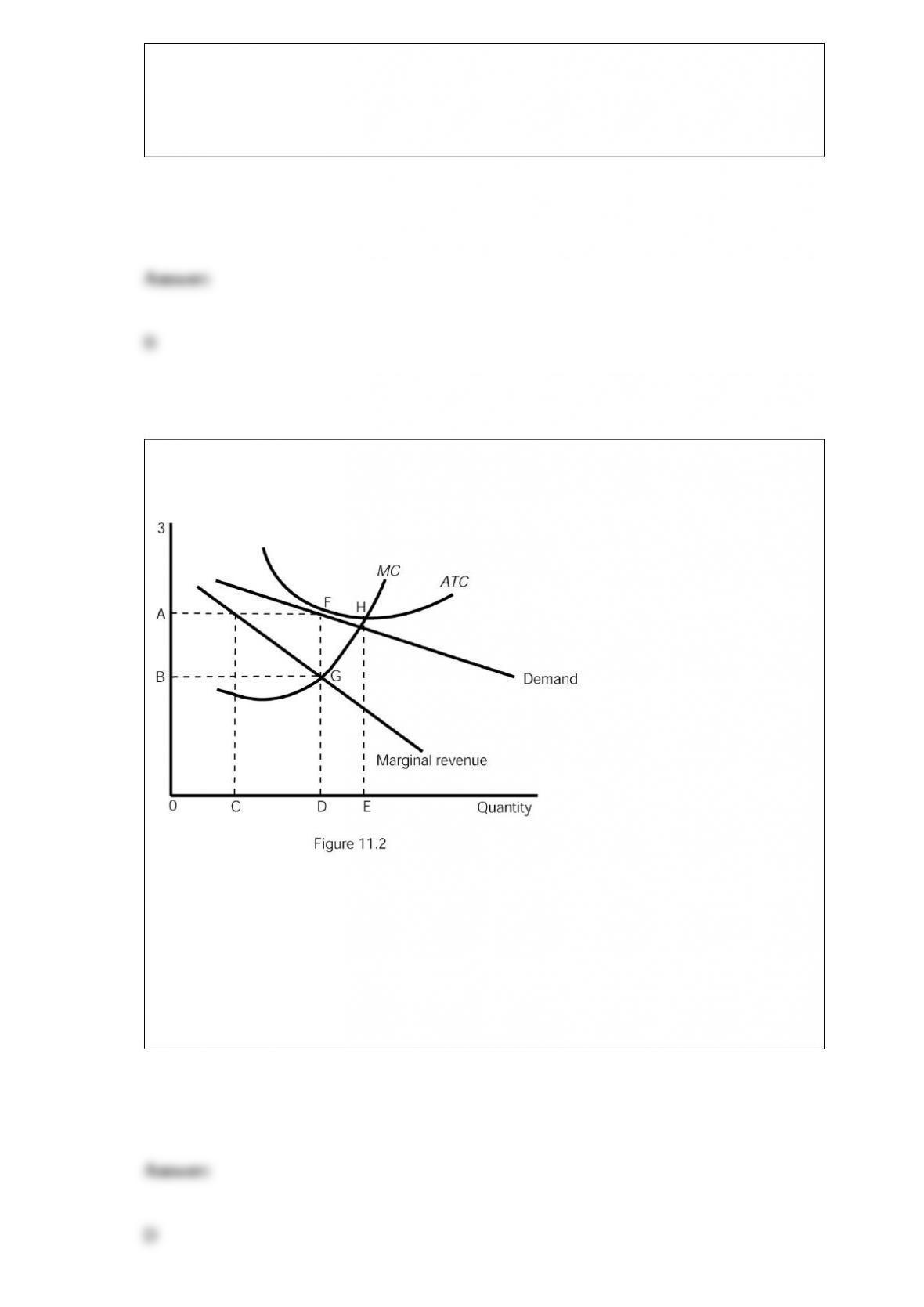
Refer to Figure 11.2. In the long run the monopolistic competitor would generate total
revenue equal to the area:
A) 0BGD.
B) AHE0.
C) AFGB.
D) 0AFD.