1) the price elasticity of demand of a straight-line demand curve is:
a.elastic in high-price ranges and inelastic on low-price ranges.
b.elastic, but does not change at various points on the curve.
c.inelastic, but does not change at various points on the curve.
d.1 at all points on the curve.
2) when product prices change, consumers are inclined to purchase larger amounts of
the now cheaper products and less of the now more expensive products. this describes:
a.the cost effect.
b.the price effect.
c.the income effect.
d.the substitution effect.
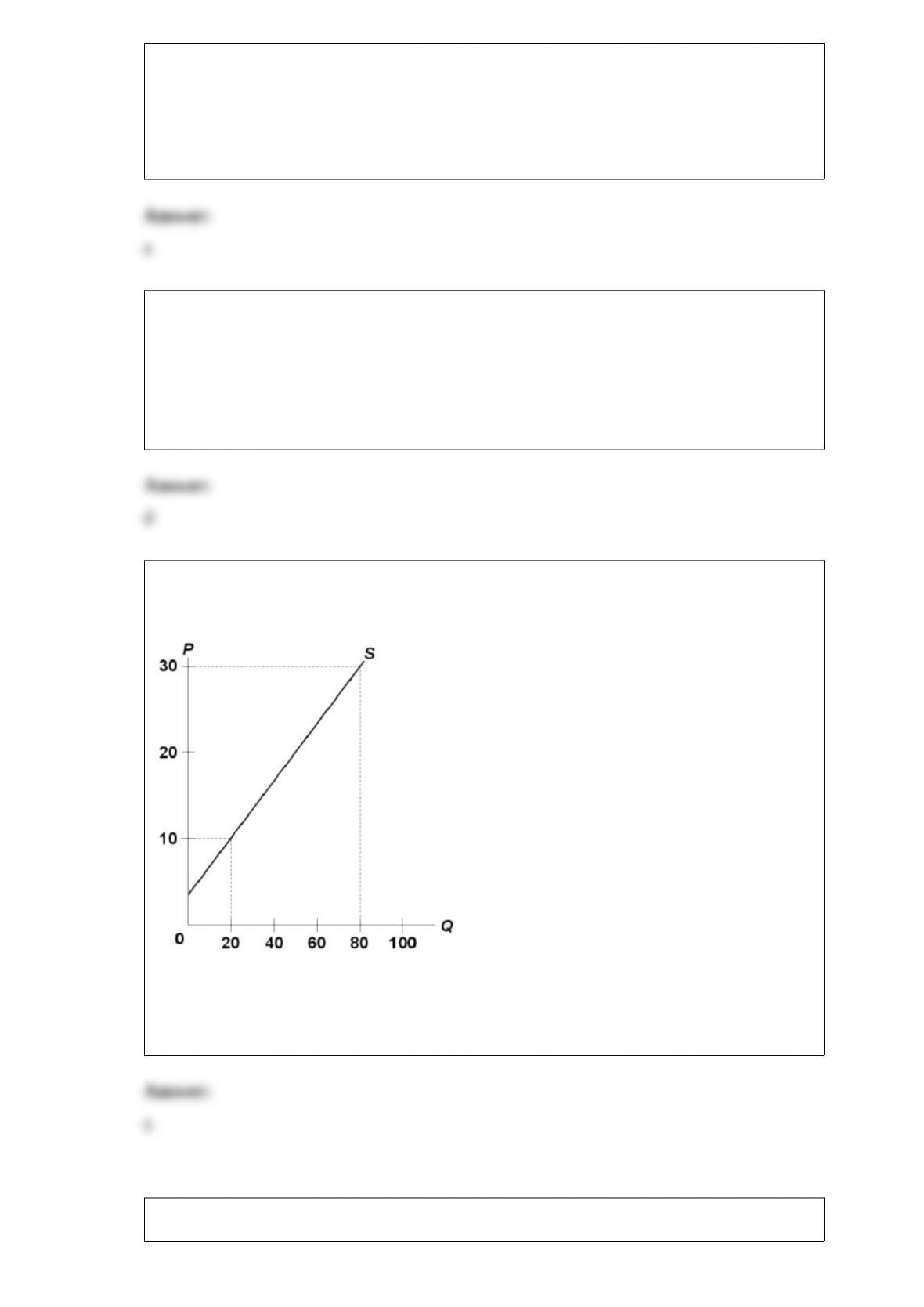
3) the equation for the supply curve in the below diagram is approximately:
a.p = 4 + 1/3q.
b.p = 4 + 2q.
c.p = 4 + 3q.
d.p = 4 – 3q.
4) if a regulatory commission wants to provide a natural monopoly with a fair return, it
should establish a price that is equal to:
a.minimum average fixed cost.
b.average total cost.
c.marginal cost.
d.marginal revenue.
5) The Social Security trust fund currently is in:
A.deficit, and it inclusion in the Federal budget increases the stated size of the budget
deficit.
B.deficit, and it inclusion in the Federal budget reduces the stated size of the budget
deficit.
C.surplus, and its inclusion in the Federal budget reduces the stated size of the budget
deficit.
D.surplus, and it inclusion in the Federal budget increases the stated size of the Federal
budget deficit.
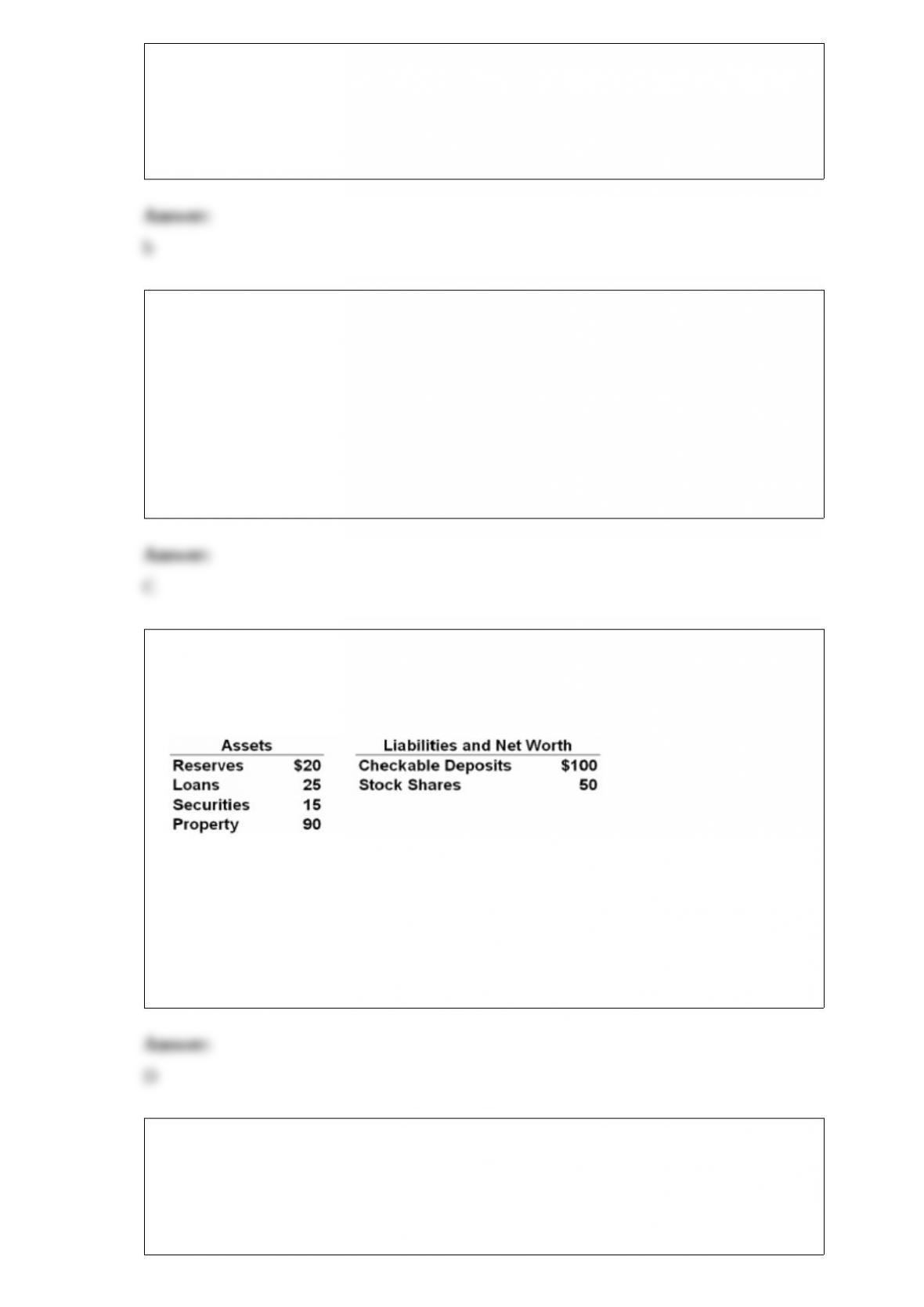
6) The following balance sheet for the First National Bank of Bunco. All figures are in
millions.
Refer to the above data. Suppose that this bank currently has $6 million in excess
reserves and that customers of this bank collectively write checks for cash at the bank in
the amount of $6 million. As a result, the bank’s excess reserves diminish to:
A.$0.
B.$6 million.
C.$0.72 million.
D.$0.84 million.
7) Suppose that a mixed open economy is producing at its equilibrium income and that
net exports are zero. If at the equilibrium income the public sector’s budget shows a
surplus:
A.Ca + Ig + Xn + G must exceed GDP.
B.planned investment must exceed saving.
C.a recessionary expenditure gap must exist.
D.saving must exceed planned investment.
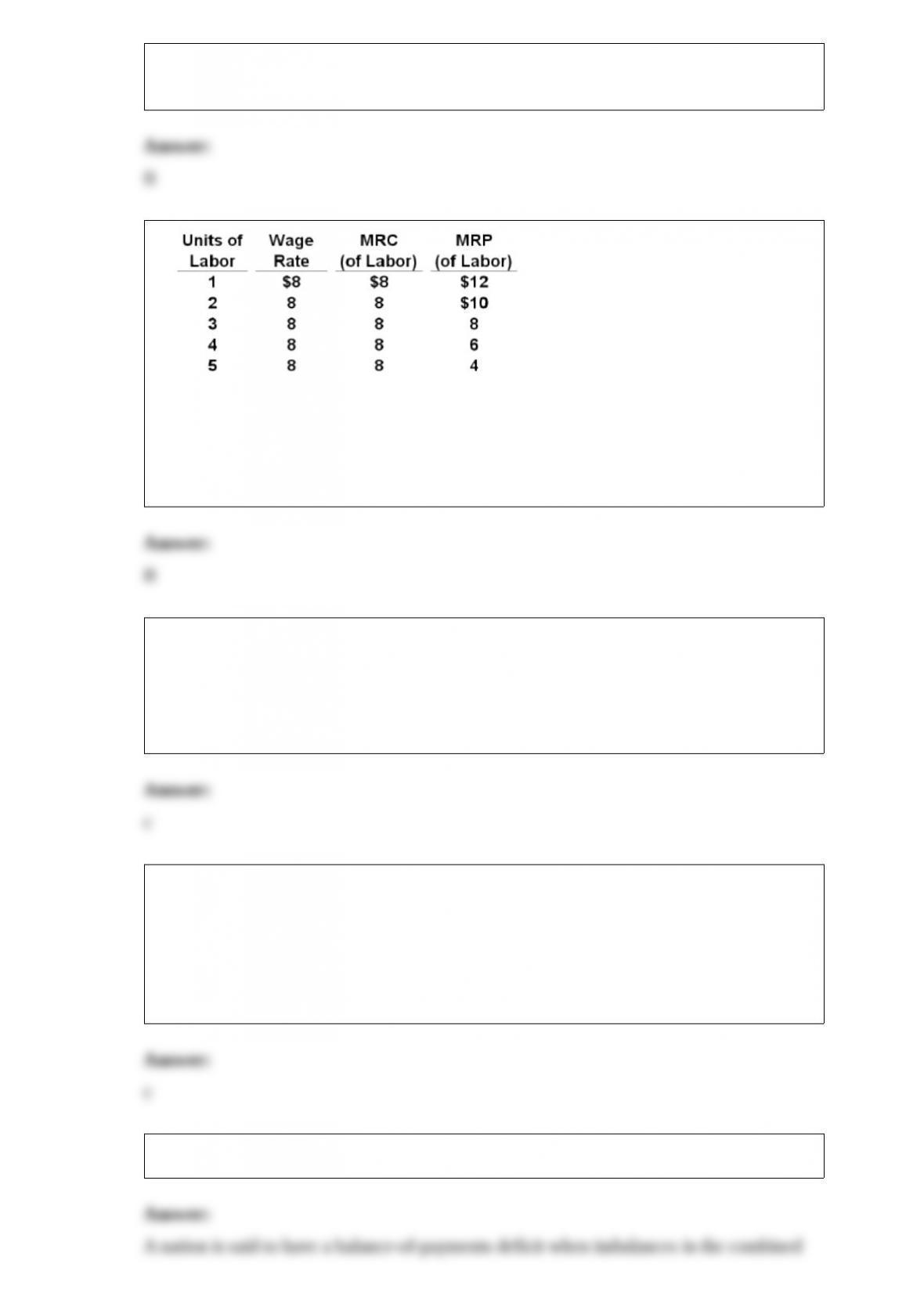
8)
Refer to the above data. In maximizing its profit, this firm will employ:
A.2 units of labor.
B.3 units of labor.
C.4 units of labor.
D.5 units of labor.
9) households and businesses are:
a.both buyers in the resource market.
b.both sellers in the product market.
c.sellers in the resource and product markets respectively.
d.sellers in the product and resource markets respectively.
10) all of the following are economic implications of the recent productivity
acceleration except:
a.a lower natural rate of unemployment.
b.higher rates of productivity advance.
c.an end to the business cycle.
d.a greater rate of economic growth.
11) What is a balance-of-payments deficit? What is a balance-of-payments surplus?
12) Pure competition or pure monopoly industries will tend to be one-price industries.
Monopolistic competition, however, is a multiprice industry. Explain.
13) Identify the four major instruments of monetary policy.
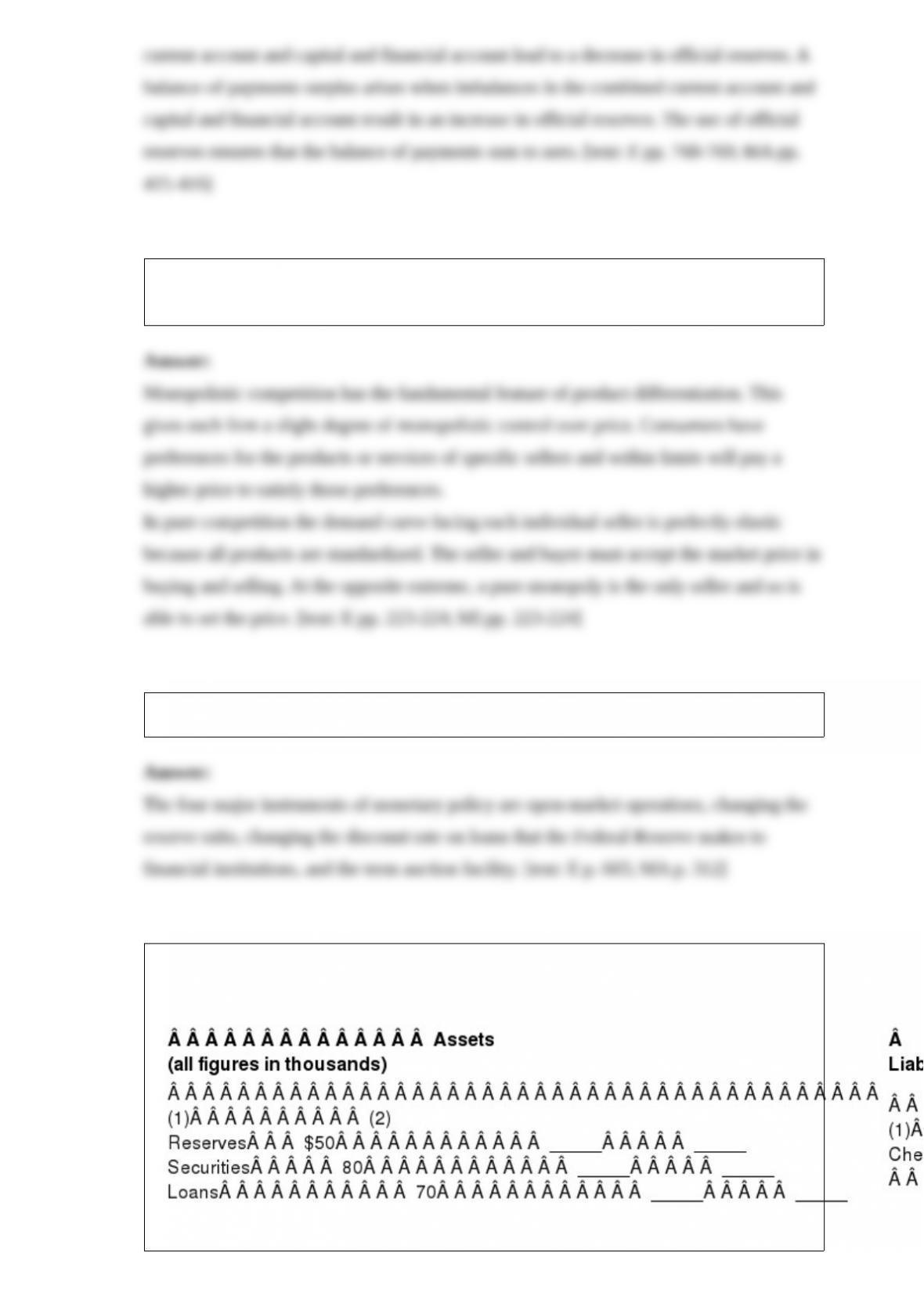
14) Suppose the Second National Bank has the following simplified balance sheet. The
reserve ratio is 25%.
Assume that households and businesses deposit $10,000 in this bank and that this
currency is added to the banks reserves.
In column (1) show the banks balance sheet after this occurs. Is there a change in the
money supply?
In column (2) show what would happen if the bank now loans all of its excess reserves
to a depositor. Is there a change in the money supply?
15) Describe the characteristics of the short-run aggregate supply curve. Explain what
happens to: (1) nominal wages; (2) employment; (3) output; (4) revenues; and, (5)
profits as the price level increases from the full-employment level of output. Then
explain what happens to these variables as the price level decreases from the
full-employment-level of output.
16) What are four characteristics of pure competition?
17) Why does the private market succeed in meeting consumers demands while
majority voting in many cases fails to do the same?
18) What are the three common features of all investments and why are they important?
19) Differentiate between the average propensity to consume and the marginal
propensity to consume.