
Compared to an economy’s self-correcting mechanism, active contractionary fiscal
policy will
a. work more slowly and calmly.
b. work more quickly.
c. have less deflationary effects.
d. have a smaller effect on real GDP.
Invention is the act of generating a new idea.
a. True
b. False
Economists consider environmental pollution to be a(n)
a. externality.
b. pure public good.
c. allocatively efficient outcome.
d. public interest outcome.

National debt is likely to fall when
a. there is a succession of budget deficits.
b. government’s expenditure falls short of its receipts.
c. government’s expenditures exceed its receipts.
d. government expenditure equals revenue.
If the price level rises, what will happen to the level of real GDP supplied?
a. It will usually decrease.
b. It will usually increase.
c. Nothing.
d. It will decrease at first and then increase.

The high unemployment of 2008-2010 caused a substantial decrease in inflation which
created fears of deflation.
a. True
b. False
Which of the following is an example of an investment?
a. A company placing cash reserves in a bank.
b. A company buying Yahoo shares.
c. A company augmenting its production capacity.
d. A company issuing bonus shares.
When someone asks how much money you made this year, they are using the term
“money” correctly.
a. True
b. False

Game theory can be used to investigate
a. why cartels break down.
b. why some firms maintain excess productive capacity.
c. how oligopolists set prices.
d. All of the above are correct.
Assume that Country X and Country Y are trading partners and the exchange rates are
fixed. If prices in Country Y rise, all of the following are expected to happen except
a. Country X will export more.
b. Country Y will import more.
c. Net exports will rise for Country X.
d. Trade will boost Country Y GDP.

Price discrimination is always illegal.
a. True
b. False
The demand curve facing a monopolist is
a. horizontal at the market price.
b. identical to the market demand curve for the good.
c. exactly twice as steep as the market demand curve for the good.
d. vertical because there are no competitors.
Prices
a. solve the problem of distribution of products among consumers.
b. act as rationing devices.
c. under laissez faire produce an efficient allocation of resources.
d. do all of the above.

Homeowners
a. are subject to double taxation.
b. benefit from several loopholes.
c. have no particular advantages in the tax system.
d. must pay tax on the “income” of living in a house.
In the long run, aggregate demand controls, no matter what happens to aggregate
supply.
a. True
b. False
Using specialized equipment to produce simultaneously a number of similar items
a. leads to economies of scale.
b. is the goal of deregulation.
c. can only happen in a high technology nation.
d. is called economies of scope.
Define the following terms briefly and concisely.
a. stock
b. bond
c. portfolio diversification
d. speculation
e. random walk
The rule of MC = MR does not apply to a monopolist.
a. True
b. False
Which of the following will most likely cause a shift in the consumption function?
a. a change in consumer confidence
b. a change in national output
c. a change in real GDP

d. a change in disposable income
An increase in the value of the U.S. dollar relative to the Japanese yen will
a. increase aggregate demand in the United States.
b. decrease aggregate supply in the United States.
c. increase aggregate demand in Japan.
d. increase aggregate supply in Japan.
In terms of macroeconomic conditions, the 1930s were the “good old days.”
a. True
b. False

If P = MC for all goods in a free-market economy, then
a. the desire for utility maximization will lead consumers to buy the amount of each
good at which MU = MC.
b. the desire for profit maximization will lead consumers to buy the amount of each
good at which MU = MC.
c. the desire for utility maximization will lead consumers to buy only those goods that
have low opportunity costs.
d. the desire for profit maximization will lead all firms to stop producing in the long run
(though possibly not in the short run).
People generally purchase less of a commodity as its price increases. This implies that
the relationship between quantity purchased and the price of the commodity must have
a
a. slope always equal to one.
b. positive slope.
c. zero slope.
d. negative slope.

Thomas Edison once said that he began making real profit on light bulbs when he
dumped his surplus on the European market at less than the “cost of production.” From
this we can deduce Edison
a. did not want to maximize profit.
b. understood the difference between marginal and average cost.
c. had a different definition of the term “profit.”
d. did not understand the difference between fixed and variable cost.
A period of stagflation is the normal aftermath of a period of
a. excess aggregate supply.
b. deficient aggregate demand.
c. excess aggregate demand.
d. high unemployment rates.
A mixed economy is one in which
a. a mixture of businesses exist and function.
b. there is a mixture of public influence over government.

c. government plays a dominant role, and private markets are secondary.
d. there is some public influence over free markets.
Expansionary monetary policy will decrease interest rates and decrease the velocity of
money.
a. True
b. False
If income is distributed equally in a society, the poorest fifth of the population receives
a. 5 percent of the total income.
b. one-fifth as much as the richest fifth of the population.
c. 20 percent of society’s total income.
d. 50 percent of society’s total income.

Research and development refers to the activity of firms, universities, and government
agencies that seek to invent new products and processes.
a. True
b. False
A consumer cannot gain consumer’s surplus if she purchases more than one unit of a
good.
a. True
b. False
Roughly 144 million people in the United States hold jobs.
a. True
b. False

If not recycled, an input used in production ultimately winds up as a waste product.
a. True
b. False
Above a certain income the marginal social security tax drops to zero.
a. True
b. False
The opportunity cost of holding excess reserves will be lower at an 8 percent federal
funds rate in comparison to a 10 percent federal funds rate.
a. True
b. False
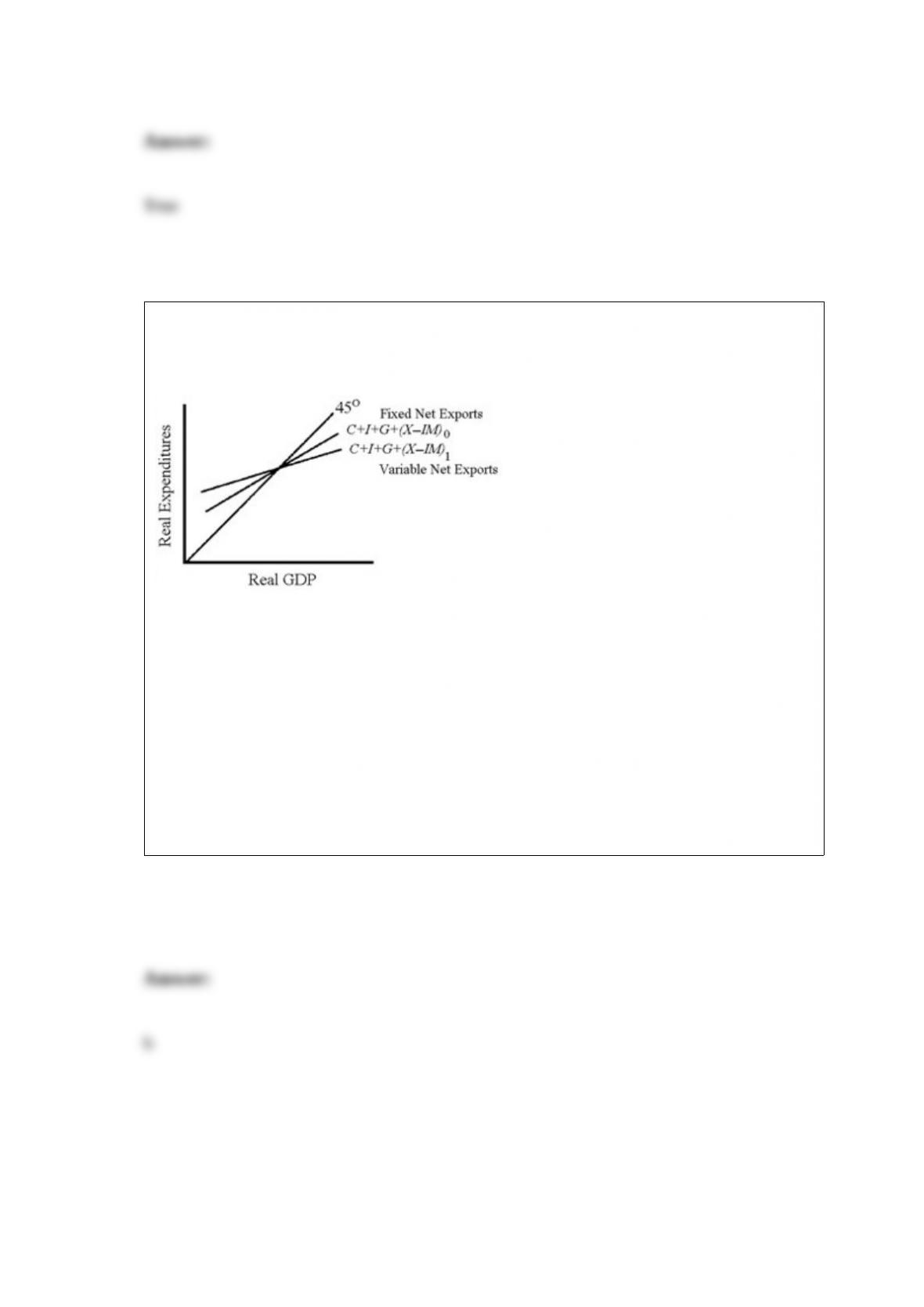
Figure 20-9
Figure 20-9 shows aggregate expenditures when net exports are fixed and aggregate
expenditures are variable. The autonomous spending multiplier is
a. smaller when net exports are fixed.
b. smaller when net exports are variable.
c. larger when net exports are variable.
d. the same whether net exports are fixed or variable.