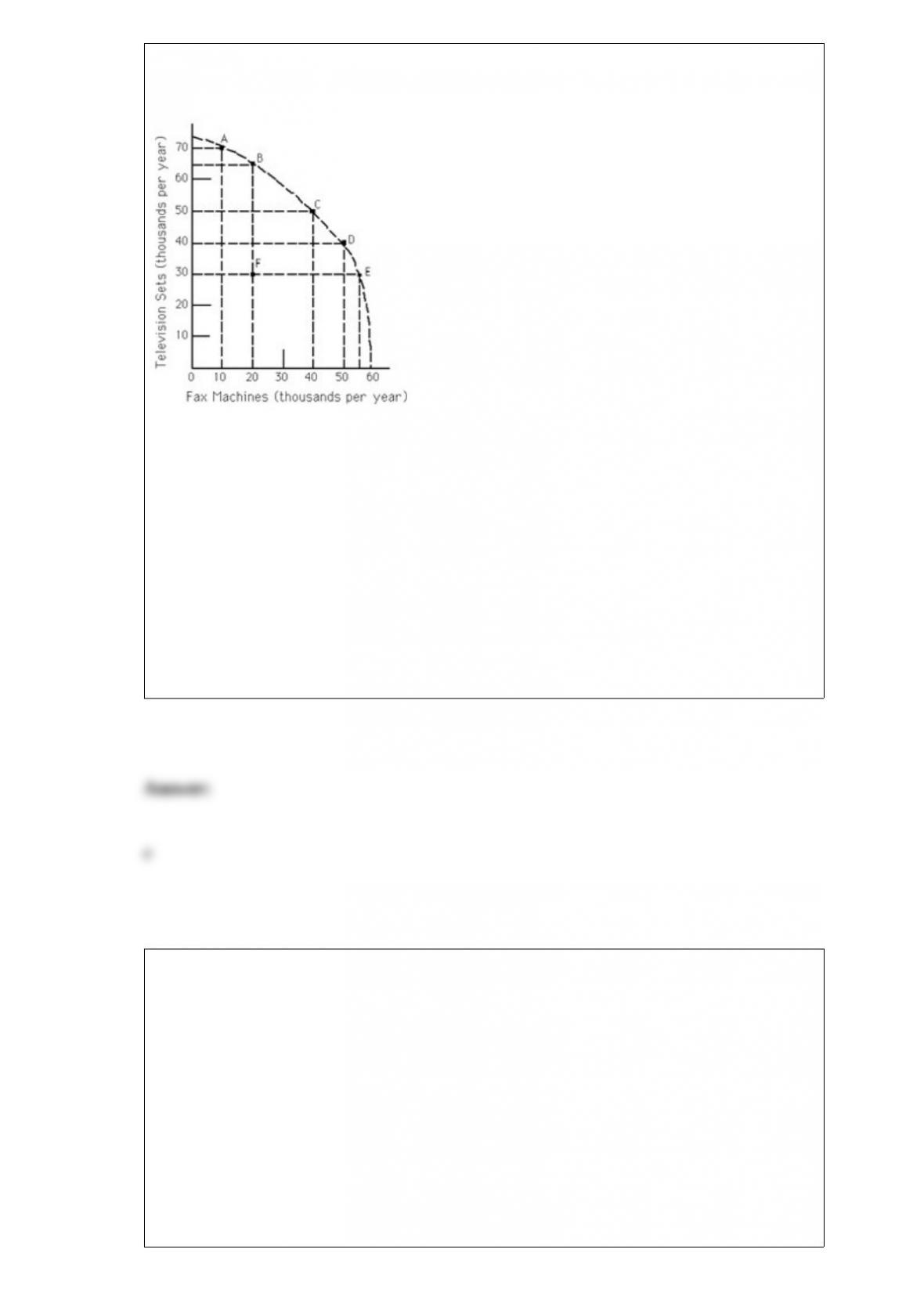
Exhibit 2-5
“In order to produce one more television set, we
must forfeit the production of one fax machine.” This statement describes a movement
from
a. point C to point D.
b. point D to point E.
c. point E to point F.
d. point E to point D.
e. point D to point C.
Logrolling refers to the
a. exchange of political favors by corporations.
b. need for the president to veto an entire bill when only certain parts of the bill are
objectionable.
c. exchange of votes to gain support for legislation.
d. a and b
e. none of the above

Suppose the government decides that every family should own its own home. To bring
this about, the government decides to subsidize the home-construction industry by
giving the home-construction companies $10,000 for every house that they build. As a
result of this,
a. the supply curve of new houses would shift leftward, since it now costs $10,000 more
for builders to produce a house.
b. the demand curve for new houses would shift rightward, since now every family
would want to buy a house.
c. the demand curve for new houses would shift leftward.
d. the supply curve of new houses would shift rightward, since builders would be
willing to produce and sell more houses at each given price.
e. c and d
The demand to attend a certain college is represented by a downward-sloping demand
curve. The supply of spots at the college is represented by a vertical supply curve. At
the tuition that students are charged, there is a shortage of spots at the college. If the
demand to attend the college rises, but the tuition stays constant, it follows that the
a. GPA required to attend the college will probably rise.
b. GPA required to attend the college will probably fall.
c. SAT score required to attend the college will probably not change.
d. a and c
e. There is not enough information to answer this question.
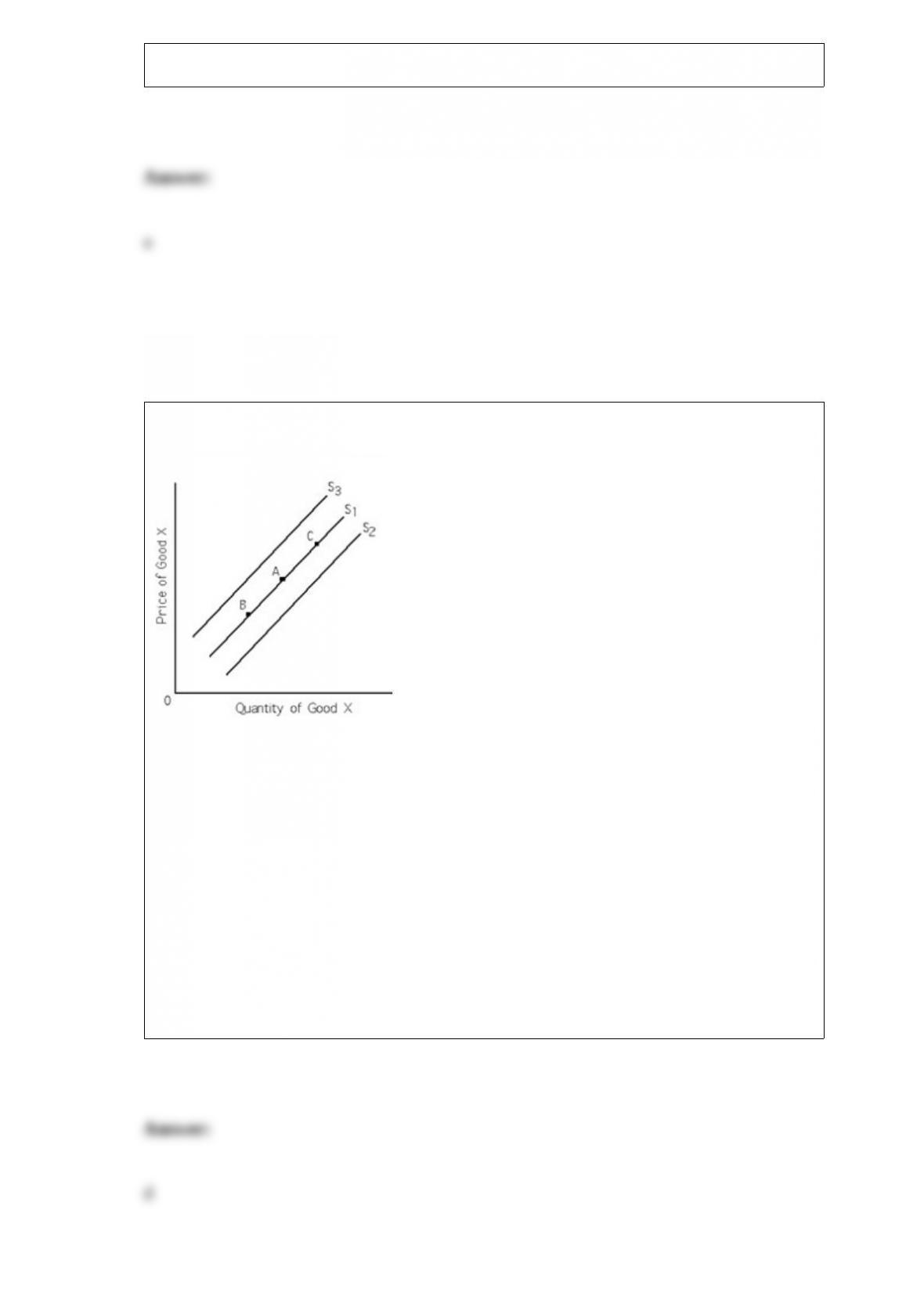
Exhibit 3-7
If S1 is the relevant supply curve, an increase in the price of good X may cause
a. the supply of good X to shift from S1 to S2
b. the supply of good X to shift from S1 to S3.
c. a movement along S1 perhaps from point A to point B.
d. a movement along S1 perhaps from point A to point C.
e. no change in the quantity supplied of good X.

For financial institutions, securitization is the means by which regulatory capital
arbitrage lowers capital requirements.
a. True
b. False
Rising savings rates in emerging countries in the period 2000-2008 are associated with
both falling and rising mortgage interest rates in the United States.
a. True
b. False
Which of the following is not one of the four broad categories of resources?
a. labor
b. money
c. capital
d. entrepreneurship
e. land

Countries tend to specialize in the production of goods in which they have a
comparative advantage because
a. government officials calculate opportunity costs and suggest to people what they
ought to produce.
b. people want to make a profit.
c. the Economic Development Office of the United Nations hires economic experts to
calculate the opportunity costs of different goods in different countries and then
suggests to countries what they ought to produce.
d. the United Nations hires economic experts to calculate the opportunity costs of
different goods in different countries and then suggests to countries what they ought to
produce.
e. none of the above
Suppose the civilian non-institutional population equals 100,000 persons; the civilian
labor force equals 75,000 persons; there are 70,000 employed persons and 5,000
unemployed persons. If 5,000 persons who are currently “not in the labor force” decide
to join the civilian labor force, and 3,000 of them are unemployed, then
a. both the unemployment and the employment rate rise.
b. both the unemployment and the employment rate fall.
c. the unemployment rate rises and the employment rate falls.
d. the unemployment rate falls and the employment rate rises.

The answer is, “Because of the free rider problem.” The question is:
a. Why can’t the government produce nonexcludable public goods?
b. Why can’t the market produce nonexcludable public goods?
c. Why do negative externalities exist?
d. Why do positive externalities exist?
e. b and d
Both the monetarist view of the economy and the simple quantity theory of money hold
that velocity is constant.
a. True
b. False
Exhibit 15-5

At short-run equilibrium, this economy is in a(n) ___________________ gap. An
economist who believes that the economy is self-regulating would assert that
_____________________________.
a. inflationary; the SRAS curve will shift leftward sufficiently to close the inflationary
gap
b. recessionary; the SRAS curve will shift rightward sufficiently to close the
recessionary gap
c. inflationary; the AD curve will shift leftward sufficiently to close the inflationary gap
d. recessionary; the AD curve will shift rightward sufficiently to close the recessionary
gap
Credit cards are a widely accepted form of money.

a. True
b. False
If the supply of aisle seats equals the supply of middle seats on an airplane, and the
demand for aisle seats is _____________ than the demand for middle seats, then the
equilibrium price of aisle seats will be ______________ the equilibrium price of middle
seats.
a. greater; higher than
b. less; higher than
c. greater; lower than
d. less; the same as