
The long-run adjustment to a negative supply shock results in
A) the short-run aggregate supply curve shifting to the right.
B) the price level rising.
C) unemployment rising.
D) workers being willing to accept higher wages.
Article Summary. Arguing that a merger would lead to higher prices, reduced
service, and significantly less competition, the Justice Department and attorneys
general from 6 states and the District of Columbia filed a lawsuit in August to
challenge the pending merger of American Airlines and US Airways. The lawsuit
took some by surprise as the Justice Department has in recent years approved the
mergers of Delta with Northwest and United with Continental. The European
Union approved the merger in August, and American and US Airways had hoped
to complete the merger by September.
Source: Even Perez, “US government seeks to block American-US Airways
merger,” CNN.com, August 13, 2013.
A merger between two competitors such as American Airlines and US Airways may
ultimately be approved by the Department of Justice and the FTC if the two companies
can substantiate ________ as a result of the merger.
A) increases in revenue for the merged company
B) an increase in the HHI to over 1,800
C) decreases in marginal revenue for the merged company
D) increases in economic efficiency

Even though it often does not result in profit maximization, some small firms use a
cost-plus pricing strategy anyway because
A) it is easy to use.
B) they do not understand what marginal revenue and marginal cost mean.
C) it is expensive to hire an economist who can determine what the profit-maximizing
price is.
D) they sell several products, each of which sells for a different price. The time and
expense involved in finding the profit-maximizing price for each product are not worth
the effort.
There is much evidence to suggest that airlines are more likely to match price cuts than
price increases. Which of the following best explains this evidence?
A) The law of demand which states that an increase in price leads to a decrease in
quantity demanded.
B) No one airline wants to be the first to renege on a tacit collusive agreement in which
all airlines implicitly agree to match price cuts but not price increases.
C) An airline fears that if it does not match a price cut, its sales may fall considerably
but if it does not match a price increase, it will be able to attract customers away from
its rivals.
D) Airlines have different costs of production and therefore it is more difficult to agree
on a price increase than on a price decrease.
The multiplier effect is the series of ________ increases in ________ expenditures that
result from an initial increase in ________ expenditures.
A) induced; investment; autonomous
B) induced; consumption; autonomous
C) autonomous; consumption; induced
D) autonomous; investment; induced
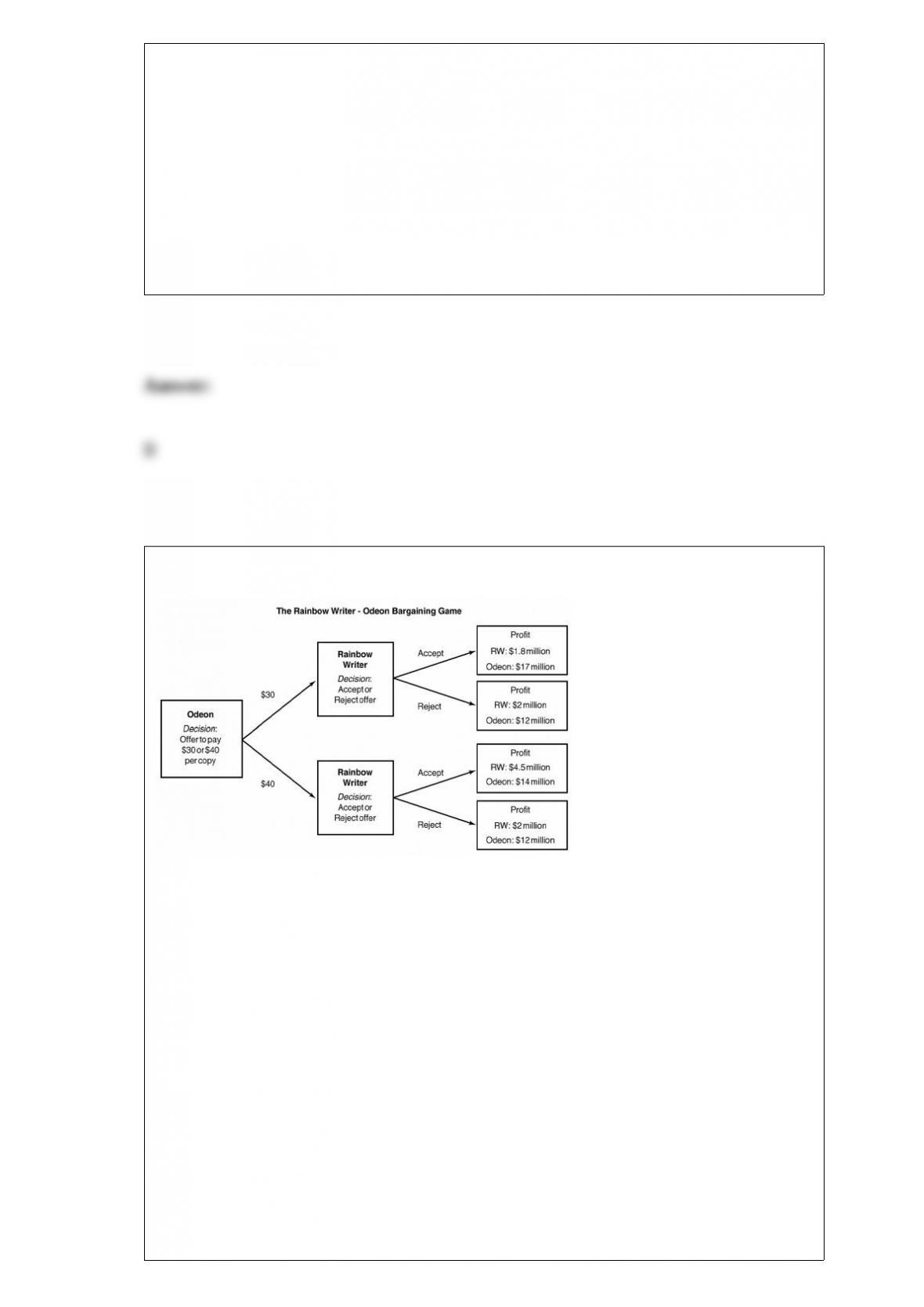
Figure 14-3
Rainbow Writer (RW) is a small online company selling a highly rated software
package for printing color labels directly onto CDs. The firm currently earns a profit of
$2 million per year selling its package exclusively on its Web site. Odeon, the producer
of the most popular software package for editing and burning CDs and DVDs has
expressed interest in bundling Rainbow Writer’s product into its own package. Odeon
expects that bundling would further boost its sales and allow it to sell the new bundled
product at a higher price, thus raising its profits beyond its current profit of $12 million.
Figure 14.3 shows the decision tree for the Rainbow Writer-Odeon bargaining game.
What is the equilibrium outcome in this game and is this a subgame-perfect
equilibrium?
A) Odeon’s offer of $40 per copy of the software package is accepted and this is a
subgame-perfect equilibrium.
B) In the equilibrium, Odeon offers $40 per copy of the software package and is
accepted but this is not a subgame-perfect equilibrium.
C) In the equilibrium, Odeon offers $30 per copy of the software package and is
rejected, and this is a subgame-perfect equilibrium.
D) There is no equilibrium in this game.
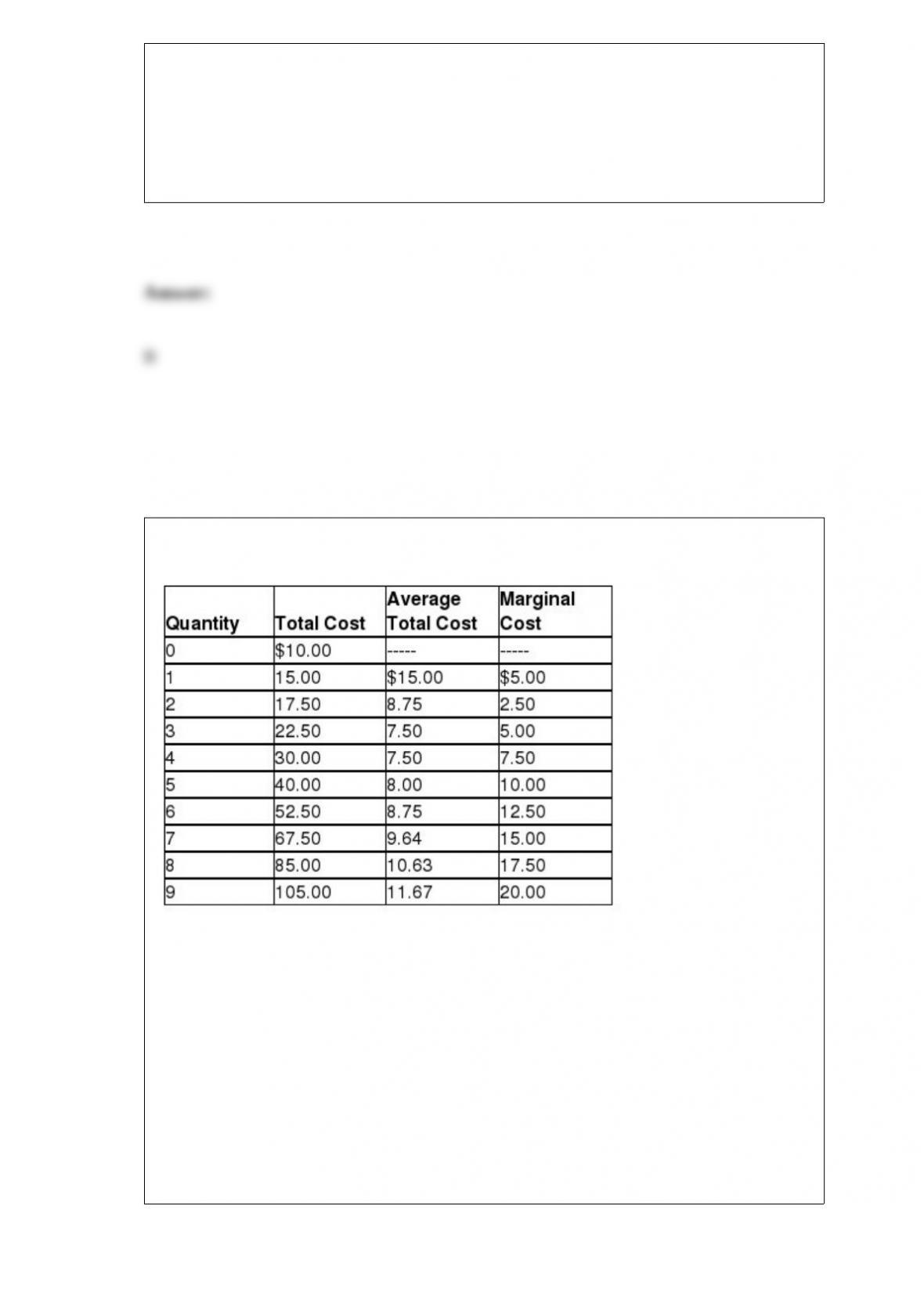
Table 12-3
Arnie sells basketballs in a perfectly competitive market. Table 12-3 summarizes
Arnie’s output per day (Q), total cost (TC), average total cost (ATC) and marginal cost
(MC). What will Arnie’s output be and how much profit will he earn if the market price
of basketballs is $5.00?
A) Q = 1; profit = -$10.
B) Q = 3; profit = -$7.50
C) Q = 0; profit = -$10.00
D) Price and profit cannot be determined from the information given.
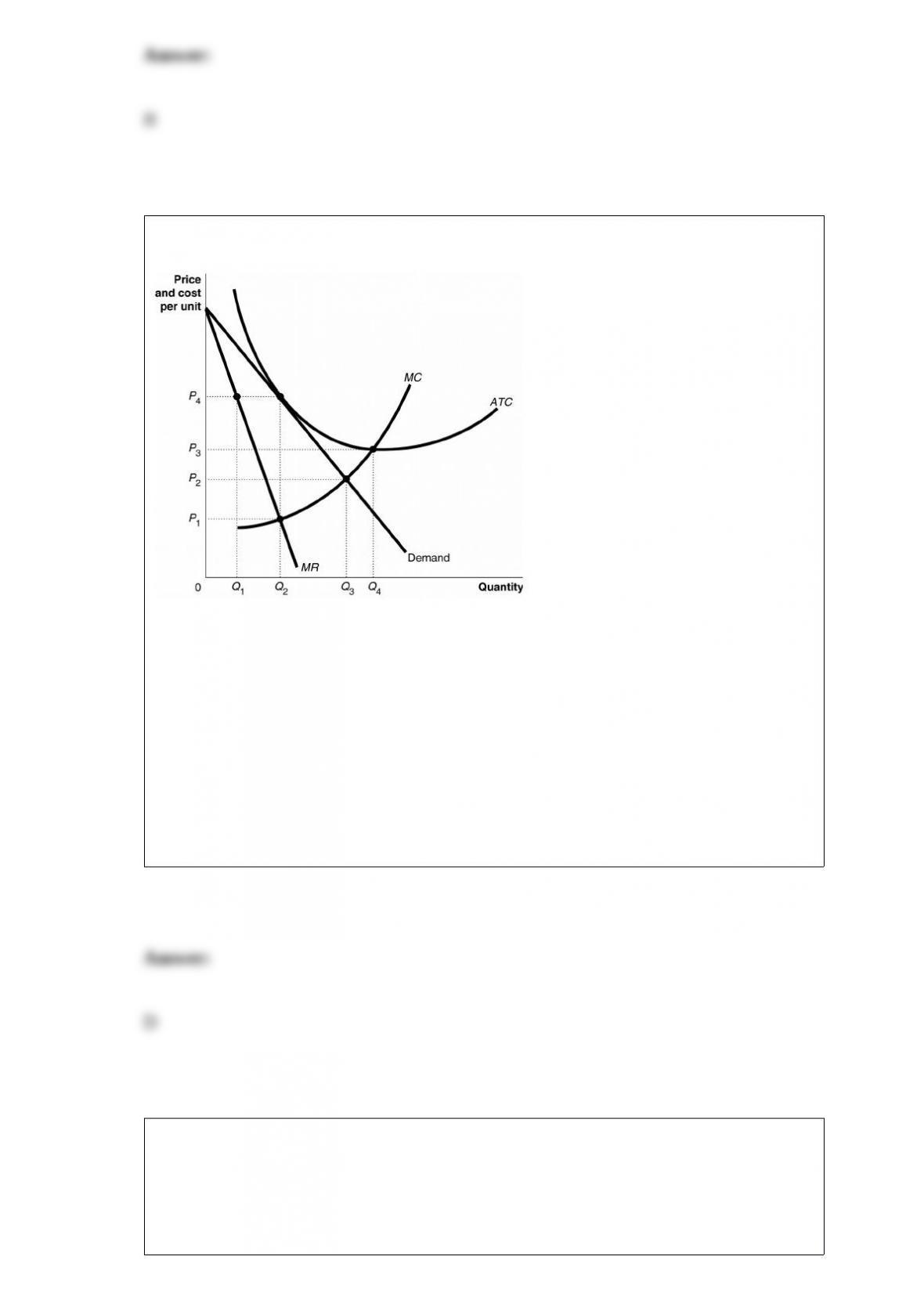
Figure 13-11
What is the monopolistic competitor’s profit maximizing price?
A) P1
B) P2
C) P3
D) P4
Suppose a bank has $100,000 in checking account deposits with no excess reserves and
the required reserve ratio is 5 percent. If the Federal Reserve lowers the required
reserve ratio to 3 percent, then the bank will now have excess reserves of
A) $0.

B) $2,000.
C) $3,000.
D) $5,000.
In the dynamic aggregated demand and aggregate supply model, inflation occurs if
A) AD shifts faster than SRAS.
B) AD shifts slower than SRAS.
C) SRAS shifts faster than AD.
D) LRAS shifts faster than AD.
Suppose real GDP is $13 trillion, potential real GDP is $13.5 trillion, and Congress and
the president plan to use fiscal policy to restore the economy to potential real GDP.
Assuming a constant price level, Congress and the president would need to decrease
taxes by
A) $500 billion.
B) less than $500 billion.
C) more than $500 billion.
D) None of the above are correct. Congress should raise taxes in this case.
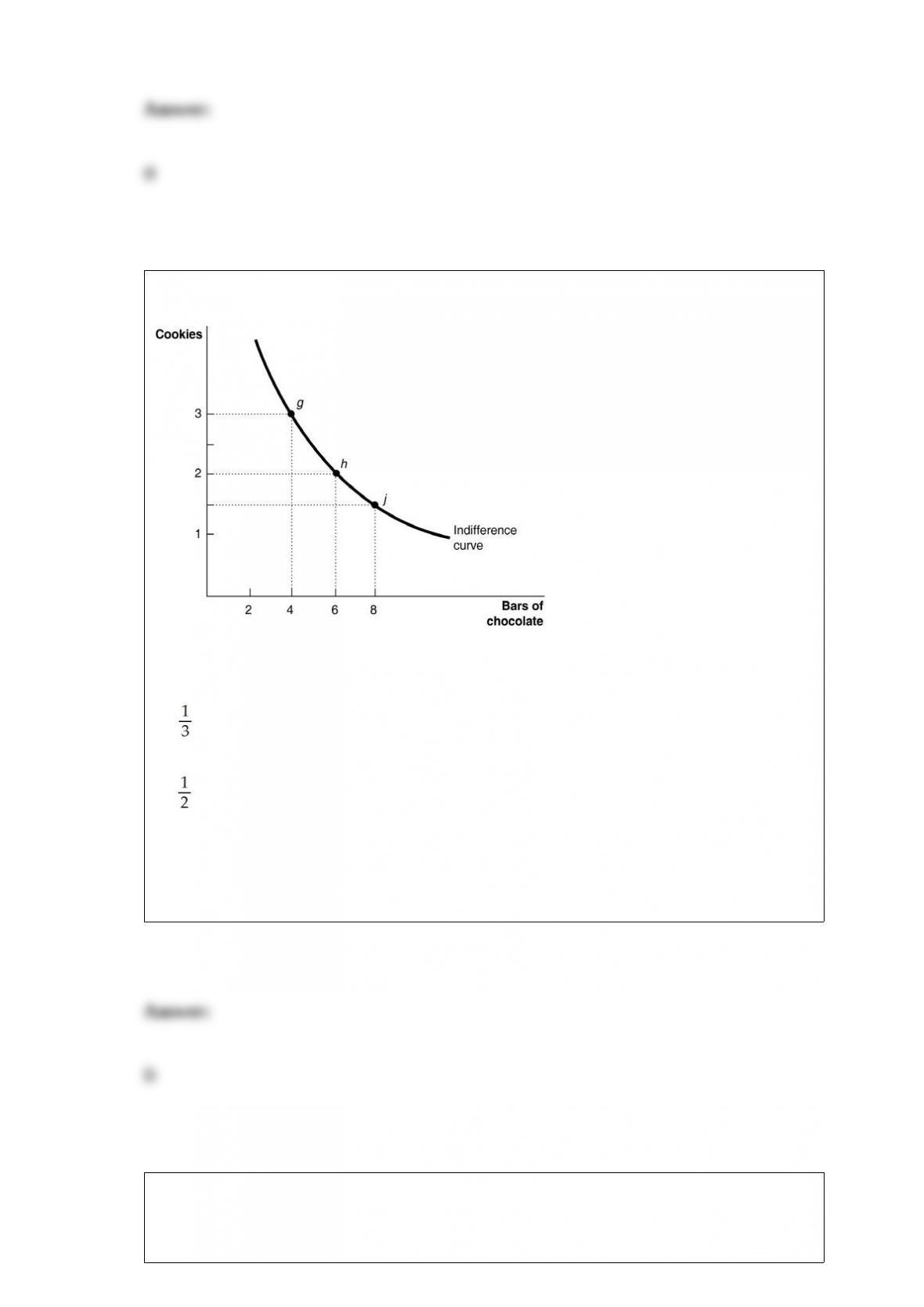
Figure 10-4
What is the marginal rate of substitution between g and h?
A) cookie.
B) cookie.
C) 2 cookies.
D) 3 cookies.
Which of the following is not an assumption made by the dynamic model of aggregate
demand and aggregate supply?
A) Potential real GDP increases continuously.
B) The aggregate demand curve shifts to the right during most periods.
C) The short-run aggregate supply curve shifts to the right except during periods when
workers and firms expect higher wages.
D) Aggregate demand and potential real GDP decrease continuously.
Discuss the correct and incorrect economic analysis in the following statement. “The
United Auto Workers Union has successfully negotiated a 9 percent increase in wages
for its workers. This increase in the wage rate causes an increase in demand for
automobiles, since many consumers now have greater incomes, and also a decrease in
the supply of automobiles because the cost of production has increased. These effects
cancel each other out resulting in no change in equilibrium price and quantity in the
automobile market.”
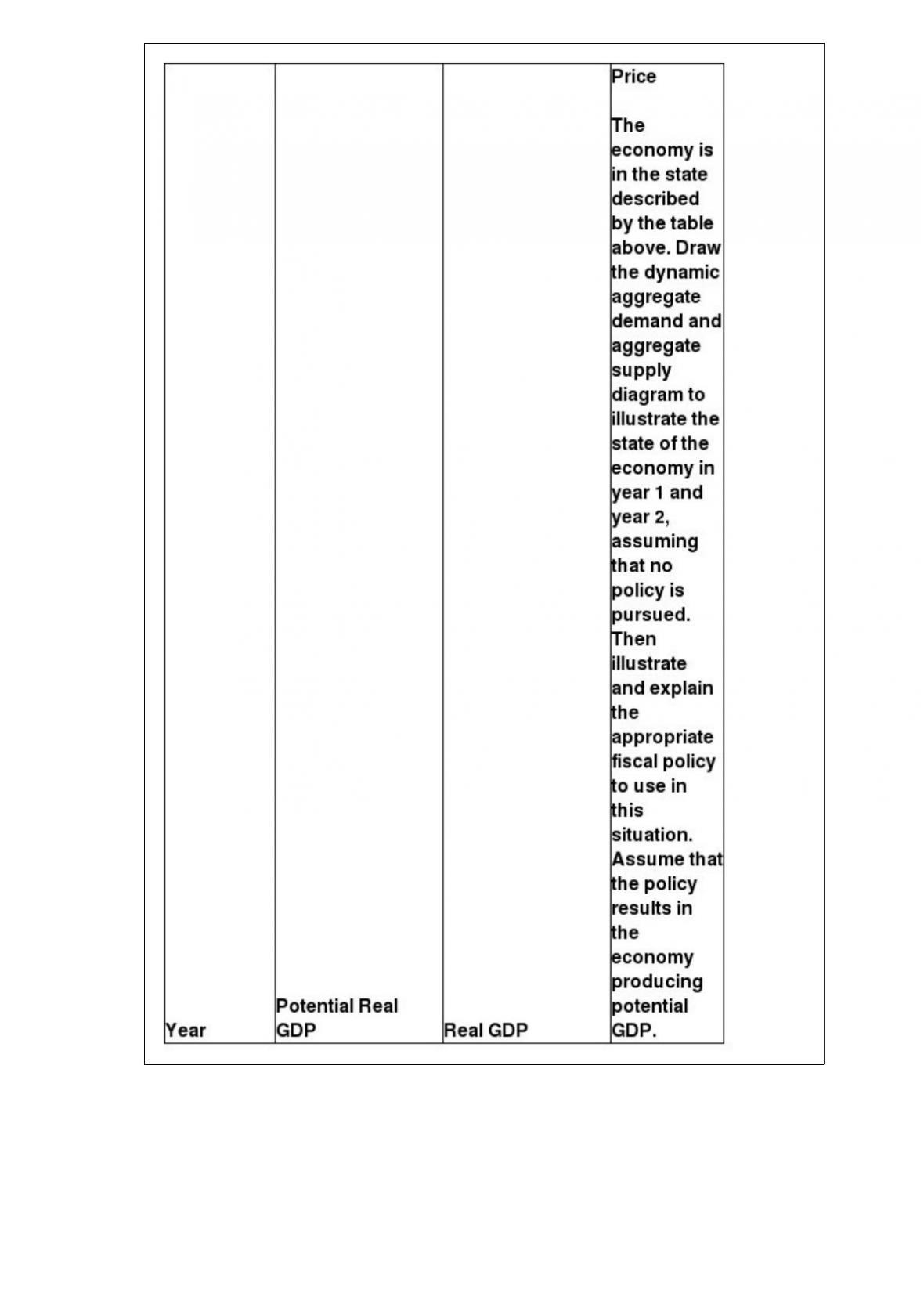
Table 27-5
Why does continued foreign investment in U.S. stocks and bonds and foreign
companies continuing to build factories in the United States result in a current account
deficit in the United States?
Consider the Taylor rule for the target of the federal funds rate. Suppose the equilibrium
real federal funds rate is 2 percent, the target rate of inflation is 3 percent, the current
inflation rate is 3 percent, real GDP equals potential real GDP, and the weights are 1/2
for the inflation gap and the output gap. Using the Taylor rule, what does the target for
the federal funds rate equal? Next, if the Federal Reserve lowered the target for the
inflation rate to 1 percent, how much would the target for the federal funds rate change?
What is the marginal product of labor and what is the average product of labor.
If firms and workers have adaptive expectations, what impact will expansionary
monetary policy have on inflation, unemployment, and the Phillips curve?
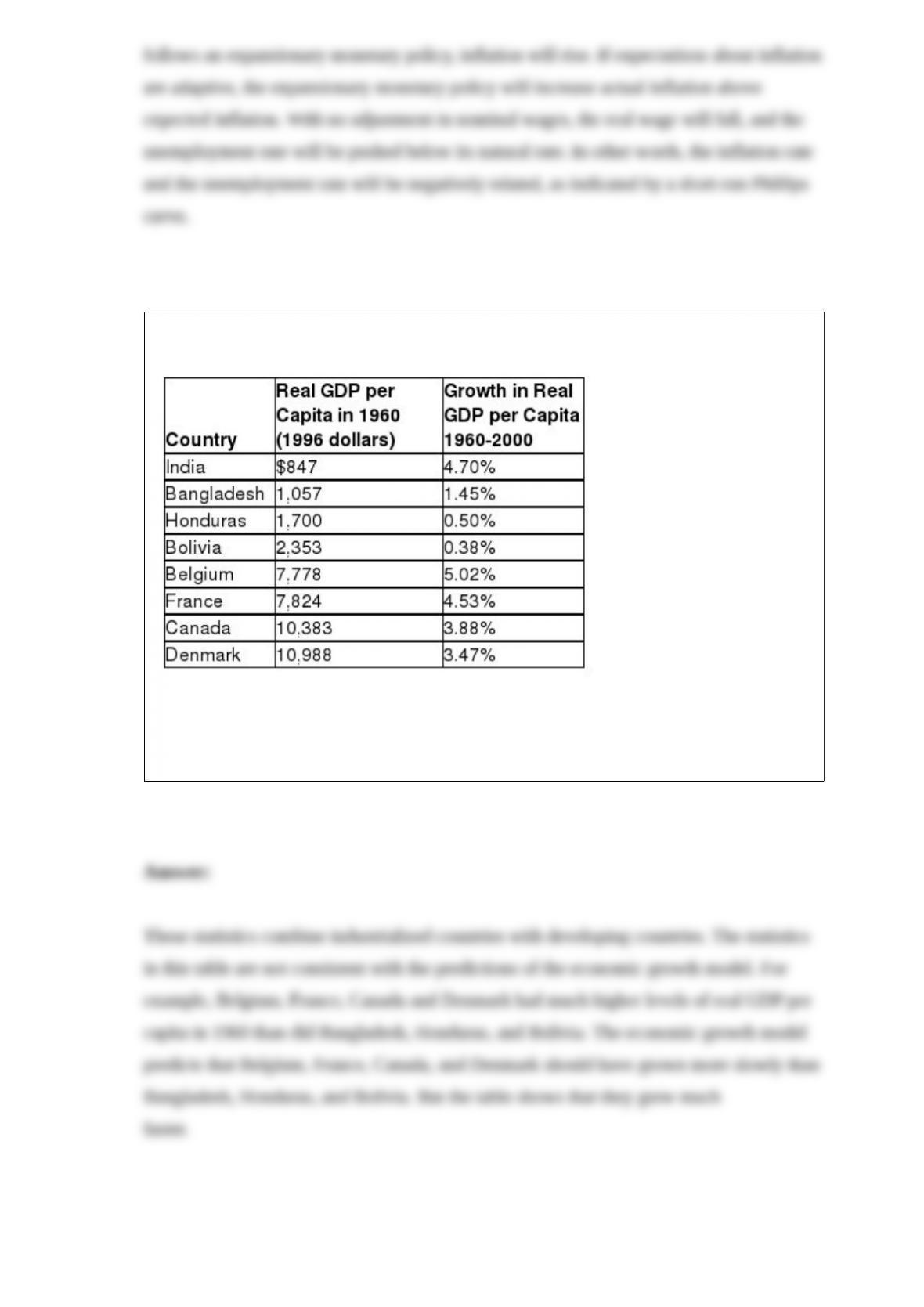
Table 22-7
Consider the statistics in the table above in describing the following industrialized and
developing countries. Are these consistent with the economic growth model? Briefly
explain.