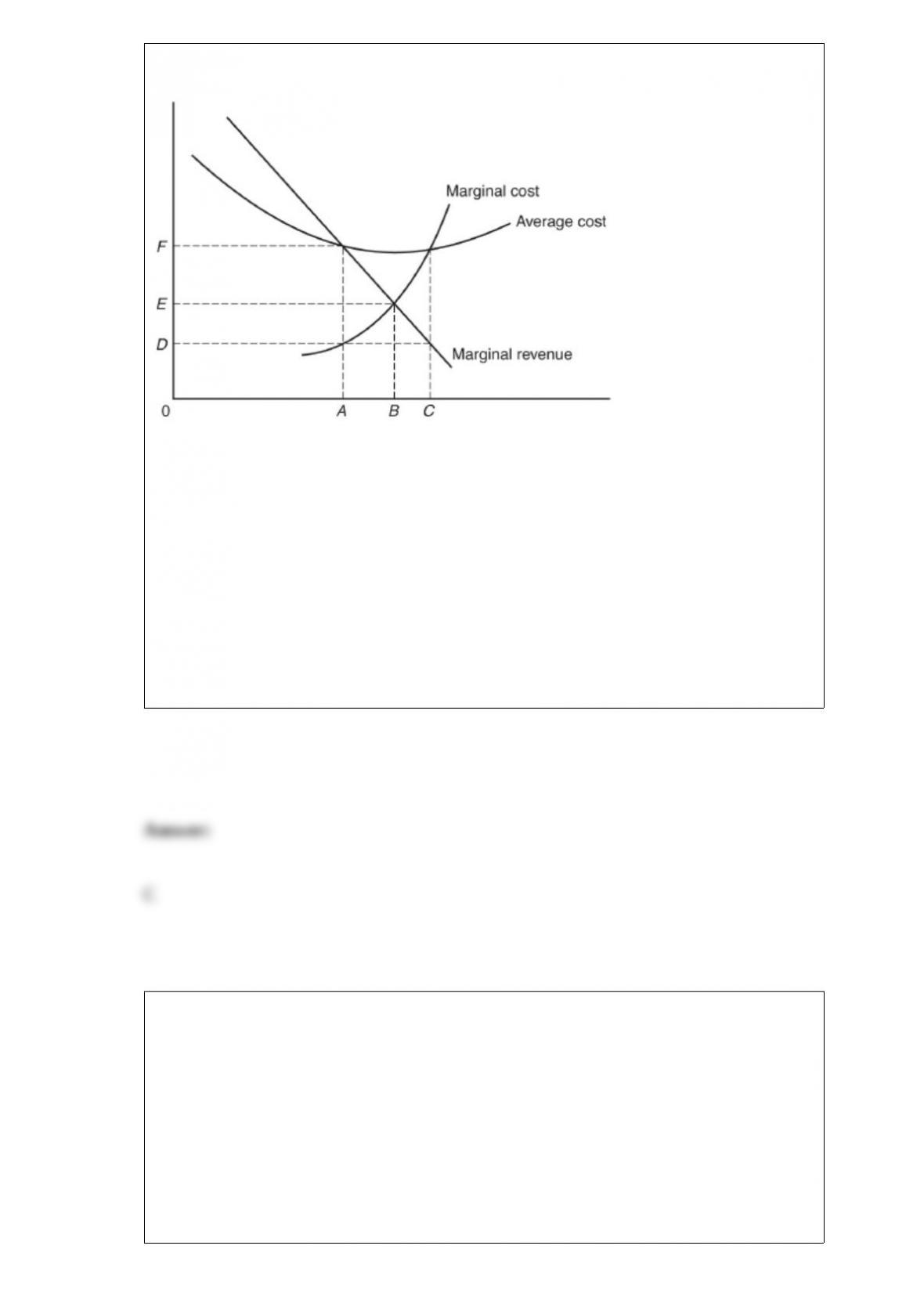
The following questions are based on the following diagram of a monopolist:
If the monopolist is currently producing 0A and wants to maximize profits, it should
a. do nothing because it is maximizing profits.
b. decrease output to zero.
c. raise output to 0B.
d. raise output to 0C.
e. raise output above 0C.
The government may attempt to reduce unemployment by
a. pushing the aggregate demand curve to the left.
b. increasing the tax rate on personal income.
c. reducing government expenditures.
d. decreasing net exports.

e. cutting taxes.
The following questions are based on the following information for a society:
Disposable incomeConsumption expenditures
$1,800 billion$1,656 billion
$1,900 billion$1,740 billion
$2,000 billion$1,820 billion
If disposable income is $1,800 billion, the average propensity to consume is
a. 0.8.
b. 0.84.
c. 0.92.
d. 1.00.
e. 1.08.
To deflate, one must

a. multiply the price ratio by 100.
b. divide the current dollar values by the price index.
c. subtract the constant dollar values from the current dollar values.
d. add the price index in the current year to the price index in the base year.
e. find the difference between the values of two different sets of goods in a given year.
The view that business cycles are the natural (indeed efficient) response of the economy
to changes in technology and the availability of resources is associated with the
a. new Keynesians.
b. traditional Keynesians.
c. monetarists.
d. adaptive demand siders.
e. real business cycle theorists.
Automatic stabilizers make fiscal policy easier to undertake because they
a. allow economists to formulate rules so that the economy is perpetually stable.

b. enable policy makers to prescribe public works programs during inflationary periods
since expenditures for unemployment and welfare have correspondingly decreased.
c. act to increase spending when the economy turns down and to decrease spending
when the economy overheats.
d. eliminate the causes of unemployment and inflation experienced by the economy.
e. give the president the complete authority for determining stabilization policy.
A sales tax is generally considered to be regressive because
a. the poor spend a greater percentage of their income on taxable items than the rich.
b. sales tax rates rise as the price of the item rises.
c. only necessities are subject to the sales tax.
d. poor people pay a larger absolute amount of sales tax than the rich.
e. poor people do not benefit from the services provided by sales tax revenues.
Economics is best defined as the study of how
a. to classify resources used to produce final goods and services.
b. resources are apportioned to satisfy human wants.
c. modern businesses have grown and prospered.
d. technology can be used to change scarce resources into free resources.
e. pure capitalism has become the best system for satisfying basic human wants.
Which of the following policies would most economists consider the LEAST desirable
method to control inflation?
a. a reduction of the rate of growth of the money supply
b. increases in personal income tax rates
c. an imposition of wage and price controls
d. significant reductions in government spending levels
e. a reduction of the size of the government budget deficit
The following questions are based on the following diagram:
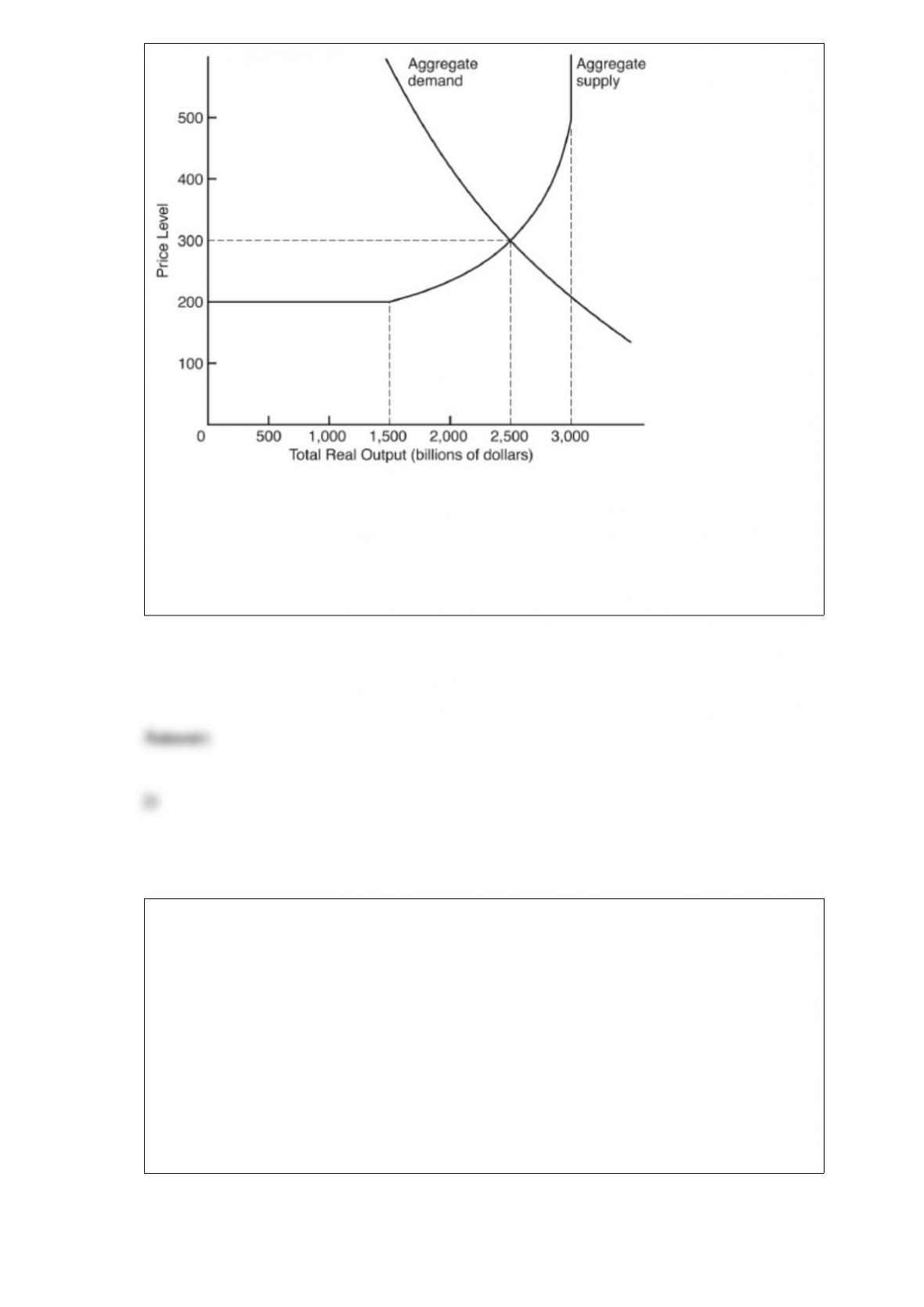
An equilibrium level of output and an equilibrium price level occur
a. only when the aggregate supply curve is horizontal.
b. when the price level equals the level of national output.
c. as long as the aggregate demand curve slopes upward.
d. where the aggregate supply and demand curves intersect.
e. in the short run only with specific government intervention.
Technology
a. concentrates on the fine arts and literature.
b. is another name for capital.
c. permits society to ignore problems of allocation.
d. is a specific managerial technique.
e. sets limits on the ability to satisfy human wants with existing resources.

The gap between actual and potential output
a. is a measure of the costs of inflation.
b. is a measure of what it costs society to tolerate less than full employment.
c. is necessary to ensure economic efficiency.
d. has always been positive.
e. is calculated as 3 (unemployment rate ” 0.055) potential GDP.
The approach to natural monopolies in the United States is to
a. nationalize them.
b. break them up into small competitive businesses.
c. give them franchises and subject them to regulation.
d. require them to merge with existing perfectly competitive business firms.
e. leave them alone.

Policies that benefit special interest groups are often adopted by governments because
a. these groups in the aggregate tend to represent a broad social consensus.
b. such groups are more efficient in the allocation of resources than government
bureaucracies; hence, support of their programs raises economic efficiency.
c. doing so equates marginal social benefits with marginal social costs.
d. such groups contribute more to government revenues than they receive in the form of
public benefits.
e. the gains of these relatively small groups come at the expense of a large number of
people, each of whom loses very little and so is less aware of the loss.
The following questions are based on the following information.
On June 1, 2014, the Pennsylvania Turnpike Commission voted to raise tolls by 30
percent.
They anticipated that traffic might initially fall by 5 percent.
If the Turnpike Commission is correct in its estimate of the price elasticity of demand,
turnpike revenue will
a. rise initially, then fall.
b. fall initially, then rise.
c. not change.
d. rise.
e. fall.

A market consisting of many firms, low barriers to entry, some control over price but
considerable nonprice competition is characteristic of
a. perfect competition.
b. monopoly.
c. monopolistic competition.
d. oligopoly.
e. dictatorship.
When the Fed buys government securities on the open market
a. the national debt increases.
b. bank deposits decrease.
c. the Treasury Department realizes a profit.
d. interest rates rise.
e. bank reserves increase.
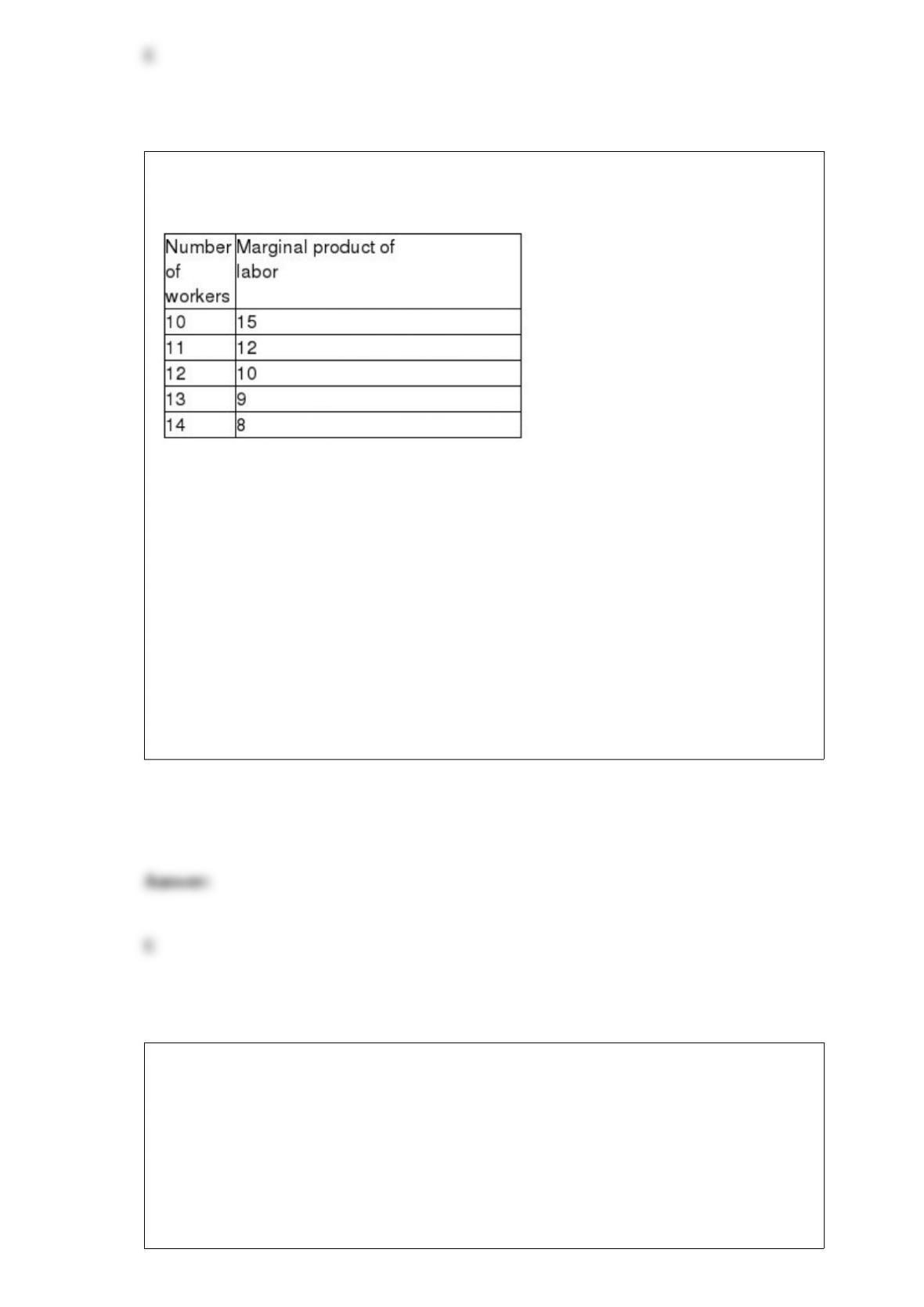
The following questions are based on the following information for a firm under
conditions of perfect competition:
If the price of the product is $5 per unit and the firm must pay $40 per worker
employed, how many workers should the firm hire to maximize profits?
a. 10
b. 11
c. 12
d. 13
e. 14
Government transfer payments are NOT included when computing GDP via the
expenditures approach because they are
a. included when computing GDP via the income approach.
b. payments to foreigners for the goods we import.
c. expressed in current rather than constant dollar terms.

d. not payments for current production.
e. incapable of affecting the economic well-being of households.
Societies must choose how to use available resources because
a. most resources are not owned by anyone.
b. the capacity to produce goods and services is unlimited.
c. in the aggregate human wants are insatiable.
d. otherwise resource prices would be zero.
e. technological progress wastes resources.
Under free trade, a country’s producers can tell whether they have a comparative
advantage in the production of a certain commodity by
a. estimating its production possibilities curve.
b. seeing whether it is profitable to export that product.
c. seeing whether the price of that commodity is in equilibrium.
d. examining relative production costs.

e. examining absolute production costs.
If, under a system of fixed exchange rates, the equilibrium value of the dollar is below
the official exchange rate for the dollar, there will be a(n)
a. shortage of dollars.
b. excess demand for dollars.
c. black market for dollars.
d. rise in the price of a dollar.
e. dollar glut.
When marginal cost exceeds marginal revenue, a monopolist should reduce
a. output.
b. price.
c. demand.
d. revenue.
e. profit.

When supply increases in a competitive market
a. equilibrium price falls.
b. demand falls.
c. shortages emerge.
d. actual price rises.
e. quantities sold decrease.
If the aggregate demand and supply curves intersect in the horizontal range of the
aggregate supply curve, an increase in aggregate demand increases
a. the price level but not the total real output.
b. total real output but not the price level.
c. both total real output and the price level.
d. neither total real output nor the price level.
e. total employment while decreasing the price level.

National defense is often cited as a major example of a
a. public good.
b. free resource.
c. basic good.
d. price support.
e. secondary good.
The following questions are based on the following information: The country has a
fractional-reserve banking system, required reserves are 12.5 percent of demand
deposits, each bank initially has reserves exactly equal to the required amount, each
wants to maintain this equality, and no person withdraws cash from the banking system.
Bank A now loans out the maximum it can to Mr. Smith. Compared to its position just
after the deposit of $10,000 in newly printed currency, bank A now has
a. demand deposits up by an additional $10,000.
b. reserves up by an additional $1,250.
c. assets up by an additional $10,000.
d. loans and investments up by $8,750.
e. net worth up by an additional $1,250.

Understanding poverty involves understanding those social mechanisms underlying the
a. banking system.
b. distribution of income.
c. stock market.
d. rate of inflation.
e. balance of payments.
Taxes imposed on imports are called
a. depreciation.
b. special drawing rights.
c. quotas.
d. cartels.
e. tariffs.

One argument for a system of fixed exchange rates such as that established under the
Bretton Woods agreement in 1944 is that fixed exchange rates
a. prevent countries from having chronic balance-of-payments deficits.
b. maintain the price of gold.
c. help all countries carry out domestic full-employment monetary and fiscal policies.
d. minimize volatility in international currency markets.
e. eliminate the need for governments to buy and sell their own currencies in foreign
exchange markets.