
1) to be officially unemployed a person must:
a.be in the labor force.
b.be 21 years of age or older.
c.have just lost a job.
d.be waiting to be called back from a layoff.
2) which of the following is not considered by economists to be an economic resource?
a.money
b.factory workers
c.computers at a retail store
d.a forest
3) Which of the following might be expected to increase union membership?
A.increased labor force participation by women and young people
B.decreased imports of manufactured goods
C.increased substitution of capital for labor in the production process
D.continued growth of servic-related industries
4) Which of the following unions best represents the exclusive unionism model?
A.the mine workers
B.the teamsters
C.the carpenters
D.the steelworkers
5)
refer to the above data: equilibrium price is:
a.$8.
b.$6.
c.$4.
d.$2.
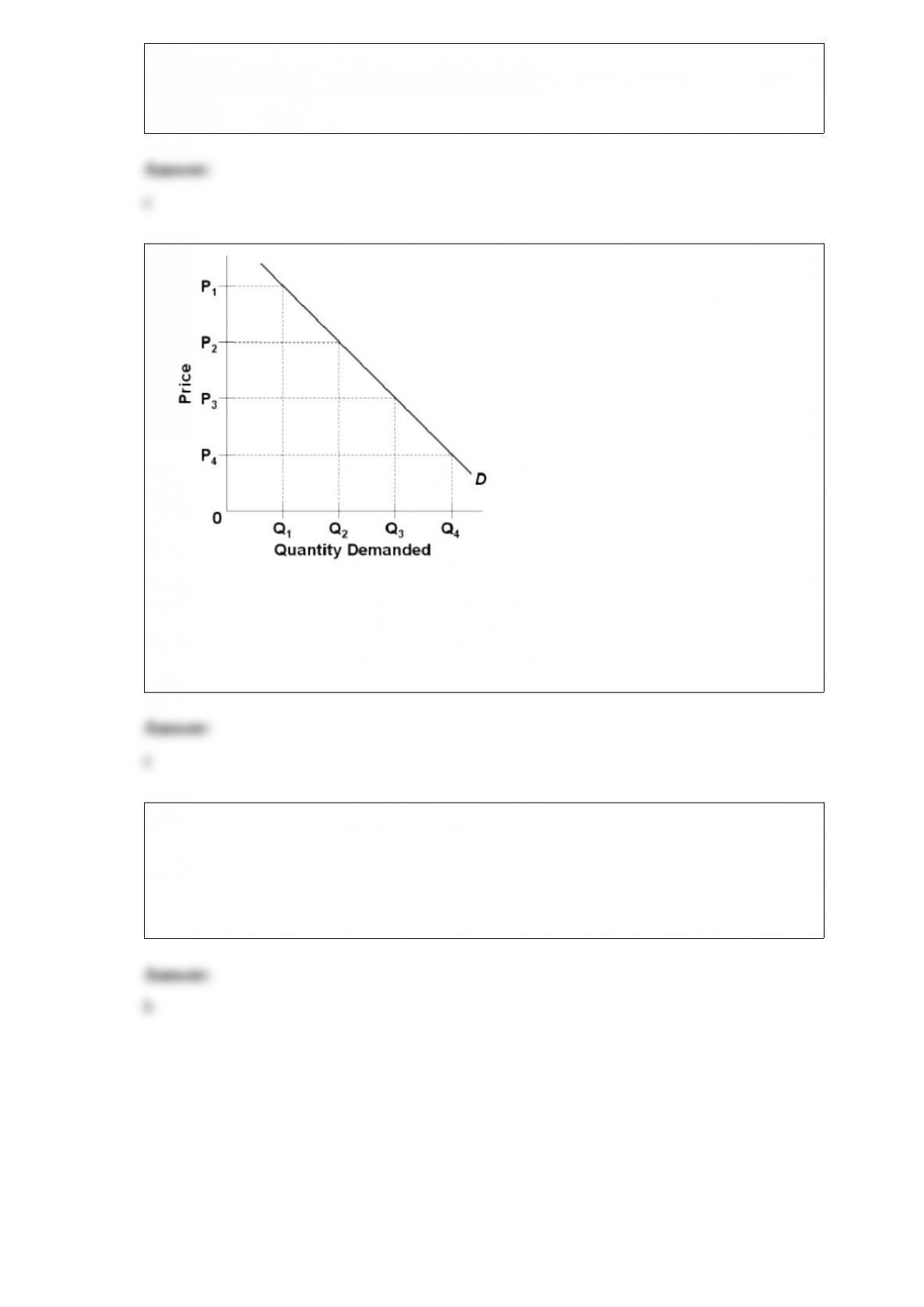
6)
refer to the above diagram. in the p1p2price range demand is:
a.of unit elasticity.
b.relatively inelastic.
c.relatively elastic.
d.perfectly elastic.
7) government purchases and transfer payments:
a.differ because the latter absorb resources while the former do not.
b.differ because the former absorb resources while the latter do not.
c.are alike because both are more inflationary than private spending.
d.are alike because both absorb resources.

8)
Refer to the above diagrams that show identical marginal utility from income curves for
Singer and Catalano. If a given income of $20,000 is initially distributed so that Singer
receives $15,000 and Catalano $5,000, the marginal utility:
A.of the last dollar of income will be greater for Catalano than for Singer.
B.derived from the last dollar will not be comparable as between the two income
receivers.
C.of the last dollar of income will be the same for both Singer and Catalano.
D.of the last dollar of income will be greater for Singer than for Catalano.
9) Suppose the government purposely changes the economy’s standardized budget from
a deficit of 3 percent of real GDP to a surplus of 1 percent of real GDP. The government
is engaging in a(n):
A.expansionary fiscal policy.
B.contractionary fiscal policy.
C.neutral fiscal policy.
D.high-interest rate policy.
10) skeptics of the recent productivity acceleration say that:
a.it is too early to predict whether recent boosts in u.s. productivity are permanent or
transitory.
b.global capitalism is a media fiction, not an economic reality.
c.the growth of service productivity is severely understated.
d. many of the factors that slowed productivity in the 1973-1995 period have now
reversed themselves.
11) By reducing labor turnover, unions may increase productivity because a lower
turnover rate:

A.results in a less-experienced work force.
B.increases the incentive for firms to provide training to their workers.
C.allows firms to employ a greater number of younger, more energetic workers.
D.increases the incentive for firms to substitute labor for capital in the production
process.