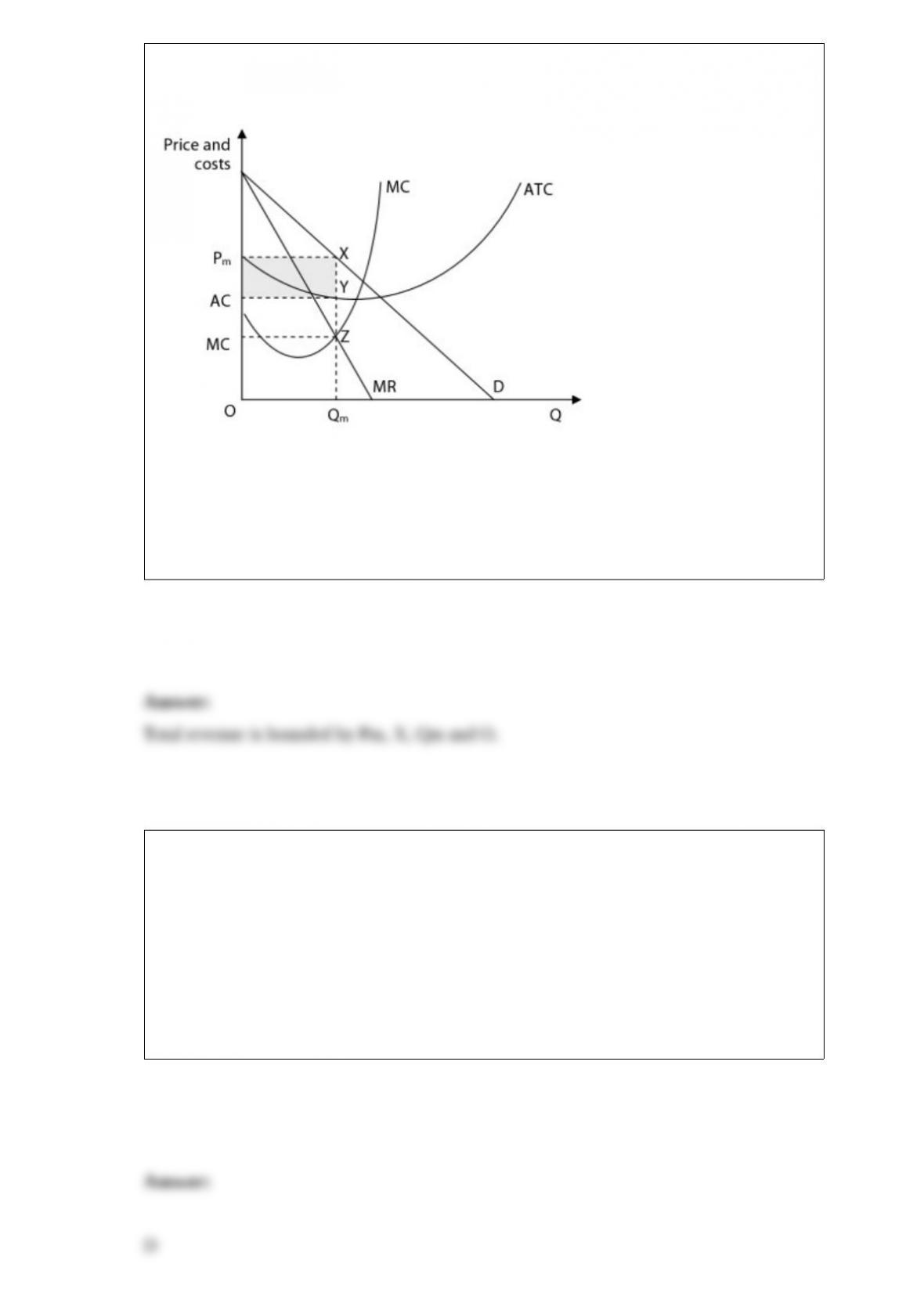
Figure 13.2
Use Figure 13.2 which depicts a monopolist firm to help with the following question.
Define the area of total revenue that this firm will collect if it is maximizing profit. Use
the letters that appear on the graph to identify the area.
Which of the following conditions is NOT necessary for the Coase theorem to apply?
A) The basic rights of the individuals must be clearly understood.
B) There must be no impediments to bargaining.
C) Only a few people can be involved.
D) Liability rules must be established and enforced.

A scientist wants to understand the relationship between automobile emissions and the
level of global warming. The scientist collects data on the volume of automobile
emissions and the levels of global warming over time. The scientist concludes that a 1%
increase in automobile emissions causes a 0.0003% increase in average global
temperatures. From this information he concludes that the automobile emissions are
harmful to the environment and should be reduced to stop the increase in global
temperatures.
The statement, “automobile emissions are harmful to the environment and should be
reduced to stop the increase in global temperatures,” is an example of
A) positive economics.
B) marginal economics.
C) normative economics.
D) the fallacy of composition.
The idea that a dollar in the hand of a rich person is worth less than a dollar in the hand
of a poor person is a consequence of ________ justice.
A) utilitarian
B) social
C) Rawlsian
D) absolute
My neighbor ________ is an example of an external benefit.
A) smoking a cigarette in my presence
B) playing loud music on his radio that I can hear
C) dumping hazardous chemicals on a stream that passes through my property
D) keeping the leaves from his trees away from my yard
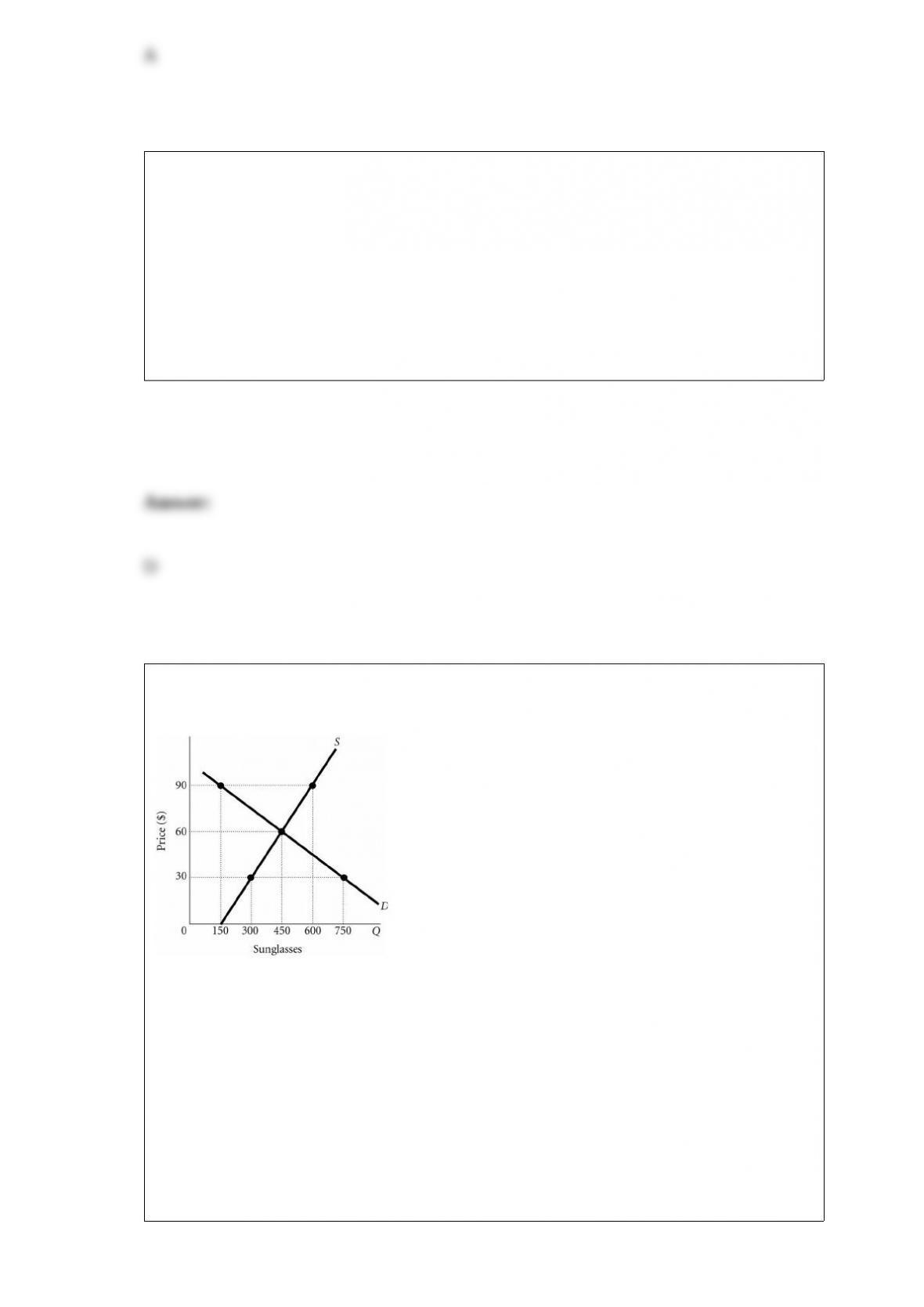
Figure 3.17
Refer to Figure 3.17. At a price of $30, there is an excess
A) demand of 450 sunglasses.
B) demand of 750 sunglasses.
C) demand of 300 sunglasses.
D) supply of 300 sunglasses.

Related to the Economics in Practice on page 717: In Indonesia, children and allies of
President Suharto were affiliated with many companies. When Suharto unexpectedly
fell ill, the stock prices of these companies dropped significantly, suggesting that
A) these companies thrived under President Suharto despite their connection with
Suharto’s allies and relatives.
B) later regimes in Indonesia will be more concerned about economic efficiency and
less corrupt.
C) President Suharto’s removal from power was based not only on illness but also on
concern over corruption.
D) investor opinion of many of these firms was based on their connections with
President Suharto and not the economic efficiency of those companies.
Amy spends $5,000 on remodeling a storefront that she then opens as a take-out deli.
Business has not been very successful, and she needs an additional $1,000 to keep the
deli open. Which of the following is true?
A) The $5,000 Amy spent on remodeling represents a part of the total variable cost of
her business.
B) The $5,000 Amy spent is a fixed cost of her business.
C) The $1,000 represents her marginal costs of production.
D) The $1,000 Amy needs to keep the deli open represents her total fixed costs.

Marginal cost
A) is the increase in total cost resulting from producing one more unit.
B) is the average cost of production divided by output.
C) equals the increase in AVC resulting from producing one more unit.
D) always equals average cost.
You own a house in Malibu, CA. During the recent downturn in the house values in the
area your house’s value declined by $100,000. If you do not sell your home during this
period, your economic income ________ and your taxable income ________.
A) was unchanged; fell
B) fell; was unchanged
C) fell; fell
D) was unchanged; was unchanged

Assume the total product of three workers is 120 and the total product of four workers
is 160. The average product of four workers is ________, and the marginal product of
the fourth worker is ________.
A) 10; 40
B) 30; 10
C) 40; 40
D) 160; 40
Relating to the Economics in Practice on page 377: One of the best predictors of a
young person’s future place in the income distribution is
A) geographic location.
B) gender.
C) the place occupied by his or her parents.
D) the amount of education obtained.

The formula for the marginal revenue product of labor (L is for labor, X is the output) is
A) MPL/PX.
B) PX/MPL.
C) (MPL)(MRX).
D) MPL + PX.
Which of the following statements is NOT correct?
A) Economics is a behavioral science.
B) In large measure, economics is the study of how people make choices.
C) If poverty were eliminated, there would be no reason to study economics.
D) Economic analysis can be used to explain how both individuals and societies make
decisions.
A monopolist ________ to sell more units of output.
A) can increase the price
B) must decrease the price

C) does not have to change the price
D) can set its price wherever it desires
________ relates to the idea that no one has an incentive to maintain collectively owned
property.
A) Collective bargaining
B) The communal-living compact
C) The Communist Manifesto
D) The tragedy of commons
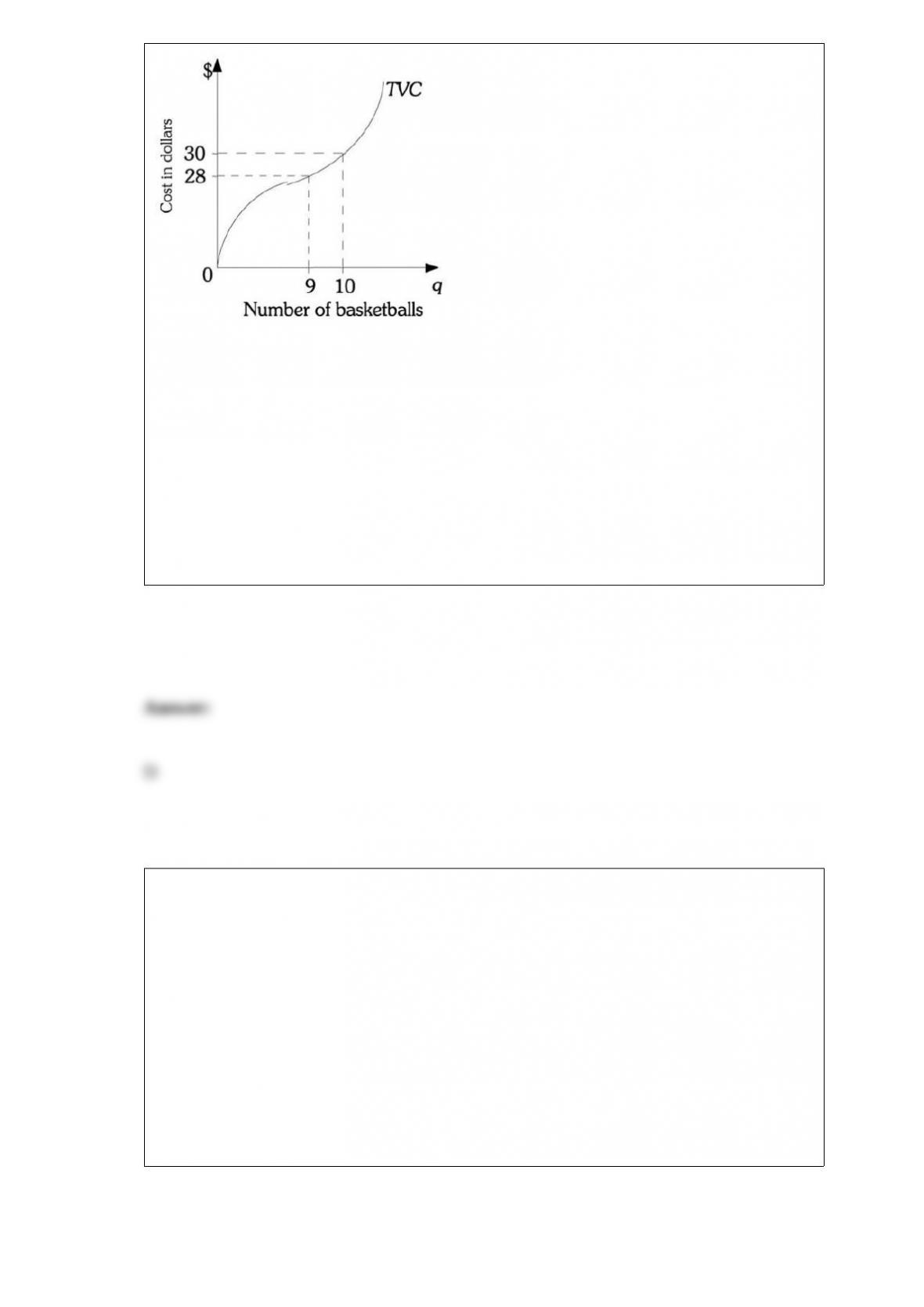
Figure 8.3
Refer to Figure 8.3. The marginal cost of the eleventh basketball is
A) less than $1.
B) $1.
C) $2.
D) greater than $2.
Suppose that the United States and Spain both produce cognac and handbags. In the
United States, cognac sells for $20 a bottle and handbags sell for $80. In Spain, cognac
sells for 30 euros a bottle and handbags sell for 40 euros. Given this information, trade
will flow in both directions if the price of a dollar is between
A) 5 and 2.5 euros.
B) 0 and 3.0 euros.
C) 5 and 0.75 euro.
D) 67 and 2.0 euros.
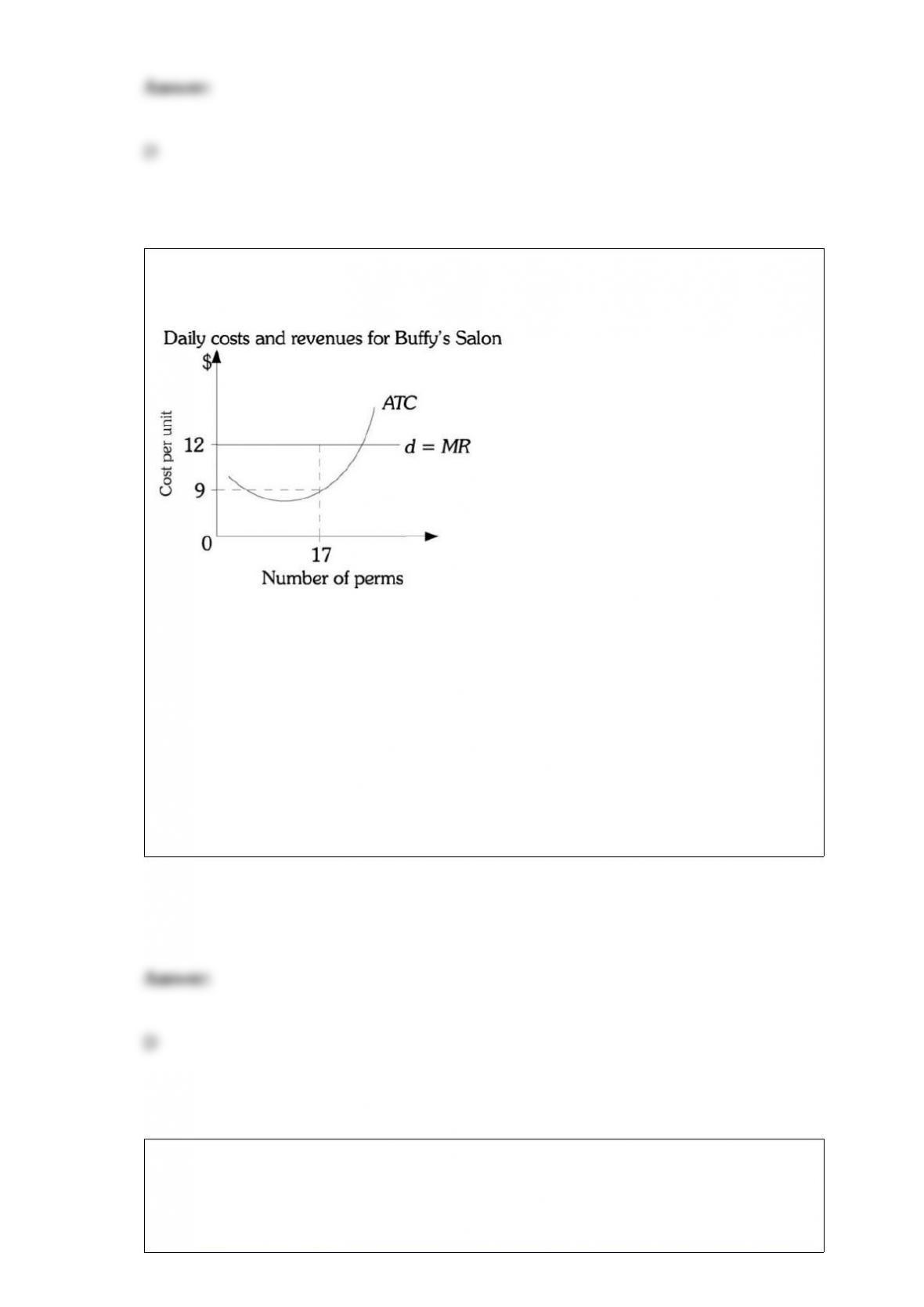
Figure 8.7
Refer to Figure 8.7. If Buffy gives 17 perms per day, her total revenue is
A) $3.
B) $51.
C) $153.
D) $204.
Related to the Economics in Practice on page 241: In terms of value, a majority of the
shares of stock in the United States are held by
A) corporate insiders.

B) foreign governments.
C) households.
D) the U.S. government.
In 2011, the top 10% of households ranked by wealth held about ________ of the
nation’s net worth.
A) 5%
B) 55%
C) 5%
D) 9%
Papayas and grapefruit are substitute goods. A drought in California destroyed a good
portion of the grapefruit crop. Ceteris paribus,
A) the price of both papayas and grapefruit will increase.
B) the price of both papayas and grapefruit will fall.
C) the price of grapefruit will increase, and the price of papayas will fall.

D) the price of grapefruit will fall, and the price of papayas will increase.
A wheat farmer sells wheat in a perfectly competitive market and hires labor in a
perfectly competitive market. The market price of wheat is $2 a bushel, the wage rate is
$10, and the farmer employs five workers. If the farmer is maximizing his profits, then
the marginal product of the fifth worker is ________.
A) 2 bushels
B) 5 bushels
C) 20 bushels
D) indeterminate from the given information.
When the price of oysters decreases 25%, quantity demanded increases 25%. The price
elasticity of demand for oysters is ________, and total revenue from oyster sales will
________.
A) inelastic; increase
B) inelastic; decrease
C) elastic; decrease
D) elastic; increase
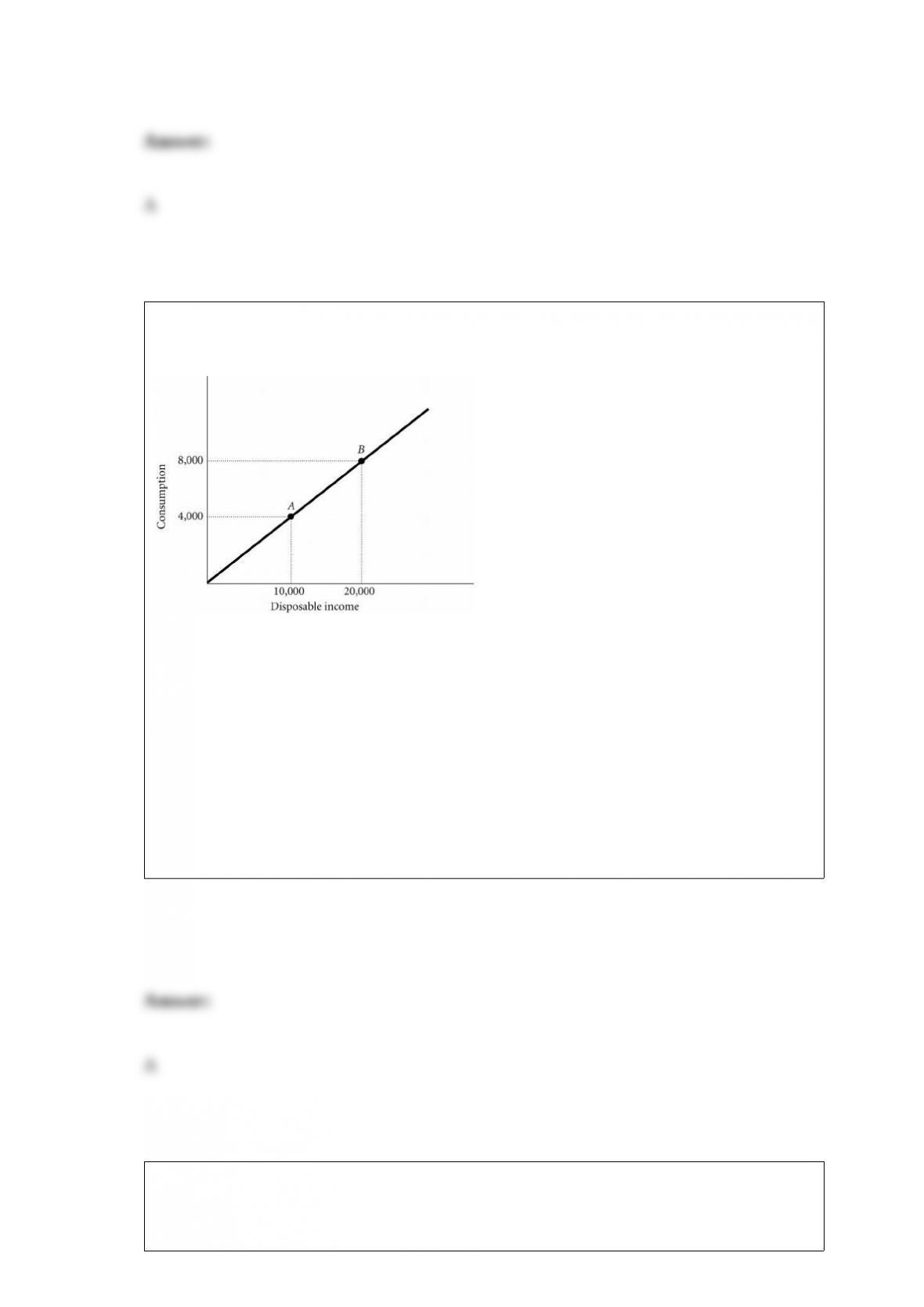
Figure 1.2
Refer to Figure 1.2. The slope of the line between Points A and B is
A) 4.
B) 2.
C) 5.
D) indeterminate from this information.
If you can buy 9 DVDs for $126 or you could buy 10 DVDs for $130, then the marginal
cost of the tenth DVD is:

A) $4.
B) $13.
C) $14.
D) $130.
In 2013, President Obama proposed increasing the minimum wage from $7.25/hr to
$9.00/hr. According to theory, what would likely be the result of such an increase?
A) Some workers would leave the labor market.
B) Firms would hire more workers.
C) All workers prior to the wage increase would now earn at least $9.00 per hour.
D) Unemployment would increase as firms lay off workers.
If a household’s income falls by 10%, its budget constraint will
A) shift out parallel to the old one.
B) pivot at the Y-intercept.
C) shift in parallel to the old one.

D) be unaffected.
Which of the following statements is true?
A) Low productivity in the agricultural sector in developing countries means that farm
output per person is barely sufficient to feed a farmer’s own family.
B) Income tends to be more equally distributed in developing countries than in
developed countries.
C) The percentage of the labor force employed in urban areas is smaller in developed
nations than in developing nations.
D) Developed nations account for only about one-half of the world’s population, but
they consume about three-quarters of the world’s output.
You are in the market for a used 2006 Honda Accord. You know that half of the 2006
Accords are lemons and half are peaches. If you could be assured that the Accord you
were buying was a peach, you would be willing to pay up to $10,000. On the other
hand, you would only be willing to pay $2,000 for a lemon. You have no ability to
discern whether any particular Accord is a lemon or a peach. Sellers of Accords, on the
other hand, are likely to know whether their particular car is a lemon or a peach.
Suppose sellers of lemons will sell their cars for $1,500 or more and peach sellers will
be willing to sell their cars for $8,500 or more. Over time the price in the market for
2006 Accords will ________ and ________ will be traded.
A) be between $8,500 and $10,000 for peaches and between $1,500 and $2,000 for
lemons; both lemons and peaches
B) be between $8,500 and $10,000 ; only peaches
C) be between $1,500 and $2,000 for lemons; only lemons
D) be between $1,500 and $10,000; both lemons and peaches
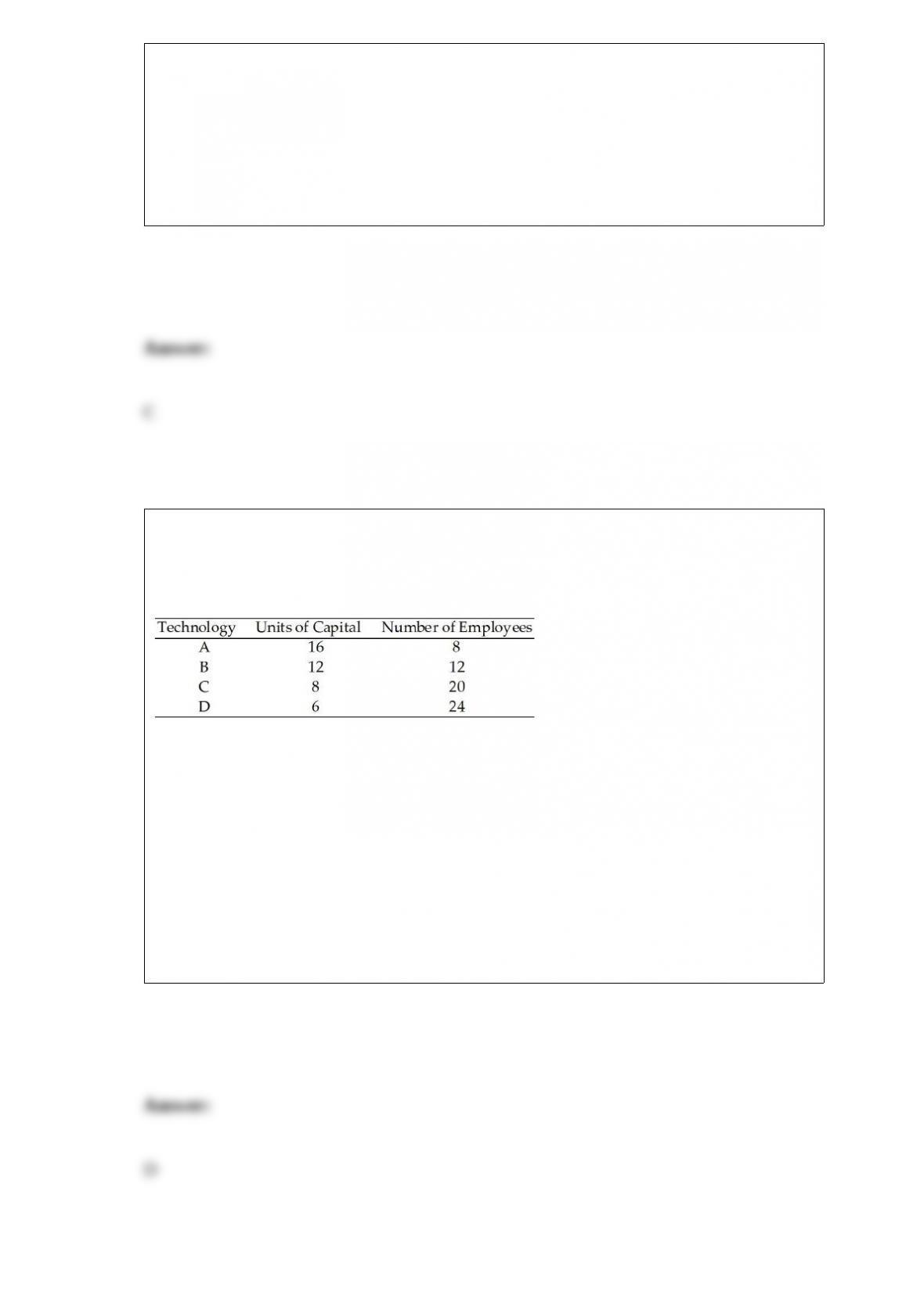
Table 7.2
Inputs Required to Produce a Product Using Alternative Technologies
Refer to Table 7.2. If the hourly wage rate is $10 and the hourly price of capital is $50,
which production technology should be selected?
A) A
B) B
C) C
D) D

When you use your own savings to start a business, you make a profit
A) after the first dollar you earn, because you borrowed no funds to start the business.
B) after you earn an amount equal to the savings you used to start the business.
C) only after you cover the opportunity cost of using your savings to start your
business.
D) only after you earn double the amount of money you invested.
Which of the following is NOT one of the three fundamental concepts of economics?
A) profit maximization
B) marginalism
C) opportunity cost
D) the working of efficient markets
In a ________ economy, the behavior of buyers and sellers determines what gets
produced, how it is produced, and who gets it.
A) command
B) laissez-faire
C) socialist
D) utopian
If all the assumptions of perfect competition hold, the result is an efficient, or Pareto
optimal, allocation of resources. What is necessary to prove this?
The U.S. government has two different methods to deal with illegal drug use. First,
the government has tried a “war on drugs”, with the idea of keeping illegal drugs out of
the country. Second, the “Just say no” campaign has been used to make individuals
more aware of the harmful effects of drugs. Use supply and demand to analyze the
effects of these two separate policies.
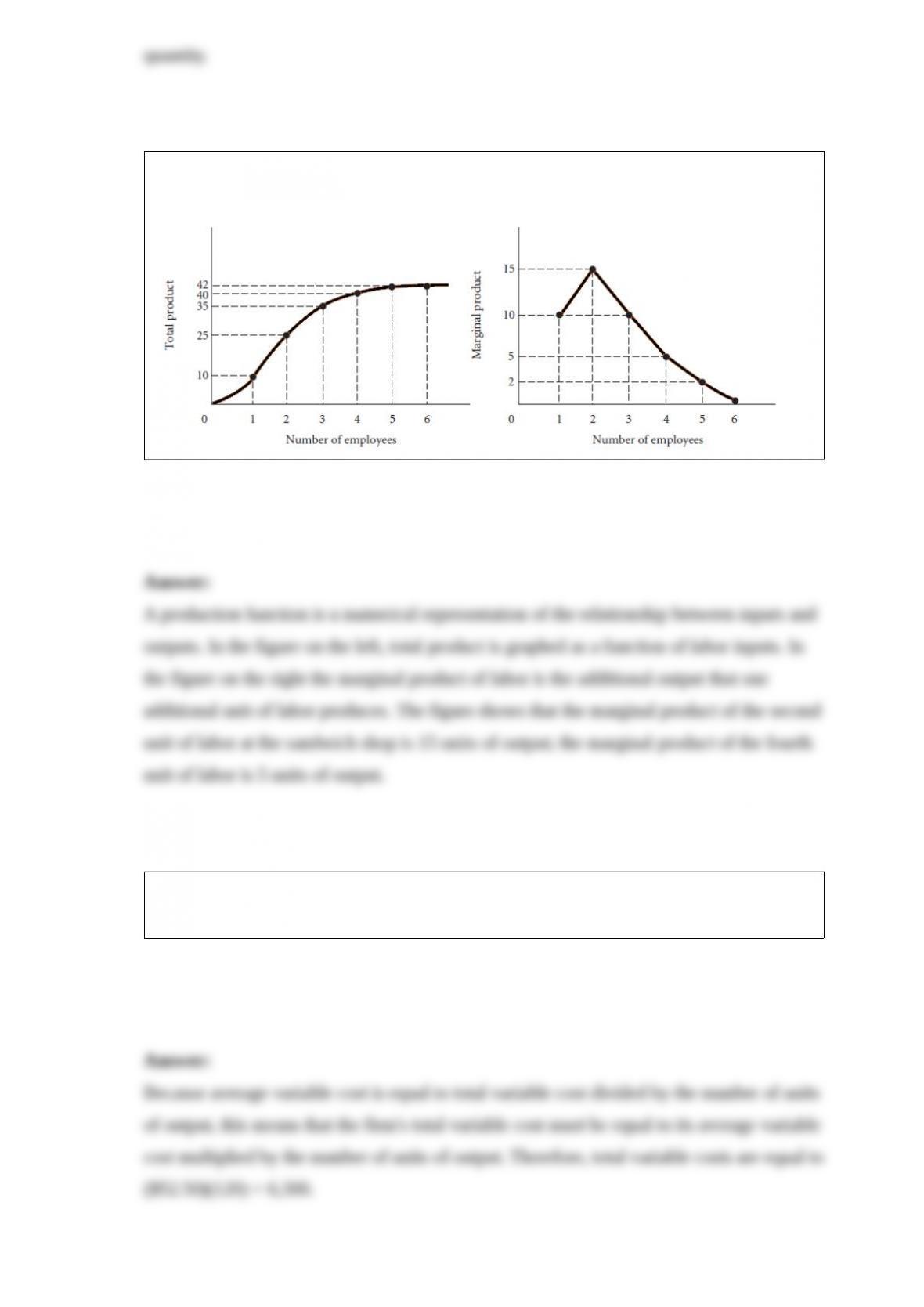
Use the two graphs below to explain the relationship between total product and
marginal product.
Suppose that a firm has an average variable cost of $52.50 when producing 120 units of
output. What is the firm’s total variable cost?
What arguments can be made against product differentiation and advertising?
The following table shows how the unit costs of producing cotton rugs varies with daily
output for a given factory:
Plot the points and trace a curve through them. Describe the relationship between cost
per rug and the number of rugs produced daily.
Consider the market for generic light beer, a product that only has “Light Beer” on its
label. We know that demand for generic light beer falls when income increases, demand
rises when the price of other beer increases, and that demand rises when the price of
potato chips falls.
Graph and explain the effect on equilibrium price and
quantity of beer due to an increase in the price of potato chips. How are the goods
related?
A purely competitive firm is faced with a marginal revenue curve that lies everywhere
below the average variable cost curve. Would this firm be able to operate in the short
run? Explain.
The chief executive officer of a monopoly firm gives a directive to his production
managers to maximize the per unit profit for the upcoming fiscal year. Evaluate the
economic wisdom of this advice.
What condition must be satisfied so that society is producing the efficient mix of
output? Why does this condition guarantee efficiency?
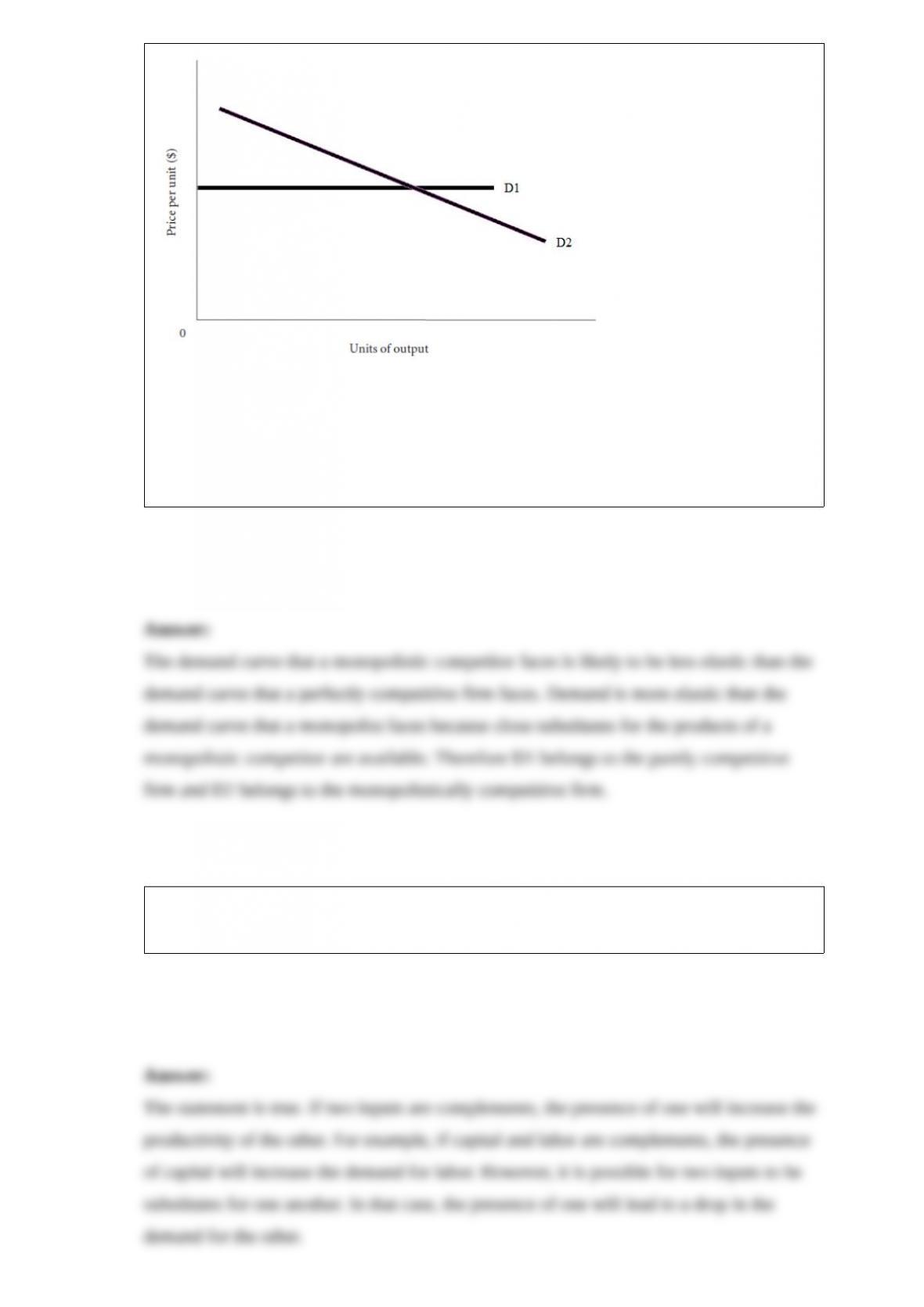
Figure 15.1
Using Figure 15.1, identify which demand curve would belong to that of a purely
competitive firm and which would belong to a monopolistically competitive firm and
explain your reasoning.
Comment on the following statement: “A firm’s demand for labor can be affected by the
availability of other inputs.”
What has been the main argument over recent efforts to replace the personal income tax
with a value-added tax?
Explain what an entrepreneur is and its function.
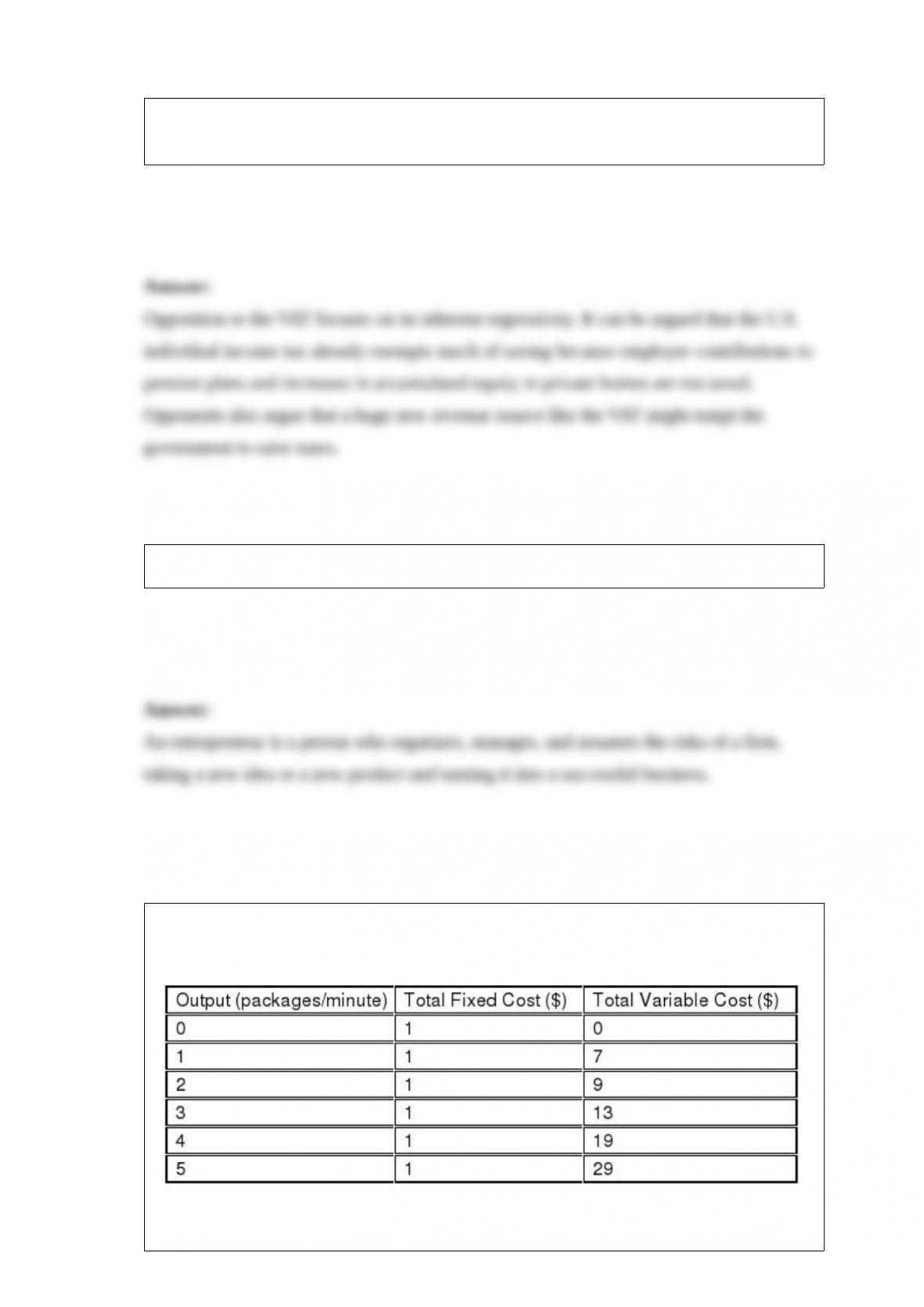
The table below represents cost data for Vester, Incorporated, which sells tennis balls in
a perfectly competitive market for a price of $4 per package:
How many units of the output will this firm produce? How much profit will it earn?
Will the firm choose to operate in the short run? Will the firm choose to operate in the
long run? Explain.
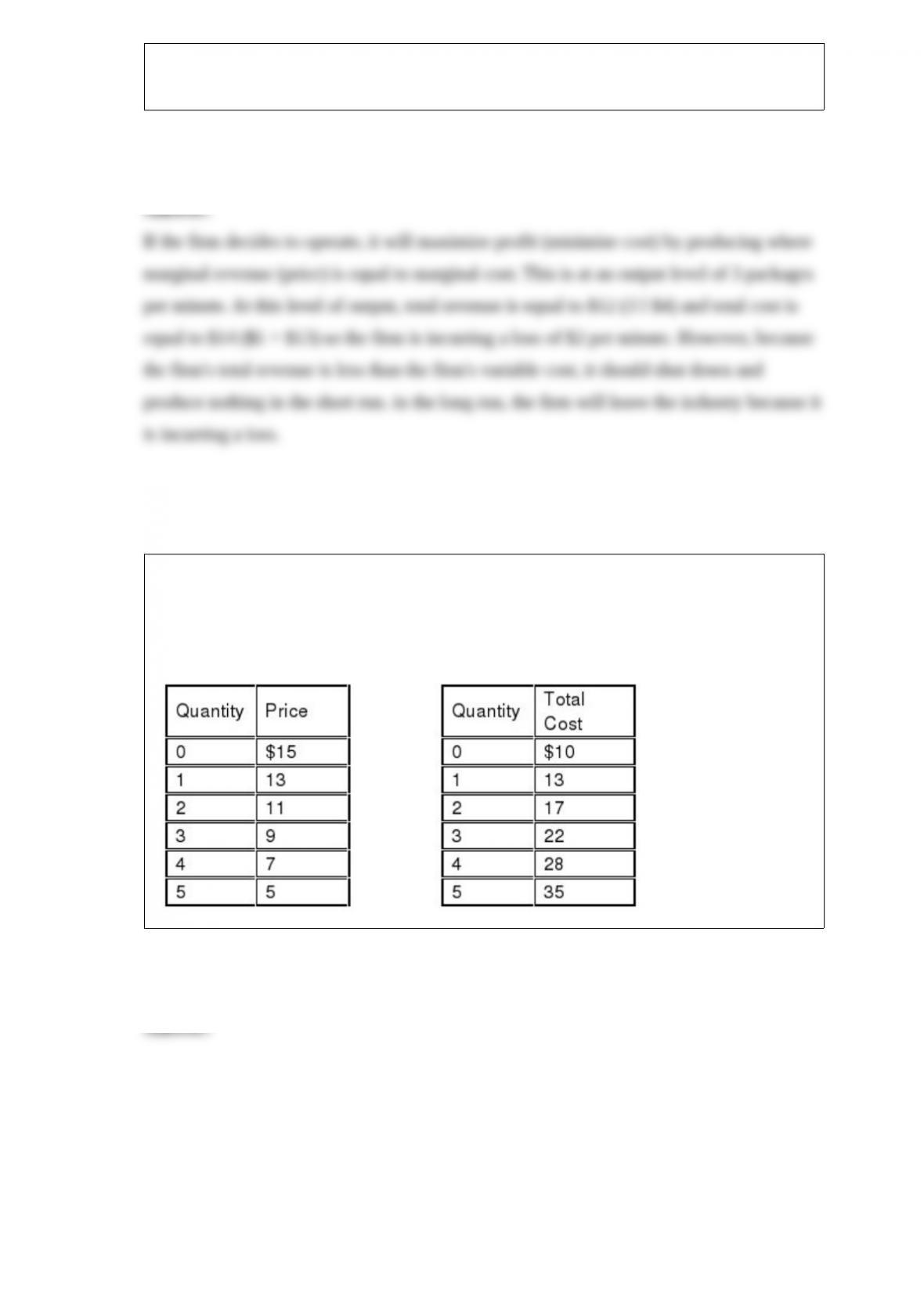
Polly’s Piñatas has a local monopoly in the sale of piñatas. The table below shows the
demand for piñatas at various prices. The total cost of production of the various levels
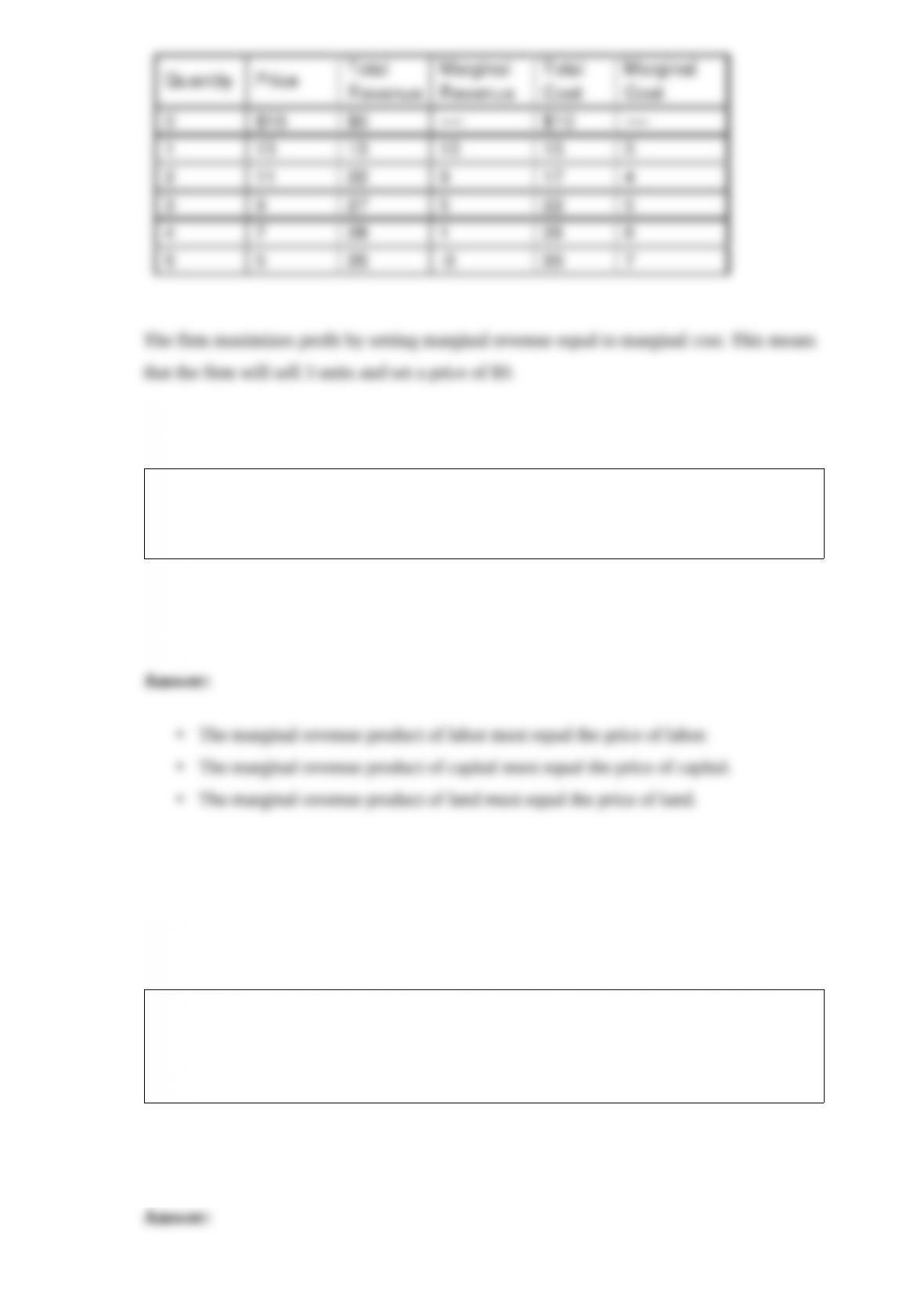
of output is also shown. Calculate marginal revenue and marginal cost for the firm.
What level of output maximizes profit? What price should the firm charge?
XYZ Corporation operates in perfectly competitive input markets and employs labor,
capital, land in its production process. What three conditions must be met for the firm to
be maximizing profit?
Suppose the U.S. economy enters a recession and incomes fall. What will happen to
the equilibrium prices and quantities of normal goods? Would your answer be the same
if you were discussing inferior goods? Why or why not?
Define a tit-for-tat strategy.