Define the following terms and explain their importance to the study of economics:
a. regressive tax
b. proportional tax
c. progressive tax
d. direct tax
e. indirect tax
When it is cheaper for one firm to produce a particular product, ____ exist(s).
a. economies of scale

b. economies of scope
c. diminishing marginal returns
d. cross-subsidization
If you believe that velocity is constant and that the aggregate supply curve is horizontal,
then the quantity theory of money would predict that a doubling of the money supply
would cause a doubling of the
a. price level and real output.
b. price level.
c. price level and no change in real output.
d. real output.
A quota sets the maximum amount of a good that is permitted into a country.
a. True
b. False

A private investment firm that holds a portfolio of securities is called a mutual fund.
a. True
b. False
A corporation is an entity separate and distinct from its owners.
a. True
b. False
The federal government employs more civilians than state and local governments.
a. True
b. False

The long-run supply curve of an industry equals the industry’s
a. long-run marginal cost curve.
b. the horizontal sum of all firms’ supply curves at any point in time.
c. long-run average cost curve.
d. long-run total variable cost curve.
The macroeconomic policy planner’s job is made difficult because of
a. inaccurate multiplier estimates.
b. timing problems.
c. disagreements over potential GDP.
d. uncertain forecasts.
e. All of the above are correct.

The blame for failing to address the budget deficits of the 1980s and early 1990s
a. is clearly the fault of the Republican administrations.
b. is clearly the fault of the Democratic Congresses.
c. is a political question rather than an economic question.
d. is an economic question rather than a political question.
One inconvenience of commodity money is the need for
a. money to be divisible.
b. uniform quality.
c. portability.
d. All of the above are correct.
A change in the aggregate price level moves the economy along a given aggregate
supply curve.
a. True

b. False
How will an increase in price tend to affect demand?
a. Demand will increase.
b. Demand will decrease.
c. Demand will not change.
d. Uncertain.
Comparative advantage is the rule that ordinarily prevents a nation from independently
producing all of the goods it requires.
a. True
b. False
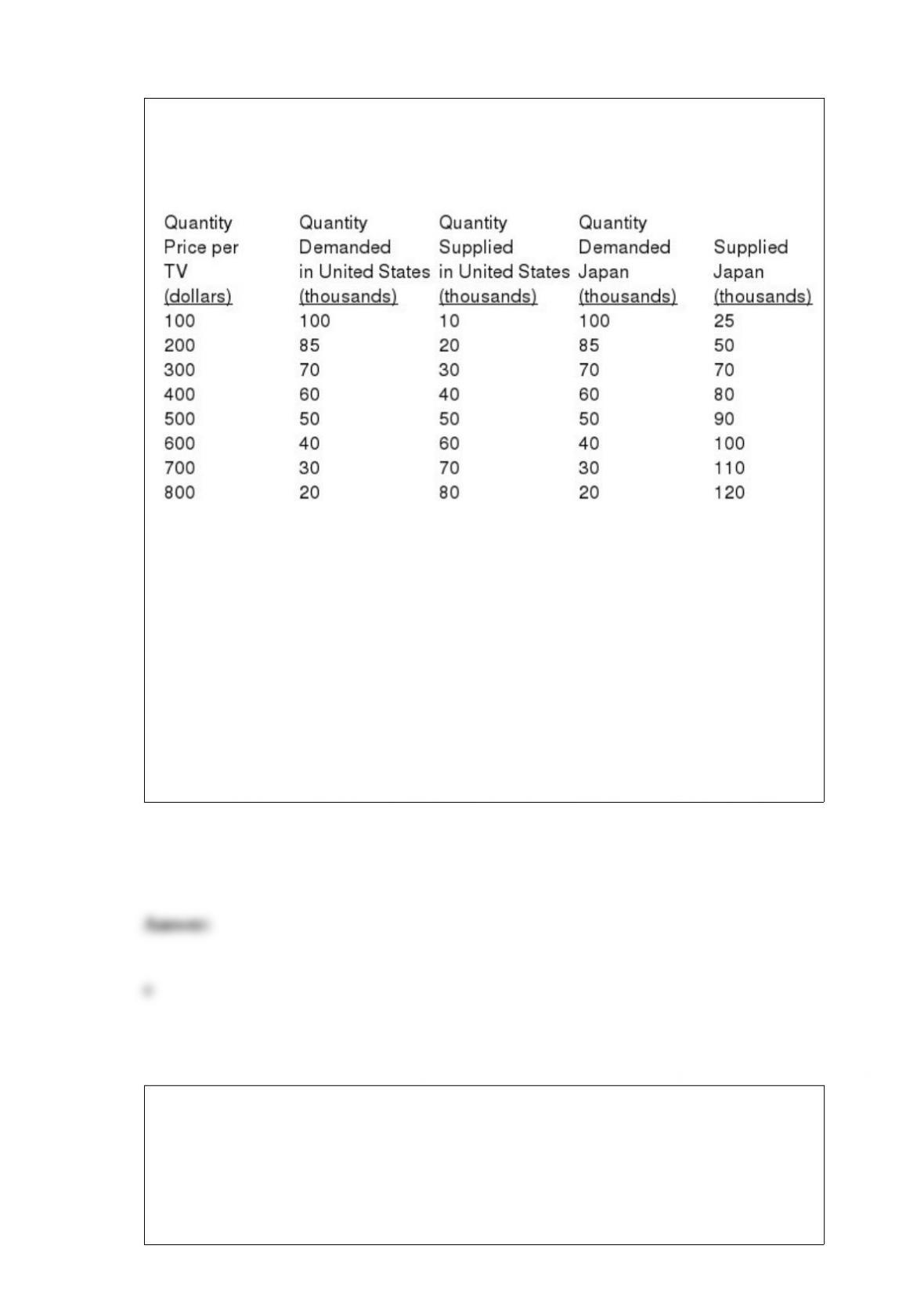
Table 22-4
Table 22-4 presents the demand and supply schedules for television sets in Japan and
the United States. If the United States and Japan trade with each other, what will happen
to the output of television sets in the United States?
a. TV production in the United States will fall by 10,000 units.
b. TV production in the United States will fall by 20,000 units.
c. TV production in the United States will fall by 30,000 units.
d. TV production in the United States will increase by 10,000 units.
In a simplified circular flow model with no government, in equilibrium, S = I + (X −
IM).
a. True
b. False

In general, as the amount of labor input increases, the amount of output
a. increases.
b. decreases.
c. remains constant.
d. increases only if the capital stock also increases.
The principal result of the rising value of the U.S. dollar in the mid-1990s was the
a. lower foreign inflation.
b. lower U.S. interest rates.
c. opportunities for currency speculation.
d. attractive investments in U.S. technology.

The inflationary gap is the
a. inflation rate that will occur from excess aggregate demand.
b. budget deficit that caused the inflation to occur.
c. distance between the equilibrium level of output and the full employment level of
output.
d. gap between expected and actual inflation.
A firm earns a profit of exactly zero at its optimal output level only if
a. P = MR.
b. P = MC.
c. P = AC.
d. P = SR AVC.
The reason that stagflation tends to follow an inflationary gap is that
a. output tends to fall even as prices continue to rise as part of the self-correcting
mechanism.

b. government officials tend to overact in controlling inflation.
c. businesses try to increase profits by raising prices and increasing output.
d. workers accept pay cuts to maintain employment.
The price elasticity of demand for an exhaustible natural resource tends to
a. fall over time because extraction costs rise over time.
b. stay constant over time because the resource’s price rises at a constant rate.
c. rise over time because the resource’s rising price stimulates conservation and the
development of substitutes.
d. rise over time because resource extraction tends to become more efficient over time.
With no change in fiscal policy, the budget
a. will run a surplus during a recession and a deficit during a boom.
b. deficit will rise during a recession and fall during a boom.
c. deficit will fall during a recession and rise during a boom.
d. will remain unchanged by adverse economic conditions.

The price system rations goods among consumers in such a way that
a. all are treated equally.
b. all needs are satisfied.
c. the rich are favored.
d. important needs are satisfied first.
Japanese Prime Minister Ryutaro Hashimoto was called the “Herbert Hoover of Japan”
because he
a. looked like a very distinguished politician.
b. advocated vast public works to combat unemployment.
c. advocated budget deficit reduction in the midst of a recession.
d. advocated easier monetary policy and lower interest rates to combat recession.
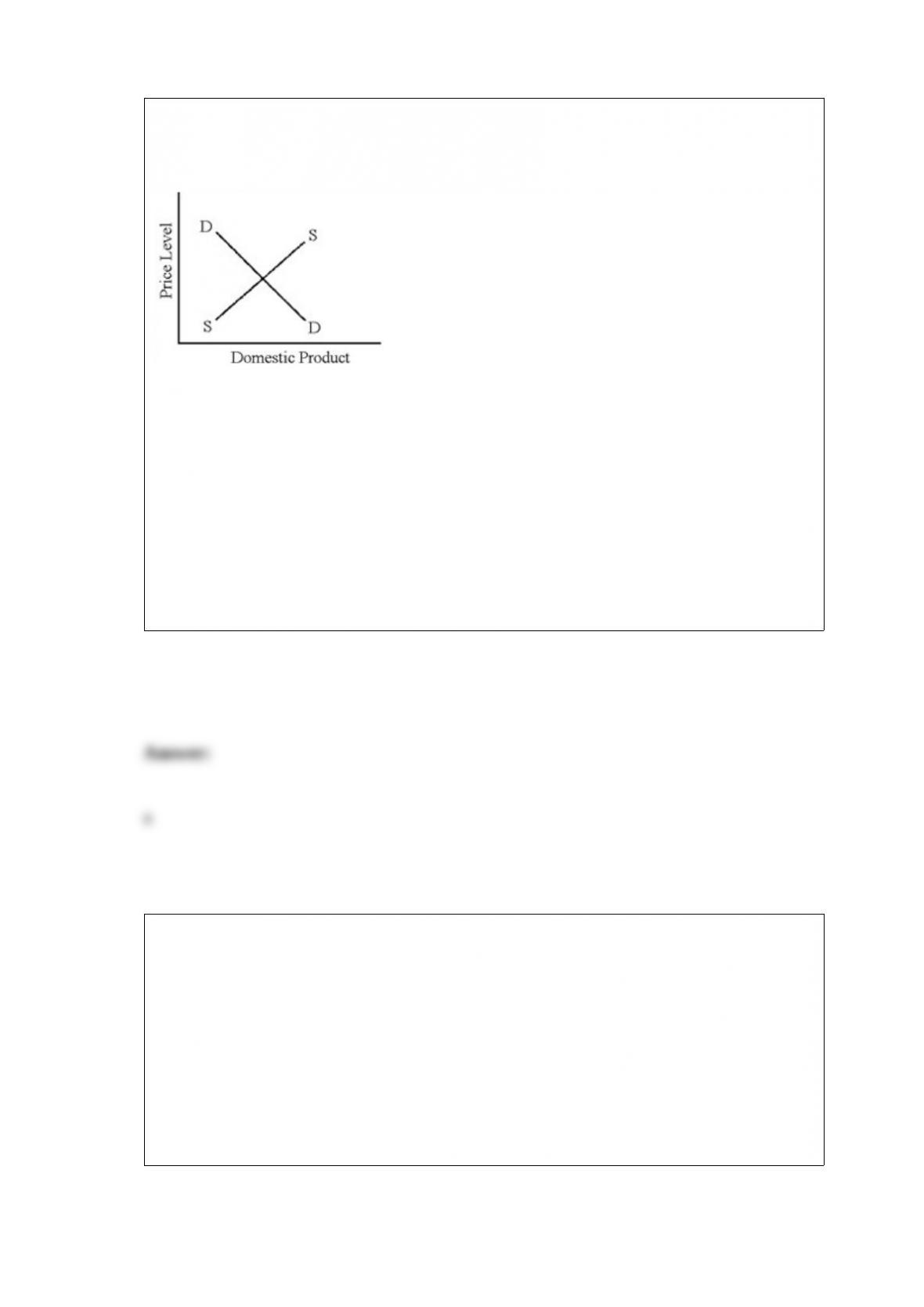
Figure 5-2
In Figure 5-2, if the aggregate demand curve shifts outward over time, the economy
will
a. experience inflation.
b. see a sustained decrease in the price level.
c. experience a significant decrease in unemployment.
d. experience economic recession.
The government considers a market to be unconcentrated if its HHI number is less than
____, and highly concentrated if that number exceeds ____.
a. 1,000; 1,800
b. 100; 9,000
c. 50; 500
d. 500; 1,300
Which of the following is included in M1?
a. savings accounts
b. money market deposit accounts
c. money market mutual funds
d. travelers’ checks
e. None of the above are included.
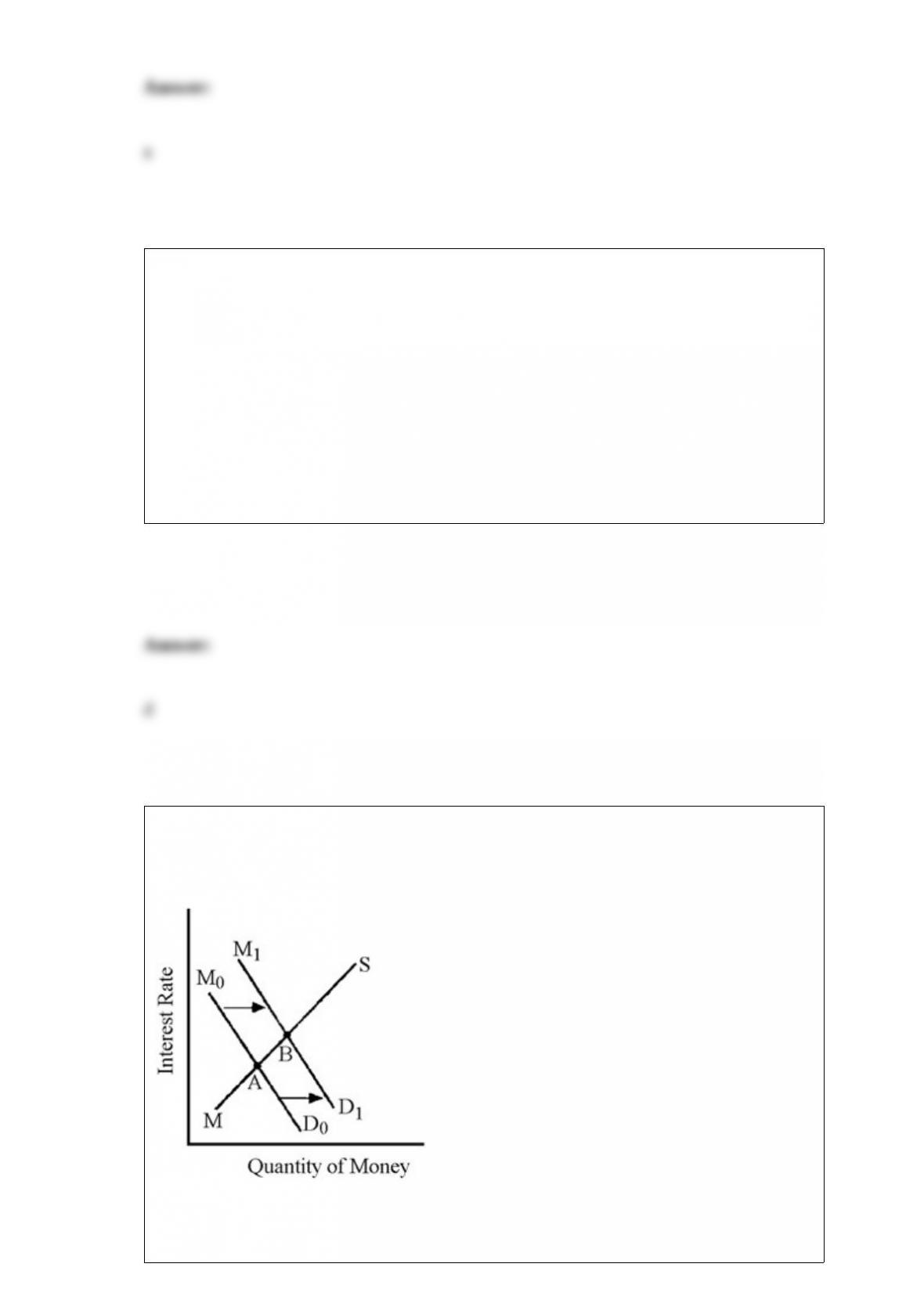
Figure 16-3
Figure 16-3 shows the impact of deficit spending and the corresponding economic
expansion on the demand curve for money. If the Federal Reserve does not want

interest rates to rise, it will
a. shift the money supply curve to the right by monetizing the deficit.
b. shift the money supply curve to the left by open market sales of government
securities.
c. maintain the current targets for both M1 and M2 money stocks.
d. engage in contractionary monetary policy, such as increases in the discount rate.
There is statistical evidence that managers’ salaries are tied most closely to
a. profits at the profit-maximizing output.
b. sales volume.
c. cost per unit at minimum-cost output.
d. the closeness of output to the point where MR = MC.
Which of the following statements is correct?
a. from the bank’s point of view, loans to customers are assets of the bank
b. from the bank’s point of view, loans to customers are liabilities of the bank
c. from the customer’s point of view, loans to customers are assets of the customer
d. from the customer’s point of view, loans to customers are liabilities of the customer
e. a and b only
f. a and d only
In Figure 5-1 from the text, if the price of pizzas is $8:
a. how many pizzas will the consumer purchase?
b. what is the payment for the optimal number of pizzas?
c. how much consumer surplus will the consumer receive?
A rise in interest rates tends to contract the economy by appreciating the currency and
reducing net exports. Provide the reasoning behind this conclusion.
How is the unemployment rate calculated? Describe the three principal types of
unemployment.
How long is the long run?
Electric utilities have trumpeted nuclear power for years, advocating it as lower in
production costs than other alternatives. Yet, society has resisted heavy reliance on
nuclear power. Explain the source of the disagreement and suggest which side (utilities
or society) is correct.
What is marginal analysis?
What is the relationship between the long-run industry supply curve and the short-run
supply curve in a perfectly competitive market?
Why does the aggregate demand curve slope downward?
What are the factors that contribute to productivity growth in the market economy and
which of them is considered most important?
Some economists argue that there is no such thing as a short-run Phillips curve. Who
are these economists and what is their argument?
American producers often complain about dumping. What is dumping, and should it be
prohibited?
Describe three arguments of why some economists object to the predictions of the
rational expectations theory and do not subscribe to the conclusions of this approach.
What you mean by business cycles? What are their consequences?
Explain why environmental damage would be classified as an externality.
The declared purpose of antitrust policy is to promote competition, yet some would say
it actually may prevent competition. Explain the two sides of the debate.
Why are bonds risky to a corporation?
What are the reasons for preferring competition to monopoly?
Is it likely that oligopolistic firms will be in both a kinked demand curve situation and
also engage in price leadership? Why or why not?