
Of the following high-income countries, which has the highest infant mortality rate?
A) Canada
B) Japan
C) the United Kingdom
D) the United States
If a firm has an incentive to increase supply now and decrease supply in the future, the
firm expects that the
A) price of its product will be lower in the future than it is today.
B) price of its product will be higher in the future than it is today.
C) price of inputs will be lower in the future than they are today.
D) demand for the product will be lower in the future than it is today.
Gross domestic product is calculated by summing up
A) the total quantity of goods and services in the economy.
B) the total quantity of goods and services produced in the economy during a period of
time.
C) the total market value of goods and services in the economy.
D) the total market value of final goods and services produced in the economy during a
period of time.
Employees at the university have negotiated a 5 percent increase in wages for the next
year, based on their inflation expectations. If inflation is actually 6 percent over the next
year, which of the following will occur?
A) Unemployment of university employees will rise.
B) Real wages for university employees will fall.
C) Inflation will be 5 percent the following year.
D) The increase in inflation is expected.
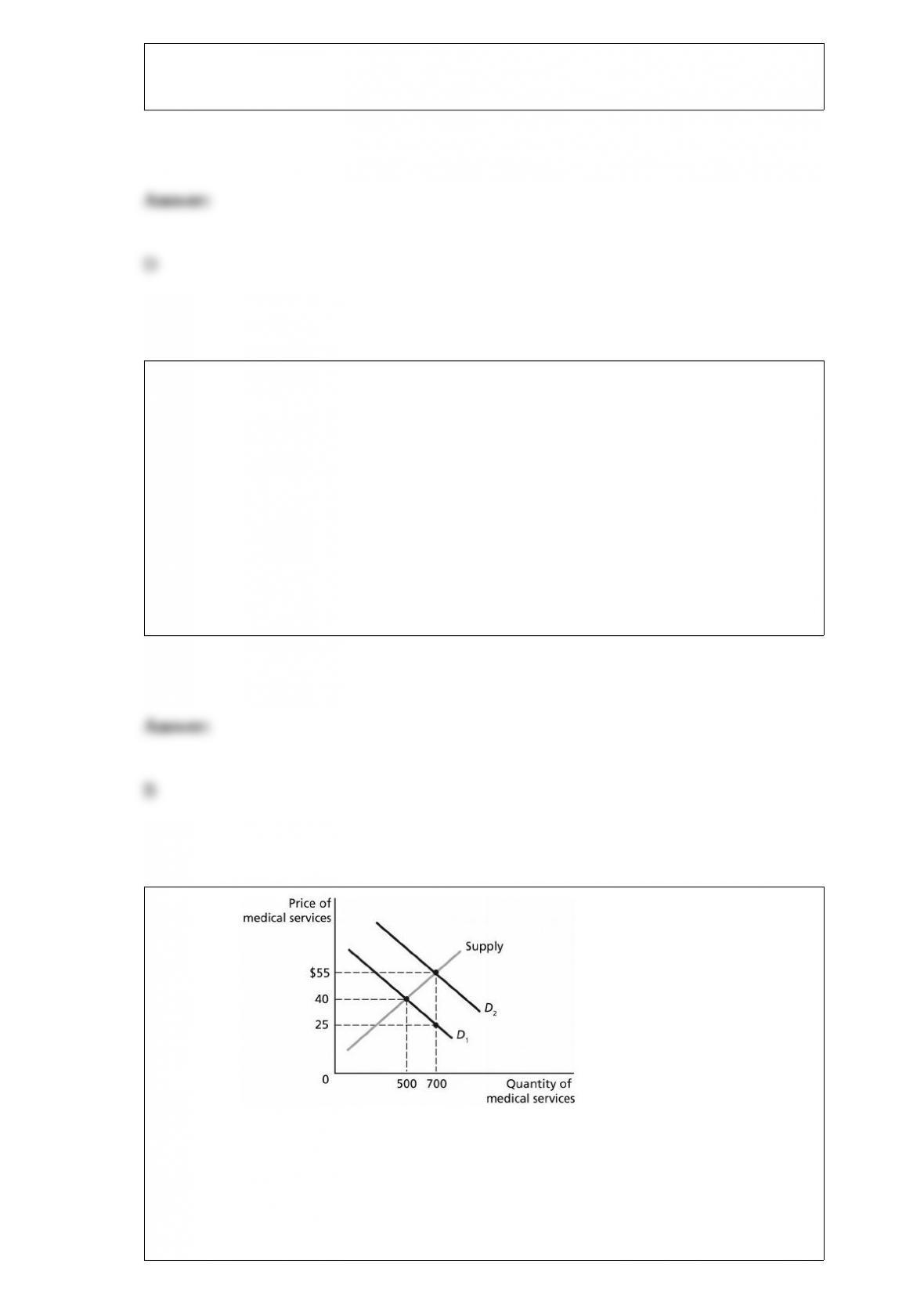
Figure 7-4 Figure 7-4 represents the
market for medical services with and without insurance, and the effect of a third-party
payer system on the demand for medical services.
With insurance and a third-party payer system, the equilibrium quantity of medical
services is

A) 200.
B) 500.
C) 700.
D) >700.
The circular flow model demonstrates
A) the role of the government in overseeing the market system.
B) the roles played by households and firms in the market system.
C) how shortages and surpluses are eliminated in a market.
D) how demand and supply for goods and services are brought into equilibrium.
If the cross-price elasticity of demand between Breeze Detergent and Faber Detergent is
a relatively large positive number, then it indicates that
A) the two brands are probably made by the same company.
B) the two brands of detergent are close substitutes.
C) consumers have a distinct preference for one brand versus the other.
D) detergents are necessities.
There is often a trade-off between
A) productive efficiency and allocative efficiency.
B) limited and unlimited resources.
C) voluntary and involuntary exchanges.
D) economic efficiency and economic equity.
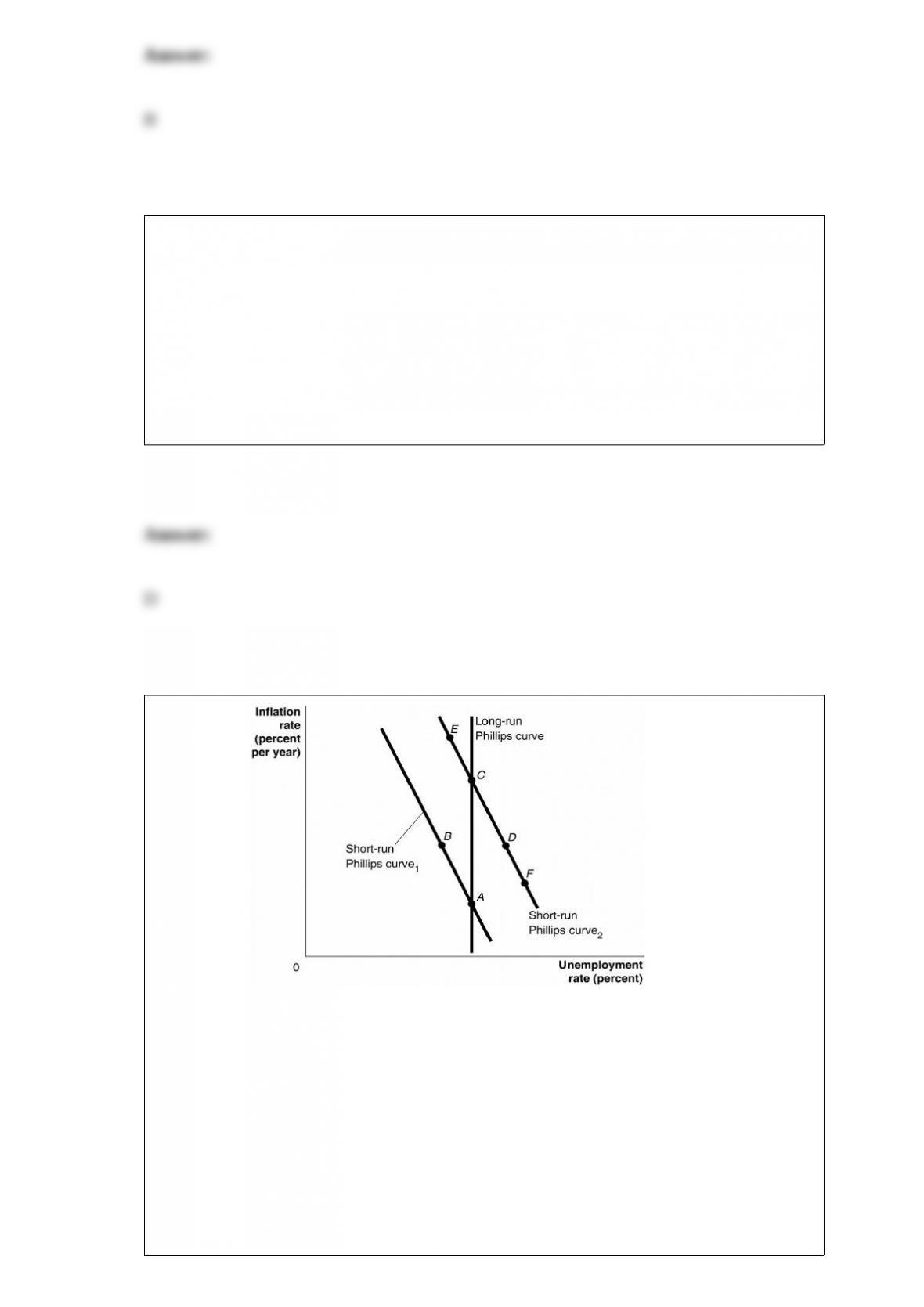
Figure 17-9
Fed Chairman Paul Volcker’s response to high inflation of the late 1970s is depicted in
the figure above as a movement from
A) A to D to C.
B) C to B to A.
C) C to D to A.
D) C to E to B.
E) A to B to C.
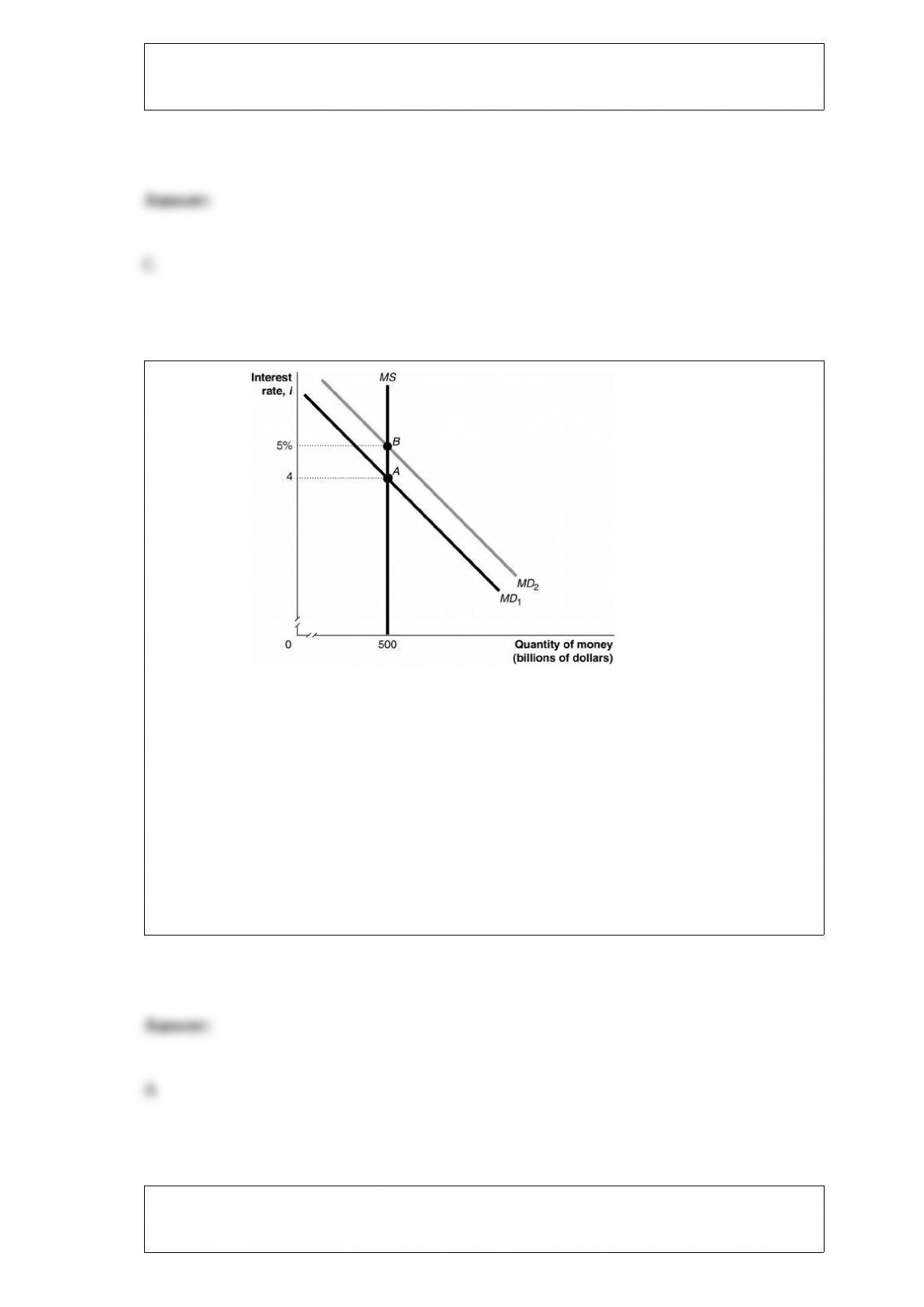
Figure 15-5
In the figure above, the movement from point A to point B in the money market would
be caused by
A) an increase in the price level.
B) a decrease in real GDP.
C) an open market sale of Treasury securities by the Federal Reserve.
D) an increase in the required reserve ratio by the Federal Reserve.
Suppose the working-age population of a fictional economy falls into the following
categories: 90 are retired or homemakers; 60 have full-time employment; 20 have

part-time employment; 20 do not have employment, but are actively looking for
employment; and 10 would like employment but do not have employment and are not
actively looking for employment. The official unemployment rate as calculated by the
U.S. Bureau of Labor would equal
A) (20/60) 100.
B) (20/80) 100.
C) (30/80) 100.
D) (20/100) 100.
Borrowing to pay for long-lived capital expenditures makes sense as
A) the benefits are received in the current year so the burden of paying for them should
be spread over many years.
B) the benefits are received over many years so the burden of paying for them should
be spread over many years.
C) the benefits are received in the current year so the burden of paying for them should
be paid in the current year.
D) the benefits are received over many years so the burden of paying for them should
be paid in the current year.
In the United States in 2012, the percentage of firms that employed between 3 and 199
workers and offered health insurance as a fringe benefit to the workers was about
A) 29%.
B) 42%.
C) 61%.
D) 98%.
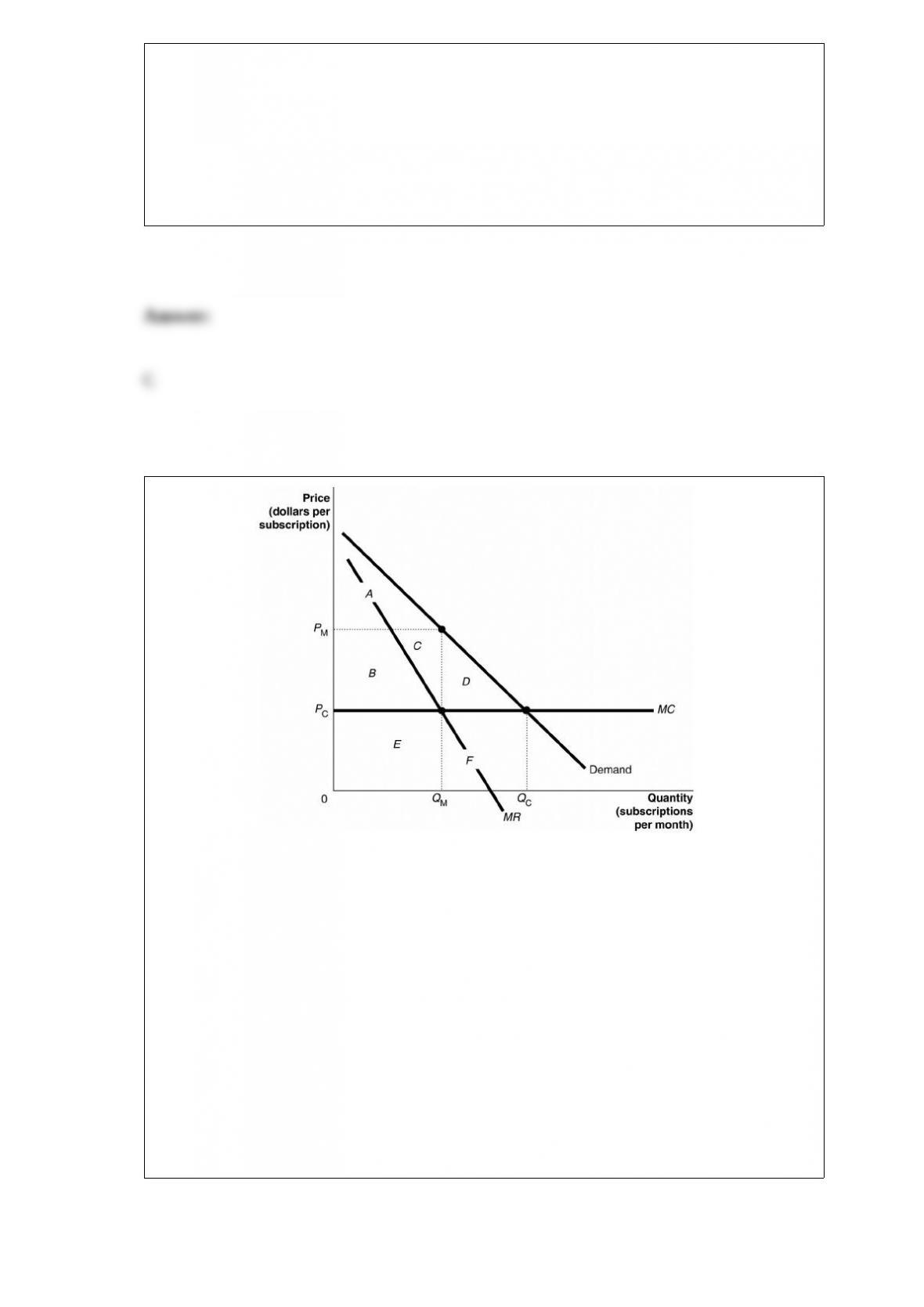
Figure 15-11 In 2011,
Verizon was granted permission to enter the market for cable TV in Upstate New York,
ending the virtual monopoly that Time Warner Cable had in most local communities in
the region. Figure 15-11 shows the cable television market in Upstate New York.
Following the entry of Verizon, the subscription price falls from PM to PC. What is the
increase in consumer surplus as a result of this change?
A) the area A + B + C
B) the area B + C
C) the area D + F
D) the area B + C + D