1) suppose that an economy’s labor productivity and total worker-hours each grew by 4
percent between year 1 and year 2. we could conclude that this economy’s:
a.real gdp also increased by 4 percent.
b.real gdp remained constant.
c.production possibilities curve shifted outward.
d. capital stock increased by 4 percent.
2)
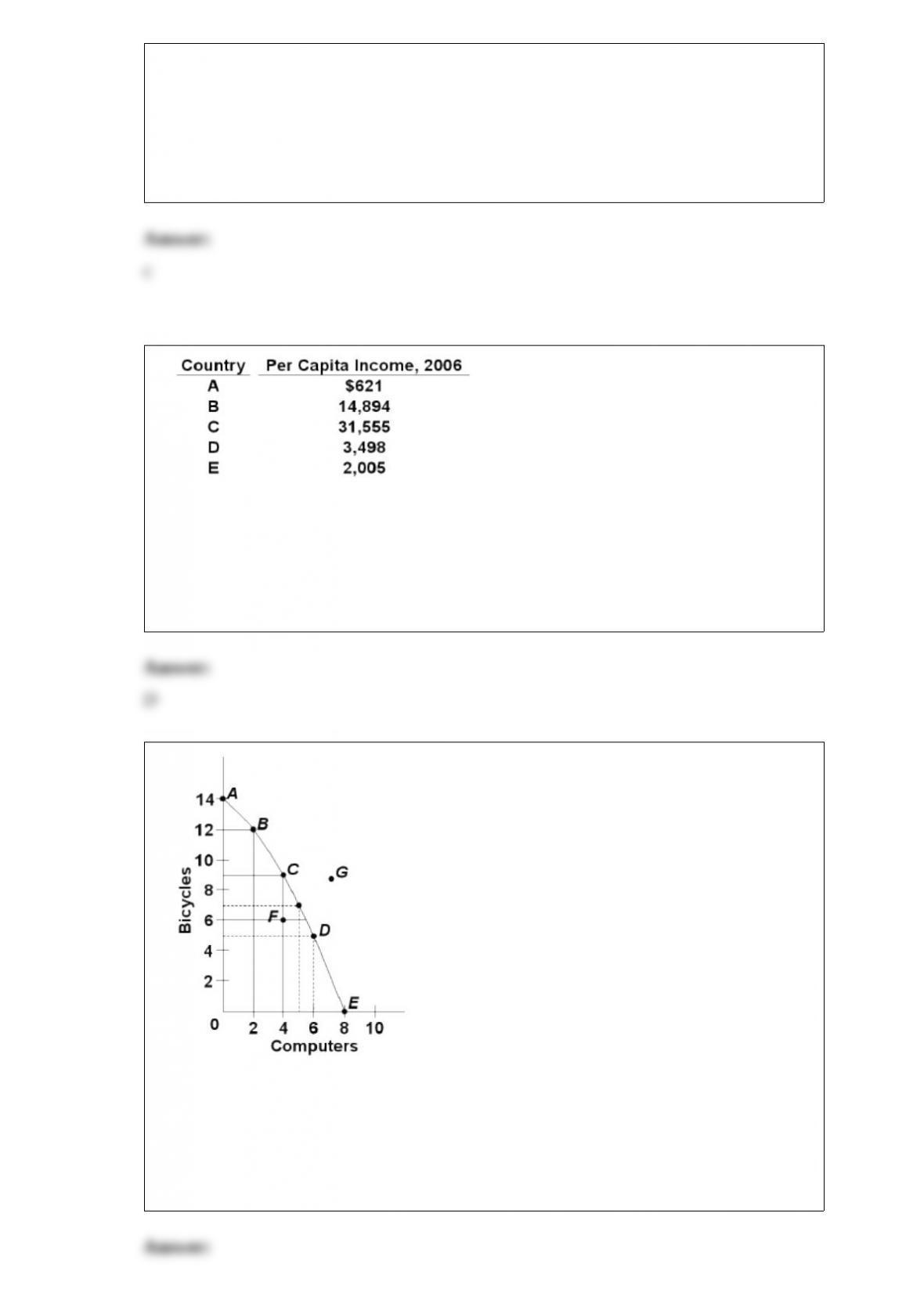
Which of the above nations would be high-income countries (IACs), according to the
World Bank?
A.country C only
B.countries B, C, and D
C.countries B, C, D, and E
D.countries B and C
3)
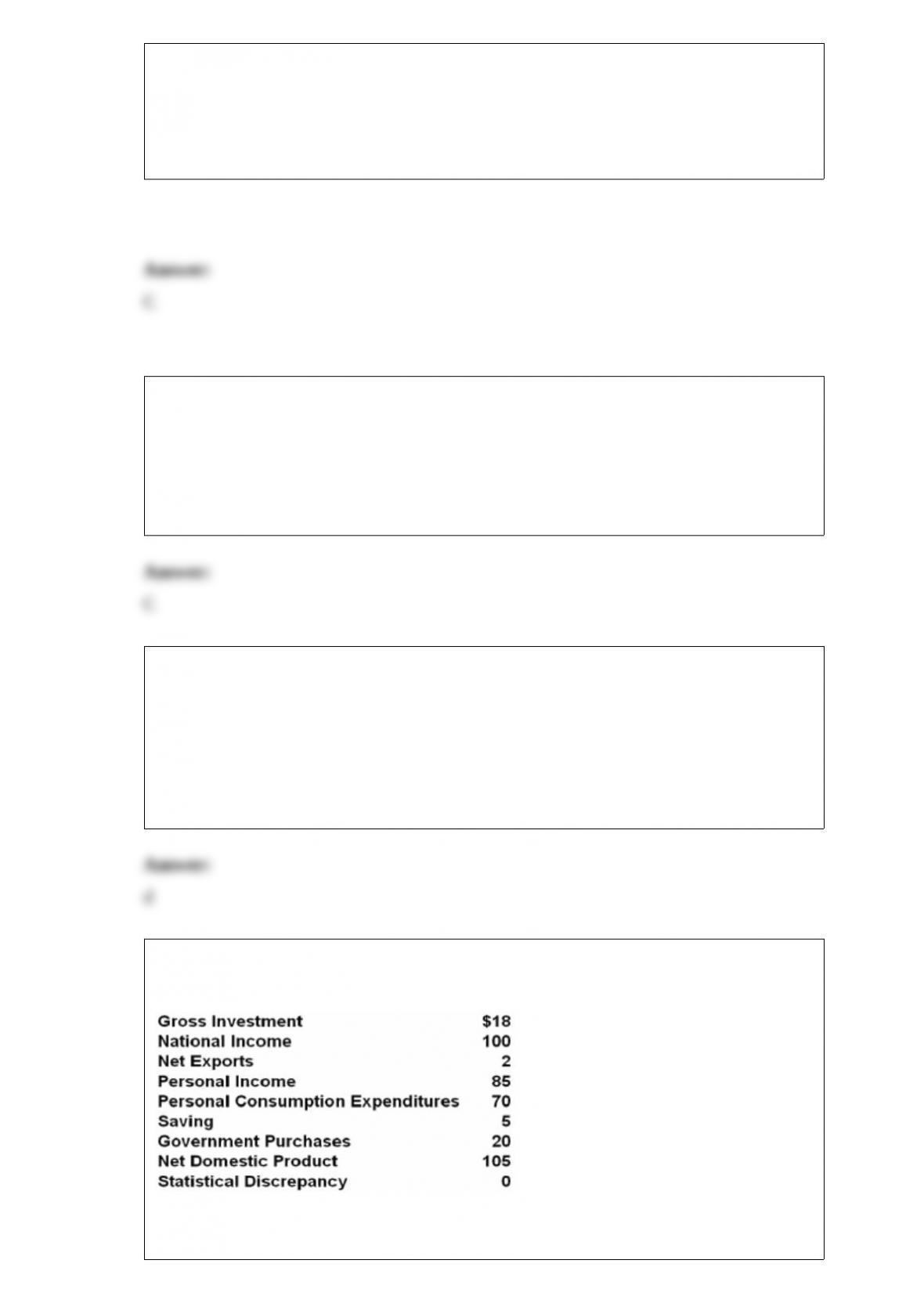
refer to the above diagram. the combination of computers and bicycles shown by point
g is:
a.attainable, but too costly.
b.unattainable, given currently available resources and technology.
c.attainable, but involves unemployment.
d.irrelevant because it is inconsistent with consumer preferences.

4) Entrepreneurs:
A.work exclusively in government and university R&D laboratories.
B.often form small companies called start-ups.
C.are less likely to exist in service industries than in manufacturing industries.
D.are engaged mainly in basic scientific research.
5) a caller to a radio talk show states that oil companies are “greedy price gougers.” this
is an example of:
a.loaded terminology.
b.the “after this, therefore because of this fallacy.”
c.the fallacy of composition.
d.the economic perspective.
6) Suppose the demand for money and the supply of money increase simultaneously.
We can:
A.expect the interest rate to rise and bond prices to fall.
B.expect the interest rate to fall and bond prices to rise.
C.the nominal GDP to expand.
D. not predict what will happen to interest rates or bond prices.
7) Gomez argues that we need to increase the nation’s output. Chang contends that our
top priority should be a more equal distribution of income and output. It can be
correctly stated that these two goals are:
A.essentially unrelated.
B.complementary because the realization of one will promote fulfillment of the other.
C.at least partially competing because the redistribution of income might impair
incentives to work and produce.
D.complementary because a more equal distribution of income always promotes
economic growth.
8)
Forestry companies typically harvest and replant an area when trees are:
A.very young and growing slowly.
B.middle aged and growing rapidly.
C.near the end of their rapid growth period.
D.extremely old and about to die anyway.
9) In the DVCs underemployment frequently takes the form of:
A.factory workers who are working longer hours than they would prefer.
B.workers who are employed inefficiently in small industry when they could be highly
productive in agriculture.
C.farmers whose productivity is very low.
D.craftsworkers and artisans who are replaced by simple machinery and equipment.
10) in 2007, trailblazer bicycle company produced a mountain bike that was delivered
to a retail outlet in november of 2007. the bicycle was sold to e.z. ryder in march of
2008. this bicycle is counted as:
a.consumption in 2007 and as disinvestment in 2008.
b.disinvestment in 2007 and as consumption in 2008.
c.disinvestment in 2007 and as investment in 2008.
d.investment in 2007 and as disinvestment in 2008.
11) answer the next question(s) on the basis of the following data. all figures are in
billions of dollars.
refer to the above data. disposable income is:
a.$83.
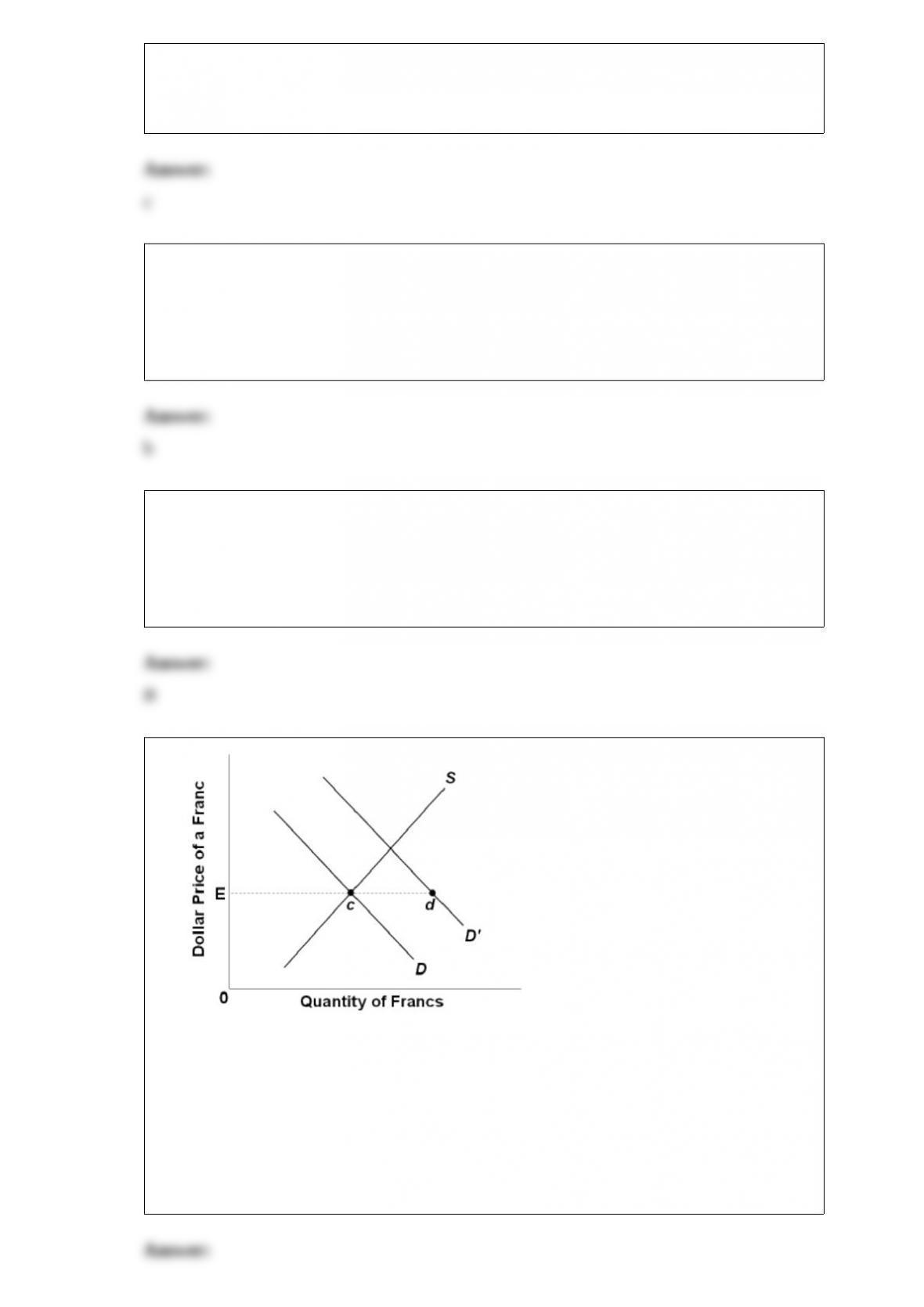
b.$73.
c.$75.
d.$77.
12) during a period of hyperinflation:
a.creditors gain because their loans are repaid with dollars of higher value.
b.people tend to hold goods rather than money.
c.income is redistributed away from borrowers.
d.the real value of the national currency rises.
13) Paper money (currency) in the United States is issued by the:
A.United States Mint.
B.Federal Reserve Banks.
C.United States Treasury.
D.national banks.
14)
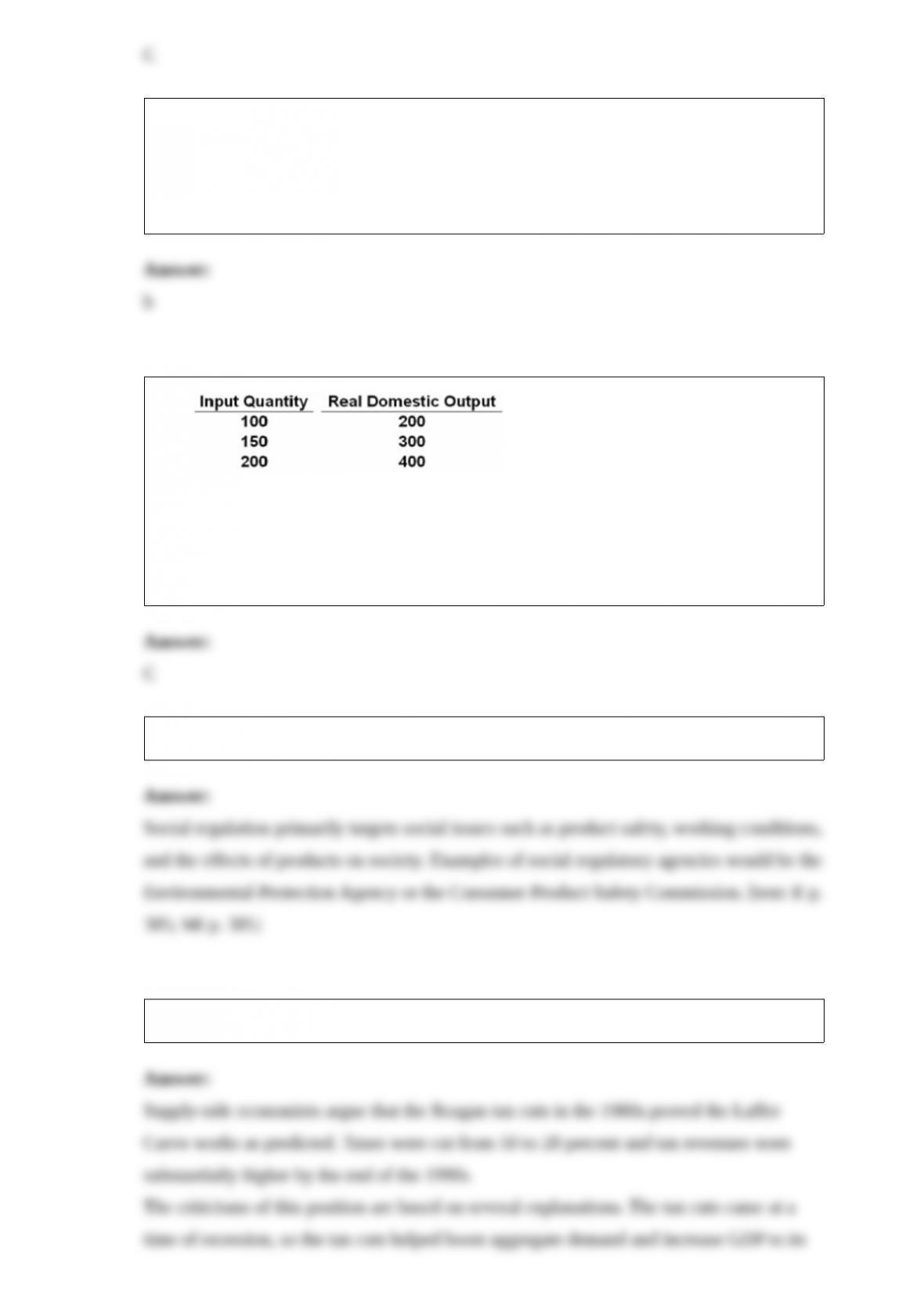
Refer to the above diagram where D and S are the United States’ demand for and supply
of Swiss francs. At the equilibrium exchange rate, E, the United States’ balance of
payments is in equilibrium. Under a system of fixed exchange rates, the shift in demand
from D to D’ will cause:
A.the United States to increase its stocks of international monetary reserves.
B.a Swiss balance of payments deficit.
C.a U.S. balance of payments deficit.
D.a U.S. balance of payments surplus.
15) the construction of a production possibilities curve assumes:
a.the quantities of all resources are unlimited.
b.technology is fixed.
c.some resources are unemployed.
d.there is no inflation in the economy.
16)
If the price of each input is $5, the per-unit cost of production in the above economy is:
A.$5.
B.$2.75.
C.$2.50.
D.$.40.
17) What are social regulation and agency examples?
18) How do supply-side advocates respond to critics? How valid is their defense?
19) Evaluate the validity of the argument that a new industry in a nation needs
protection from foreign competition if it is to prosper.
20) How does economic rivalry take place in monopolistic competition? Describe the
different aspects of product differentiation and price competition.
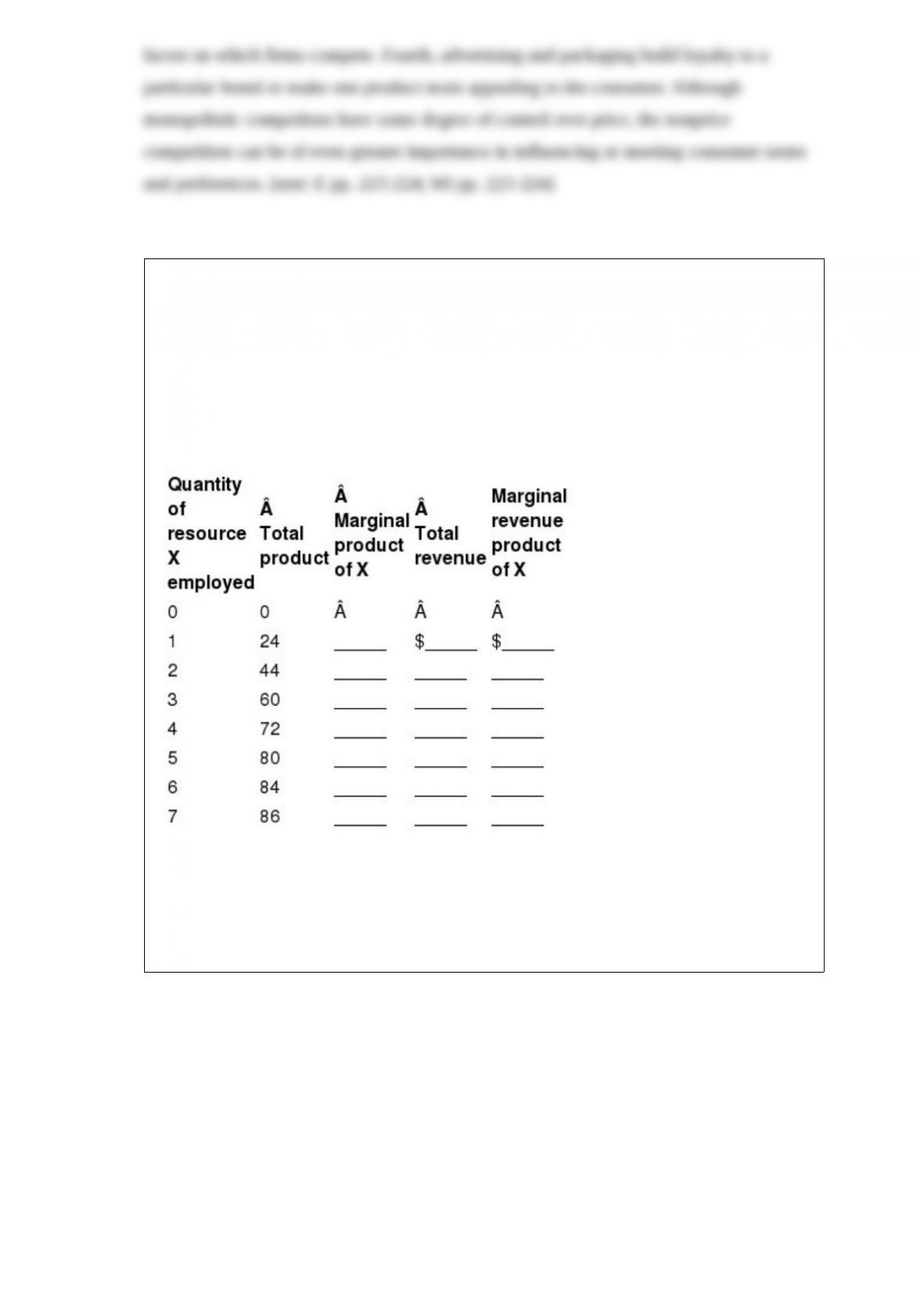
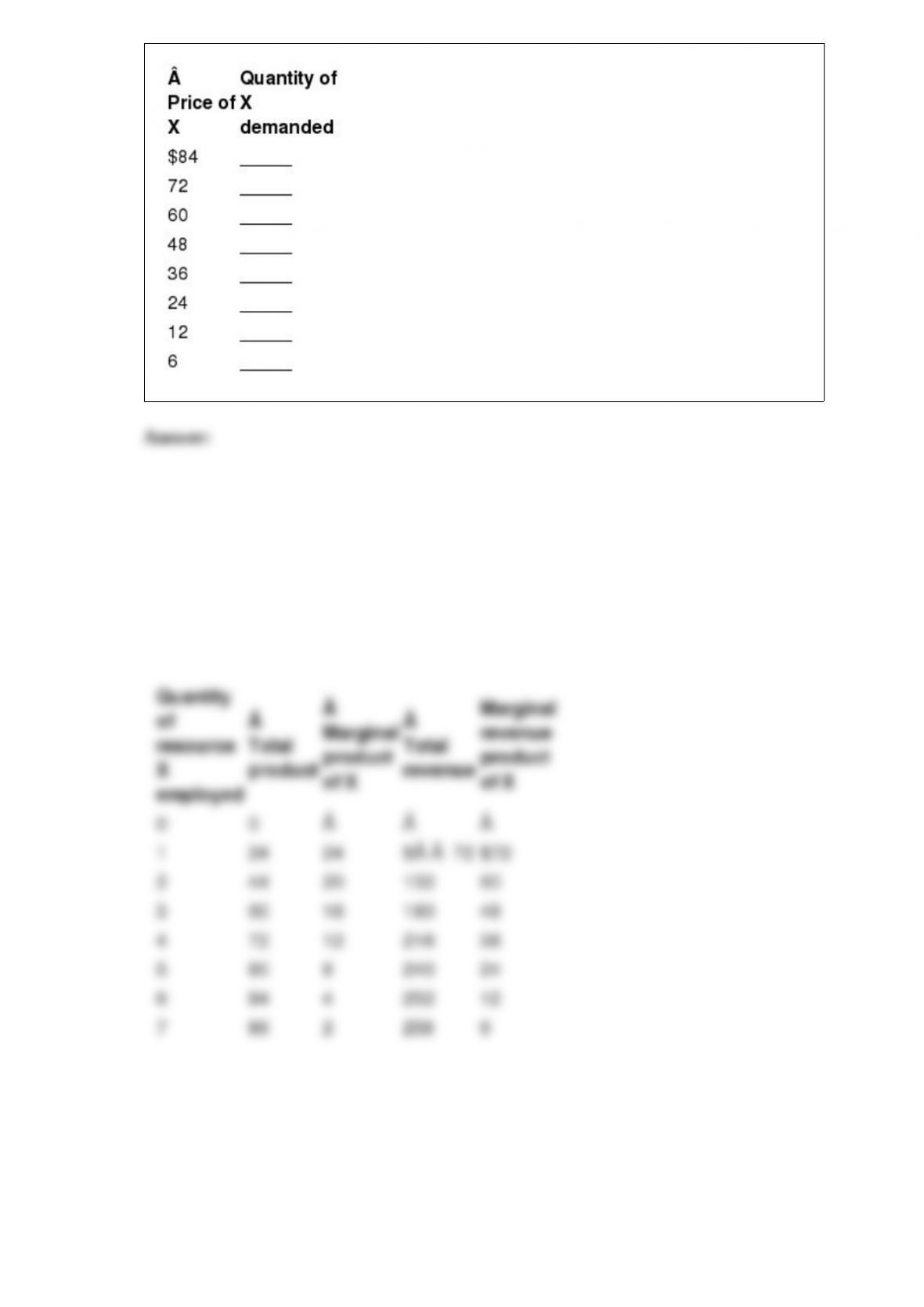
21) The table below shows the total production a firm will be able to obtain if it
employs varying amounts of resource X while the amounts of the other resources the
firm employs remain constant. Compute the marginal product of each of the seven
units of resource X and enter these figures in the table. Assume the product the firm
produces sells in the market for $3.00 per unit. Compute the total revenue of the firm at
each of the eight levels of output and the marginal revenue product of each of the seven
units of resource X. Enter these figures in the table below.
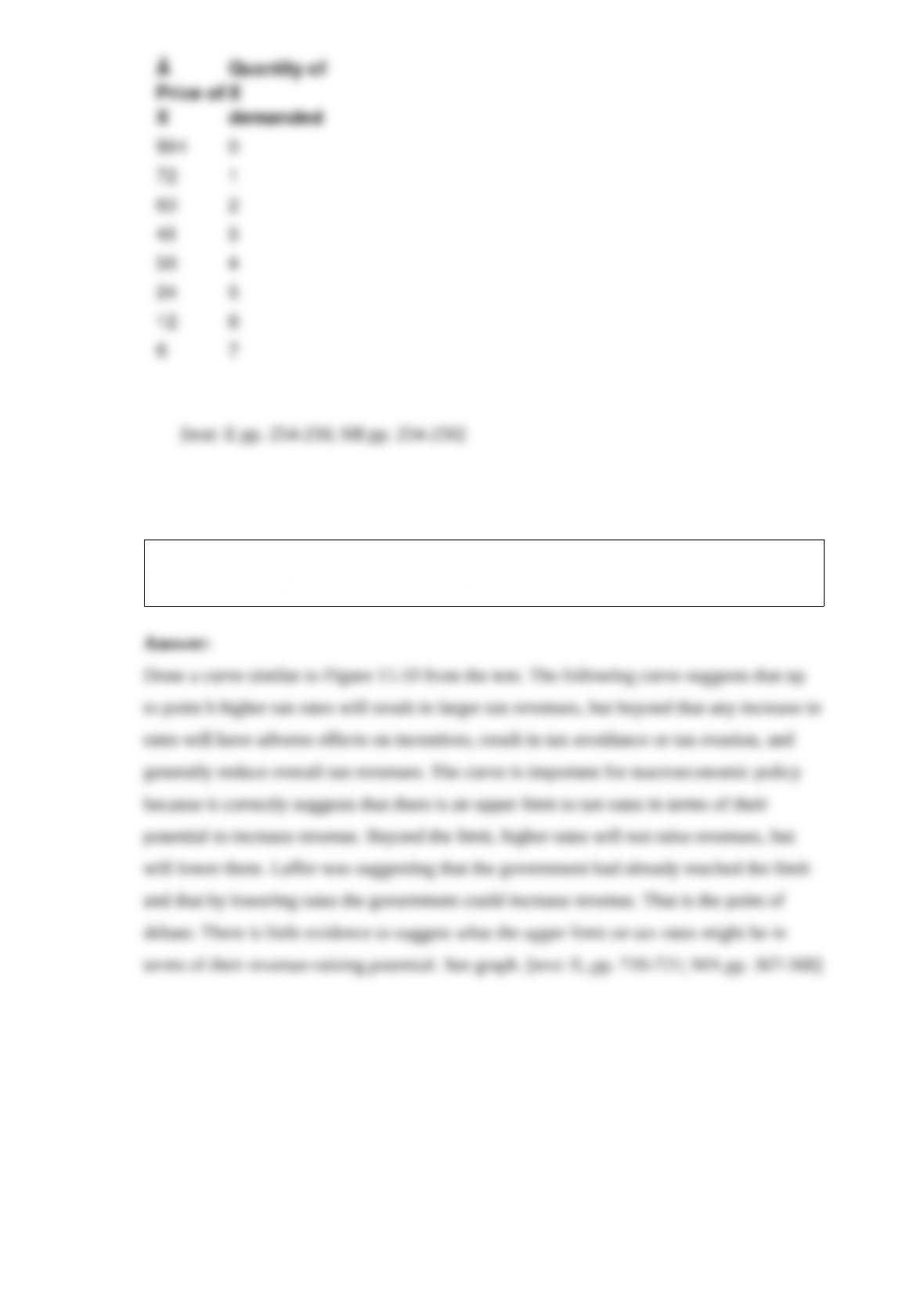
On the basis of your computations complete the firm’s demand schedule for
resource X by indicating in the table below how many units of resource X the firm
would employ at the given prices.
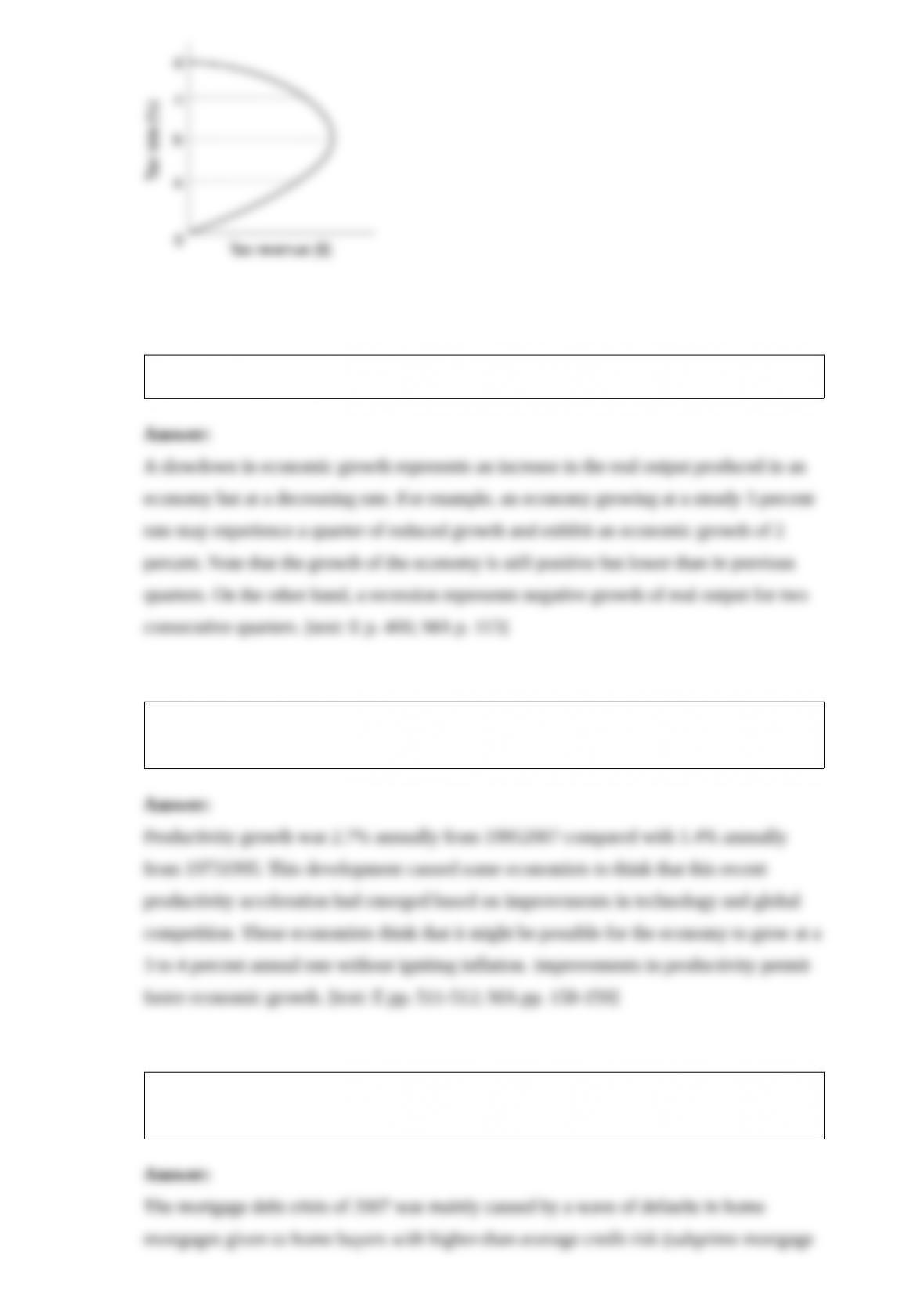
22) Draw a Laffer Curve and explain the relationship it purports to portray. Why might
this curve be important for macroeconomic policy?
23) What is the difference between a slowdown in economic growth and a recession?
24) Explain why some economists think the recent productivity acceleration will
continue in the United States.
25) How did the Federal Reserve act to restore confidence and keep loans flowing
during the 2007 mortgage debt crisis?