
During which of the following time periods did inflation remain above 5 percent every
year?
A) 1990 through 1999
B) 1973 through 1982
C) 1968 through 1971
D) 1958 through 1962
In preparing their estimates of the stimulus package’s effect on GDP, Obama
administration economists estimated a government purchases multiplier of 1.57. This
indicates that a ________ increase in government purchases would increase equilibrium
real GDP by $157 billion
A) $1 billion.
B) $10 billion.
C) $100 billion.
D) $157 billion.
Table 16-1
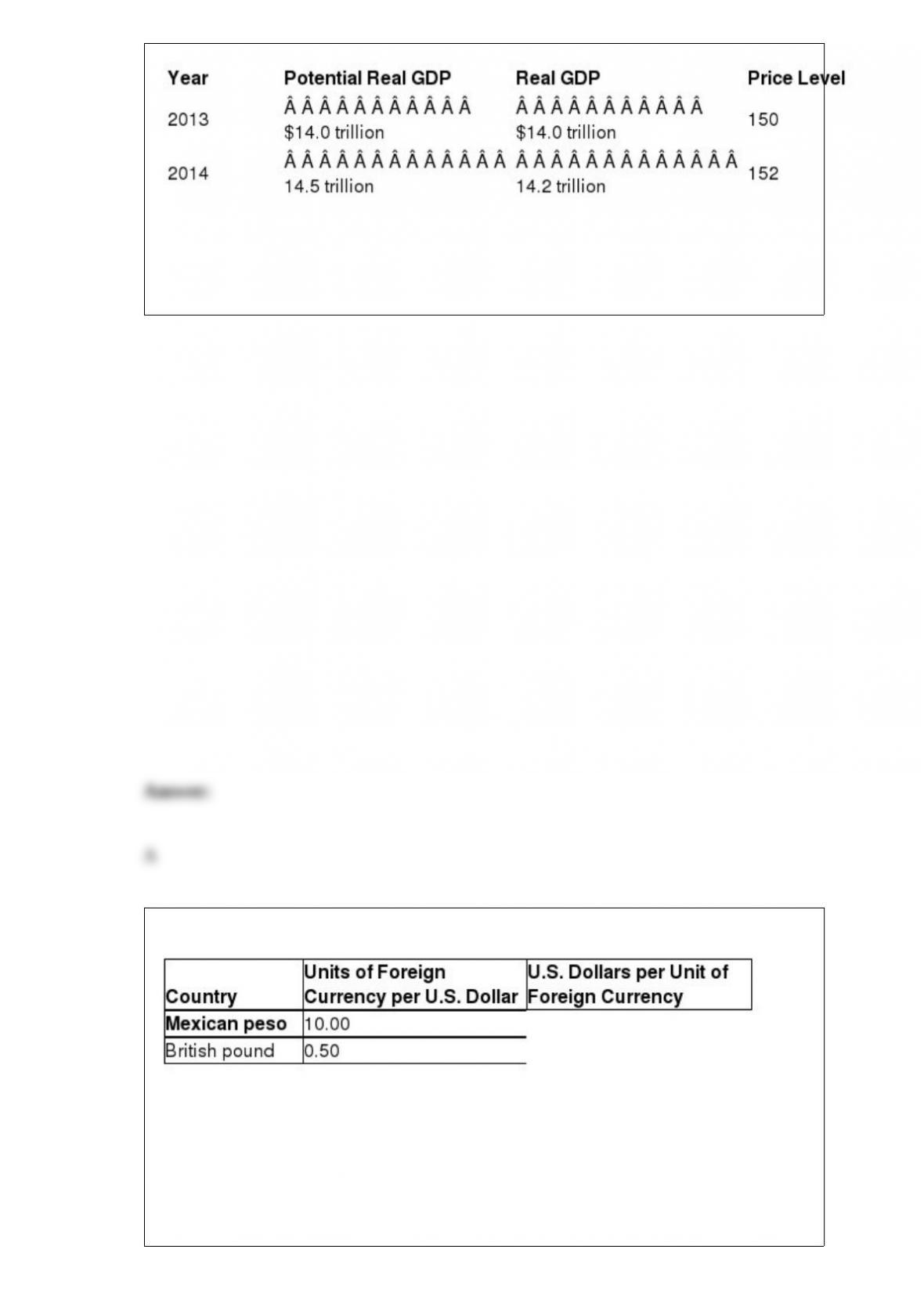
Refer to Table 16-1. Consider the hypothetical information in the table above for
potential real GDP, real GDP and the price level in 2013 and in 2014 if the Congress
and the president do not use fiscal policy. If the Congress and the president want to
keep real GDP at its potential level in 2014, they should
1. A) decrease income taxes.
2. B) decrease government purchases.
3. C) decrease the money supply.
4. D) increase the level of interest rates.
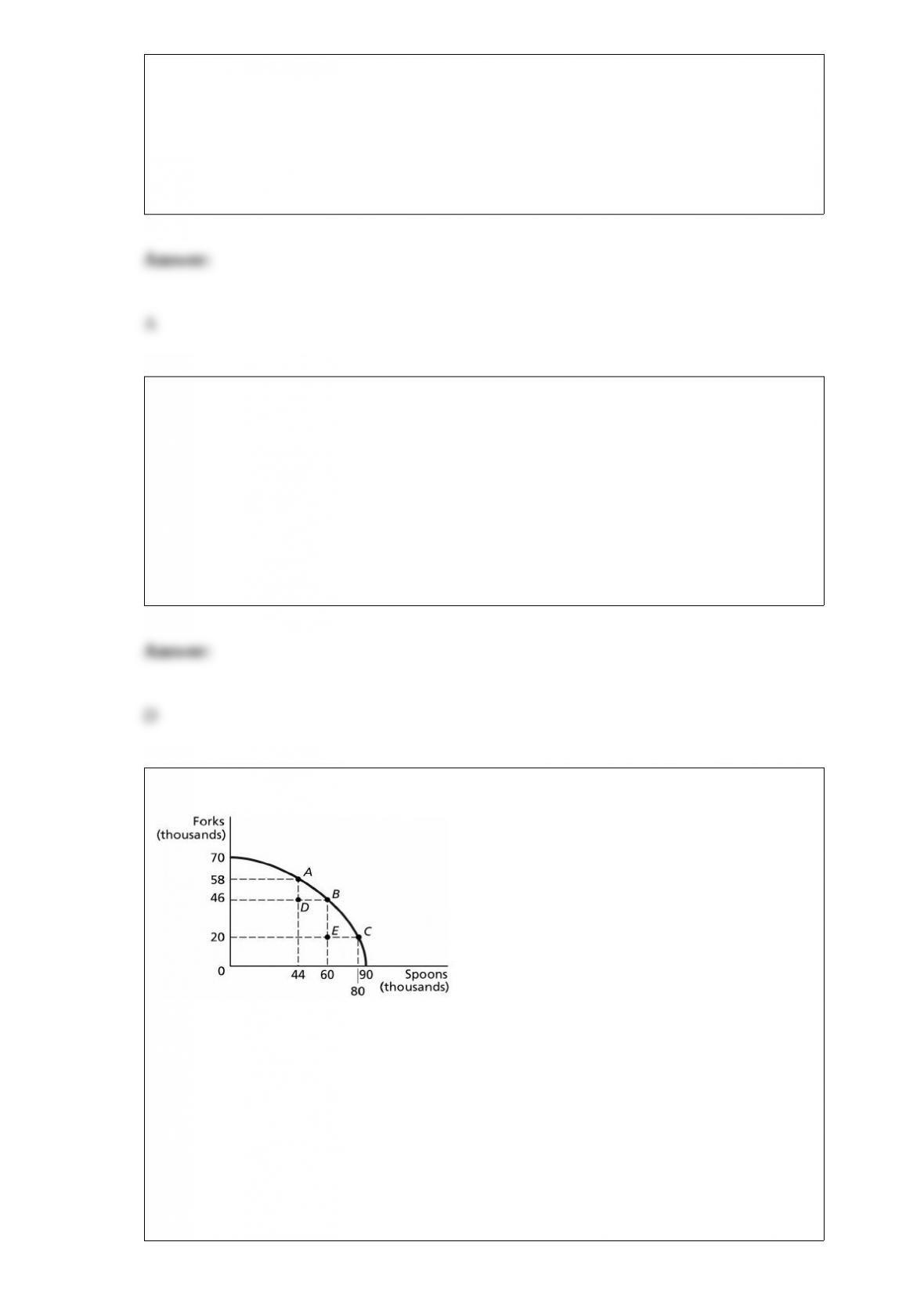
Table 18-2
Refer to Table 18-2. Given the following exchange rates in the above table, what are
the exchange rates stated as U.S. dollars per Mexican peso and U.S. dollars per British
pound respectively?
A) 0.10 dollars per peso and 2.00 dollars per pound
B) 1.00 dollars per peso and 20.00 dollars per pound
C) 0.01 dollars per peso and 0.20 dollars per pound
D) 0.10 dollars per peso and 5.00 dollars per pound
E) 0.01 dollars per peso and 0.50 dollars per pound
The first discussion of comparative advantage appears in a book written by
A) Adam Smith.
B) Paul Samuelson.
C) David Portugal.
D) David Ricardo.
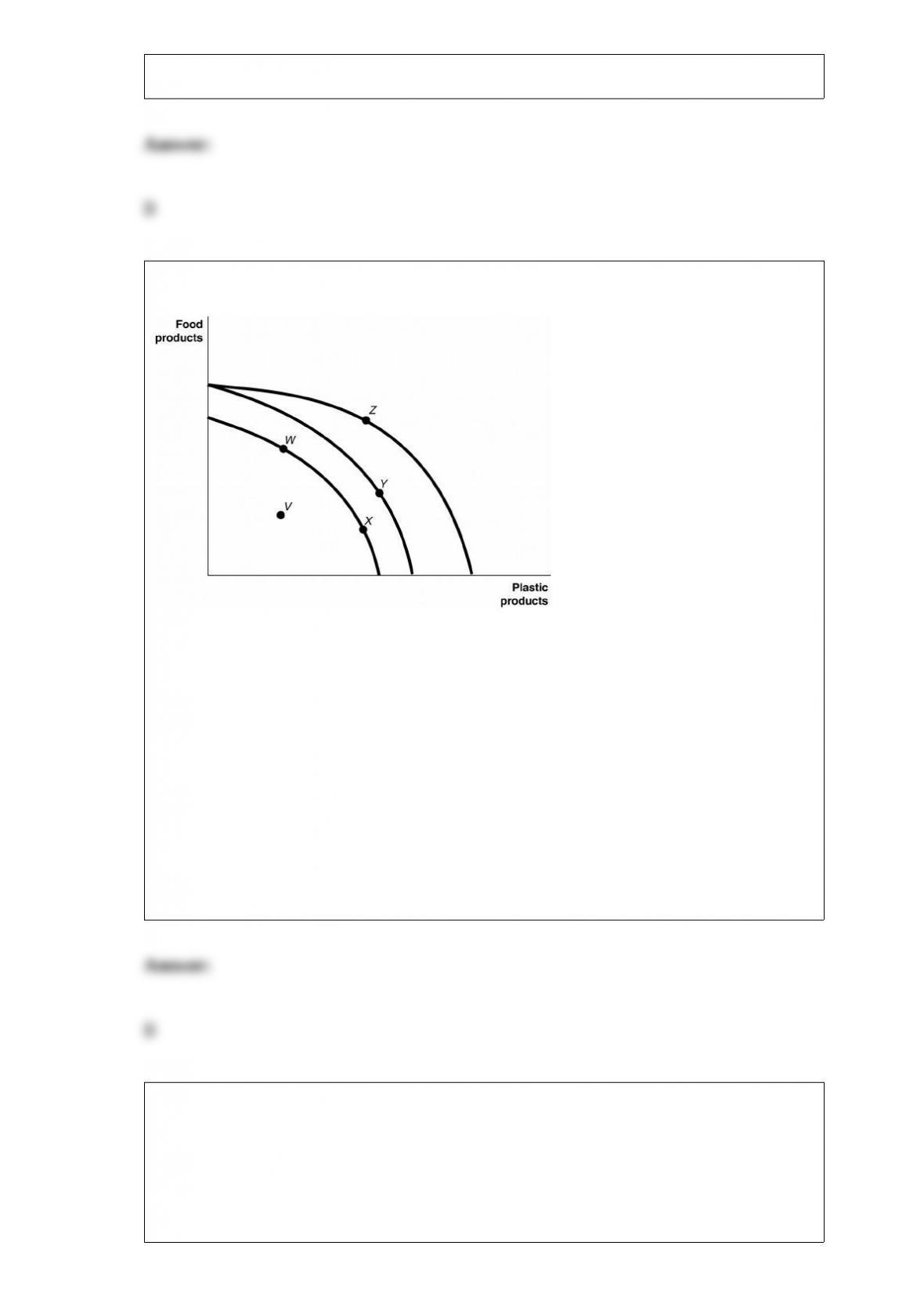
Figure 2-6
Refer to Figure 2-6. If the economy is currently producing at point A, what is the
opportunity cost of moving to point B?
A) 16 thousand spoons
B) 12 thousand forks
C) 60 thousand spoons
D) 46 thousand forks

Currency traders expect the value of the dollar to fall. What effect will this have on the
demand for dollars and the supply of dollars in the foreign exchange market?
A) Demand for dollars will increase, and supply of dollars will decrease.
B) Demand for dollars will increase, and supply of dollars will increase.
C) Demand for dollars will decrease, and supply of dollars will increase.
D) Demand for dollars will decrease, and supply of dollars will decrease.
Increases in government spending result in ________ in the short run, and permanent
increases in government spending result in ________ in the long run.
A) partial crowding out; partial crowding out
B) partial crowding out; complete crowding out
C) complete crowding out; complete crowding out
D) complete crowding out; partial crowding out
Firms in Thailand that had borrowed dollars while the baht was pegged to the dollar
faced interest payments that were ________ than they had planned while the Thai
government continued trying to defend the peg, because the baht had been pegged
________ the equilibrium exchange rate for the baht.
A) higher; above
B) higher; below

C) lower; above
D) lower; below
Countries that use the euro as their currency face similar concerns as countries did
during the years of the gold standard in that each are (were)
A) unable to conduct monetary policy.
B) unable to conduct fiscal policy.
C) using currency which is backed by gold.
D) using a floating currency.
What two factors are the keys to determining labor productivity?
A) the business cycle and the growth rate of real GDP
B) the growth rate of real GDP and the interest rate
C) technology and the quantity of capital per hour worked
D) the average level of education of the workforce and the price level
Table 7-6
Production and
Consumption Production
Without Trade With Trade

Estonia and Morocco can produce both swords and belts. Table 7-6 shows the
production and consumption quantities without trade, and the production numbers with
trade.
Refer to Table 7-6. Which country has an absolute advantage in producing belts?
A) Estonia
B) Morocco
C) both countries
D) neither country
In ________, health care spending per person based on income per person is
significantly higher than the average for most other countries.
A) Austria
B) Canada
C) Norway
D) the United States
If firms sell what they expected to sell, which of the following will be true?
A) Aggregate expenditure will be greater than GDP.
B) There is no unplanned change in inventories.
C) Inventories will rise, and GDP and employment will fall.
D) Aggregate expenditure will be less than GDP.
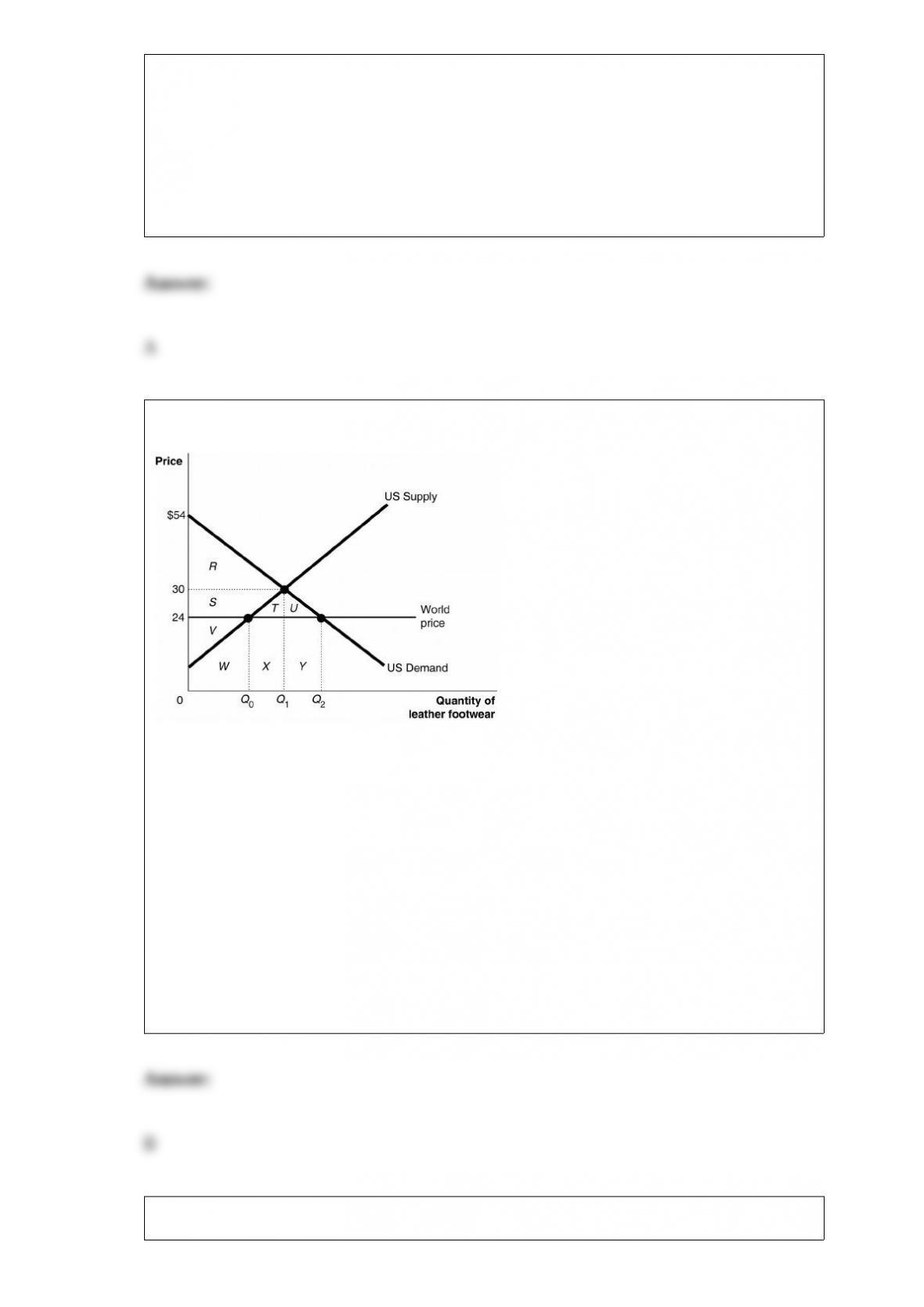
Figure 2-4
Figure 2-4 shows various points on three different production possibilities frontiers for
a nation.
Refer to Figure 2-4. A movement from ________ could occur because of an influx of
immigrant labor.
A) X to W
B) X to Y
C) W to V
D) W to X
How does an increase in a country’s exchange rate affect its balance of trade?
A) An increase in the exchange rate raises imports, reduces exports, and reduces the
balance of trade.
B) An increase in the exchange rate reduces imports, raises exports, and reduces the
balance of trade.
C) An increase in the exchange rate reduces imports, raises exports, and increases the
balance of trade.
D) An increase in the exchange rate raises imports, reduces exports, and increases the
balance of trade.
Figure 7-1
Figure 7-1 shows the U.S. demand and supply for leather footwear.
Refer to Figure 7-1. Suppose the government allows imports of leather footwear into
the United States. The market price falls to $24. What area represents domestic
producer surplus?
A) T + U
B) V
C) V + W + X + Y
D) W + X + Y
Digital video recorders (DVRs) were introduced to the market in 1999, and new

technology has allowed for the cost of manufacturing the recorders to decline
significantly since the initial introduction. How did this change in technology affect the
market for DVRs?
A) The new technology caused an increase in the supply of DVRs and a decrease in
price of DVRs.
B) The new technology caused an increase in the supply of DVRs and an increase in
price of DVRs.
C) The new technology caused an decrease in the demand for DVRs.
D) The new technology caused an increase in the quantity of DVRs supplied.
If the per-worker production function shifts up,
A) it now takes more capital per hour worked to get the same amount of real GDP per
hour worked.
B) an economy can increase its real GDP per hour worked without changing the level of
capital per hour worked.
C) the per-worker production function becomes flatter.
D) negative technological change has occurred in the economy.