
A country has a (an) __________ in the production of a good it produces at lower
opportunity cost than another country.
a. absolute advantage
b. specialization disadvantage
c. tariff-efficient advantage
d. infant-industry advantage
e. none of the above
Profits are income to
a. owners of capital.
b. all factors of production in a profitable firm.
c. owners of land.
d. entrepreneurs who bear the risks of production.
e. owners of a highly productive resource.
Assume the following for a certain industry: (l) there is no incentive for firms to enter
or exit the industry; (2) for some firms in the industry, short-run average total cost is
greater than long-run average total cost at the level of output where marginal revenue

equals marginal cost; (3) all firms in the industry are currently producing the quantity of
output at which marginal revenue equals marginal cost. Is the industry in long-run
competitive equilibrium?
a. Yes.
b. No, because of number 2.
c. No, because of numbers 2 and 3.
d. No, because of numbers 1 and 2.
e. No, because of numbers 1, 2, and 3.
Natural monopoly exists when
a. one firm can supply the entire output demanded at lower cost than two or more firms
can.
b. one firm can supply the entire output demanded at higher cost than two or more firms
can.
c. one firm can supply the entire output demanded at the same cost as two or more
firms.
d. one firm controls all of the rights to a scarce resource.

Which of the following statements is false?
a. The perfectly competitive firm’s demand curve is horizontal at the market price.
b. The theory of perfect competition is completely and accurately descriptive of most
real-world firms.
c. If Firm X does not strictly meet all the assumptions of the theory of perfect
competition, but behaves as if it does, then the theory of perfect competition is relevant
to it.
d. In perfect competition, the market price is established at the intersection of the
market demand and market supply curves.
A divisive society is a nonexcludable public _____________ because it comes with
____________.
a. good; utility
b. bad; disutility
c. bad; utility
d. good; disutility
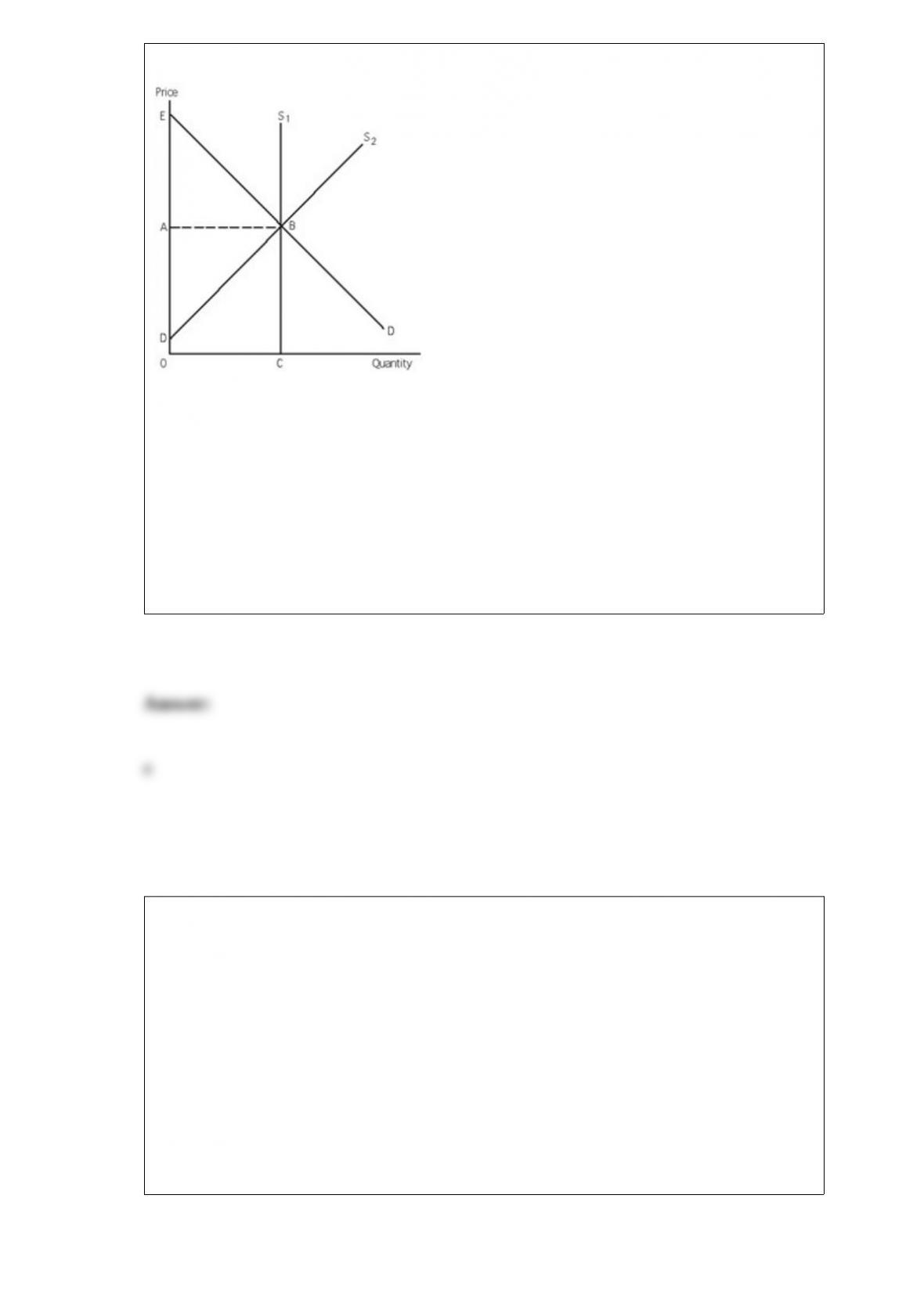
Refer to Exhibit 30-1. Suppose the supply curve is S1 and the price is A. Pure economic
rent equals area
Exhibit 30-1
a. ABD.
b. EBA.
c. ODBC.
d. EBD.
e. none of the above
The _________________ the opportunity cost of bad behavior, the
_________________ likely one is to exhibit bad behavior.
a. higher; less
b. lower; more
c. higher; more
d. lower; less
e. a and b

The nominal interest rate is the
a. interest rate in current dollars, unadjusted for expected inflation.
b. real interest rate minus the expected inflation rate.
c. interest rate determined in the loanable funds market.
d. a and c
e. all of the above
Consider two straight-line PPFs. They have the same vertical intercept, but curve I is
flatter than curve II. The opportunity cost of producing the good on the vertical axis
a. is greater along curve I.
b. is greater along curve II.
c. is the same along both curves.
d. cannot be compared for the two curves without more information.
The theory of perfect competition generally assumes that
a. sellers act independently of other sellers, but buyers do not act independently of other
buyers.
b. buyers act independently of other buyers, but sellers do not act independently of
other sellers.
c. buyers and sellers act independently of other buyers and sellers.
d. neither buyers nor sellers act independently of other buyers and sellers.
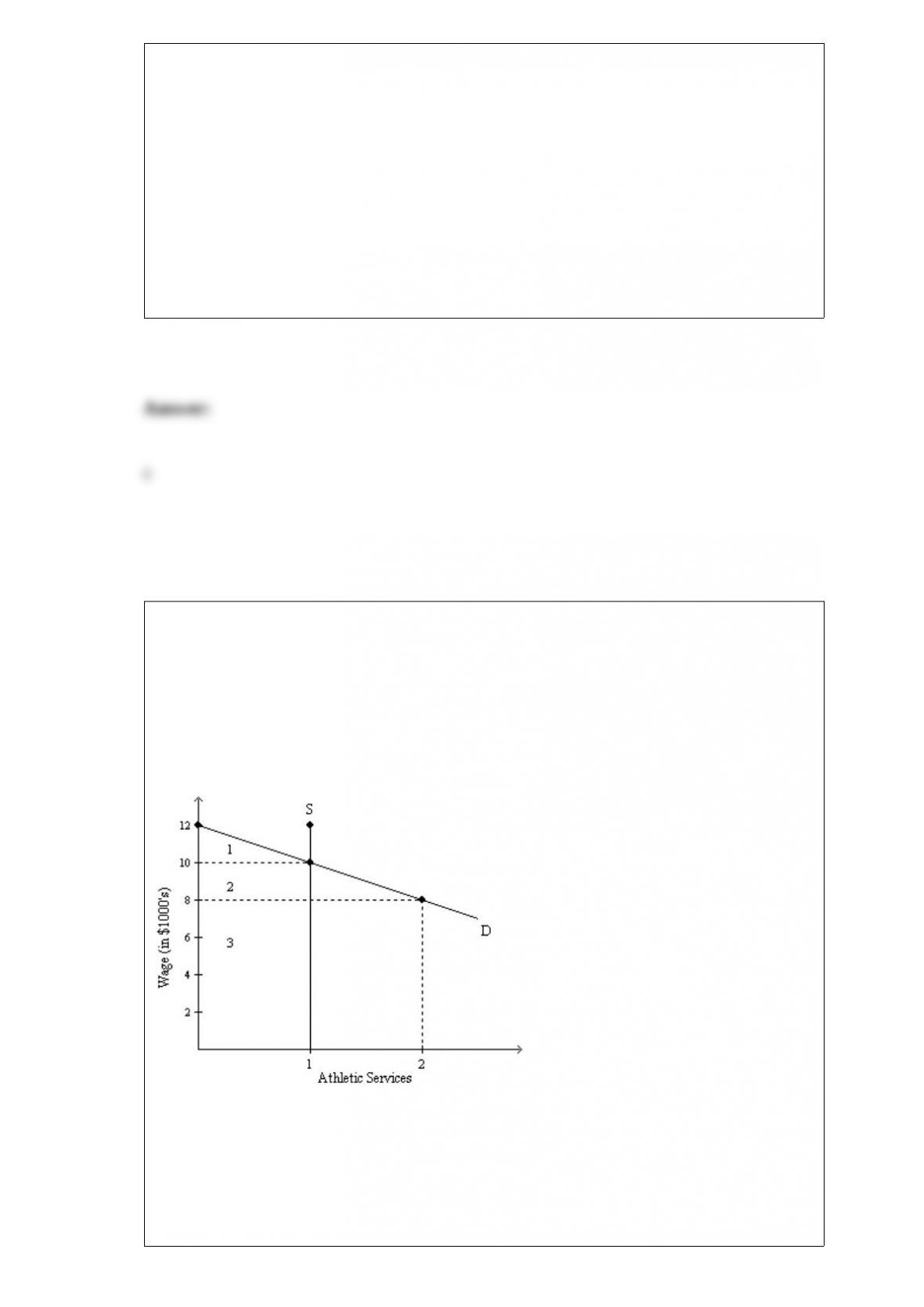
Refer to Exhibit 5-3 which shows the demand and supply of a college athlete.Suppose
that NCAA rules limit the amount that the college can pay this athlete, such that their
payment cannot exceed the cost of attending the college (currently $8,000).The impact
of this ruling would be a loss of income to the athlete of __________ and an equal gain
in consumers’ surplus to the college represented by ________________.
Exhibit 5-3
a. $2,000; area 2
b. $8,000; area 3
c. $10,000; area 2 + 3
d. $2,000; area 1 + 2
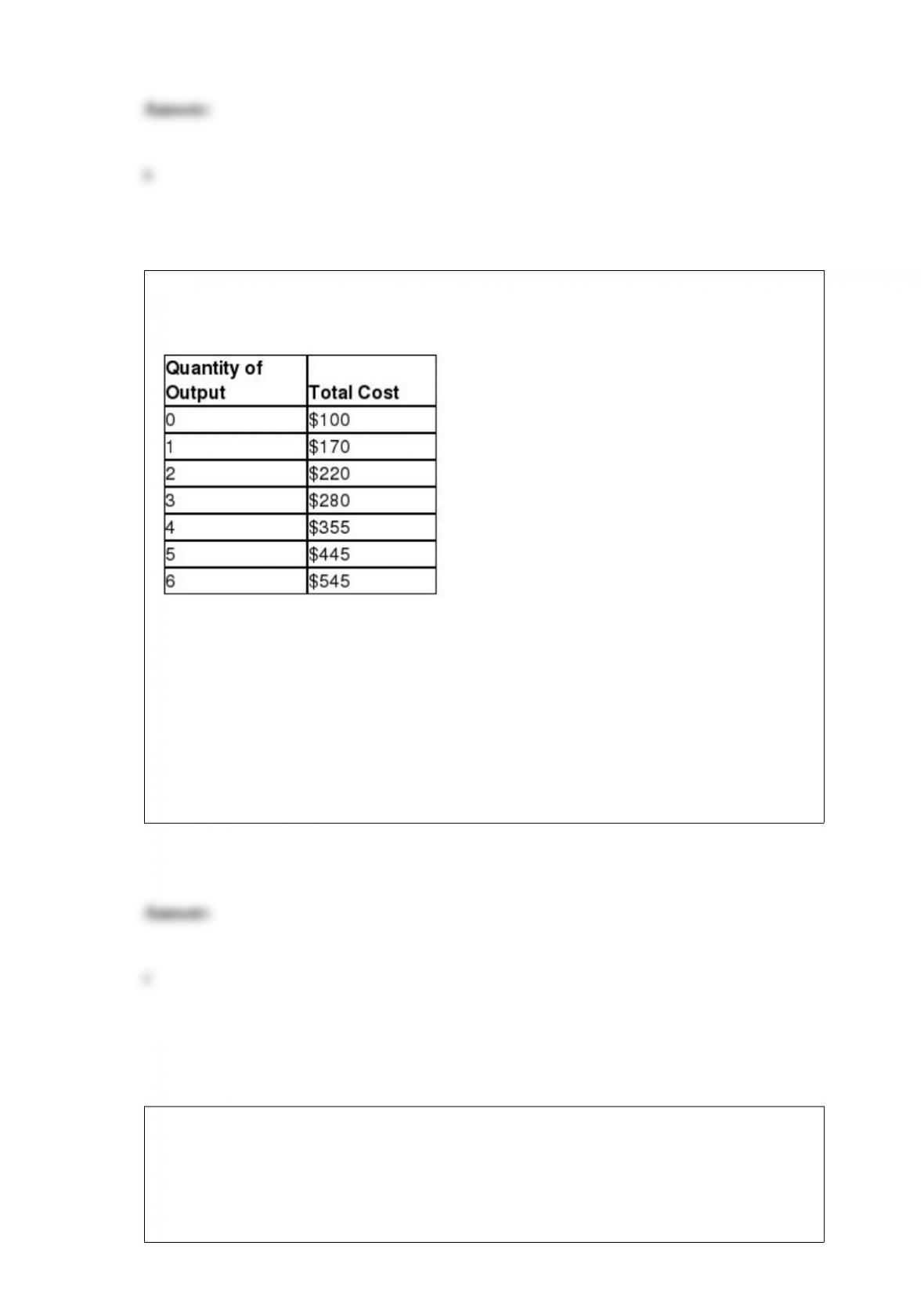
Refer to Exhibit 22-11. Total fixed cost is
Exhibit 22-11
a. $500.
b. $600.
c. $100.
d. $110.
e. There is not enough information provided to answer this question.
Which of the following points would not be used as an argument in support of the
current international monetary system?
a. It allows nations to pursue independent monetary policies.

b. It results in stable exchange rates.
c. It helps solve trade problems without trade restrictions.
d. It is flexible and can easily adjust to shocks.
e. All of the above could be used as arguments supporting the current system.
A college professor berates his political science students for being uninformed on
current political and government issues. For example, most of them do not know who
represents them in the U.S. House of Representatives. He tells his students that they
will never get very far in life by staying so uninformed and uninterested. The professor
is probably overlooking the fact that
a. people are uninformed and uninterested in only some things-not all things.
b. his students could be choosing rational ignorance.
c. by not taking out time to find out certain things, his students have more time to study
for his tests.
d. a, b, and c
e. none of the above
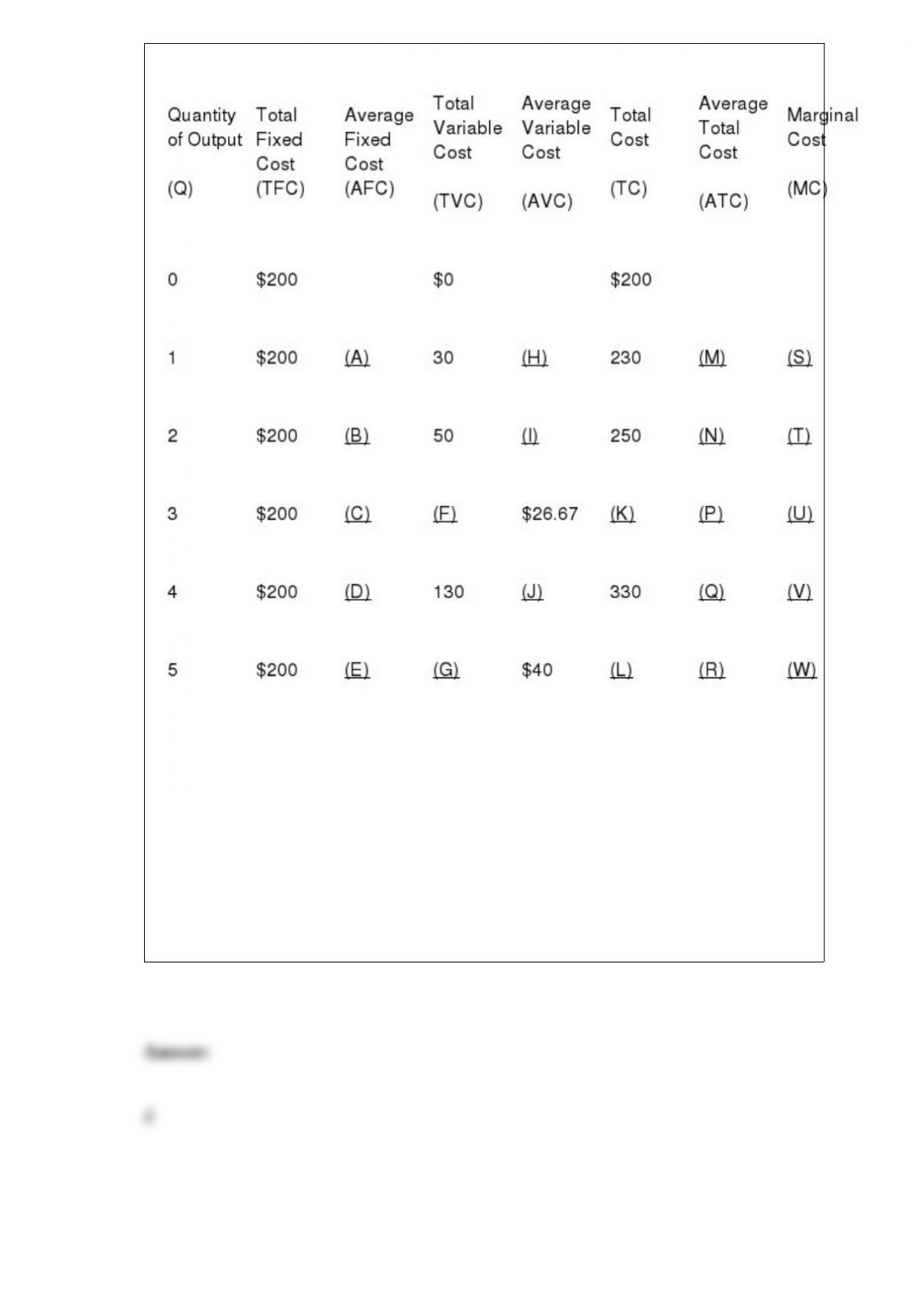
Refer to Exhibit 22-13.What dollar amounts go in blanks (P) and (Q), respectively?
Exhibit 22-13 Quantity of Output (Q) Total Fixed Cost (TFC) Average Fixed Cost
(AFC) Total Variable Cost
a. $120; $125
b. $10; 95
c. $30; $80
d. $93.33; $82.50
e. There is not enough information to answer this question.
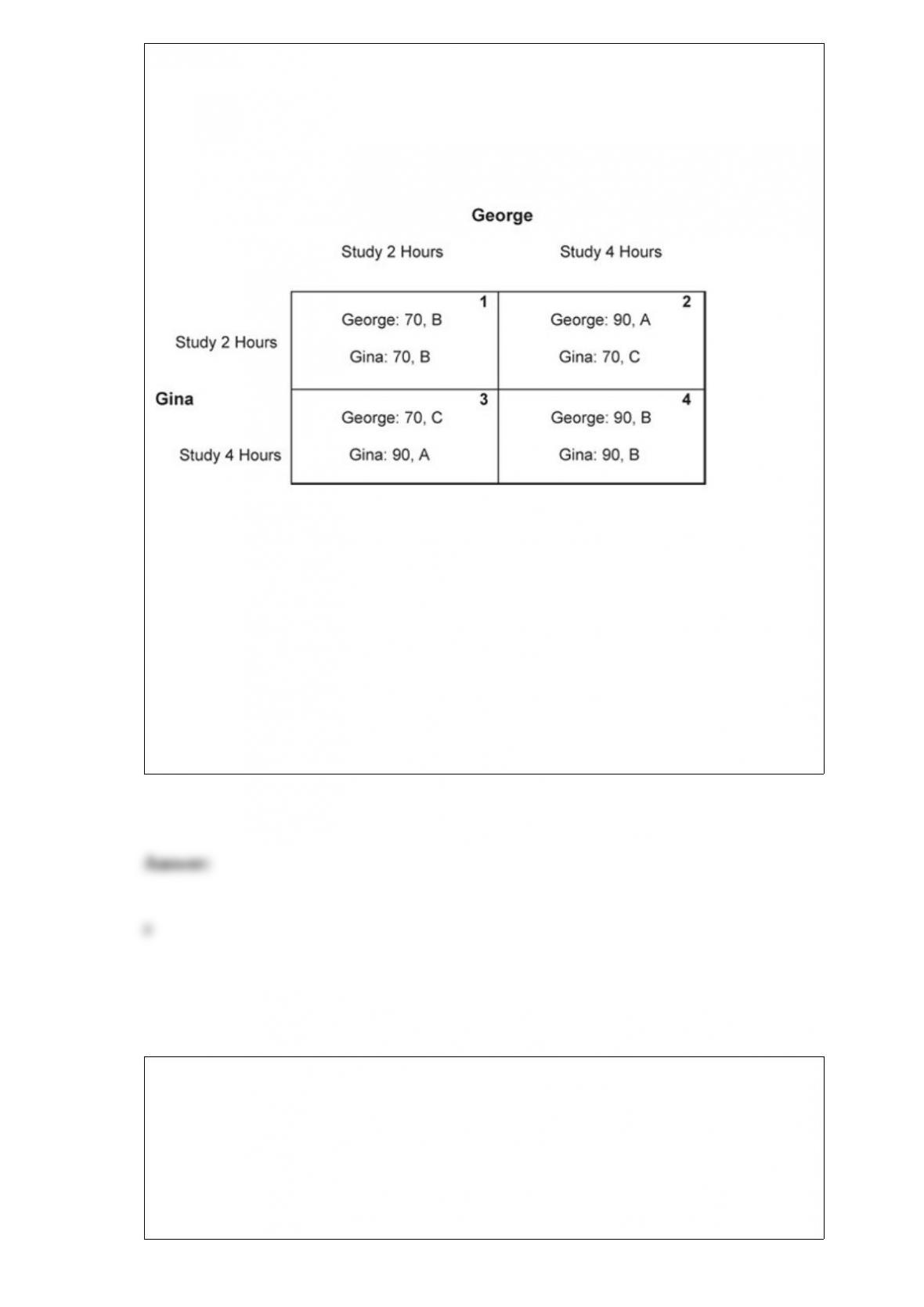
Refer to Exhibit 25-10.If George studies for two hours and Gina studies for four hours,
George’s letter grade on the test will be a ___________ and Gina’s letter grade on the
test will be a __________________.
Exhibit 25-10
Suppose that the letter grade earned on a test for each student in a class depends upon
how well he/she does relative to other students in the class.This exhibit shows a
prisoner’s dilemma setting for two representative students in the class, George and
Gina.
a. C; A
b. C; C
c. B; B
d. A; C
Productive efficiency implies
a. the possibility of gains in one area without losses in another.
b. that more output has been produced.
c. the impossibility of gains in one area without losses in another.
d. that prices are stable.
e. c and d
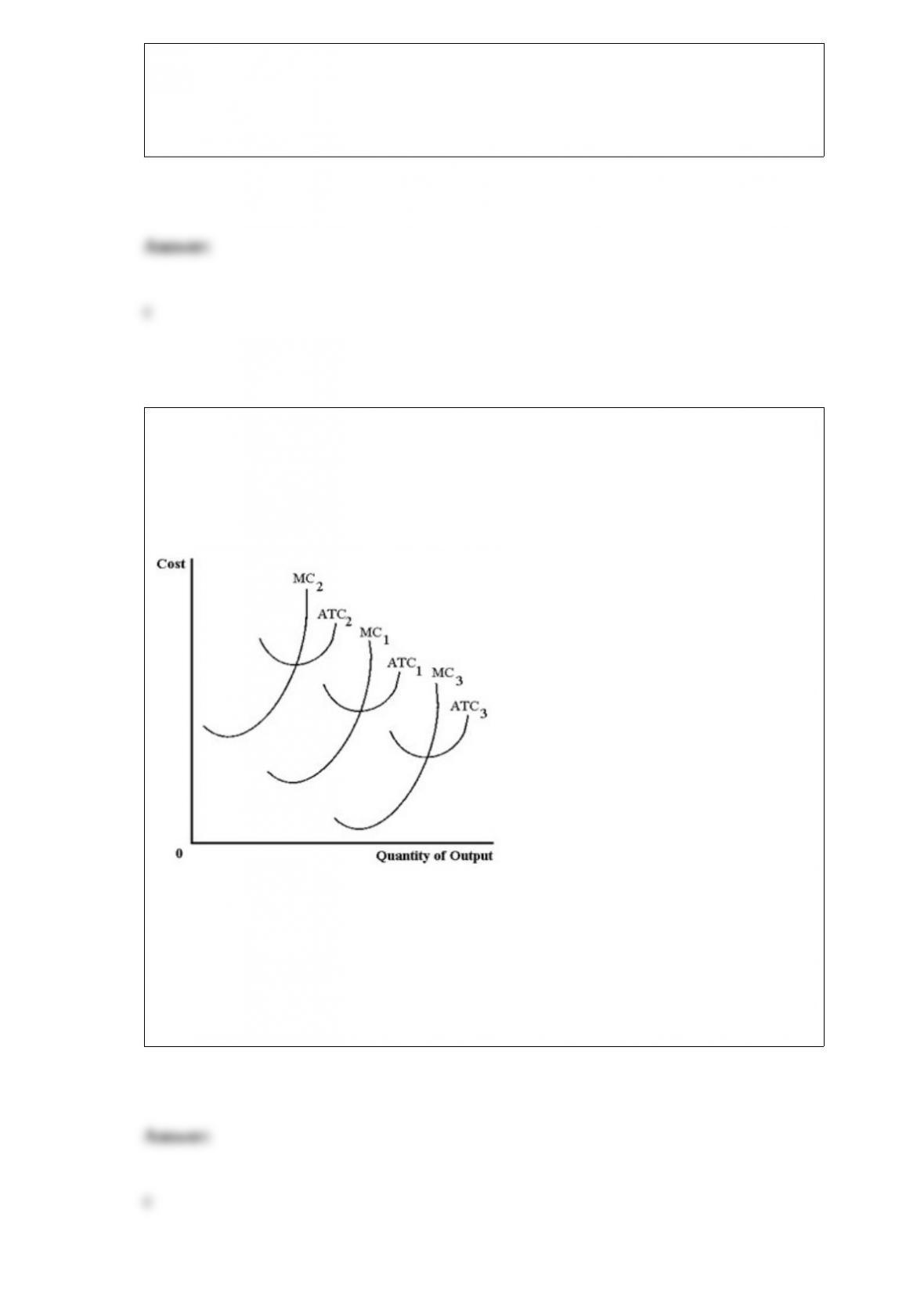
Refer to Exhibit 22-9. Let MC1 and ATC1 represent the initial cost curves of an
aluminum can producer. In which of the following cases is it most likely that the curves
will shift rightward fromMC1, and ATC1 to MC3 and ATC3?
Exhibit 22-9
a. A new tax of $0.03 per can is imposed on the producer.
b. There is an increase in energy costs.
c. A new supplier offers to supply aluminum to the firm at a lower price.
d. a and b

Which of the following is the best example of a homogeneous good?
a. new cars
b. ice cream
c. soft drinks
d. wheat
The average-marginal rule states:
a. when the marginal magnitude is rising, the average magnitude must also be rising.
b. when the marginal magnitude is falling, the average magnitude must also be falling.
c. when the marginal magnitude is below the average magnitude, the average magnitude
falls.
d. when the average magnitude rises, the marginal magnitude falls.
e. a and b