
As people’s incomes rise, they tend to purchase relatively less ________ and relatively
more ________.
A) durable goods; nondurable goods
B) nondurable goods; services
C) services; durable goods
D) services; nondurable goods
In the United States from 1949 to 2010, the vast majority of economic growth has been
a result of the contribution from
A) capital.
B) labor.
C) total factor productivity.
D) Capital, labor, and total factor productivity have contributed about equally to
economic growth.
Hyperinflation can be caused by
A) the Fed selling bonds to the public.

B) the government selling bonds to the Fed.
C) the Fed selling bonds to the government.
D) the government selling bonds to the public.
All else equal, if the demand for capital decreases and the supply of capital does not
change, the equilibrium real rental cost of capital will ________ and the equilibrium
quantity of capital will ________.
A) increase; increase
B) decrease; not change
C) decrease; decrease
D) not change; decrease
If the MPC = 0.8, an increase in investment spending from $35 billion to $38 billion
will increase real GDP by
A) $3 billion.
B) $3.75 billion.
C) $15 billion.

D) $24 billion.
Other things equal, when the real interest rate falls, C, I and NX ________ and the
output gap will ________.
A) decrease; decrease
B) decrease; increase
C) increase; increase
D) increase; decrease
The growth rate of real GDP in Astoria is 7.5%. Assume the growth rate of velocity is
constant at a rate of 5%. If Astoria wishes to decrease the inflation rate from the annual
rate of 5.99% to a target rate of 4.5% and maintain its current growth rate of real GDP,
what will the growth rate of the money supply need to be?
A) 6.49%.
B) 7%.
C) 8%.
D) 8.49%.

Bonds with ________ tend to have higher interest rates than bonds with ________.
A) high liquidity; low liquidity
B) high default risk; low default risk
C) shorter maturity; longer maturity
D) low tax burdens on their interest; high tax burdens on their interest
All else equal, an increase in the government’s budget deficit accompanied by a
decrease in corporate taxes would definitely result in
A) an increase in the equilibrium real interest rate.
B) a decrease in the equilibrium real interest rate.
C) an increase in the equilibrium level of saving and investment.
D) a decrease in the equilibrium level of saving and investment.

Through open market operations, the Fed
A) controls the demand for reserves, but not the supply of reserves, in the banking
system.
B) controls the supply of reserves and the demand for reserves in the banking system.
C) controls the supply of reserves, but not the demand for reserves, in the banking
system.
D) has influence over, but cannot directly control, the supply of reserves and the
demand for reserves in the banking system.
Suppose for every dollar change in household wealth, consumption expenditures
change by $0.05. If real household wealth declines by $45 billion, potential GDP is
$120 billion, and the multiplier effect for the first year after an expenditure shock is 1.4,
what is the total change in output relative to potential for the first year?
A) -1.63%
B) -2.63%
C) -2.8%
D) -7.0%
Maryanne expects to work for another 30 years and expects to live another 10 years

after she retires. If Maryanne completely smooths consumption over her lifetime, for
every $1,000 increase in disposable income, she will use ________ for consumption
each year.
A) $100
B) $333
C) $667
D) $750
Changes in ________ that are intended to achieve macroeconomic policy XOAXOAs
refer to fiscal policy.
A) exchange rates
B) interest rates
C) government taxes and purchases
D) the money supply
The Fed greatly increased the monetary base in 2009 and 2010 by purchasing assets in
an attempt to boost the economy, while making it known that they intended on selling
these assets once the economy showed signs of stability, and at the same time keep a
watchful eye on possible inflation. The Fed’s inflation expectations would most likely

be considered as ________, and the Fed was able to increase the monetary base without
causing expected inflation to increase because their intentions and statements were
generally considered ________.
A) adaptive; not credible
B) adaptive; credible
C) rational; not credible
D) rational; credible
The higher the real interest rate, the ________ investment projects firms can profitably
undertake, and the ________ the quantity of loanable funds they will demand.
A) more; smaller
B) more; greater
C) fewer; greater
D) fewer; smaller
Assume the economy is initially in equilibrium with real GDP equal to potential GDP.
Other things equal, if the economy enters a recession, automatic stabilizers
A) reduce the magnitude of the multiplier and reduce the size of the decline in real

GDP.
B) reduce the decline in investment expenditures and therefore increase the real
short-term interest rate.
C) cause any decrease in real GDP to be offset by an equal decrease in the inflation rate.
D) raise the interest rate to prevent the output gap from falling below equilibrium.
Positive demand shocks have a tendency to ________ real GDP relative to potential
GDP and ________ the inflation rate.
A) increase; increase
B) increase; decrease
C) decrease; increase
D) decrease; decrease
Since 1900, real GDP per capita in the United States has ________ in the short run and
has ________ in the long run.
A) fluctuated; displayed a strong upward trend
B) remained fairly stagnant; grown considerably

C) decreased more often than it has increased; increased more often than it has
decreased
D) grown at a stable and consistent rate; wildly fluctuated
The price of domestic goods in terms of foreign goods is referred to as the
A) nominal exchange rate.
B) real exchange rate.
C) relative inflation rate.
D) purchasing power parity rate.
Figure 14.2
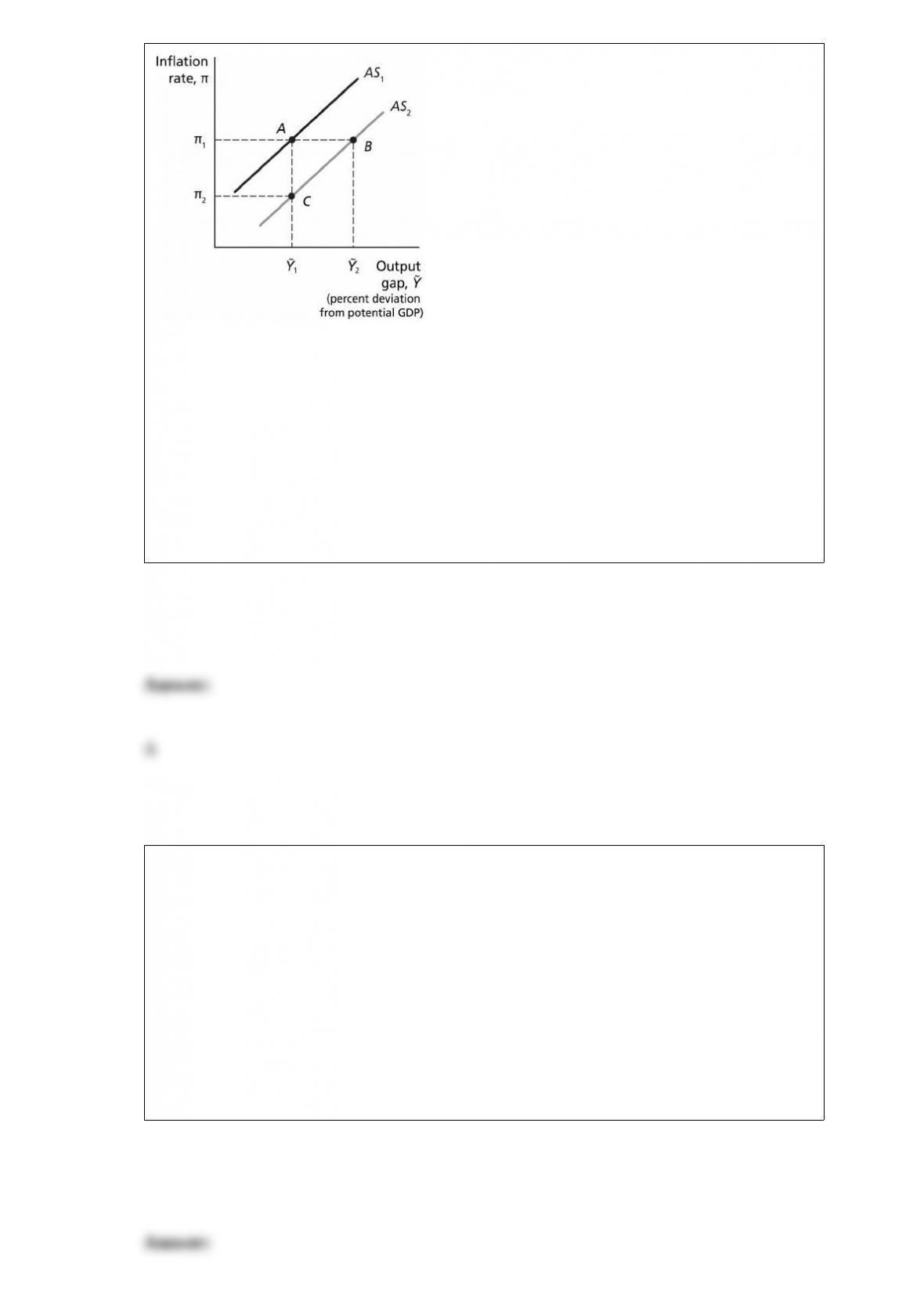
Refer to Figure 14.2. Other things equal, an increase in worker productivity would best
be represented by a movement from
A) point A to point B.
B) point B to point A.
C) point C to point A.
D) point C to point B.
According to the National Bureau of Economic Research, the “two most reliable
comprehensive estimates of aggregate domestic production” are ________ when dating
the beginning and ending of recessions.
A) the level of employment and monthly payroll data
B) industrial production and wholesale and retail sales
C) gross domestic product and gross domestic income
D) real manufacturing production and the natural rate of unemployment
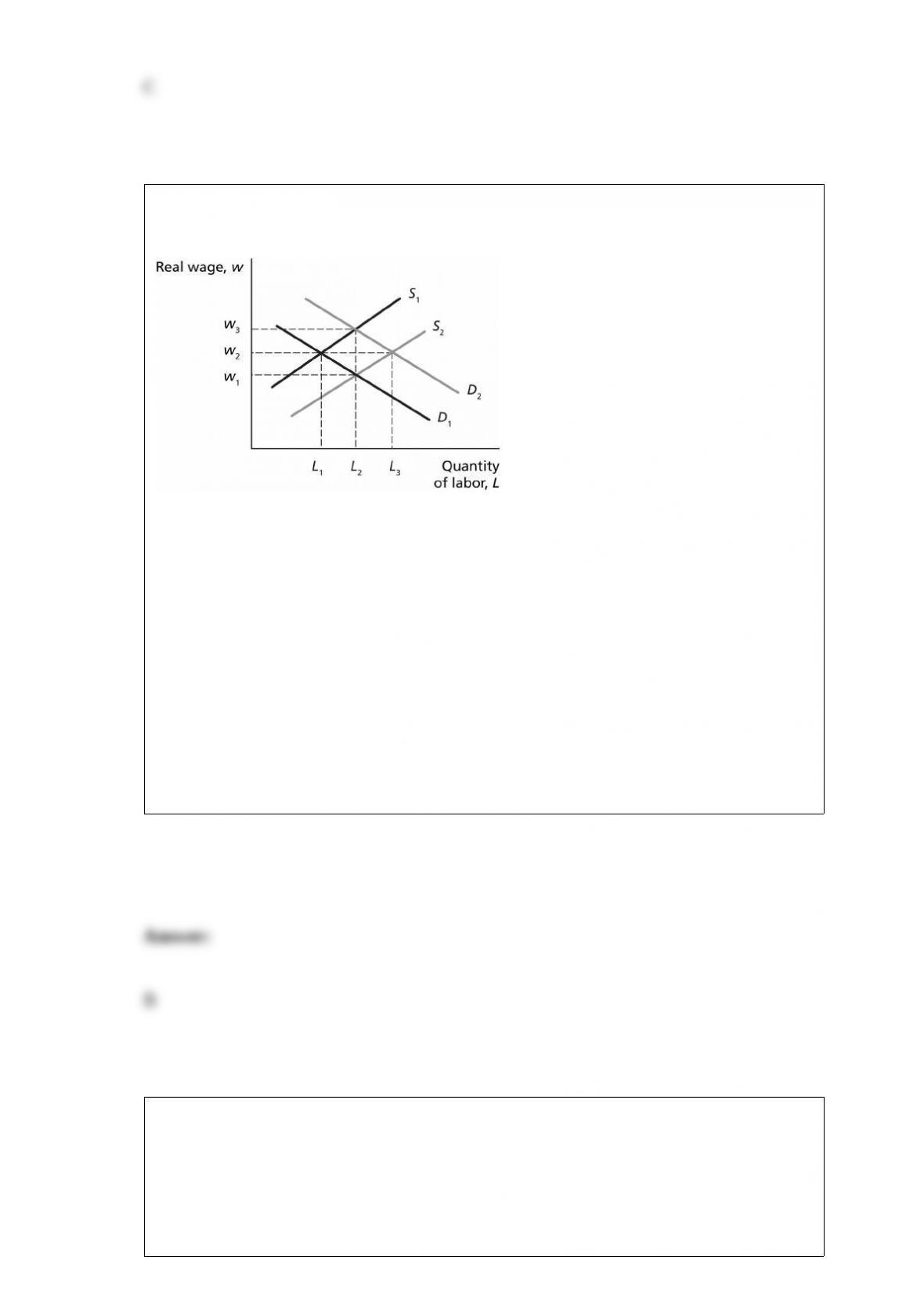
Figure 8.3
Refer to Figure 8.3. Holding other variables constant, if the economy is originally in
equilibrium at the intersection of D1 and S1 and firms experience an increase in
technology of production, the economy would move to the new equilibrium point
represented by
A) w1 and L2.
B) w3 and L2.
C) w2 and L2.
D) w2 and L3.
Joshua has decided that he will only purchase a one-year Treasury bill with a face value
of $500,000 if he receives an interest rate of 25%. How much will Joshua end up
paying for this Treasury bill?
A) $439,338

B) $468,750
C) $470,588
D) $531,250
The steeper the central bank reaction function, the ________ the central bank increases
the interest rate in response to the current inflation rate being above the target inflation
rate and the ________ the central bank decreases the interest rate in response to the
actual inflation rate being below the target inflation rate.
A) more; more
B) more; less
C) less; more
D) less, less
The percentage deviation of real GDP from potential GDP is called
A) nominal GDP.
B) the output gap.
C) the multiplier.

D) Okun’s law.
Suppose you lend $5,000 to your brother for one year at a nominal interest rate of 7%.
Inflation during that year is 4%. As a result, you will receive ________ at the end of the
year.
A) $5,150
B) $5,225
C) $5,350
D) $5,550
An increase in capital outflows from the United States will
A) decrease the balance of the U.S. current account.
B) decrease the balance of the U.S. financial account.
C) increase the balance of the capital account of the United States.
D) decrease the balance of the capital account of the United States.

The labor force is
A) the sum of the employed and unemployed workers in an economy.
B) the total number of people in an economy who are over the age of 16.
C) the total number of employed people in an economy.
D) the percentage of employed people divided by the population.
Maryanne expects to work for another 30 years and expects to live another 10 years
after she retires. If Maryanne completely smooths consumption over her lifetime, for
every $1,000 increase in wealth, she will use ________ for consumption each year.
A) $10.00
B) $25.00
C) $100
D) $333
An increase in the real interest rate outside of the United States will cause net capital
outflows to ________ and cause the dollar to ________ relative to other currencies.
A) increase; appreciate
B) increase; depreciate
C) decrease; appreciate
D) decrease; depreciate
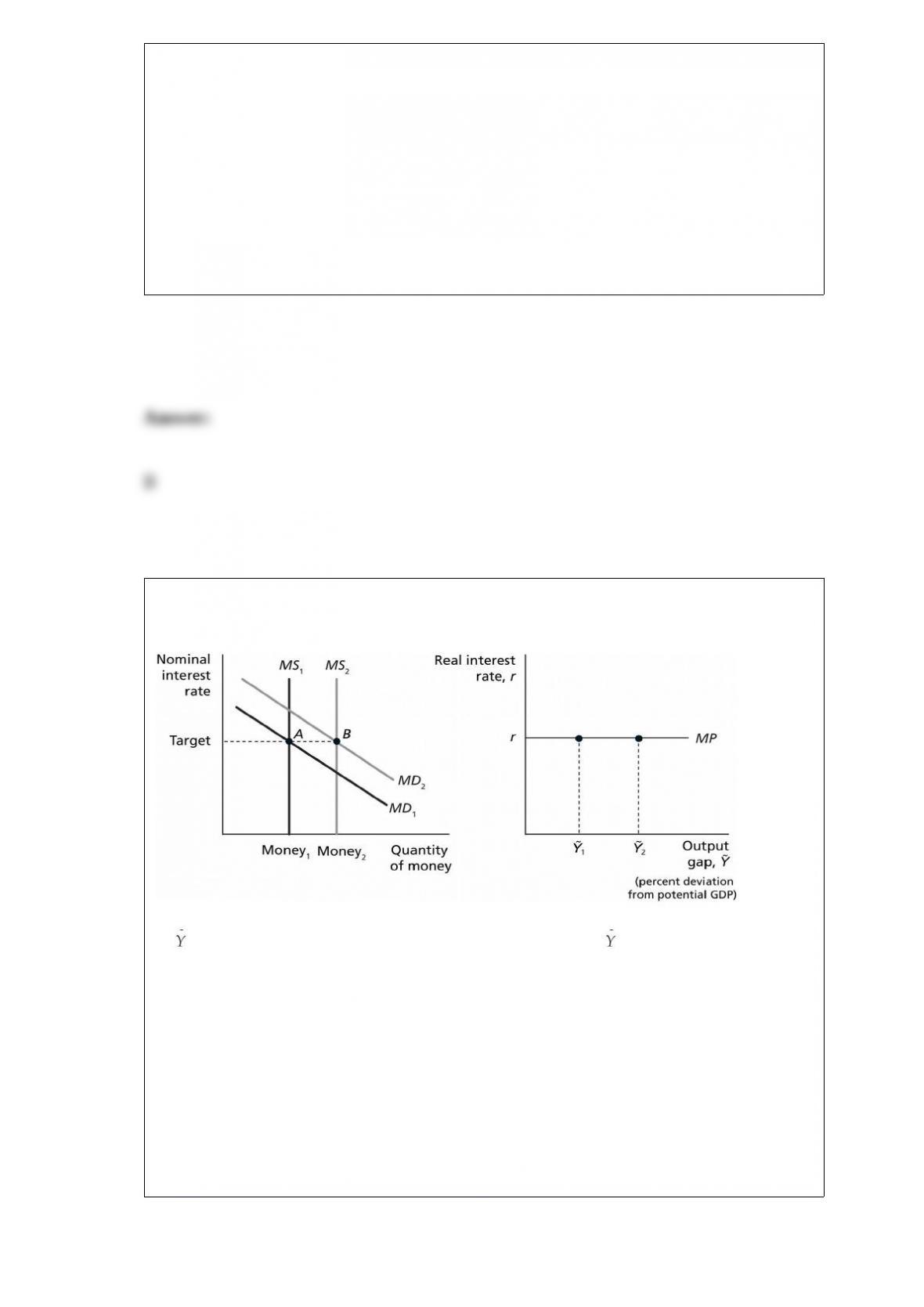
Figure 10.4
Refer to Figure 10.4. Suppose the economy’s equilibrium starts out with an output gap
of 1, and real GDP increases so the output gap increases to 2. If the Fed keeps the
money supply constant, money demand will ________ and the nominal interest rate
will ________.
A) increase; increase
B) increase; decrease
C) increase; remain constant
D) remain constant; remain constant

Reducing ________ unemployment may be beneficial for an economy, but reducing
________ unemployment to zero would definitely reduce the efficiency of the economy
A) structural and frictional; cyclical
B) frictional and cyclical; structural
C) the natural rate of; cyclical
D) structural and cyclical; frictional