1) It is impossible for a nation to have a comparative advantage in producing
everything.
2) A decrease in per unit production costs will shift the aggregate supply curve leftward.
3)
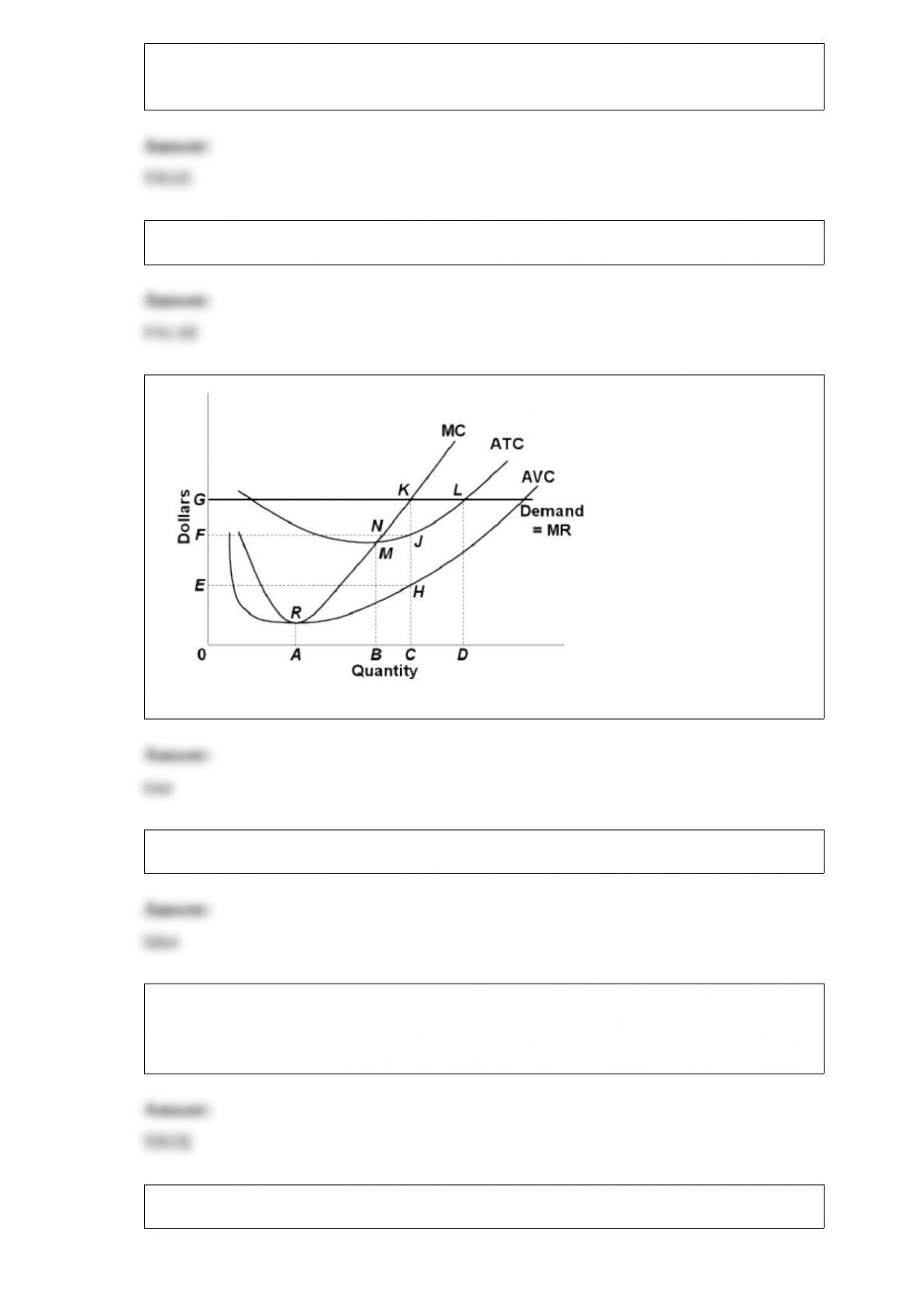
refer to the above diagram. at any price below r the firm will shut down in the short run.
4) indifference analysis assumes that utility is numerically measurable.
5) The U.S. Justice Department, the Federal Trade Commission, state attorneys general,
and injured private parties can independently file charges against firms under the
Sherman Act.
6) when total utility is at a maximum, marginal utility is zero.
7) Price fixing is illegal under Section 1 of the Sherman Act.
8) The equilibrium price level and equilibrium level of real GDP occur at the
intersection of the aggregate demand curve and the aggregate supply curve.
9) ITQs generate the most efficient use of resources when everyone keeps and fills their
own quotas.
10) according to economist donald boudreaux, the world’s tens of billions of individual
resources get arranged productively:
a.because government has become highly effective at central planning.
b.because private property encourages people to consider the alternative uses of their
resources and select those that provide the most rewards.
c.because people tend to be creative and orderly.
d.through random trial and error.
11) an increase in product price will cause:
a.quantity demanded to decrease.
b.quantity supplied to decrease.
c.quantity demanded to increase.
d.the supply curve to shift to the left.
12) which of the following is a demand-increasing factor in the health care market?
a.rising incomes
b.the aging of the population
c.asymmetric information
d.all of these
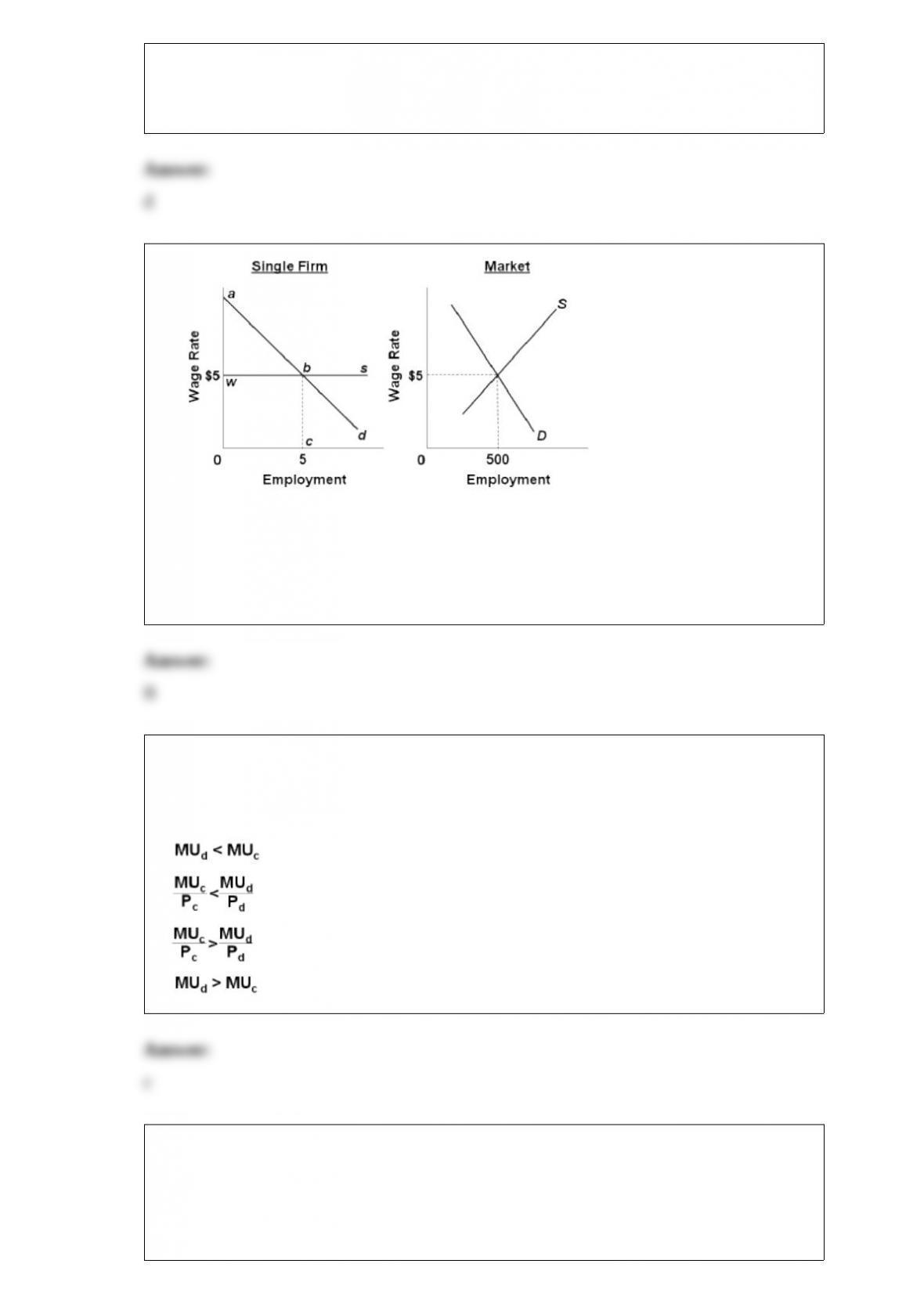
13)
Refer to the above diagrams. The firm:
A.has a principal-agent problem.
B.has a constant marginal resource cost of $5.
C.has a marginal resource cost that exceeds the wage rate for each worker.
D.will fail to maximize profits if it hires 5 workers.
14) assume muc and mud represent the marginal utility that a consumer gets from
products c and d, the respective prices of which are pc and pd. the consumer will
increase his total utility from a specific money outlay by spending more on c and less
on d if initially:
a.
b.
c.
d.
15) barter:
a.is the major means of exchange in centrally planned economies.
b.accounts for over 30 percent of the dollar volume of all exchange in the u.s. economy.
c.entails the exchange of goods for goods.
d.is used to circumvent the problem of a lack of coincidence of wants among potential

buyers and sellers.
16) taxable income is:
a.total income less deductions and exemptions.
b.the same as gross income.
c.only income to which marginal tax rates apply.
d.the sum of all wage and property income.
17) The impact of increasing, as opposed to constant, costs is to:
A.intensify and prolong the comparative advantages that any nation may have initially.
B.expand the limits of the terms of trade.
C.cause the bases for further specialization to disappear as nations specialize according
to comparative advantage.
D.cause nations to realize economies of scale in those products in which they
specialize.
18) Suppose the Federal government had budget surpluses of $80 billion in year 1 and
$120 billion in year 2 but had budget deficits of $10 billion in year 3 and $40 billion in
year 4. Also assume that it used its budget surpluses to pay down the public debt. At the
end of these four years, the Federal government’s public debt would have:
A.increased by $50 billion.
B.increased by $150 billion.
C.decreased by $200 billion.
D.decreased by $150 billion.
19) The basic reason why the commercial banking system can increase its checkable
deposits by a multiple of its excess reserves is that:
A.reserves lost by any particular bank will be gained by some other bank.
B.the central banks follow policies that prevent reserves from falling below the level
required by law.
C.the MPC of borrowers is greater than zero, but less than 1.
D.the banking system must keep reserves equal to 100 percent of its checkable-deposit
liabilities.
20) if the supply and demand curves for a product both decrease, then equilibrium:
a.quantity must fall and equilibrium price must rise.
b.price must fall, but equilibrium quantity may rise, fall, or remain unchanged.
c.quantity must decline, but equilibrium price may rise, fall, or remain unchanged.
d.quantity and equilibrium price must both decline.
21) Suppose that Book-Cost Busters (BCB), without authorization, reproduced a
best-selling novel and placed it for downloading on the BCB pay-for-use website. This
action would violate the publisher’s:
A.profit rights.
B.patent.
C.copyright.
D.trademark.
22) the assertion that “there is no free lunch” means that:
a.there are always tradeoffs between economic goals.
b.all production involves the use of scarce resources and thus the sacrifice of alternative
goods.
c.marginal analysis is not used in economic reasoning.
d.choices need not be made if behavior is rational.
23) Other things equal, economists would prefer:
A.free trade to tariffs and tariffs to import quotas.
B.free trade to import quotas and import quotas to tariffs.
C.import quotas to tariffs and tariffs to voluntary export restrictions.
D.import quotas to free trade and free trade to tariffs.
24) In the inverted-U theory of R&D, which of the following industry concentration
ratios would be most conducive to R&D (as a percentage of firm sales)?
A.1 percent
B.10 percent
C.50 percent
D.70 percent
25) the free-rider problem is that:
a.free public transportation is overcrowded.
b.people will not voluntarily pay for something that they can obtain without paying.
c.government supplies goods at no charge to people who can afford to pay for them.
d.public goods often create large external costs.
26) critics of economic growth:
a.contend that growth and industrialization reduce pollution.
b.argue that economic growth does not resolve socioeconomic problems such as an
unequal distribution of income and wealth.
c.point out that growth results in greater economic security for workers.
d.say that its benefits accrue nearly exclusively to white males.
27) a product has utility if it:
a.takes more and more resources to produce successive units of it.
b.violates the law of demand.
c.satisfies consumer wants.
d.is useful.
28) (Last Word) Suppose you borrow $500 for a year and the lender discounts $75 of
interest at the time the loan is made (giving the borrower only $425). The interest rate
on this loan is about:
A.12.5 percent.
B.14 percent.
C.18 percent.
D.10 percent.
29) suppose an increase in product demand occurs in a decreasing-cost industry. as a
result:
a.the new long-run equilibrium price will be lower than the original long-run
equilibrium price.
b.equilibrium quantity will decline.
c.firms will eventually leave the industry.
d.the new long-run equilibrium price will be higher than the original price.
30) (Consider This) What is the Prisoners Dilemma? How is this dilemma similar to the
one for two firms competing for market share as described in the text?
31) (Last Word) What is the purpose of the Conference Boards index of leading
economic indicators?
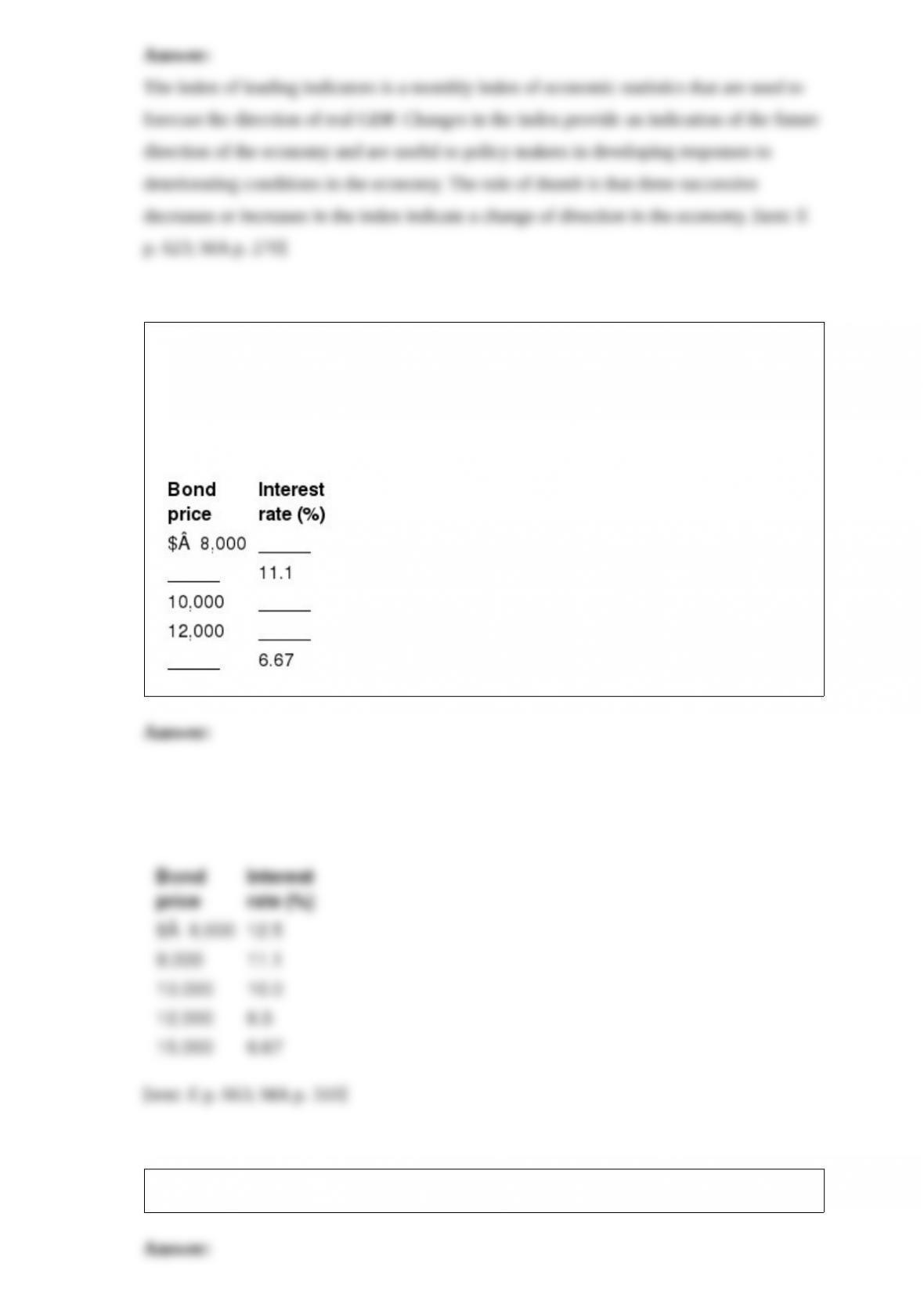
32) Suppose that a bond having no expiration date has a face value of $10,000 and pays
a fixed amount of interest of $1000 annually. Compute and enter in the spaces provided
either the effective interest rate which a bond buyer could receive at the new price or
the bond price (rounded to the nearest $1000) required to receive the interest rate
shown.
33) Dont put all your eggs in one basket. Interpret in terms of economic concepts.
34) What are the main characteristics of modern economic growth? What is the effect
of modern economic growth on the cultural, social and political arrangements of our
times?
35) Assuming the basic purpose is to raise additional revenue, should government levy
an excise tax on cigarettes whose demand is highly inelastic or on a product whose
demand is highly elastic? Are there any other reasons to levy such a tax?
36) What are usury laws and what are their economic effects?
37) What quantity should the purely competitive firm produce to maximize profits?
Analyze from a total revenue and total cost perspective and a marginal revenue and
marginal cost perspective.
38) Describe cost-push inflation in the extended aggregate demand and aggregate
supply model. Explain the policy dilemma for government policy if they take no action
or use monetary and fiscal policy to counter the cost-push inflation.