
At the minimum efficient scale
A) all possible economies of scale have not been exhausted.
B) the firm has achieved the lowest possible average cost of production.
C) any increases in the scale of operation will encounter further economies of scale.
D) marginal cost is at its minimum.
If tolls on a toll road can be raised significantly before commuters will consider using a
free alternative, demand for using the toll road must be
A) inelastic.
B) elastic.
C) unit elastic.
D) perfectly elastic.
Which of the following describes the substitution effect of a price change?
A) The change in demand that results from a change in price, making the good more or
less expensive relative to other goods, holding constant the effect of the price change on
consumer purchasing power.

B) The change in quantity demanded of a good that results from the effect of a change
in price on consumer purchasing power, holding everything else constant.
C) The change in quantity demanded of a good that results from the change in the price
of a substitute for the good.
D) The change in quantity demanded of a good that results from a change in price,
making the good more or less expensive relative to other goods, holding constant the
effect of the price change on consumer purchasing power.
Scenario 17-1
In academia, professors in some disciplines receive higher salaries than others. For
example, professors teaching in business schools receive higher salaries than professors
in the English department. Suppose at Unity College, assistant professors in the
business school earn $80,000 while assistant professors in the English department earn
$50,000. Now suppose the government passes comparable worth legislation that
requires academic institutions to pay all faculty the same salaries.
Refer to Scenario 17-1. Following the passage of comparable worth legislation, Unity
College responds by placing salaries at $65,000. Which of the following is the result of
the legislation?
A) The supply of English professors increases and the supply of business professors
decreases.
B) The demand for English professors decreases and the demand for business
professors increases.
C) There will be a surplus in the market for English professors and a shortage in the
market for business professors.
D) There will be a surplus in the market for English professors and the market for
business professors will not be affected.
Which of the following products allows the seller to identify different groups of
consumers (segment the market) at virtually no cost?
A) early bird dinner specials
B) books sold online
C) a pair of Bose speakers
D) iPhones
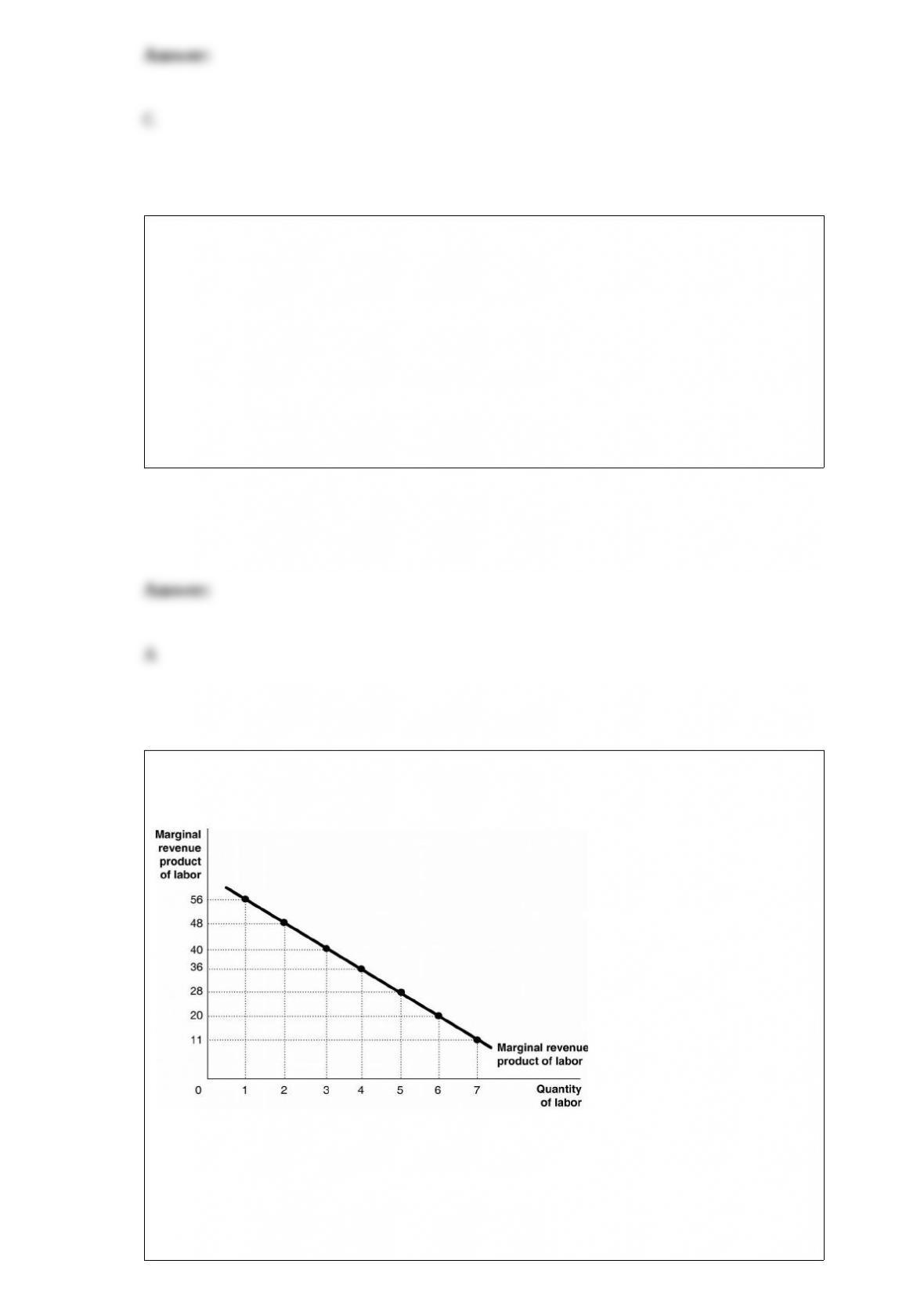
Figure 17-2
Figure 17-2 shows the marginal revenue product for Becca’s Baubles, a producer of
hand-beaded bracelets.
Refer to Figure 17-2. Suppose the market price of bracelets falls to $2. What happens
to the curve given in the diagram?

A) Nothing, because labor’s productivity has not changed.
B) There will be a movement along the curve.
C) The curve shifts to the left.
D) We cannot answer the question without knowing if Becca would want to hire more
workers.
For each of the following pairs of products state which are complements, which are
substitutes, and which are unrelated.
a. Blu-ray discs and video-on-demand
b. Fiat 500 and Mini Cooper S
c. Toothpaste and toothbrush
d. Popcorn and snowboards
e. Razors and razor blades

Writing in the New York Times on the technology boom of the late 1990s, Michael
Lewis argues, “The sad truth, for investors, seems to be that most of the benefits of new
technologies are passed right through to consumers free of charge.” What does Lewis
means by the benefits of new technology being “passed right through to consumers free
of charge”?
A) Firms in perfect competition are price takers. Since they cannot influence price, they
cannot dictate who benefits from new technologies, even if the benefits of new
technology are being “passed right through to consumers free of charge.”
B) In perfect competition, price equals marginal cost of production. In this sense,
consumers receive the new technology “free of charge.”
C) In the long run, price equals the lowest possible average cost of production. In this
sense, consumers receive the new technology “free of charge.”
D) In perfect competition, consumers place a value on the good equal to its marginal
cost of production and since they are willing to pay the marginal valuation of the good,
they are essentially receiving the new technology “free of charge.”
In game theory, the three key characteristics of a game are
A) rules, strategies, and payoffs.
B) rules, regulations, and payoffs.
C) winners, losers, and rules.
D) risks, rewards, and penalties.
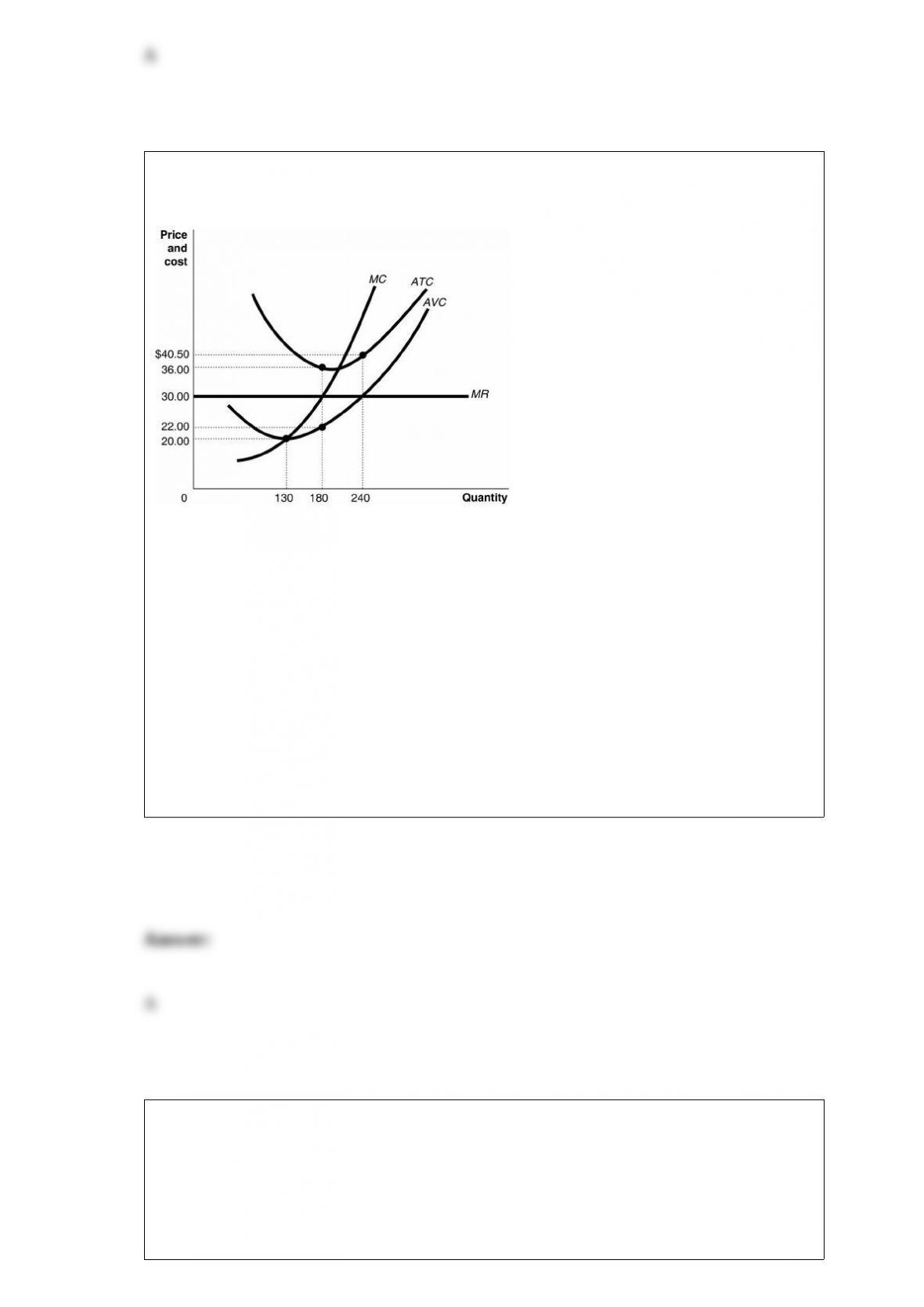
Figure 12-4
Figure 12-4 shows the cost and demand curves for a profit-maximizing firm in a
perfectly competitive market.
Refer to Figure 12-4. If the market price is $30 and the firm is producing output, what
is the amount of the firm’s profit or loss?
A) loss of $1,080
B) profit of $1,440
C) loss of $2,520
D) profit of $1,300
The proposition that the outcome of a majority vote is likely to represent the
preferences of the voter who is in the political middle is called
A) the mean (or average) voter theorem.
B) the voting paradox.
C) the Arrow impossibility theorem.
D) the median voter theorem.
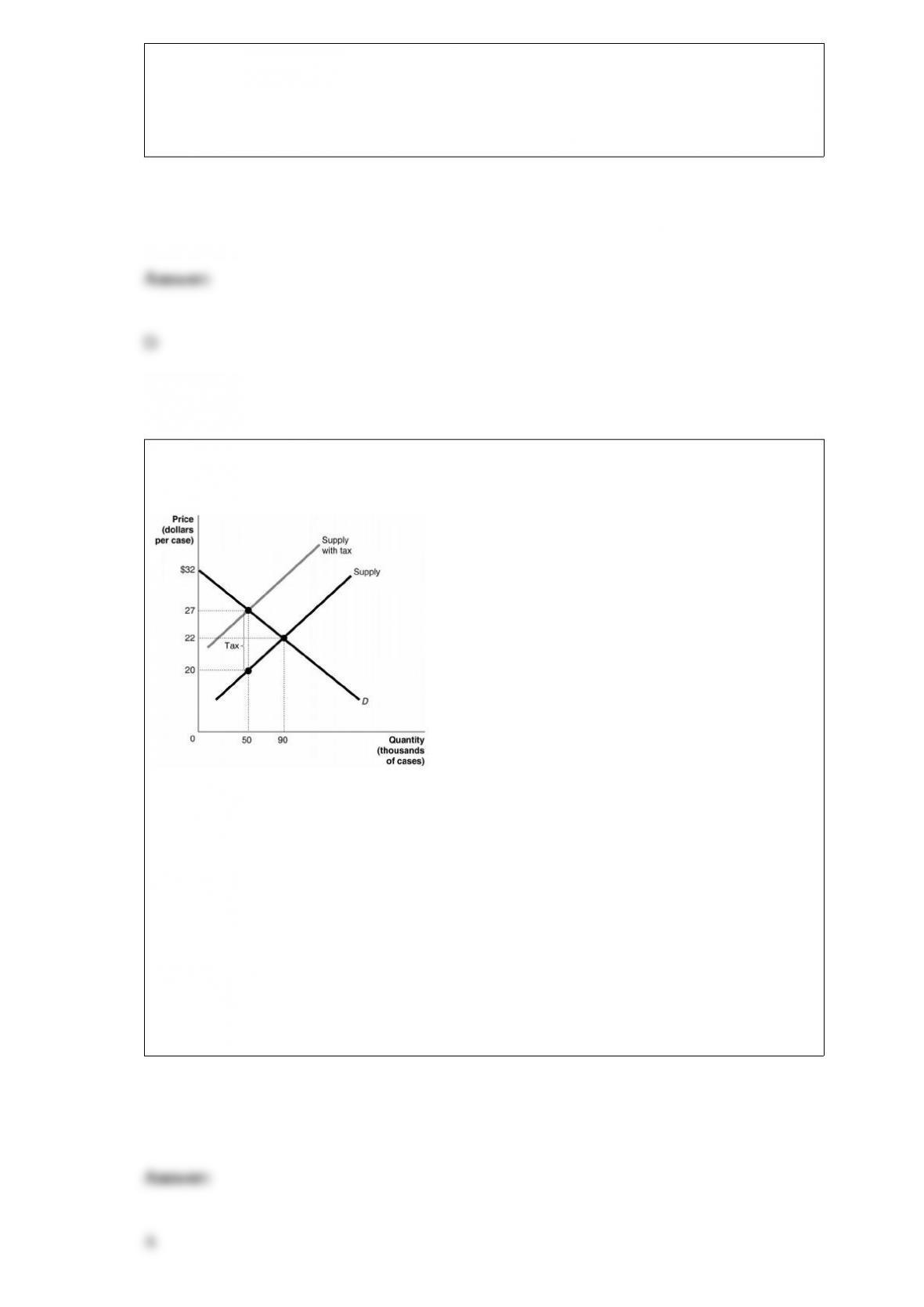
Figure 4-8
Figure 4-8 shows the market for beer. The government plans to impose a unit tax in this
market.
Refer to Figure 4-8. As a result of the tax, is there a loss in consumer surplus?
A) Yes, because consumers paying a price above the economically efficient price.
B) No, because the producer pays the tax.
C) No, because the market reaches a new equilibrium
D) No, because consumers are charged a lower price to cover their tax burden.

Which antitrust law prohibited firms from buying stock in competitors and from having
directors serve on the boards of competing firms?
A) the Clayton Act
B) the Securities and Exchange Act
C) the Sherman Act
D) the Robinson-Patman Act
Consider a public good such as fire protection services. Rich people may benefit more
than the poor from such a service because rich people stand to lose more from a fire that
destroys property. In this case
A) the ability-to-pay principle may support the rich paying more taxes than the poor,
but not the benefits-received principle.
B) the benefits-received principle may support the rich paying more taxes than the poor,
but not the ability-to-pay principle.
C) both the benefits-received and the ability-to-pay principles may support the rich
paying more taxes than the poor.
D) neither the benefits-received nor the ability-to-pay principles may support the rich
paying more taxes than the poor.

Which of the following statements is false?
A) An inverse relationship has a negative slope value.
B) A direct relationship has a positive slope value.
C) A curved line has slope values that change at every point.
D) A straight line has a slope of zero.
Let MP = marginal product, P = output price, and W = wage, then the equation that
represents a situation where a competitive firm should lay off some workers to
maximize profits is
A) P MP = W.
B) P MP > W.
C) P MP < W.
D) MP W = P.
The price of wheat has fallen since 1950. Which of the following explains this price
decline?
A) The price elasticity of demand is less than 1 (in absolute value) and the income
elasticity of demand for wheat is low.
B) The price elasticity of demand is greater than 1 (in absolute value) and the income
elasticity of demand for wheat is low.
C) The price elasticity of demand is less than 1 (in absolute value) and wheat is an
inferior good.
D) The price elasticity of demand is greater than 1 (in absolute value) and the income
elasticity of demand for wheat is greater than 1.
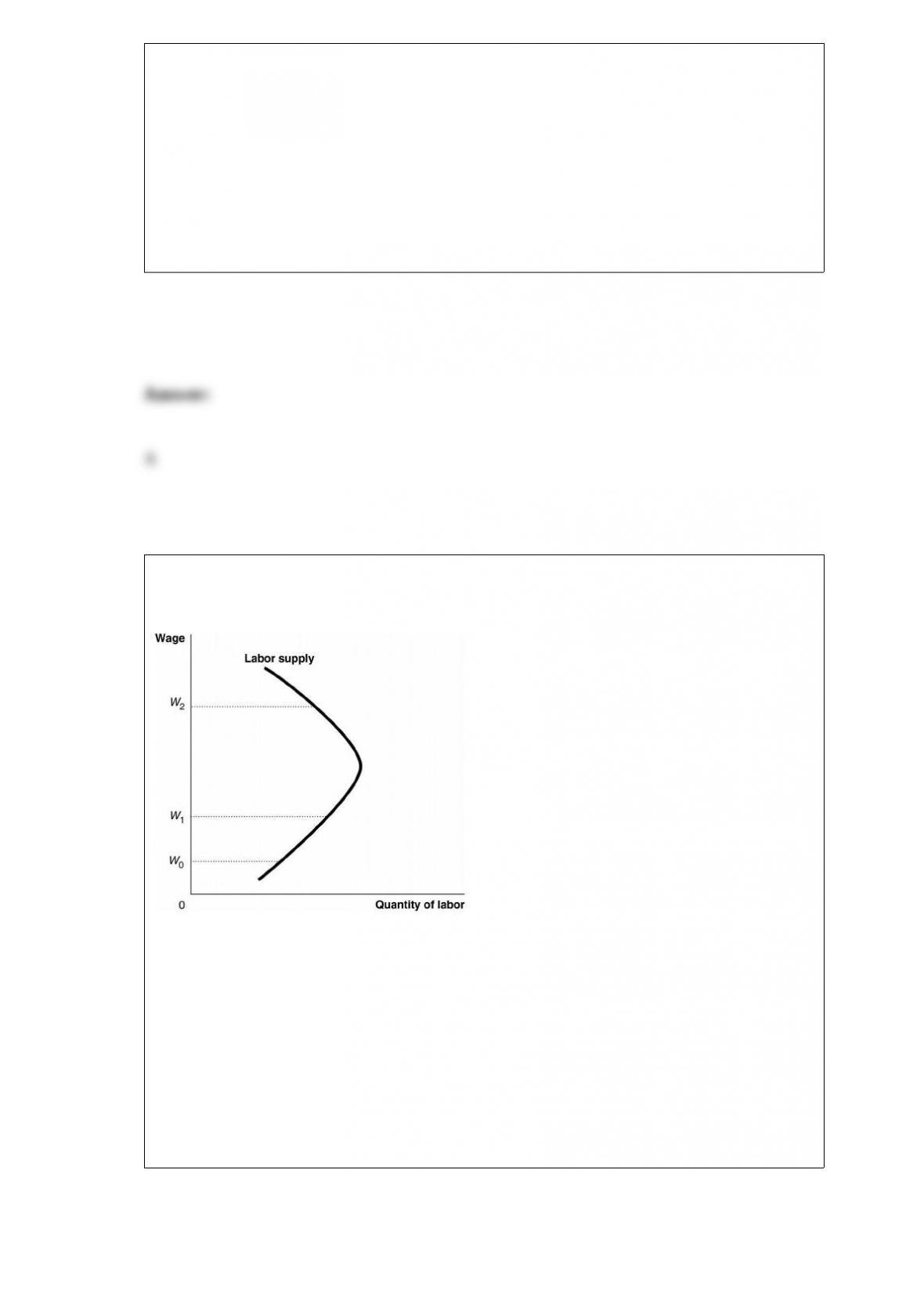
Figure 17-4
Refer to Figure 17-4. Which of the following is true if the wage rate increases from W0
to W1?
A) The income effect is larger than the substitution effect.
B) The substitution effect is larger than the income effect.
C) The income effect and the substitution effect are equal.
D) The supply curve is unit-elastic.
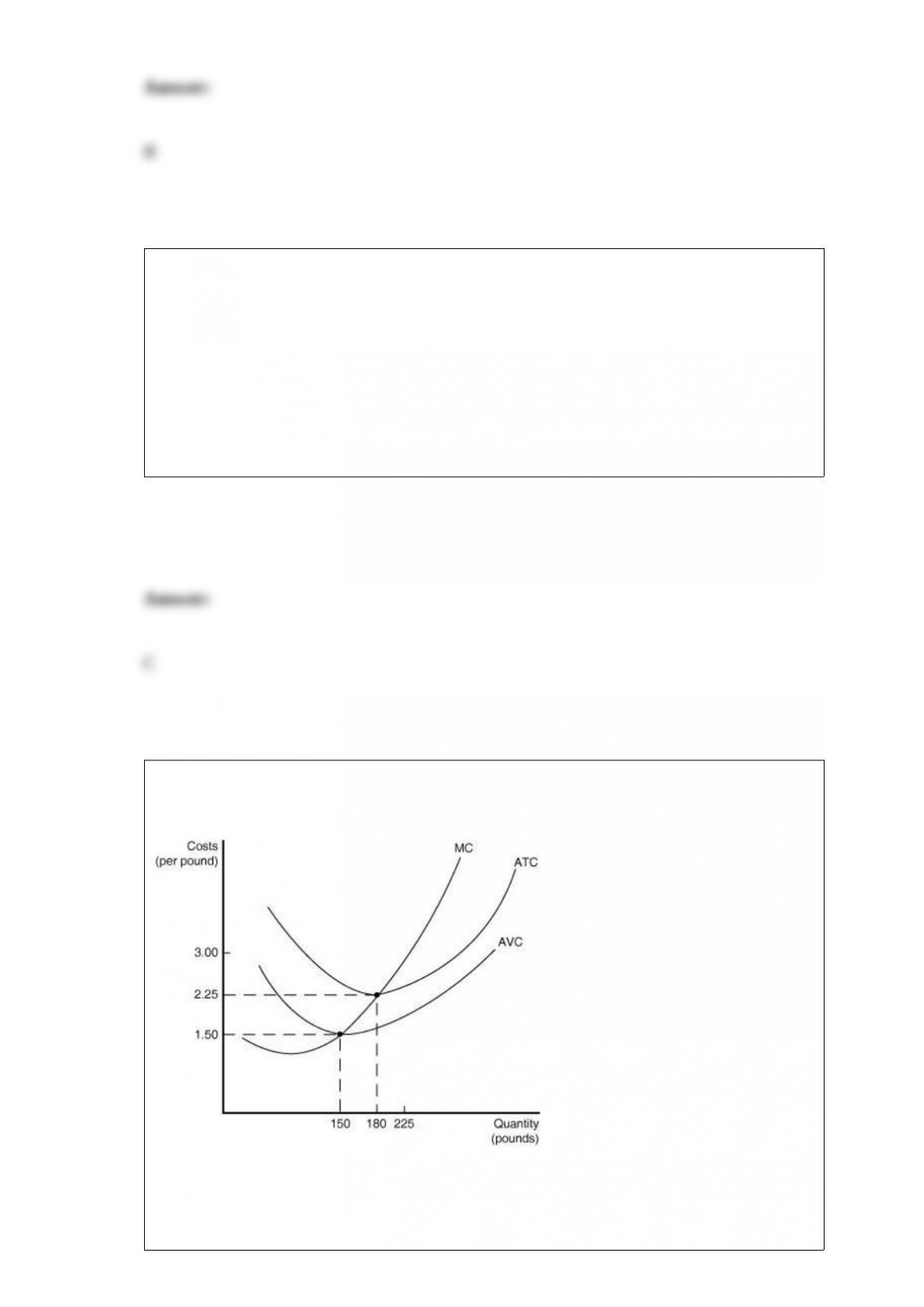
If a firm’s average total cost is less than price where MR=MC,
A) the firm should shut down.
B) the firm should raise its price.
C) the firm should continue to produce the output it is producing.
D) the firm should cut back on its output to lower its cost.
Figure 12-19
Refer to Figure 12-19. The figure above shows the cost curves of a perfectly
competitive firm in the coffee market. Use the graph in Figure 12-19 to answer the
following questions. Assume the market price is $3 per pound.
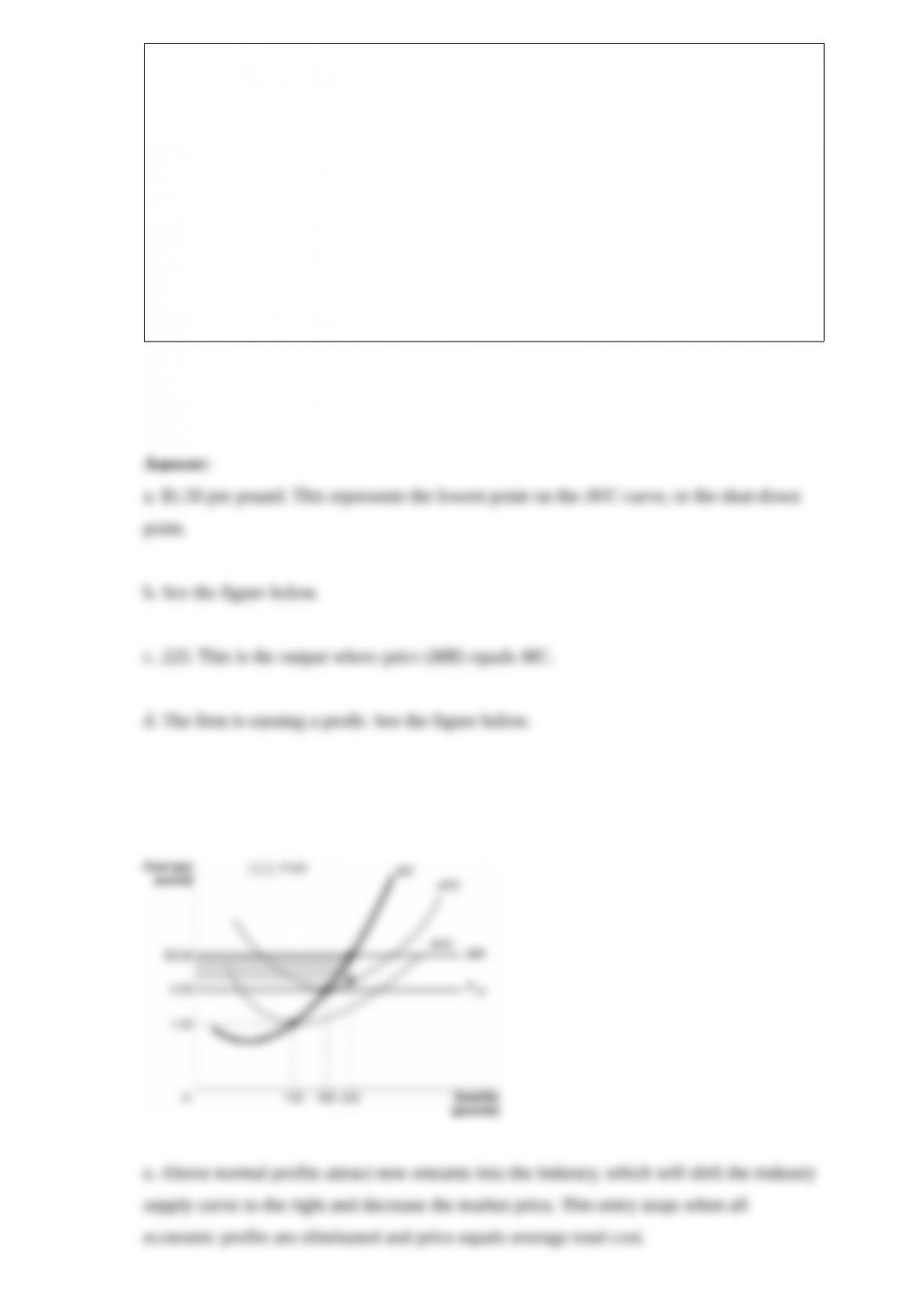
a. What is the lowest price at which the coffee grower will supply output in the short
run?
b. In the diagram draw the firm’s demand curve (label this “MR” for marginal revenue).
c. What is the firm’s profit-maximizing output?
d. Is the firm earning a profit or a loss? Identify the area in the graph that represents the
firm’s profit or loss.
e. Explain how entry or exit will occur in the market to ensure that firms will break
even in the long run.

Allison’s Auto Art is a company that applies pinstripes to vehicles. Allison’s cost for a
basic 1-color pinstriping job is $35, and she charges $95 for this service. For a total
price of $175, Allison will apply a fancier 3-color pinstripe application to an
automobile, a service that adds an additional $40 to the total cost of the package. What
is the marginal cost of moving up from the 1-color application to the 3-color
application?
A) $35
B) $40
C) $80
D) $175
Suppose that some teachers have decided that economic and financial uncertainty have
made the prospect of retiring more risky, and therefore carry a higher cost than not
retiring. By using all available information as they act to achieve their goals, these
teachers are exemplifying the economic idea that
A) people are rational.
B) people respond to economic incentives.
C) optimal decisions are made at the margin.
D) equity is more important than efficiency.
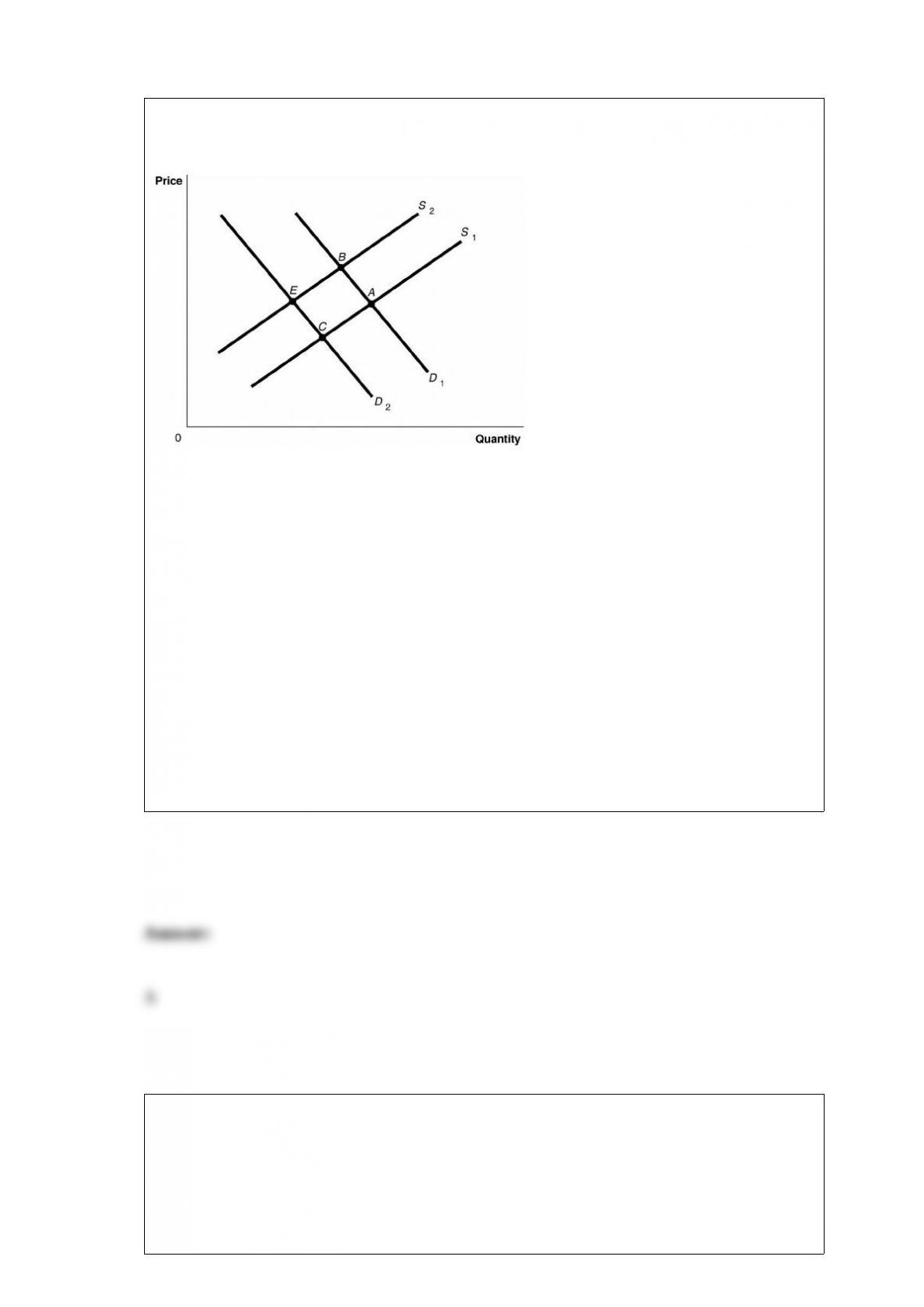
Figure 3-8
Refer to Figure 3-8. The graph in this figure illustrates an initial competitive
equilibrium in the market for apples at the intersection of D1 and S2 (point B). Which of
the following changes would cause the equilibrium to change to point C?
A) A positive change in the technology used to produce apples and decrease in the price
of oranges, a substitute for apples.
B) An increase in the wages of apple workers and an increase in the price of oranges, a
substitute for apples.
C) An increase in the number of apple producers and a decrease in the number of apple
trees as a result of disease.
D) A decrease in the wages of apple workers and an increase in the price of oranges, a
substitute for apples.
If in the market for peaches, the supply curve has shifted to the left
A) the supply of peaches has increased.
B) the supply of peaches has decreased.

C) the quantity of peaches supplied has increased.
D) the quantity of peaches supplied has decreased.
The value of the four-firm concentration ratio that many economists consider indicative
of the existence of an oligopoly in a particular industry is
A) anything greater than 10 percent.
B) anything greater than 20 percent.
C) anything greater than 30 percent.
D) anything greater than 40 percent.
A product is considered to be rivalrous if
A) you can keep those who did not pay for the item from enjoying its benefits.
B) you cannot keep those who did not pay for the item from enjoying its benefits.
C) your consumption of the product reduces the quantity available for others to
consume.
D) it is jointly owned by all members of a community.

Which of the following is not an example of price discrimination?
A) Adobe Systems offers software at discounted prices to students and faculty at K-12
and university levels.
B) Unlike foreign tourists, citizens of Cambodia are exempted from paying an
admission fee to the temples of Angkor.
C) Senior citizens may purchase special fare tickets for public transportation that are
not available to others.
D) Buyers at an automotive parts store receive a discount for bulk buying because the
store is able to pass on to its customers some of the lower average cost for producing
large quantities.
Which of the following is not a characteristic of long-run equilibrium in a
monopolistically competitive market?
A) Selling price equals average total cost.
B) Production is at minimum average total cost.
C) Marginal revenue equals marginal cost.
D) Selling price is greater than marginal cost.

Interdependence of firms is most common in
A) monopolistically competitive industries.
B) monopolistic industries.
C) monopolistically competitive and oligopolistic industries.
D) oligopolistic industries.
With the increased usage of cell phone services, what has happened to the price
elasticity of demand for land-line telephone services?
A) It has become more price inelastic.
B) It has become more price elastic.
C) It has become more income elastic.
D) The absolute value of the price elasticity coefficient has probably gone down.