
Foreign currency prices of the U.S. dollar are currently determined by a managed float
exchange rate system.
The question of whether economic growth is desirable is a positive question, easily
settled by economic analysis.
As the number of firms in a market increases, the supply curve will shift to the left and
the equilibrium price will rise.
Unlike the market process, in the political market it is possible for some individuals to
receive very large benefits from the political process without any significant impact on
their tax bills.

The substitution effect explains why there is an inverse relationship between the price
of a product and the quantity of the product demanded.
A Big Mac costs $4.00 in the United States and 9.00 reals in Brazil. If the exchange rate
is 2 reals per dollar, what is the dollar cost of a Big Mac in Brazil?
A) $0.89
B) $2.25
C) $4.50
D) $8.00
Article Summary. Brandeis University economist Benjamin Shiller has written a
paper which explains how Netflix could combine demographic data with
customers’ Web browsing habits to more accurately predict how much a customer
would be willing to pay for a Netflix subscription, and how using this method of
first-degree price discrimination would generate higher profits. Shiller explains
that the more information a company has about its customers, the better it is at
being able to set prices to increase profits. As he stated in his paper, “Using all
variables to tailor prices, one can yield variable profits 1.39 percent higher than
variable profits obtained using non-tailored 2nd degree price-discrimination.
Using demographics alone to tailor prices raises profits by much less, yielding
variable profits only 0.14% higher than variable profits attainable under 2nd
degree [price discrimination].” Source: Brian Fung, “How Netflix could use Big
Data to make twice as much money off you,” Washington Post, September 4, 2013.

If Netflix chose to use Shiller’s pricing method,
A) consumer surplus would be zero.
B) producer surplus would be zero.
C) deadweight loss would be maximized.
D) consumer surplus, producer surplus, and deadweight loss would all be equal.
Trinh quits his $80,000-a-year job to become a full-time volunteer at a museum. What
is the opportunity cost of his decision?
A) 0 since he will no longer be earning a salary
B) depends on the “going rate” of museum employees
C) at least $80,000
D) the value he attributes to the joy of working at a museum
In recent years online bookseller Amazon.com has lowered its profits by offering some
of its customers free shipping and building more warehouses to hold its inventories.
Which of the following explains Amazon.com’s actions?
A) Amazon.com feared government regulation if its profits were too high.
B) Amazon.com took these actions to deter entry into its market by new online
booksellers.
C) Amazon.com took these actions to compete more effectively with existing online
booksellers.
D) Amazon.com was forced to take these actions because of the bargaining power of its
suppliers.
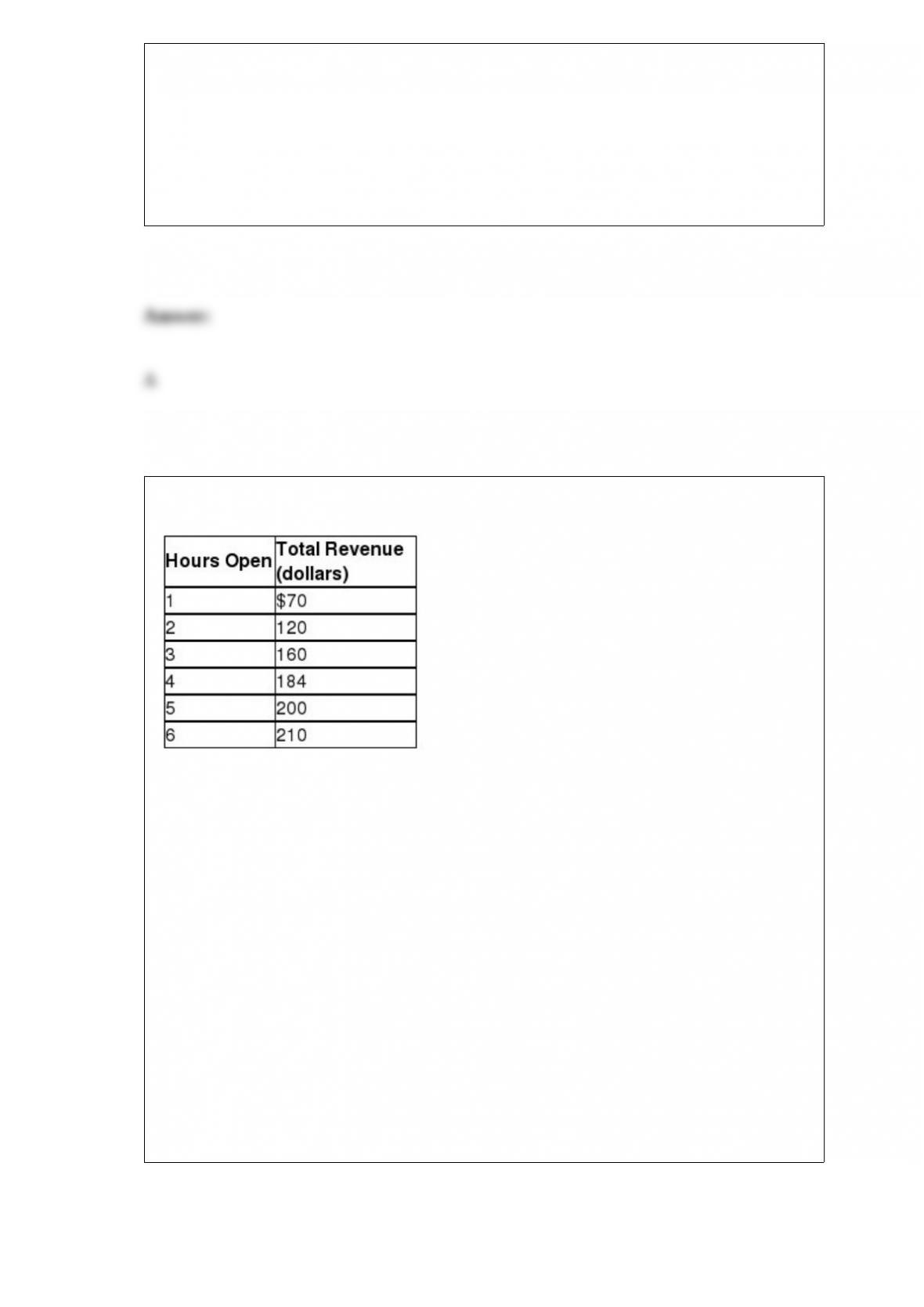
Figure 24-2
Ceteris paribus, a decrease in productivity would be represented by a movement from
A) SRAS1 to SRAS2.
B) SRAS2 to SRAS1.
C) point A to point B.
D) point B to point A.
When the price of summer tank tops falls and you buy more of them because they are
relatively less expensive, this is called
A) the substitution effect.
B) the income effect.
C) the deadweight loss effect.
D) the elasticity effect.
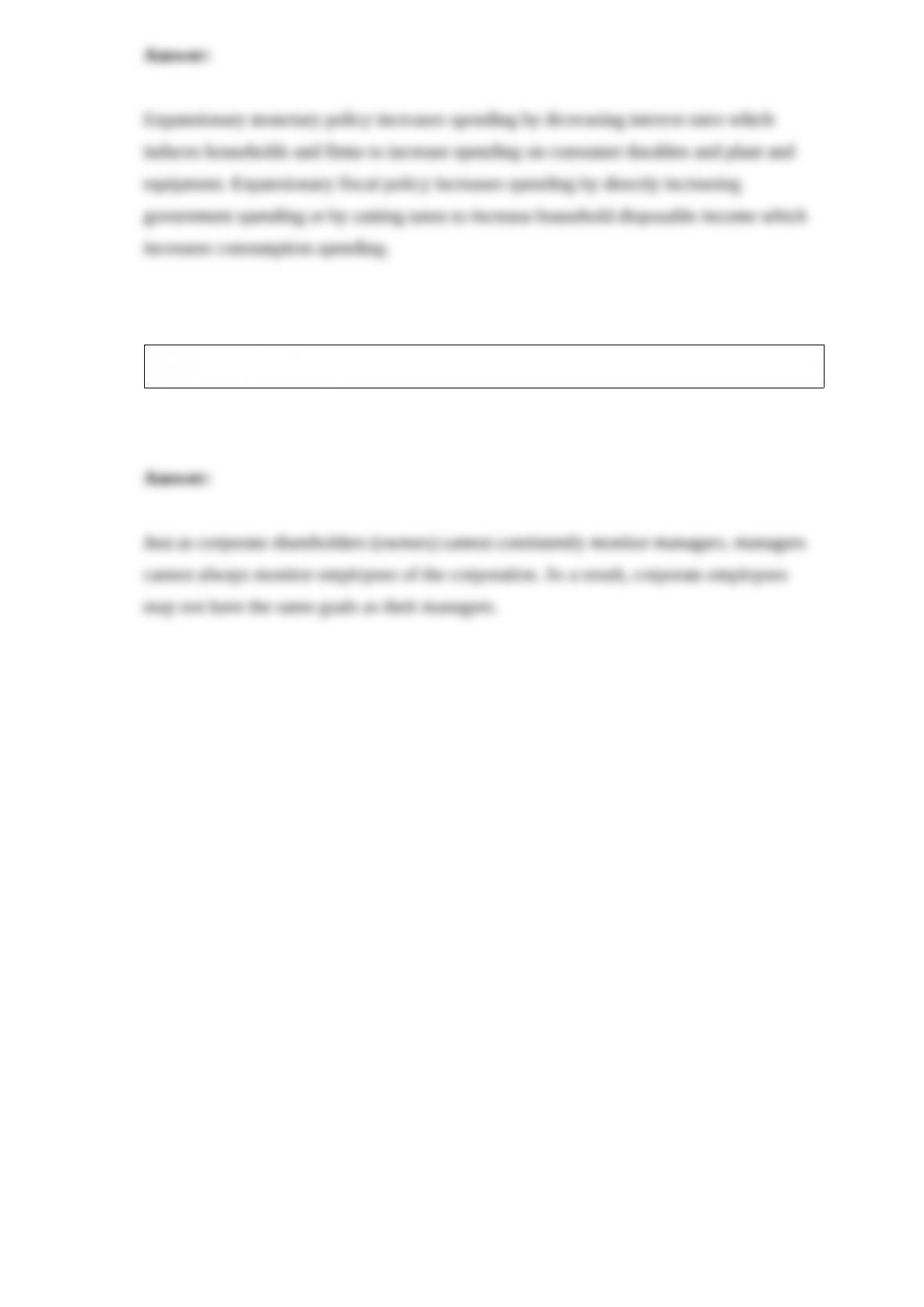
Table 1-3
Santiago runs a comic book store in the town of East Arbor. He is debating whether he
should extend his hours of operation. Santiago figures that his sales revenue will
depend on the number of hours the store is open as shown in the table above. He would
have to hire a worker for those hours at a wage rate of $18 per hour.
Using marginal analysis, determine how many hours should Santiago extend his store’s
hours of operations?
A) 2 hours
B) 3 hours
C) 4 hours
D) 5 hours
E) 6 hours

If Sweden exports cell phones to Denmark and Denmark exports butter to Sweden,
which of the following would explain this pattern of trade?
A) Sweden has a lower opportunity cost of producing cell phones than Denmark, and
Denmark has a comparative advantage in producing butter.
B) The opportunity cost of producing butter in Denmark is higher than the opportunity
cost of producing butter in Sweden.
C) Sweden must have an absolute advantage in producing cell phones, and Denmark
must have an absolute advantage in producing butter.
D) Sweden has a higher opportunity cost of producing cell phones than Denmark, and
Denmark has a higher opportunity cost of producing butter.
________ of unemployment during ________ make it easier for workers to ________
wages.
A) High levels; a recession; accept lower
B) Low levels; an expansion; accept lower
C) Low levels; a recession; negotiate higher
D) High levels; an expansion; negotiate higher

Assume that a comparable worth law is passed that determines that kindergarten
teachers and bricklayers have comparable jobs; therefore, workers in both of these
occupations should be paid the same wages. Assume that prior to the law, bricklayers
were paid a higher wage than kindergarten teachers. Which of the following is the most
likely result of the comparable worth law?
A) The equilibrium wage will be the same for kindergarten teachers and bricklayers.
B) Some former bricklayers will become kindergarten teachers and some former
kindergarten teachers will become bricklayers.
C) There will be a shortage in the market for bricklayers and a surplus in the market for
kindergarten teachers.
D) There will be surplus in the market for bricklayers and a shortage in the market for
kindergarten teachers.
A game in which each player adopts its dominant strategy
A) will not lead to an equilibrium.
B) must be a cooperative game.
C) could result in a Nash equilibrium.
D) can never result in a Nash equilibrium.

Table 4-3
The table above lists the marginal cost of cowboy hats by The Waco Kid, a firm that
specializes in producing western wear. If the market price of cowboy hats is $35, The
Waco Kid will produce
A) 1 hat.
B) 2 hats.
C) 3 hats.
D) 4 hats.
Arbitrage refers to the act of
A) resolving a dispute in front of an arbitrator instead of a court of law.
B) buying a product in one market at a low price and reselling in another market at a
higher price.
C) trading in the foreign exchange market.
D) suing a producer for illegal business practices.

Which of the following exemplifies the tragedy of the commons?
A) Residents on the northern coast of California receive only one public broadcasting
signal which may be eliminated altogether if government funding is cut.
B) The Pleasant Hill community is growing so fast that the city’s only post office is not
able to keep pace with the population growth in the community.
C) Canadian citizens receive free universal health care administered by provincial
governments.
D) The Malaysian tapir, distinguished for its unusual coloration, is a target for poachers
who hunt it for its tough and leathery hide.
In general, the costs tariffs and quotas impose on consumers are
A) large in total but relatively small per person.
B) small in total but relatively large per person.
C) large in total and large per person.
D) small in total and small per person.
Why do banks create money? Do they create money to help the Federal Reserve control
the money supply or is there a more basic reason?

Will equilibrium in a market always result in an outcome that is economically efficient?
Explain.
What is dumping? Who benefits and who loses from dumping?
Goods Differ on the basis of whether their consumption is rival and excludable. Explain
the terms “rivalry” and “excludability” as they are used to define goods. List the four
categories of goods, and define these categories in terms of rivalry and excludability.

(, and we get S = C + I + G – C – G. The consumption values cancel as does the level of
government spending, leaving S = I.
What is corporate governance?
How does expansionary monetary policy increase spending in the economy compared
to how expansionary fiscal policy increases spending in the economy?
How does the principal-agent problem extend to managers and employees?