
1) The following information about a banking system: new currency deposited in the
system = $40 billion; legal reserve ratio = 0.20; excess reserves prior to the currency
deposit = $0.
Refer to the above information. The $40 billion deposit of currency into checking
accounts will create excess reserves of:
A.$20 billion.
B.$32 billion.
C.$40 billion.
D.$0.
2) a nation’s production possibilities curve is bowed out from the origin because:
a.resources are not equally efficient in producing every good.
b.the originator of the idea drew it this way and modern economists follow this
convention.
c.resources are scarce.
d.wants are virtually unlimited.
3) If the demand for money and the supply of money both decrease, the equilibrium:
A.interest rate will decline, but we cannot predict the change in the equilibrium quantity
of money.
B.quantity of money and the equilibrium interest rate will both increase.
C.quantity of money will increase, but we cannot predict the change in the equilibrium
interest rate.
D.quantity of money will decline, but we cannot predict the change in the equilibrium
interest rate.
4) The labor demand curve of a purely competitive seller:
A.slopes downward because the elasticity of demand is always less than unity.
B.slopes downward because of diminishing marginal productivity.
C.is perfectly elastic at the going wage rate.
D.slopes downward because of diminishing marginal utility.
5) the regulatory mechanism of the market system is:

a.self-interest.
b.private property.
c.competition.
d.specialization.
6) A special-interest issue is one whose passage yields:
A.large private benefits compared to external benefits.
B.large external benefits compared to private benefits.
C.small economic losses to a small number of people and large economic losses to a
large number of people.
D.large economic gains to a small number of people and small economic losses to a
large number of people.
7) in the short run a purely competitive firm that seeks to maximize profit will produce:
a.where the demand and the atc curves intersect.
b.where total revenue exceeds total cost by the maximum amount.
c.that output where economic profits are zero.
d.at any point where the total revenue and total cost curves intersect.
8) Suppose the Federal government had budget deficits of $40 billion in year 1 and $50
billion in year 2 but had budget surpluses of $20 billion in year 3 and $50 billion in year
4. Also assume that it used its budget surpluses to pay down the public debt. At the end
of these four years, the Federal government’s public debt would have:
A.increased by $90 billion.
B.increased by $20 billion.
C.decreased by $70 billion.
D.decreased by $20 billion.
9) unemployment rates in the united states:
a.tend to be lower than rates in europe, but higher than rates in japan.
b.tend to be lower than rates in japan, but higher than rates in europe.
c.tend to be lower than rates in europe and japan.
d.tend to be higher than rates in europe and japan.
10) Most modern banking systems are based on:
A.money of intrinsic value.
B.commodity money.
C.100 percent reserves.
D.fractional reserves.
11) The earnings of highly educated workers:
A.rise more slowly than those of less-educated workers.
B.rise more rapidly than those of less-educated workers.
C.rise at about the same rate as those of less-educated workers.
D.stagnate earlier than do those of less-educated workers.
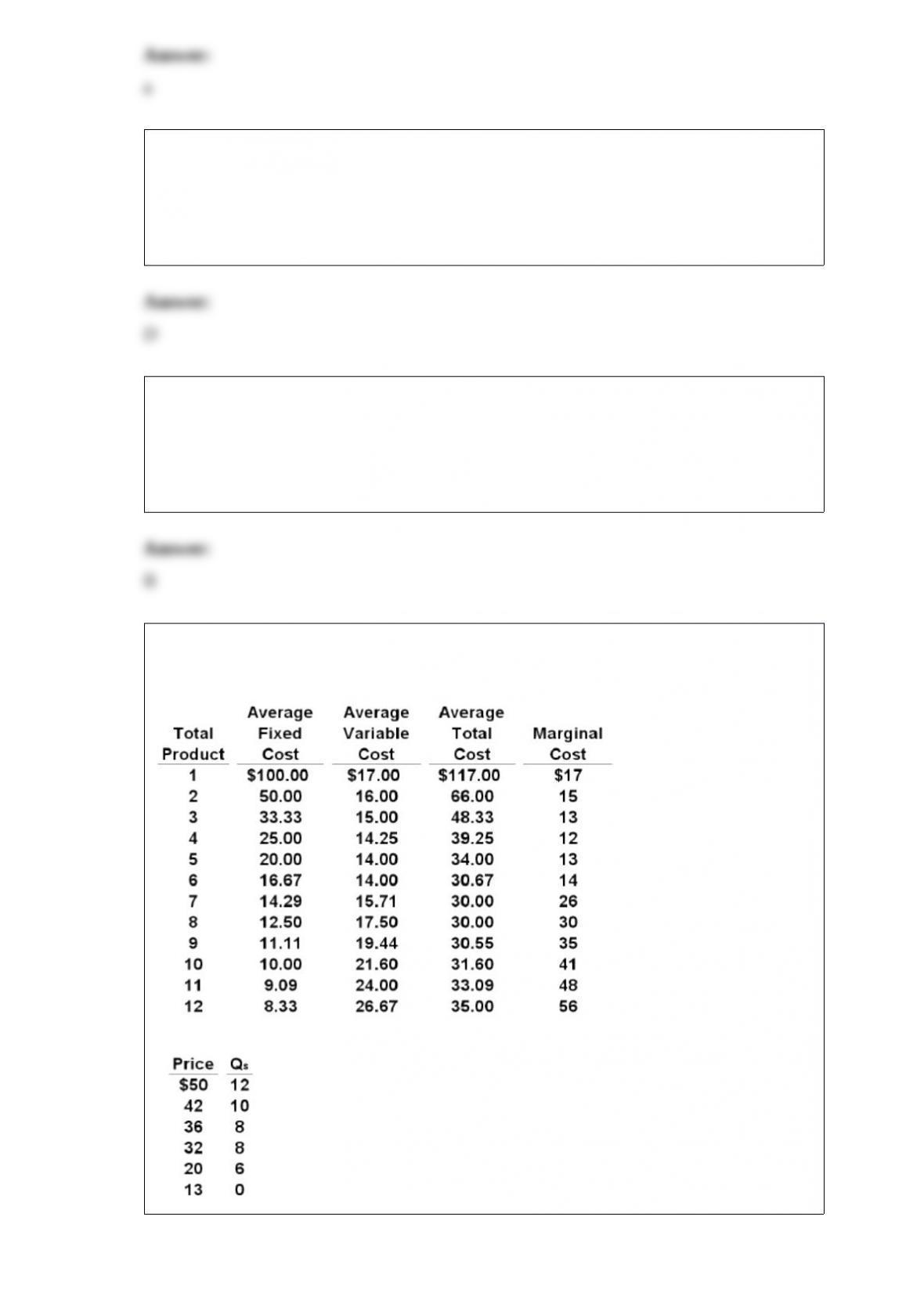
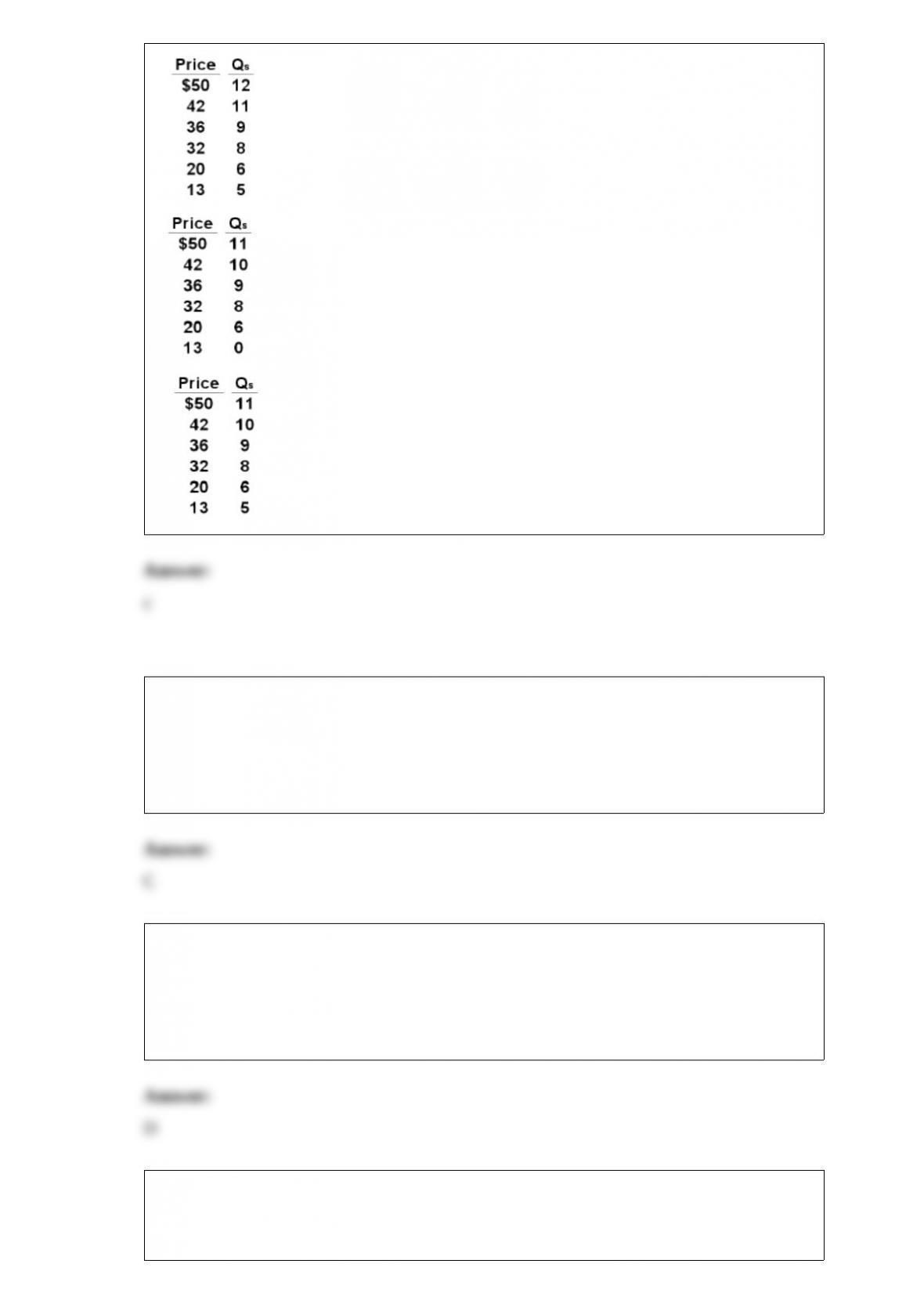
12) the following cost data for a firm that is selling in a purely competitive market:
refer to the above data. which of the following is the firm’s short-run supply schedule?
a.
b.
c.
d.
13) The short-run aggregate supply curve represents circumstances where:
A.both input and output prices are fixed.
B.both input and output prices are flexible.
C.input prices are fixed, but output prices are flexible.
D.input prices are flexible, but output prices are fixed.
14) Banks create money when they:
A.add to their reserves in the Federal Reserve Bank.
B.accept deposits of cash.
C.sell government bonds.
D.exchange checkable deposits for the IOU’s of businesses and individuals.
15) government purchases include government spending on:
a.government consumption goods and public capital goods.
b.government consumption goods only.
c.public capital goods only.
d.government consumption goods, public capital goods, and transfer payments.
16) In the aggregate expenditures model, it is assumed that investment:
A.automatically changes in response to changes in real GDP.
B.changes by less in percentage terms than changes in real GDP.
C.does not respond to changes in interest rates.
D.does not change when real GDP changes.
17) if a firm in a purely competitive industry is confronted with an equilibrium price of
$5, its marginal revenue:
a.may be either greater or less than $5.
b.will also be $5.
c.will be less than $5.
d.will be greater than $5.
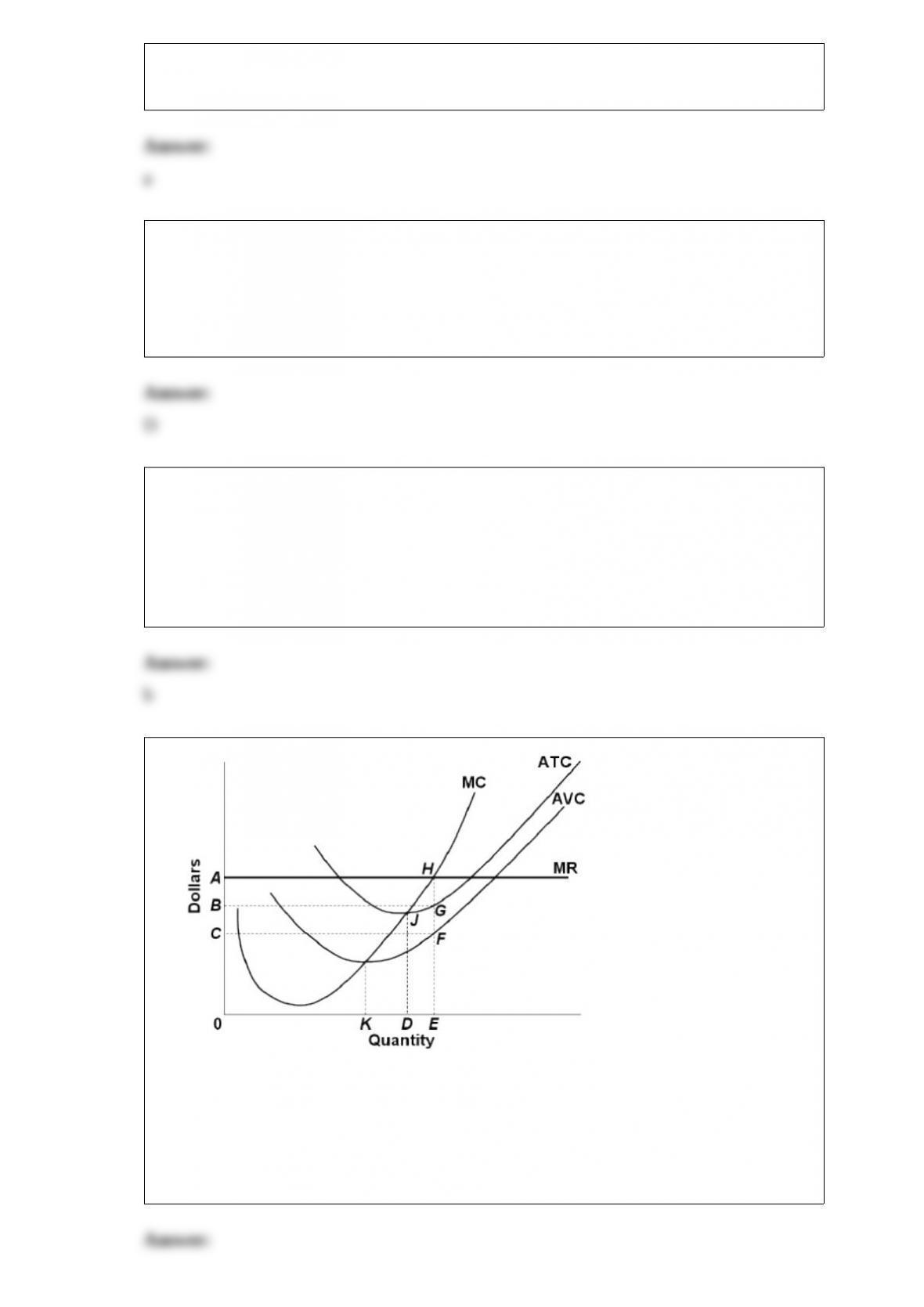
18)
refer to the above diagram. to maximize profit or minimize losses this firm will
produce:
a.k units at price c
b.d units at price j
c.e units at price a
d.e units at price b

19) If the price level does not change from one period to the next:
A.the money supply must have been constant during the period.
B.velocity must have been constant during the period.
C.nominal GDP must have remained constant during the period.
D.none of these responses are valid.