1) if incomes rise rapidly in the united states and u.s. preferences for foreign goods
strengthen, we would expect:
a.the dollar to appreciate in value.
b.the dollar to depreciate in value.
c.the dollar price of foreign monies to decrease.
d.u.s. exports to increase.
2) The output effect occurs:
A.only when wage elasticity of demand is greater than 1.
B.because a change in the price of a resource will alter costs and therefore the
equilibrium output.
C.only when the inputs being employed are substitutes.
D.only when the inputs being employed are complementary.
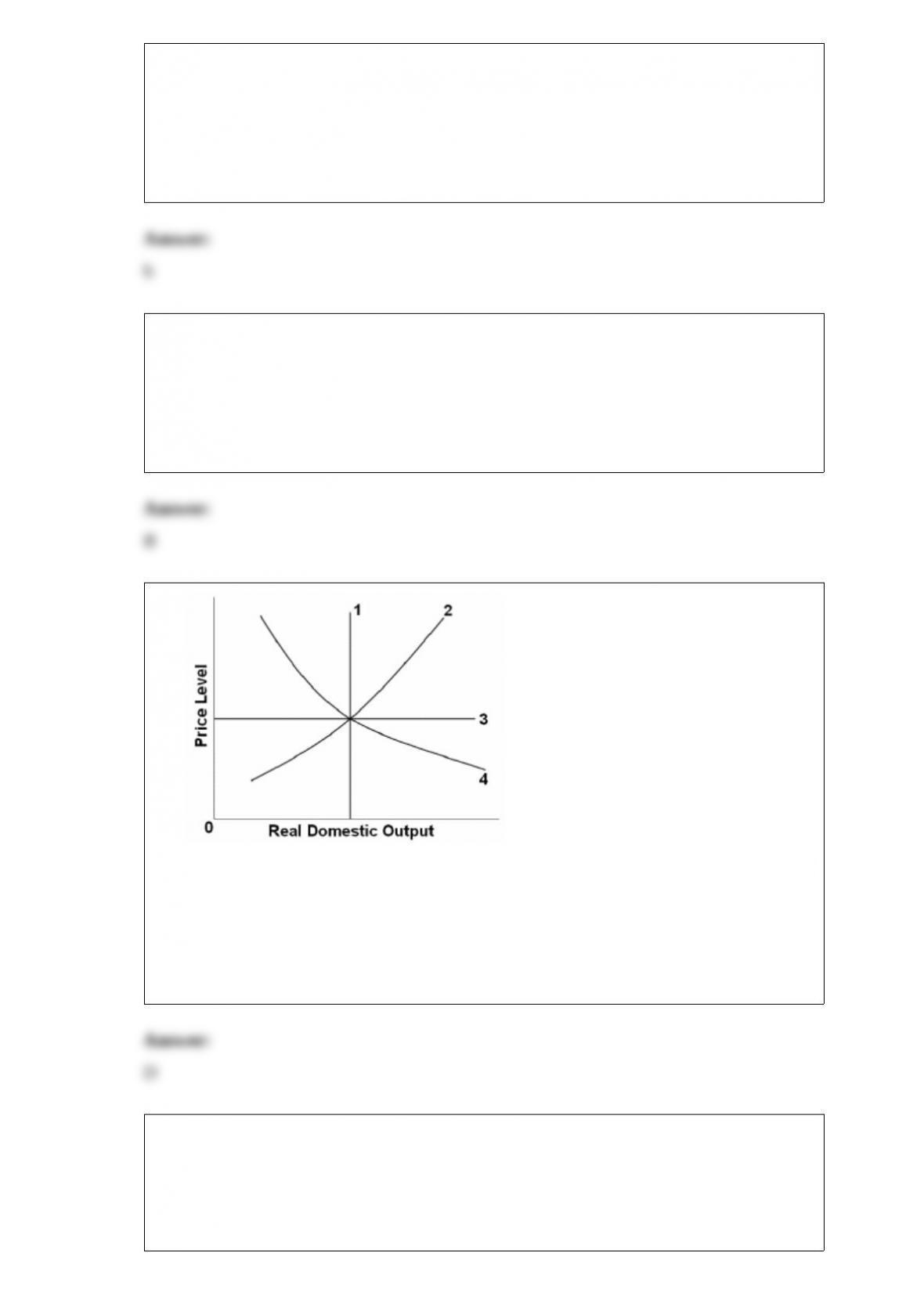
3)
In the above diagram, the economy’s short-run AS curve is line ___ and its long-run AS
curve is line ___.
A.1; 3
B.2; 4
C.3; 4
D.2; 1
4) refer to the above data sets. the equation for data set 5 is:
a.v = .5y.
b.u = -.5v.
c.u = v.
d.v = 2u.
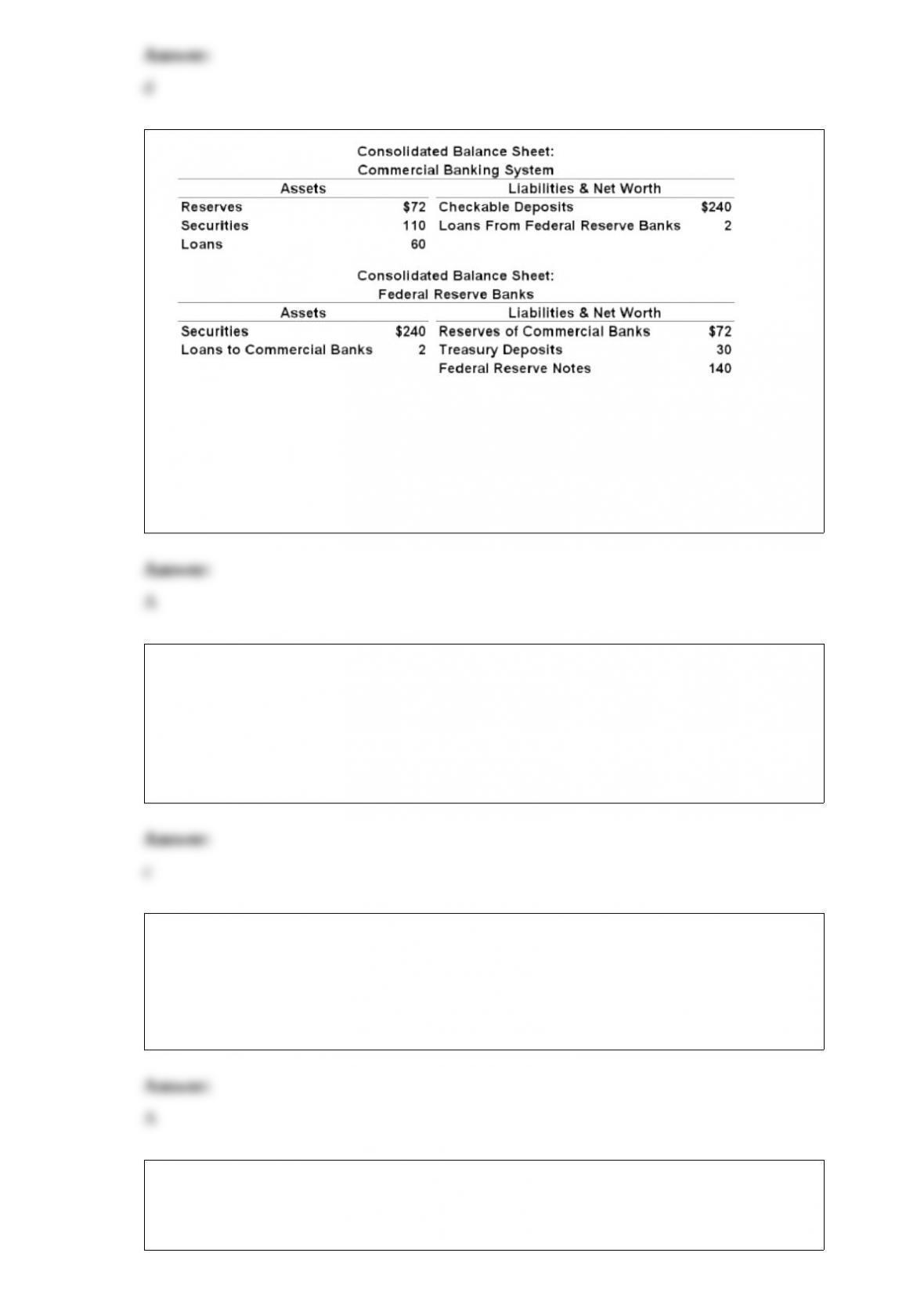
5)
Refer to the above balance sheets. If the reserve ratio is 25%, commercial banks have
excess reserves of:
A.$12.
B.$22.
C.$16.
D.$24.
6) if producers must obtain higher prices than previously to produce various levels of
output, the following has occurred:
a.a decrease in demand.
b.an increase in demand.
c.a decrease in supply.
d.an increase in supply.
7) Which of the following is a true statement?
A.innovation normally follows invention and precedes diffusion.
B.invention normally follows diffusion and precedes innovation.
C.diffusion normally follows invention and precedes innovation.
D.innovation normally follows diffusion and precedes invention.
8) a purely competitive firm’s short-run supply curve is:
a.perfectly elastic at the minimum average total cost.
b.upsloping and equal to the portion of the marginal cost curve that lies above the
average variable cost curve.
c.upsloping and equal to the portion of the marginal cost curve that lies above the
average total cost curve.
d.upsloping only when the industry has constant costs.
9) in the short run, a monopolist’s economic profits:
a.are always positive because the monopolist is a price-maker.
b.are usually negative because of government price regulation.
c.are always zero because consumers prefer to buy from competitive sellers.
d.may be positive or negative depending on market demand and cost conditions.
10) Which of the following are included and which are excluded in calculating this
years GDP? Explain in each instance.
(a)Social Security checks received by a retired person
(b)An increase in business inventories
(c)The income of a tax accountant working for a business
(d)Income received from interest on a corporate bond
(e)The cashing in of a U.S. savings bond
11) If the real output of a DVC increases from $200 billion to $260 billion and its
population increases from 100 to 120 million, its real per capita output will have:
A.remained unchanged.
B.increased by about $167.
C.increased by about $55.
D.decreased by about $20.
12) The efficiency loss of a tax is:
A.the net value of sacrificed output caused by the tax.
B.that portion of the tax paid by producers minus the portion paid by consumers.
C.that portion of the tax paid by consumers minus the portion paid by producers.
D.the total tax revenue minus the output loss caused by the tax.
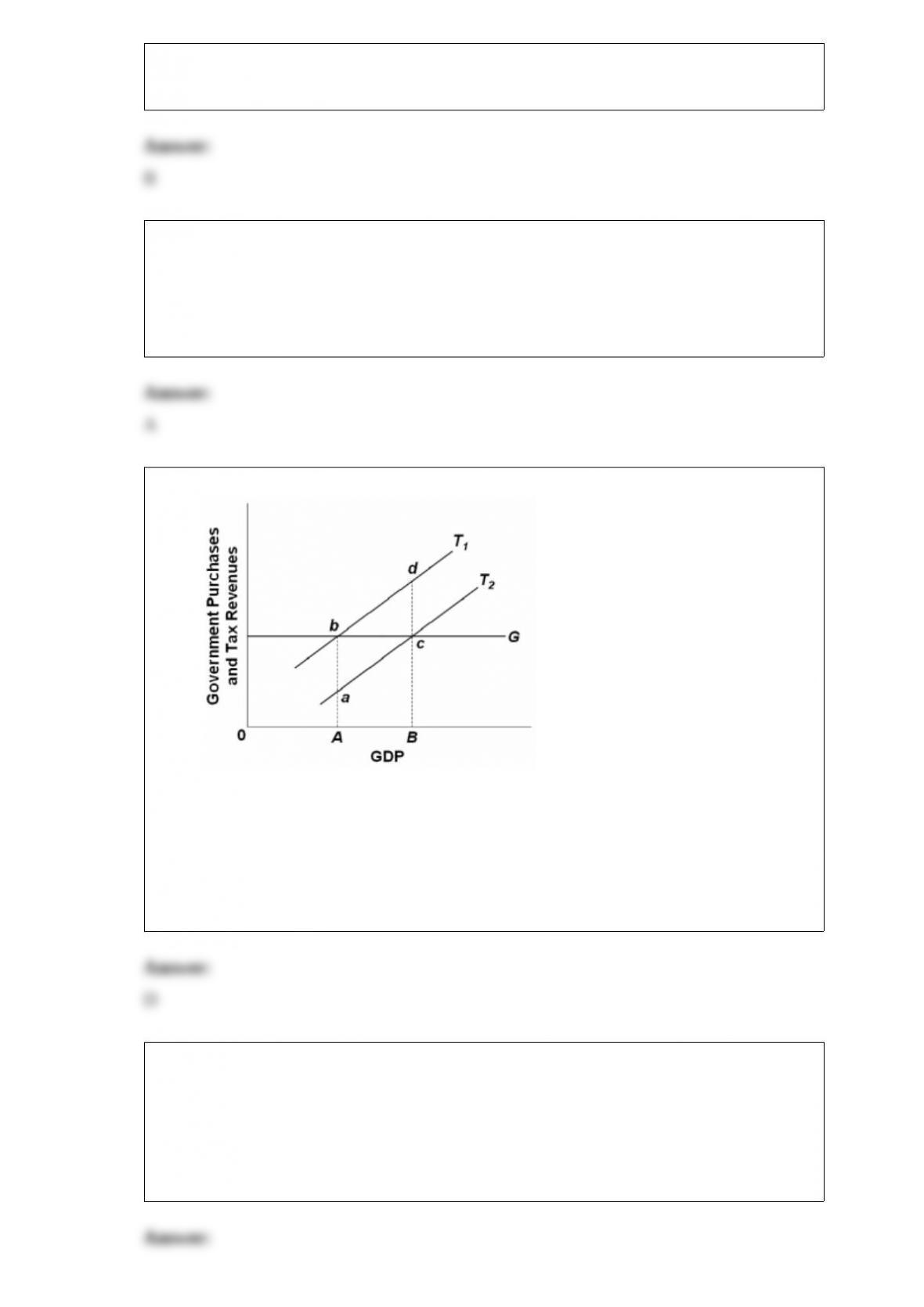
13)
Refer to the above diagram. Assume that G and T1 are the relevant curves, the economy
is currently at B, and the full-employment GDP is A. This economy has a(n):
A.standardized budget surplus.
B.actual budget deficit.
C.standardized budget deficit.
D.actual budget surplus.
14) According to the concept of present value, a $50 barrel of oil today is worth:
A.less than a $50 barrel in 2 years.
B.more than a $50 barrel in 2 years.
C.the same as a $50 barrel in 2 years.
D.the same as a $50 barrel in 2 years, but only if there is no inflation during those 2
years.
15) What are the two main investor preferences and how do they conflict?
16) What economic conditions are necessary to achieve productive and allocative
efficiency under pure competition?
17) What do critics of social regulation need to remember about government?
18) How does the fact that asset prices and expected rates of return are inversely related
cause asset risk and expected rates of return to be positively related?
19) What are the basic purposes of antitrust policy?
20) How does inflation affect peoples standards of living and savings?
21) How will a change in productivity change the demand for a resource? What three
factors will affect productivity?
22) What is the free rider problem and how does it cause the underproduction of a
public good in a competitive market?
23) What is a Lorenz curve? How is it constructed?