
1) Saving is low in many DVCs primarily because income is very equally distributed.
2) The M2 money supply equals M1 minus small time deposits plus Money Market
Mutual Fund balances held by individuals.
3) The banking system can lend by a multiple of its excess reserves because lending
does not result in a loss of reserves to the banking system as a whole.
4) mexican importers are suppliers of pesos in the foreign exchange market.
5) The actual budget may be in deficit while the standardized budget is in surplus.
6) Tax increases and government spending cuts by state governments during recessions
often reduce the expansionary impact of fiscal policy by the Federal government.
7) costs can be defined as total payments made to workers, land owners, and capital
suppliers less payments to the entrepreneur for organizing and combining the other
resources used to produce a good.

8) The total cost of extracting and selling a resource in a given year is the sum of the
extraction cost and user cost.
9) In an uncontrolled or unregulated system commercial bank lending will tend to
intensify the business cycle.
10) the invisible hand refers to the many indirect controls that the federal government
imposes in a market system.
11) The World Trade Organization (WTO) is an international organization designed to
provide short-term advances of foreign monies to those nations faced with trade
deficits.
12) illegal immigration can result in higher wages for domestic-born workers who are
complementary inputs.
13) continued losses in an industry will cause some firms to reduce output or eventually
leave the industry.
14) Given demand, the more inelastic the supply of a product, the larger the portion of
an excise tax that is borne by producers.
15) The recessionary expenditure gap is the amount by which the equilibrium GDP and
the full-employment GDP differ.
16) given the availability of the medicaid program, why are so many poor people
uninsured?
a.because only a fixed percentage of the population can participate in medicaid at any
time.
b.because many poor people earn enough that they do not qualify for medicaid.
c.because nonincome requirements screen many poor people from the program.
d.because only native-born americans are eligible for the program.
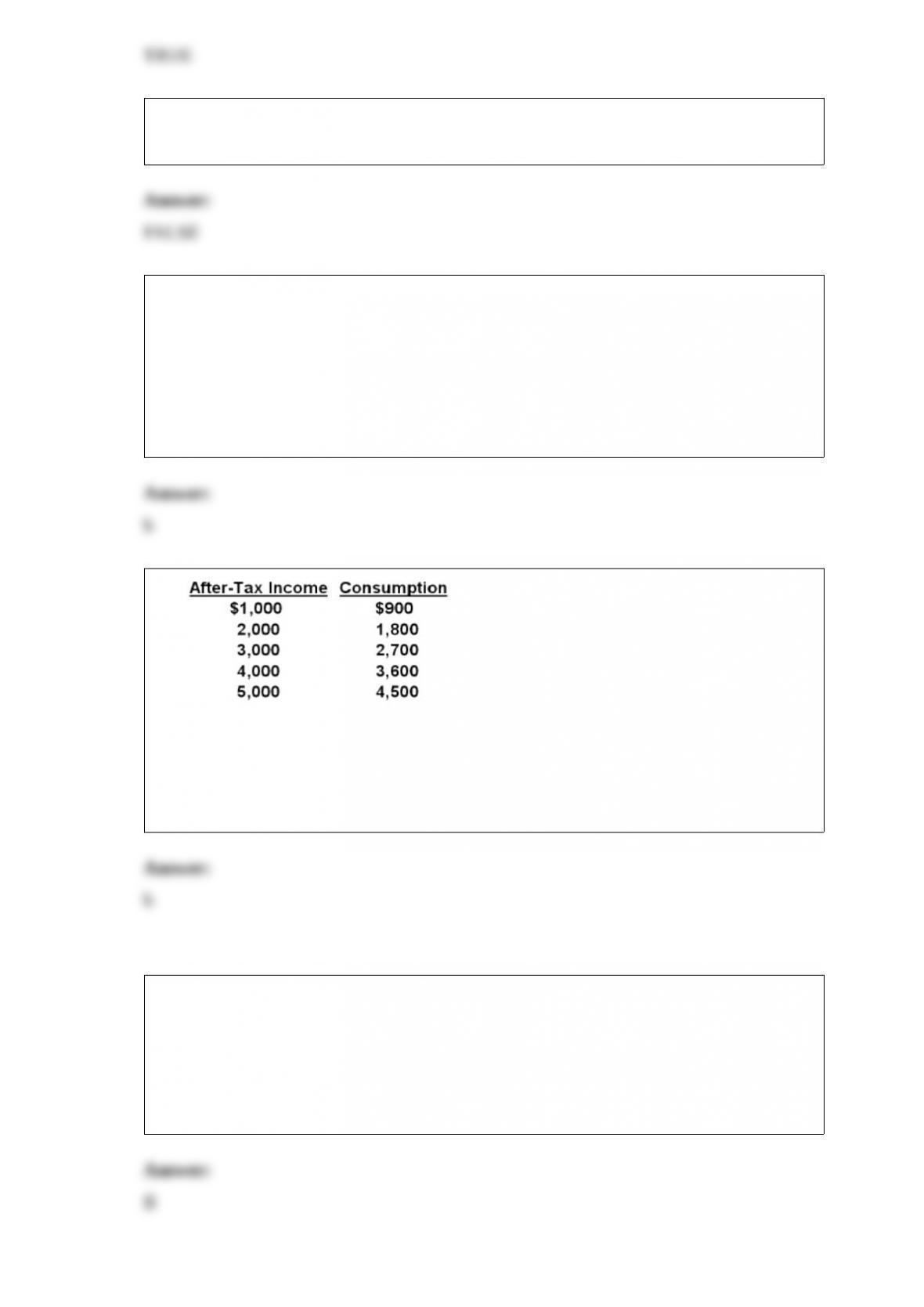
17)
the above data suggest that:
a.consumption varies inversely with after-tax income.
b.consumption varies directly with after-tax income.
c.consumption and after-tax income are unrelated.
d.a tax increase will increase consumption.
18) Tying agreements:
A.are legal in the United States, even though they may reduce competition.
B.occur when the purchase of one product obligates the buyer to purchase other
products from the same seller.
C.refer to any long-term contract between a buyer and a seller.
D.were outlawed by the Celler-Kefauver Act.
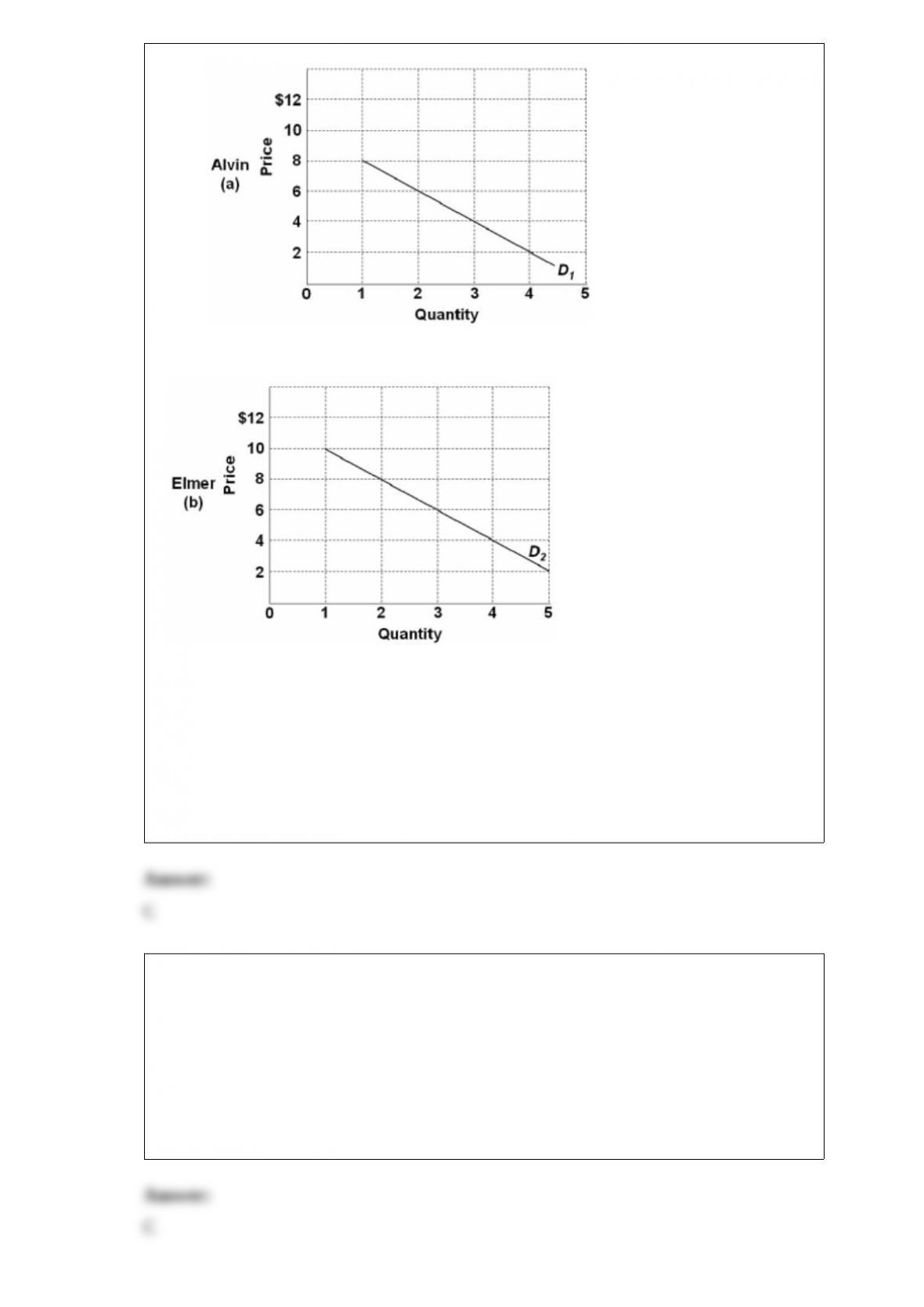
19)
Refer to the above diagrams in which figures (a) and (b) show demand curves reflecting
the prices Alvin and Elmer are willing to pay for a public good, rather than do without
it. If the marginal cost of the optimal quantity of this public good is $10, the optimal
quantity must be:
A.1 unit.
B.2 units.
C.3 units.
D.4 units.
20) Which of the following statements is correct?
A.The price support program hastened the exodus of resources from agriculture.
B.The main beneficiaries of government price support assistance were the very
low-income farmers.
C.If the demand for agricultural products is inelastic, a relatively small decrease in
supply will increase gross farm incomes.
D.There is a misallocation of resources in rural America because of absolute and
relative increases in the size of the farm population.
21) unlike demand-pull inflation, cost-push inflation:
a.is self-limiting.
b.drives up the price level.
c.increases nominal income.
d.increases real income.
22) The velocity of money:
A.is defined as the number of times per year the average dollar is spent on final goods
and services.
B.is defined as the multiple by which a final increase in GDP exceeds an initial increase
in spending.
C.is equal to the reciprocal of the monetary multiplier.
D.has been nearly constant during the past several decades.
23) the supply curve for a monopolist is:
a.perfectly elastic.
b.upsloping.
c.that portion of the marginal cost curve lying above minimum average variable cost.
d.nonexistent.
24) Use the extreme points from a production possibilities schedule below to draw two
straight line production possibilities curves for two nations, A and B using the below
graphs. Assume constant costs.
(a)What is the cost ratio for the two products?
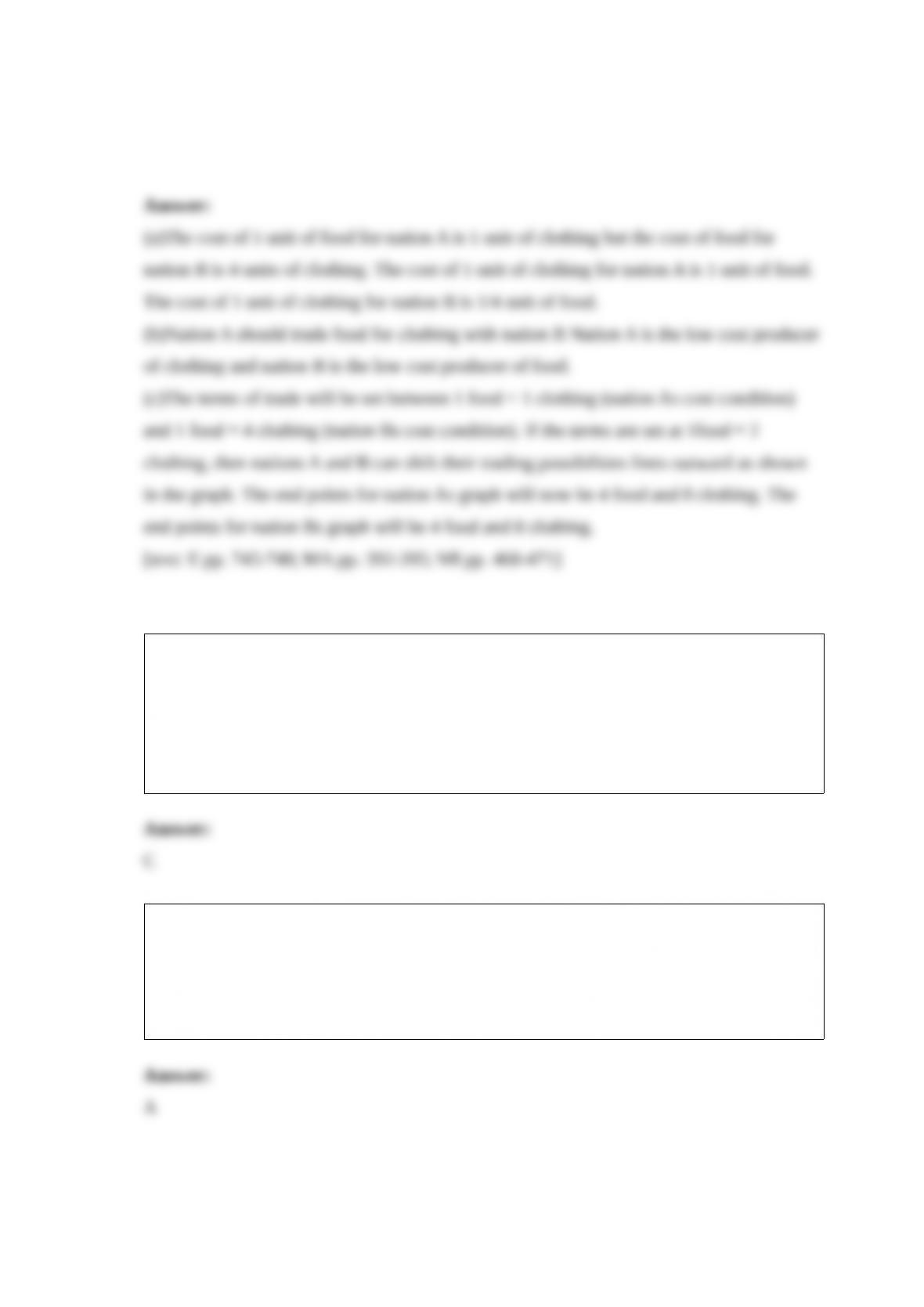
(b)If each nation specializes according to comparative advantage, who should produce and
trade each product? Why?
(c)What will be the range for the terms of trade? If the terms are set at 1 food = 2 clothing,
show how the trading possibilities lines will change in the graph. Explain.
25) Suppose the multiplier is 4 and lump-sum taxes are increased by $16 in a closed
economy. We can predict that:
A.GDP will increase by $64.
B.GDP will decrease by $64.
C.the aggregate expenditures schedule will shift downward by $12.
D.inflation will occur.
26) Which of the following will increase commercial bank reserves?
A.the purchase of government bonds in the open market by the Federal Reserve Banks
B.a decrease in the reserve ratio
C.an increase in the discount rate
D.the sale of government bonds in the open market by the Federal Reserve Banks
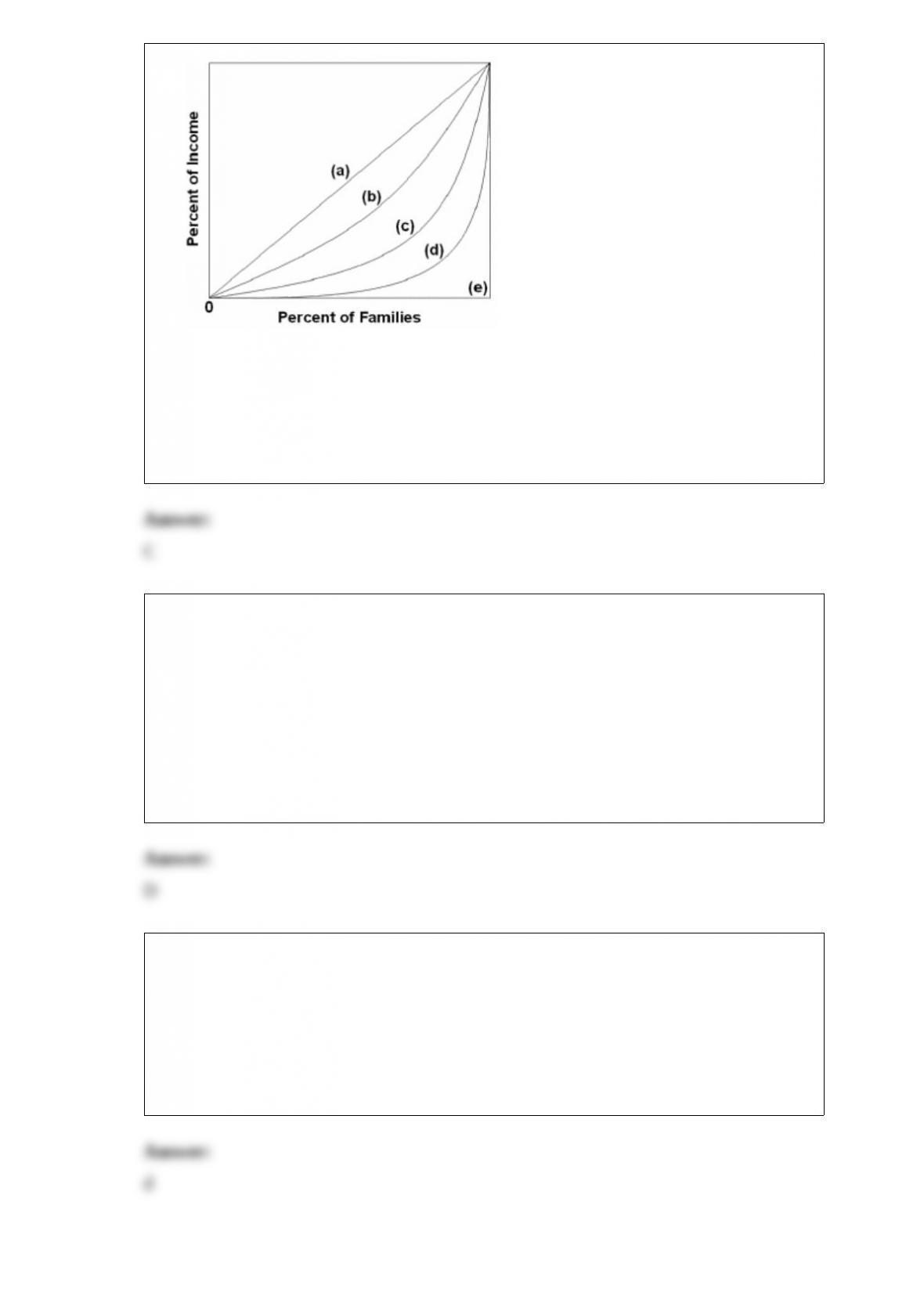
27)
Refer to the above diagram where curves (a) through (e) are for five different countries.
The Gini ratio is:
A.zero in country (e) and 1 in country (a).
B.greater in country (b) than in country (c).
C.zero in country (a) and 1 in country (e).
D.less than 0.5 in country (d).
28) Which of the following statements best describes the parity concept?
A.The prices of farm commodities should vary inversely with changes in the
prices-paid index for farmers.
B.Because of productivity increases, farmers are entitled to the same real income for a
smaller volume of output.
C.The money incomes of farmers should always be the same, regardless of increases or
decreases in the prices of the products they buy.
D.The production of a given real output entitles the producer to the same real income
over time.
29) an economist for a bicycle company predicts that, other things equal, a rise in
consumer incomes will increase the demand for bicycles. this prediction is based on the
assumption that:
a.there are many goods that are substitutes for bicycles.
b.there are many goods that are complementary to bicycles.
c.there are few goods that are substitutes for bicycles.
d.bicycles are normal goods.

30) the government agency responsible for collecting and reporting unemployment data
is the:
a.bureau of labor statistics.
b.bureau of unemployment.
c.bureau of economic analysis.
d.bureau of economic research.
31) if l and m are complementary goods, an increase in the price of l will result in:
a.an increase in the sales of l.
b.no change in either the price or sales of m.
c.a decrease in the sales of m.
d.an increase in the sales of m.
32) The impact of increasing, as opposed to constant, costs is to:
A.intensify and prolong the comparative advantages that any nation may have initially.
B.expand the limits of the terms of trade.
C.cause the bases for further specialization to disappear as nations specialize according
to comparative advantage.
D.cause nations to realize economies of scale in those products in which they
specialize.
33) the vertical distance between the total cost and the total variable cost curves differs
by an amount which:
a.initially increases, but then decreases, as output increases.
b.is constant as output changes.
c.decreases as output increases.
d.increases as output increases.
34) Compare and explain the significance of the substitution and output effects as they
apply to resource pricing. What relationship, if any, do they bear to the income and
substitution effects discussed in connection with product demand?
35) What is the argument for income inequality?
36) What are the similarities and differences in the economic effects of tariffs and
quotas?
37) The sizeable and continuous flow of immigrants into the United States seems to
indicate that there is a positive return to moving. Many economic immigrants, however,
never achieve pay-parity with similarly educated native-born workers while others
eventually outdo domestic-born workers in salary wage advancement. Explain.
38) What are the many different sources of funding to finance firms R&D expenditures?
If an entrepreneur uses personal funds is there a cost for financing?
39) Suppose the economy is experiencing a recession and high unemployment. What
would be the interpretation of how an expansionary monetary policy would address this
problem?
40) When a check is drawn against bank A and deposited in another bank, the first bank
loses reserves as the check is cleared. Yet the check collection involves no loss of
reserves by the banking system. Explain what significance this has for the lending
ability of the system as a whole.
41) Assume that labor and capital are substitutes in production. If there is an increase in
the price of capital, how can this lead to either an increase or decrease in the demand
for labor?
42) What economic conditions are necessary to achieve productive and allocative
efficiency under pure competition?