
When a firm’s long-run average cost curve is horizontal for a range of output, then that
range of production displays
A) increasing returns to scale.
B) constant returns to scale.
C) decreasing returns to scale.
D) constant average fixed costs.
Which of the following will prevent firms from engaging in price discrimination?
A) yield management
B) arbitrage
C) transactions costs
D) odd pricing
If a monopolist’s price is $50 per unit and its marginal cost is $25, then
A) to maximize profit the firm should increase output.
B) to maximize profit the firm should decrease output.

C) to maximize profit the firm should continue to produce the output it is producing.
D) Not enough information is given to say what the firm should do to maximize profit.
According to public choice theory, policymakers
A) place the interests of the public above their own self-interest.
B) are likely to pursue their own self-interest, even if their self-interest conflicts with
the public interest.
C) act in ways to maximize economic efficiency.
D) act in ways to bring about an equitable distribution of society’s wealth.
The Brooks Appliance Store and the Lefingwell Appliance Store (both are located in the
same city) each sell an identical washer-dryer pair. The owner of each store considered
offering the washer-dryer pair for $700, but decided on a price of $500. If this is a Nash
equilibrium we can conclude that
A) each store owner feared charging the higher price would result in being undercut by
the other store charging the lower price.
B) the owners of the stores feared that charging $700 could be used as evidence of
collusion.
C) charging $500 was the most profitable strategy for each store, regardless of what
price was charged by the other store.
D) the stores were less concerned about making a profit from the washer-dryer pair than
they were with attracting customers who would also buy other appliances.
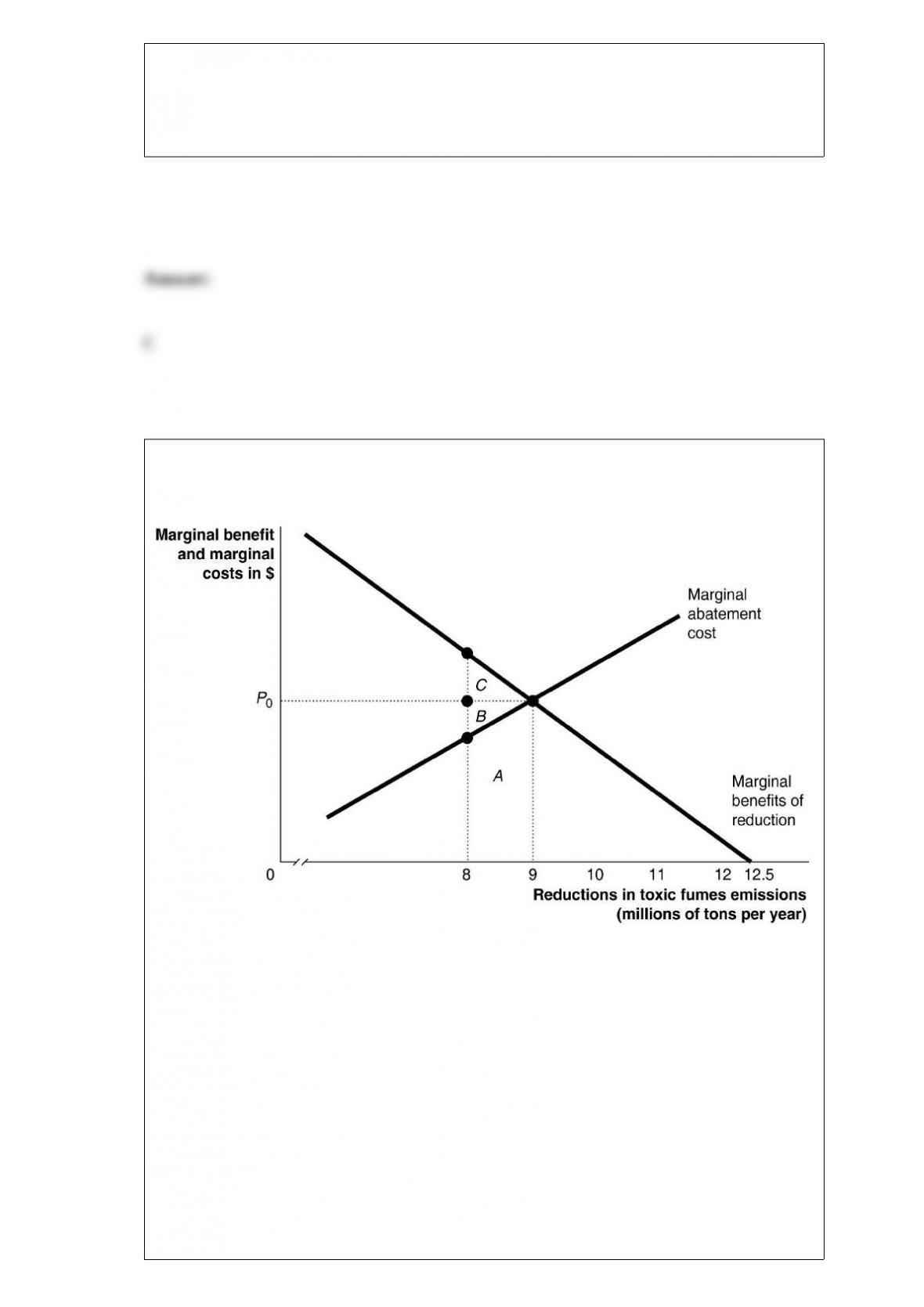
Figure 5-8
Consider a chemical plant that discharges toxic fumes over a nearby community. To
reduce the emissions of toxic fumes the firm can install pollution abatement devices.
Figure 5-8 shows the marginal benefit and the marginal cost from reducing the toxic
fumes emissions.
Refer to Figure 5-8. What is the economically efficient level of pollution reduction?
A) 5 million tons
B) 9 million tons
C) 8 million tons
D) 0 tons
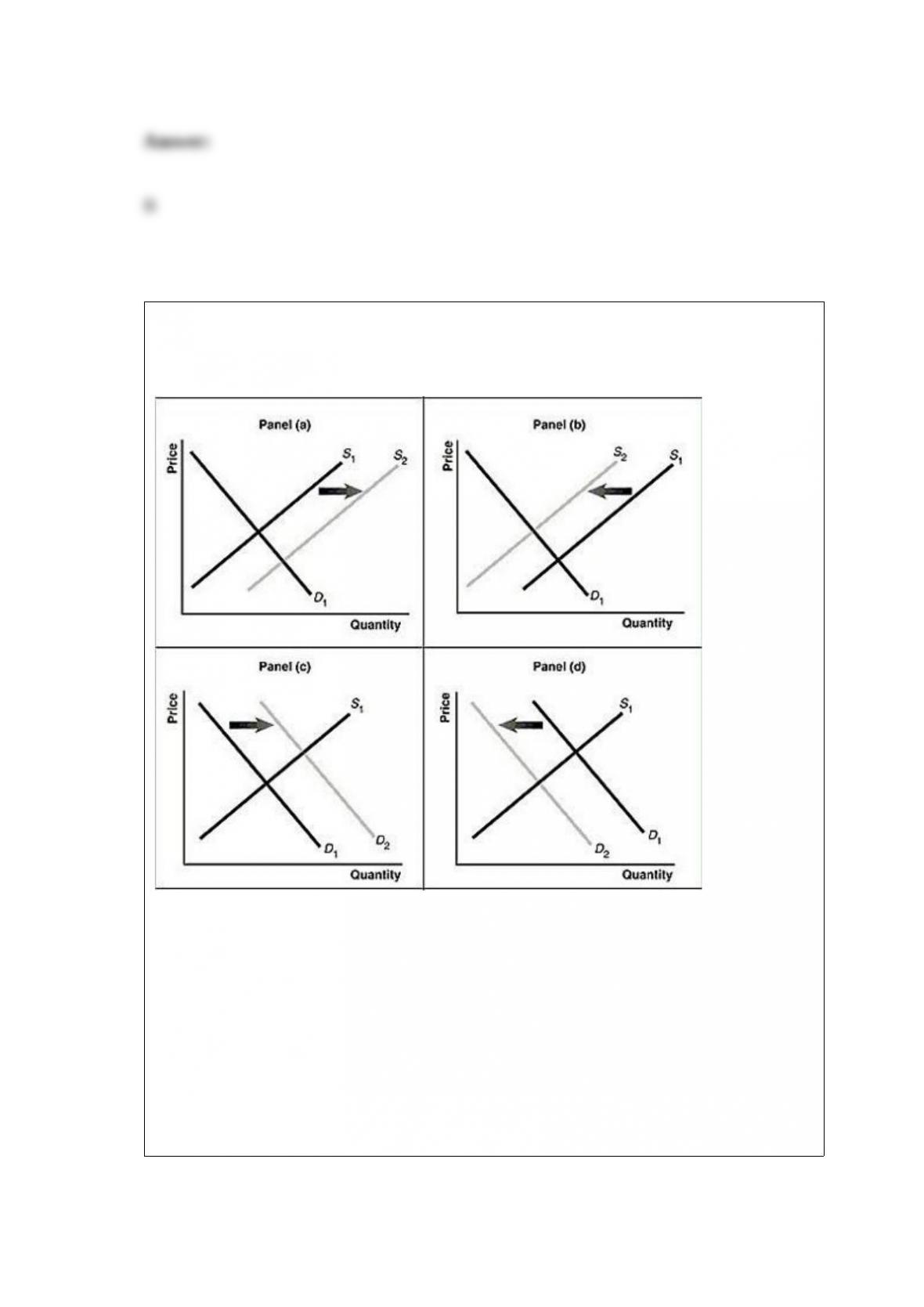
Figure 3-7
Refer to Figure 3-7. Assume that the graphs in this figure represent the demand and
supply curves for rice. What happens in this market if buyers expect the price of rice to
fall?
A) Panel (a)
B) Panel (b)
C) Panel (c)
D) Panel (d)
The Arrow impossibility theorem states that
A) no system of voting can be devised that will always consistently represent the
underlying preferences of voters.
B) it is impossible for a majority voting system not to consistently represent the
preferences of voters.
C) it is impossible to separate corporate desires from public bureaucracy.
D) no system of voting can be devised that will ensure a 100 percent voter turnout.
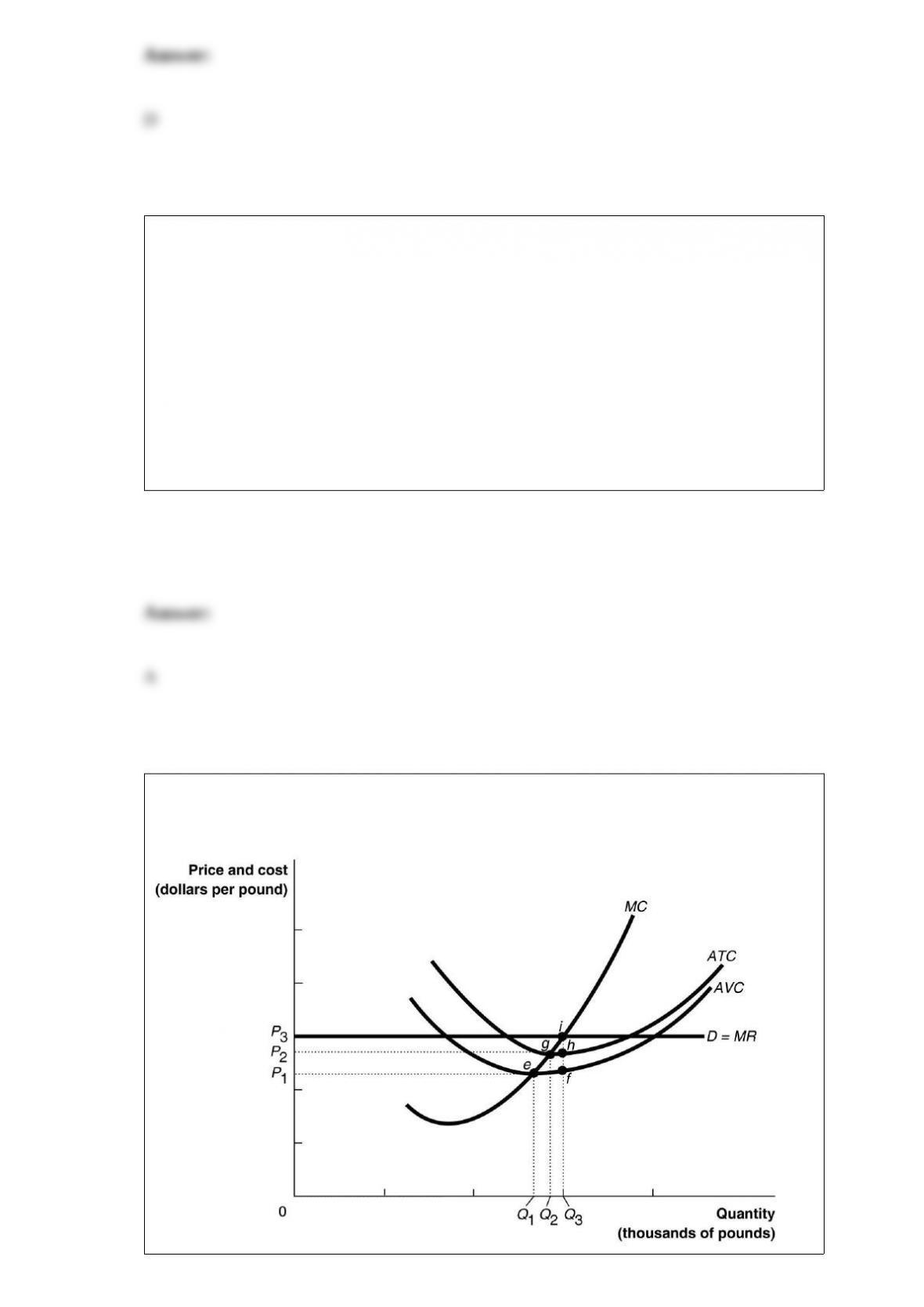
Figure 12-7

Figure 12-7 illustrates the cost curves of a perfectly competitive firm.
Refer to Figure 12-7. If the market price is P2 the firm
A) will break even and produce a quantity of Q2.
B) will make a profit and produce a quantity of Q2.
C) will make a profit and produce a quantity of Q1.
D) will make a profit and produce a quantity of Q3.
Online companies gather personal information about the customers who shop on their
Web sites and some of those companies will use the data to estimate price elasticities of
the customers. Doing this is a way that these companies might be able to charge a
higher price for a product to those customers who have a ________ price elasticity of
demand.
A) high
B) low
C) negative
D) unitary

Which of the following undermines a firm’s ability to engage in price discrimination?
A) the seller’s market power
B) the inability to prevent resale of the product from one market segment to another
C) buyers having different elasticities of demand for the product
D) the seller’s ability to segment the total market
Anything of value owned by a person or a firm is
A) an asset.
B) a liability.
C) wealth.
D) owner’s yield.
How are sunk costs and fixed costs related?
A) They are not related in any way.
B) Sunk costs cannot be recovered and fixed costs can be avoided by shutting down.
C) In the short run they are equal to each other.
D) In the long run they are equal to each other.
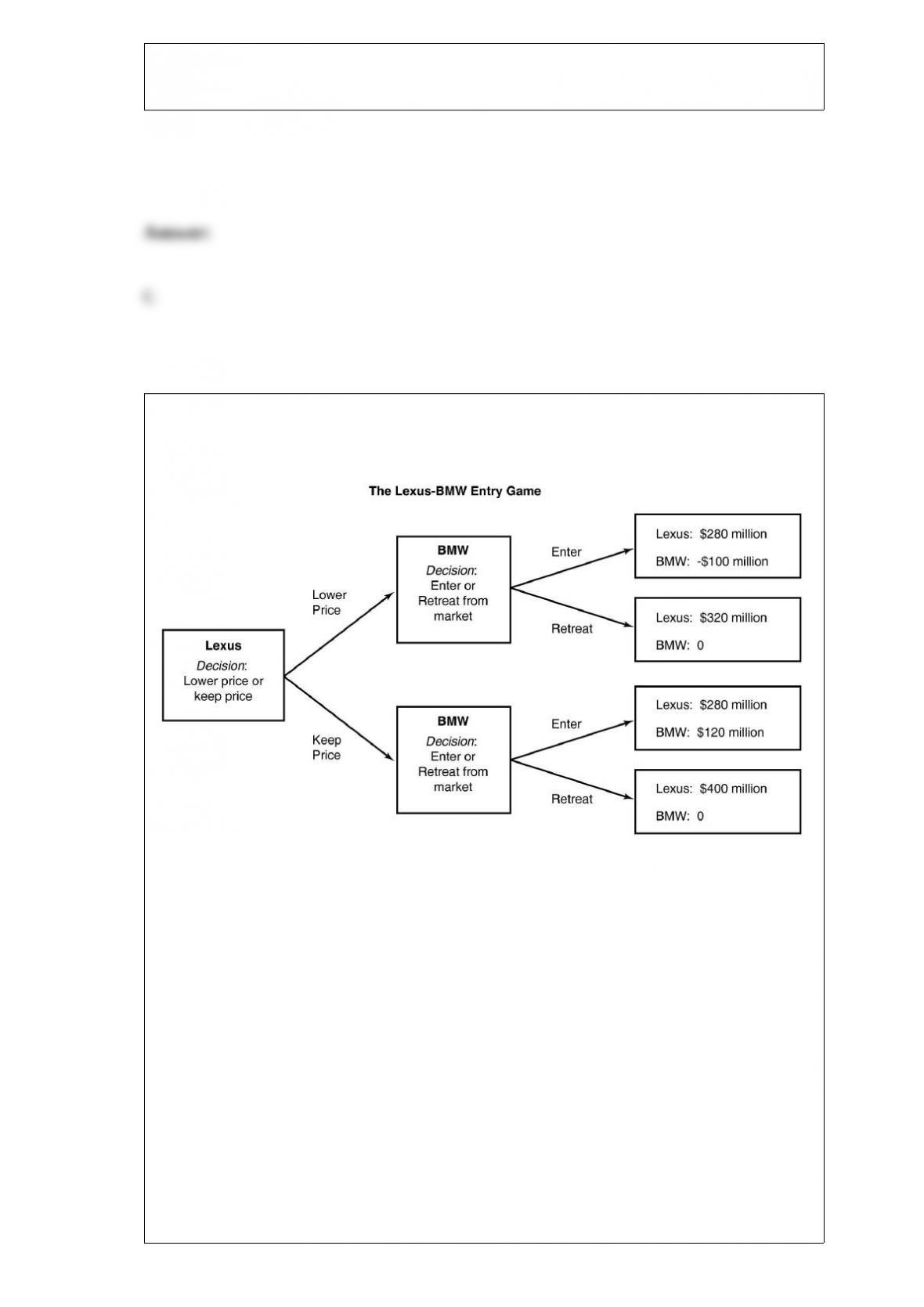
Figure 14-1
Assume that Lexus (L) is the first automobile company to produce a luxury class hybrid
automobile and is the only such company for the past four years. BMW is now
considering producing its own luxury hybrid automobile and Lexus must decide
whether or not to lower the price of its luxury hybrid to counter BMW’s entry into the
luxury hybrid niche.
Refer to Figure 14-1. Should Lexus lower its price in order to deter BMW’s entry into
the luxury hybrid automobile market?
A) In terms of profit earned, it makes no difference whether Lexus lowers its price or
not; in either case it will make $280 million profit if BMW enters.
B) No, it should keep the same price and work to capitalize on its brand loyalty.
C) Yes, it will drive BMW out of the market.
D) No, because BMW will enter the market regardless of Lexus’ decision about its

price.
If a natural monopoly regulatory commission sets a price where marginal cost is equal
to demand
A) the firm would earn monopoly profits.
B) economic efficiency would not be achieved.
C) the firm would incur a loss.
D) the firm would break even.
Vipsana’s Gyros House sells gyros. The cost of ingredients (pita, meat, spices, etc.) to
make a gyro is $2.00. Vipsana pays her employees $60 per day. She also incurs a fixed
cost of $120 per day. What is Vipsana’s total cost per day when she does not produce
any gyros and does not hire any workers?
A) $0
B) $2
C) $60
D) $120
Natural monopolies in the United States are generally regulated by
A) the Federal Trade Commission.
B) the Department of Justice.
C) local or state regulatory commissions.
D) the Department of Commerce.
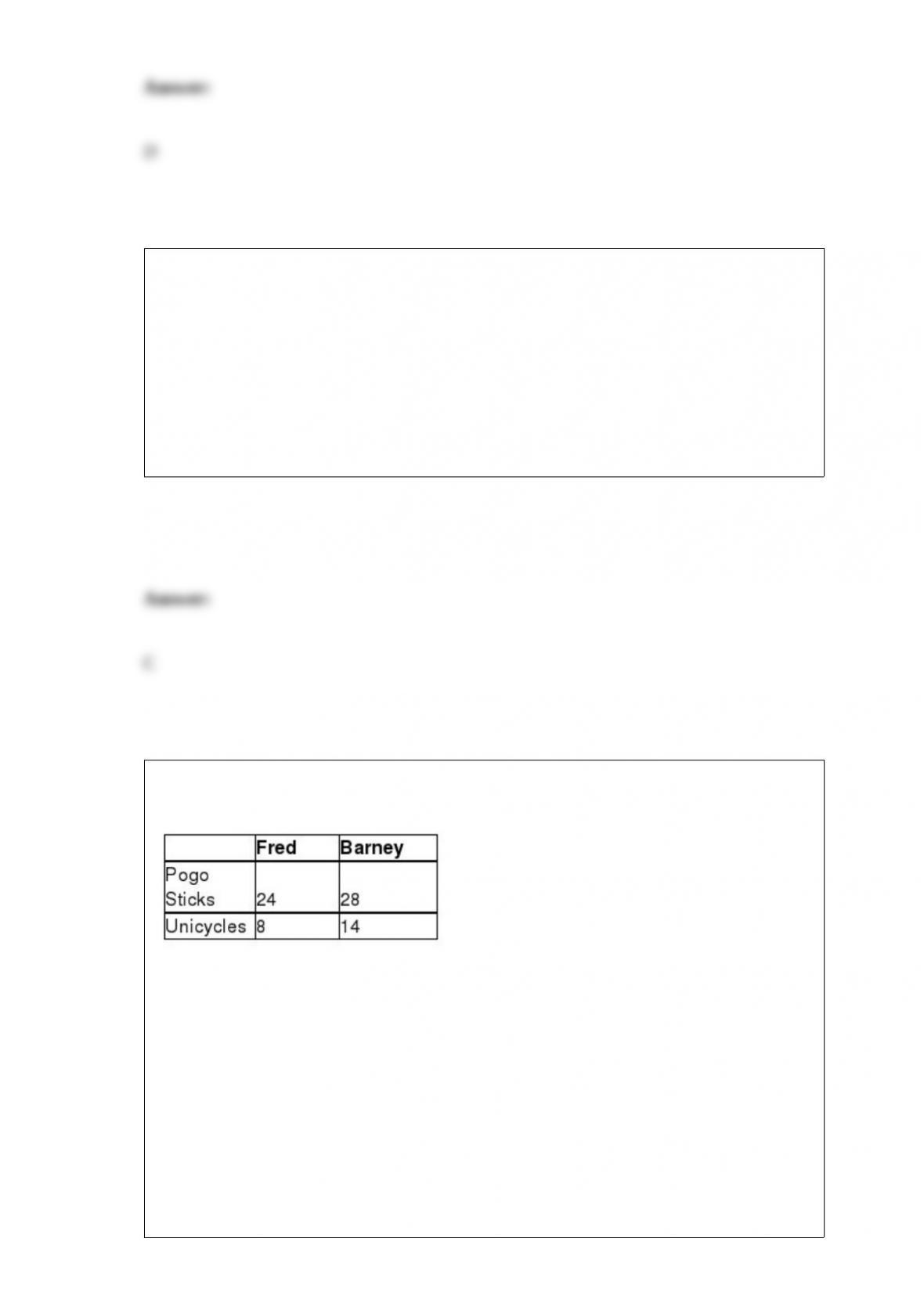
Table 2-7
Table 2-7 shows the output per month of two people, Fred and Barney. They can either
devote their time to making pogo sticks or making unicycles.
Refer to Table 2-7. What is Fred’s opportunity cost of making a pogo stick?
A) 1/3 of a unicycle
B) 3 unicycles
C) 6/7 of a pogo stick
D) 1/2 of a unicycle
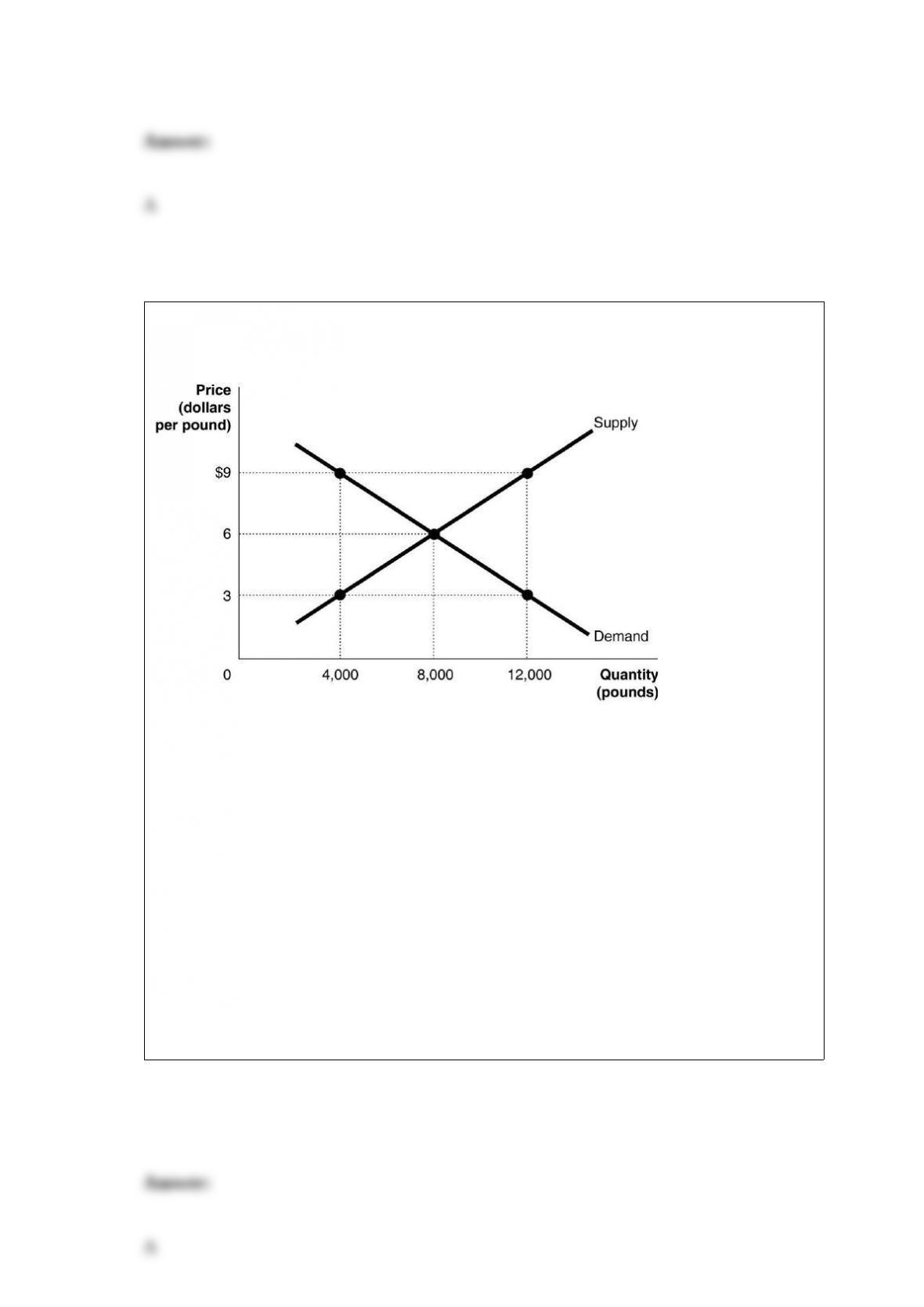
Figure 4-4
Refer to Figure 4-4. The figure above represents the market for pecans. Assume that
this is a competitive market. If the price of pecans is $9, what changes in the market
would result in an economically efficient output?
A) The price would decrease, the quantity supplied would decrease, and the quantity
demanded would increase.
B) The quantity supplied would increase, the quantity demanded would decrease, and
the equilibrium price would decrease.
C) The price would decrease, the demand would increase, and the supply would
decrease.
D) The price would increase, the quantity demanded would decrease, and the quantity
supplied would increase.

Which of the following statements is true?
A) Any time you have to decide which action to take you are experiencing economic
equity.
B) Trade-offs do not apply when the consumers purchase a product for which there is
excess supply, such as with a stock clearance sale.
C) Every individual, no matter how rich or poor, is faced with making trade-offs.
D) Economics is a social science that studies the trade-offs we are forced to make
because resources are unlimited.
Economists usually assume that people act in a rational, self-interested way. In
explaining how consumers make choices this means that economists believe
A) consumers will always buy goods and services at the lowest possible prices.
B) consumers spend their incomes to order to accumulate the most goods and services.
C) consumers make choices that will leave them as satisfied as possible given their
incomes, tastes, and the prices of goods and services available to them.
D) consumers will spend their incomes and time on activities that benefit themselves as
much as possible, without regard to the welfare of others.

A successful compensation scheme
A) must pay workers with comparable skills a comparable wage.
B) must induce effort from workers and ensure that both employer and employees
benefit.
C) must enable workers to enjoy a certain standard of living and must enable employers
to earn a normal rate of return.
D) must allow employees to participate in a firm’s profits.
DeShawn’s Detailing is a service that details cars at the customers’ homes or places of
work. DeShawn’s cost for a basic detailing package is $40, and he charges $75 for this
service. For a total price of $90, DeShawn will also detail the car’s engine, a service that
adds an additional $20 to the total cost of the package. Should DeShawn continue to
offer the engine detailing service?
A) yes, he still makes a profit by selling the engine detailing service with the basic
detailing package
B) yes, but only if he raises the price of the basic detailing package
C) no, his marginal benefit is less than his marginal cost
D) More information is needed for DeShawn to make this decision.
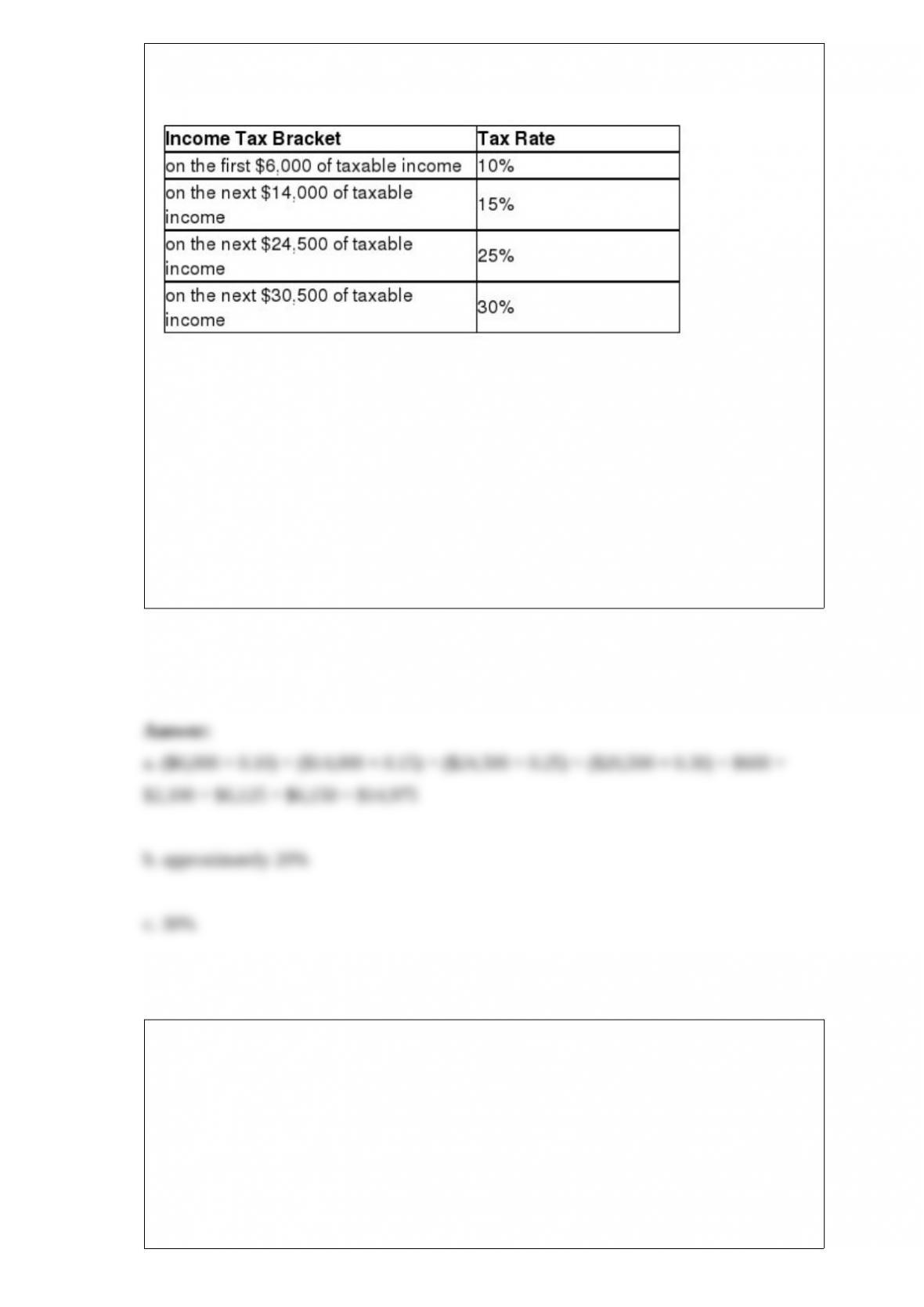
Table 18-10
Table 18-10 shows the income tax brackets and tax rates for single taxpayers in
Bauxhall.
Refer to Table 18-10. A tax exemption is granted for the first $10,000 earned per year.
Suppose you earn $75,000.
a. What is the amount of taxes you will pay?
b. What is your average tax rate?
c. What is your marginal tax rate?
Which of the following is not a result of imposing a rent ceiling?
A) Some consumer surplus is converted to producer surplus.
B) There is a reduction in the quantity of apartments supplied.
C) There is an increase in the quantity of apartments demanded.
D) The marginal benefit of the last apartment rented is greater than the marginal cost of
supplying it.
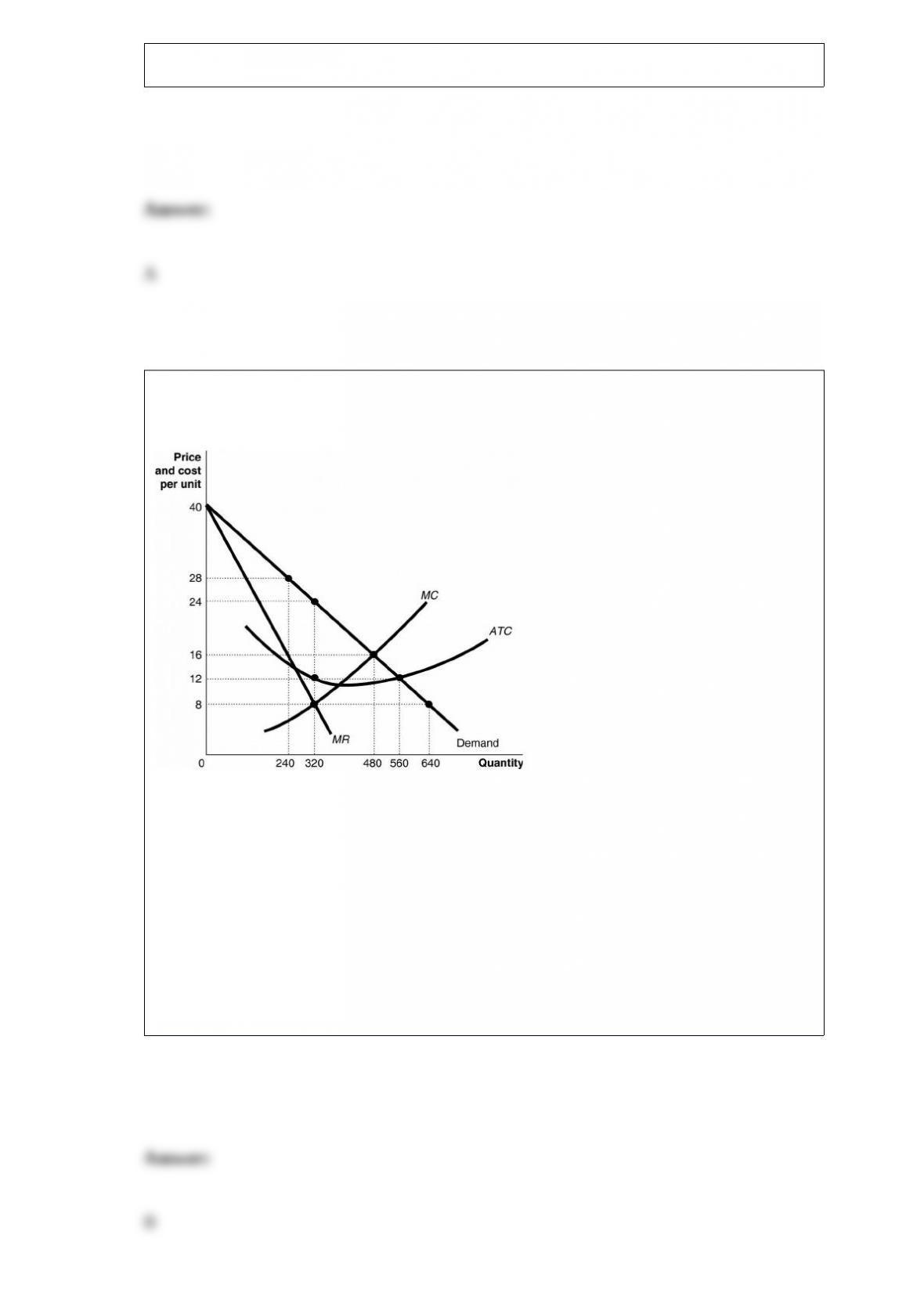
Figure 16-5
Refer to Figure 16-5. Suppose the firm represented in the diagram decides to use a
two-part pricing strategy such that it charges a fixed fee and a per-unit price equal to the
monopoly price. What is the per-unit price?
A) $28
B) $24
C) $12
D) $8
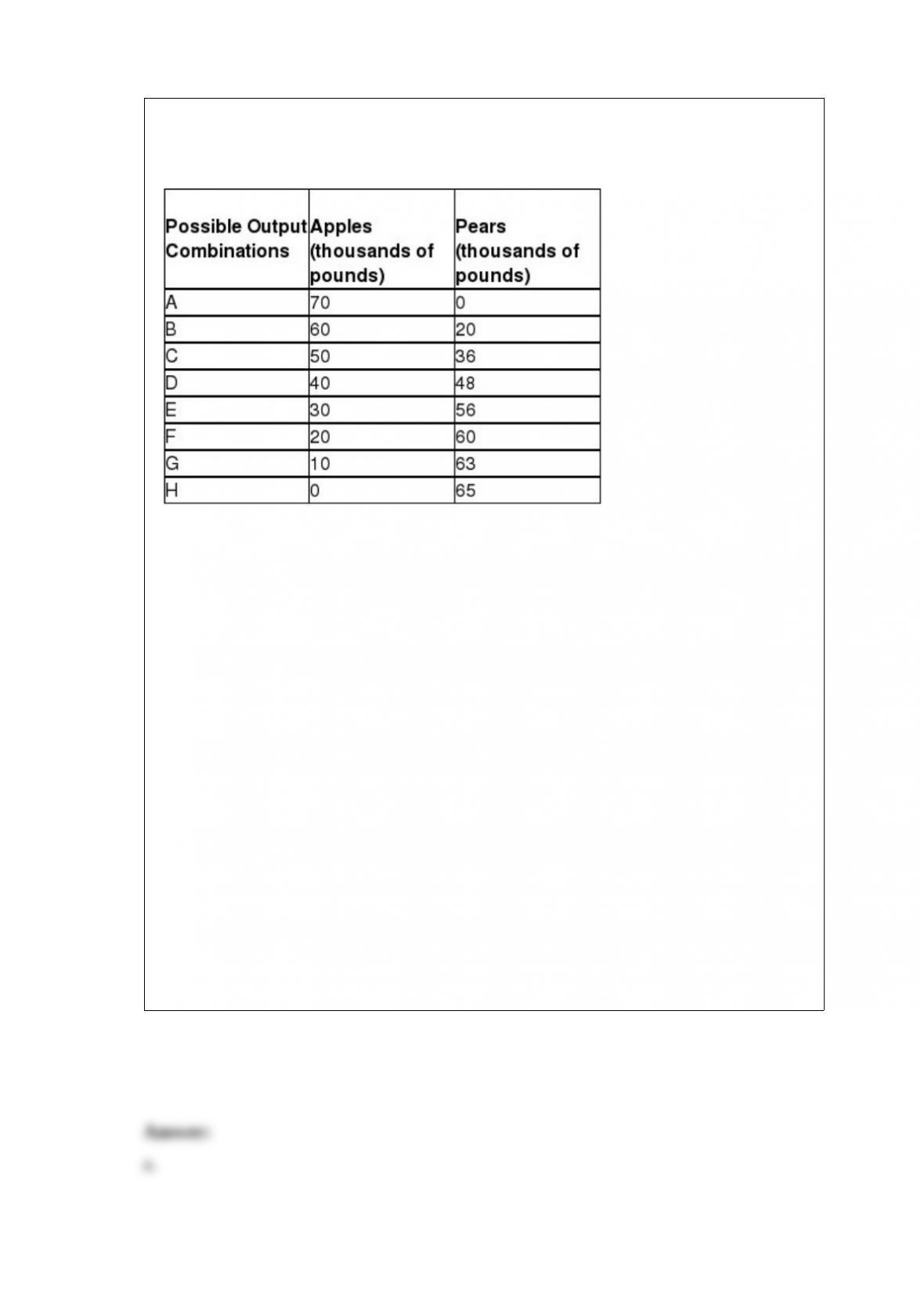
Table 2-4
Refer to Table 2-4. The Fruit Farm produces only apples and pears. The table above
shows the maximum possible output combinations of the two fruits using all resources
and currently available technology.
a. Graph The Fruit Farm’s production possibilities frontier. Put apples on the horizontal
axis and pears on the vertical axis. Be sure to identify the output combination points on
your diagram.
b. Suppose The Fruit Farm is currently producing at point D. What is the opportunity
cost of producing an additional 8,000 pounds of pears?
c. Suppose The Fruit Farm is currently producing at point D. What happens to the
opportunity cost of producing more and more pears? Does it increase, decrease, or
remain constant? Explain your answer.
d. Suppose The Fruit Farm is currently producing at point G. What happens to the
opportunity cost of producing more and more apples? Does it increase, decrease, or
remain constant? Explain your answer.
e. Suppose The Fruit Farm is plagued by the apple maggot infestation which destroys
apple trees but not pear trees. Show in a graph what happens to its PPF.
Before its IPO, Facebook was an example of a private firm. As a private firm, Facebook

was
A) not subject to government regulations and taxation.
B) run by stockholders and a board of directors.
C) run by its founder, Mark Zuckerberg.
D) not legally allowed to raise funds through venture capital firms.
Orange juice drinkers want to consume more orange juice at a lower price. Which of the
following events would have this effect?
A) a decrease in the price of orange juice processing
B) an increase in the cost of fertilizer used for orange groves
C) a decrease in income, assuming orange juice is a normal good
D) a decrease in the population
Figure 3-5
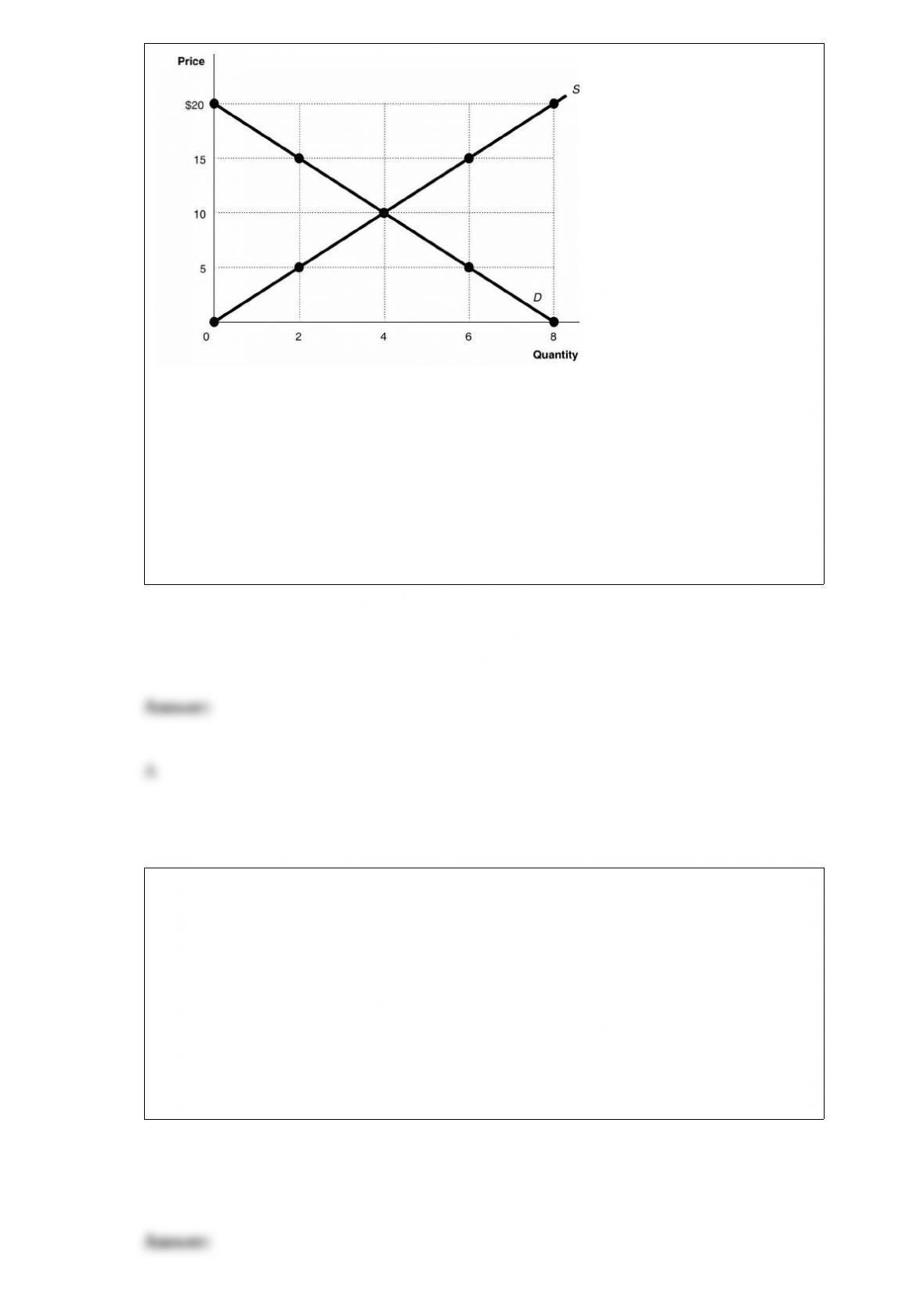
Refer to Figure 3-5. At a price of $5, the quantity sold
A) is 2 units.
B) is 4 units.
C) is 6 units.
D) cannot be determined.
Economists reason that the optimal decision is to continue any activity up to the point
where the
A) marginal benefit is zero.
B) marginal benefit is greater than the marginal cost.
C) marginal cost is zero.
D) marginal benefit equals the marginal cost.
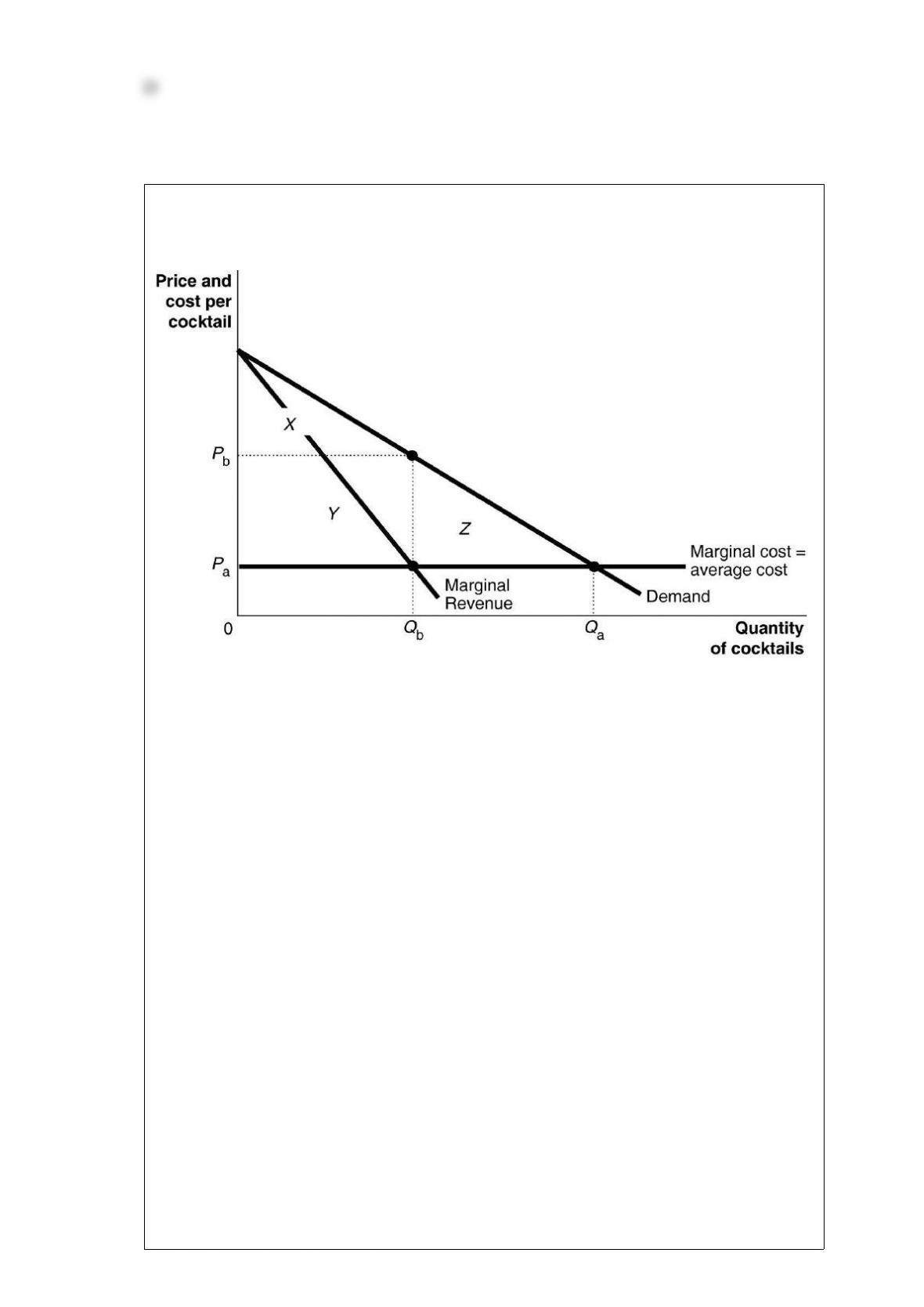
Figure 16-7
The Lizard Lounge is well known for its exotic cocktails. Figure 16-7 shows its
estimated demand curve for cocktails.
Refer to Figure 16-7. The owners of the Lizard Lounge are considering the following
four pricing options:
a. A single price scheme where the price of cocktails equals the monopoly price.
b. A single price scheme where the cocktail price equals the competitive price.
c. A two-part tariff: a monopoly price for cocktails and a cover charge that will generate
total revenue equal to the area X.
d. A two-part tariff: a competitive price for cocktails and a cover charge that will
generate total revenue equal to the area X + Y + Z.
Which scheme will earn the largest profit?
A) scheme a
B) scheme b
C) scheme c
D) scheme d

A tax is efficient if
A) individuals with the lowest incomes pay proportionately lower taxes than individuals
with the highest incomes.
B) it is based on profits earned and not on wages.
C) it encourages saving and investment.
D) it imposes a small excess burden relative to the revenue it raises.